Gimbal
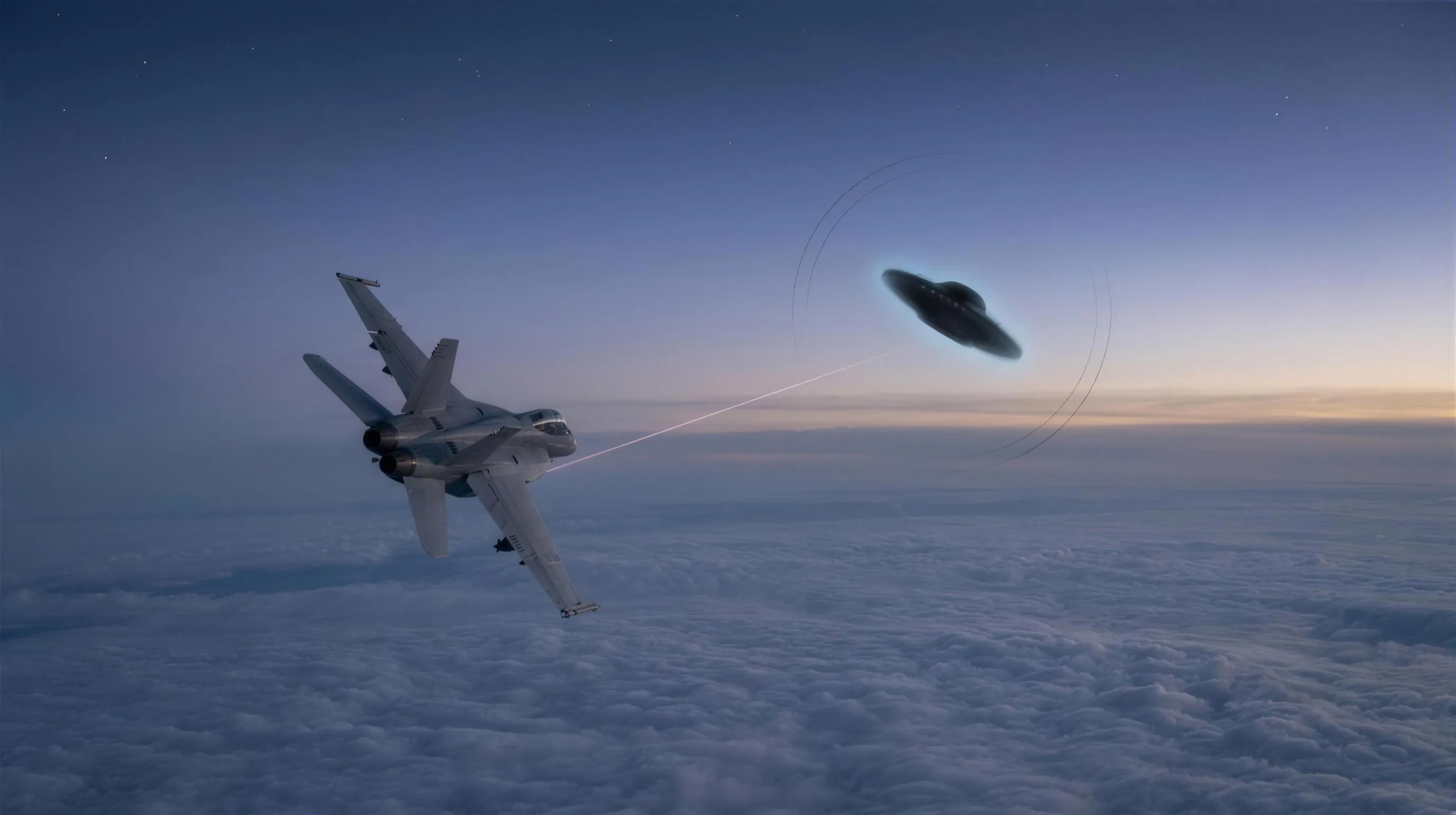
One night in January 2015, off the US East Coast, a Super Hornet's targeting pod locked onto something the radar page showed trailing a formation, and in the last seconds of the recording the dark shape began to turn in place while the clouds behind it stayed perfectly level. "Look at that thing, dude. It's rotating." Released in 2017, confirmed genuine in 2020, the clip named itself: GIMBAL. This instrument rebuilds the geometry that name points at: the pole every nose-crossing track must pay for, the leveling roll that rotates anything welded to the pod's optics, and the range dial the video never supplies, so you can watch the same 34 seconds mean a distant jet's glare, or something that braked mid-air and turned against a 120-knot wind.
Keep the signal
The station is free. No ads, no tracking cookies. If the files are worth your time, following is the support.
 Open the interactive ▸
 What you're looking at
The Pod view is the mechanism made visible. A low dusk sun and its horizon band, rendered by the classic three.js sky atmosphere; the F/A-18F banking left through its recorded turn while the nose swings toward the line of sight; the pole cone riding the nose axis; and the pod-up ring on the sight-line, where a rose marker (the pod's "up") and a blue tick (the world's) slowly disagree, then violently. The rotation you came to see is the angle between those two marks, and you can watch it get paid for in real time.
The Screen view rebuilds the black-hot ATFLIR display from the geometry: level streaming clouds, the dark shape replaying the measured tilt curve frame by frame: flat near −47° for twenty-three seconds, then five snaps and a hold through ~110°: with the display jolting on each snap, exactly where the released video bumps. The symbology is live and clickable: the azimuth counting down through zero, the bank arcs, EL −2°, and the number that never appears: RNG.
The Tracks view is the range debate as one picture: the jet's arc, the fan of recorded sight-lines, and the family of worlds the angles allow. A straight, level world fits near 30 nmi with an ordinary flying-away profile; drag the anchor to 8 nmi and the best straight world must brake from ~300 knots to a stop. The published close reconstruction, with its vertical reversal, is drawn beside it as published; six dated cards put the record, 2015 to the open AARO ledger, one click away.
Why it's here
This closes this site's Navy trilogy. Tic Tac Kinematics audits a number that exists only in recollection; GoFast audits a speed manufactured by parallax; Gimbal audits something stranger: a turn. The method of the first two runs again here, but the protagonist changes: no longer "how fast is it," but "what rotates: the object, or the camera that rolls to keep the clouds level." All three instruments share one discipline: audit the sensor, then the numbers, then the testimony, and leave the conclusion to the reader, always.
It is also the highest-tension application of this site's evidence tiers, because GIMBAL's four layers rarely stop colliding: provenance is MEASURED (DoD confirmed it in 2020); the margins and the audio are REPORTED (including "a whole fleet of them" and the 120-knot wind); the leveling roll, the steps and the range families are MODELLED (re-derived live on this page); and identity is a READING. 'Oumuamua and the crop circles run the same stratigraphy; what makes Gimbal special is that the strongest sceptical argument and the strongest anomalous testimony sit on different layers, where neither can reach the other.
How it works
One gimbal-geometry formula and one straight-world fit run the whole instrument; nothing else is asserted.
image-up = roll-axis ⊥ LOS · tilt = ∠(image-up, world-up) · pole: az→0 at el −2° · P(t) = ray(0)∩R + u·(v₀t + ½at²)
The scene is calibrated, not replayed. The jet arc integrates the recorded bank breakpoints (22.6° → 38.2° peak → 30°) at 365 kt TAS; the sight-line fan is then re-derived from a straight, level reference target at 32 nmi: Sitrec's own start distance: so the fan is exactly self-consistent while staying within ~1° of the published frame measurements. The dossier's raw azimuth and bank tables ship in the source, three keystrokes from anyone who wants to check.
The leveling roll is computed, not quoted. A roll-over-nod gimbal's image-up is the projection of its roll axis onto the image plane; the tilt of anything welded to the pod is the signed angle from projected world-up to that image-up. The roll axis rides the nose, pitched up by 3.6°/cos(bank): West's own scaling, flagged by him as critical near the sweep-over. Feed in the recorded azimuth, elevation and bank, and the −47°-flat-then-whip curve falls out; the measured frames are overlaid as dots so the residual is never hidden.
The steps are a mechanism you can dial. The pod's heavy roll gimbal holds while internal fine-steering mirrors absorb a few degrees of error, then snaps to catch up. The stiction dial sets that tolerance: zero gives the frictionless smooth rotation; ~18° reproduces the video's five chunky steps, and every snap kicks the rebuilt display the way the released frames jump. The patent-based objection that smooth concerted motion should preclude steps is quoted in the inspector, beside the model it argues with.
The range family is fitted honestly. For any anchor range, the instrument grid-fits a straight, level, constant-heading world with a constant speed ramp through the recorded fan and reports the worst angular miss. Near 30 nmi the miss collapses to ~0.02°; at 8 nmi the only near-straight worlds brake to a stop. The published ≤10 nmi reconstruction used inputs this fan cannot supply: the crew's radar range and the apparent-size trend: so it is drawn as a cited overlay, never presented as a ray fit.
The evidence is tagged as you go. The bottom-left table is the conscience of the sim: symbology, audio and the fleet account are REPORTED, the DoD provenance is MEASURED, the pole, the roll, the steps and the range families are MODELLED, and identity is a READING. Rows flash as you touch the controls that depend on them, so the boundary between record, model and testimony stays visible at all times.
The provenance is measured. The margins and the fleet are reported. The pole, the leveling roll, the steps, and the two range worlds are modelled, exactly, from stated inputs. And what the shape was is the reading this site never supplies. The instrument computes; you conclude.
The three scenarios on the dial
Three positions of the same instrument, so the whole argument has somewhere to land.
- Angles only. The default, and the most honest position: no range assumed, because the video assumes none. The fan of recorded sight-lines is drawn bare, with both named worlds sketched faintly beside it. Everything on screen is either printed on the released frames or derived from them by the formulas above.
- Distant jet · ~30 nmi. West's reading. The straight-world fit threads the fan with a miss of hundredths of a degree, flying away at an ordinary jet's pace; the rotation is the pod's leveling roll carrying a glare, and the steps are the mirrors catching up. The cost of this world is printed on its label: an aircraft nobody identified, in airspace the Navy was instrumenting end to end.
- Close object · ~8 nmi. The crew's reading, refined by the WSO to six-to-eight miles on radar. The same fan now forces the best straight world to brake from ~300 knots toward zero, and the published reconstruction adds the climb and the vertical turn against the 120-knot wind, timed with the on-screen rotation. The cost of this world is also printed on its label: kinematics with no public precedent, resting on classified tapes.
The readings, as they stand
Every serious reading of the shape, with who argued it and where it lands today. One row is retired by the DoD confirmation; the file itself is open.
| A distant jet's engine glare, rotated by the pod's leveling roll argued by West 2021-22 · Metabunk / Sitrec, open source | OPEN | Open, and the mechanically cheapest fit: the tilt curve tracks the computed roll, the steps land on the tracking bumps, and near 30 nmi a straight world threads the recorded rays. Its unpaid bill: no candidate jet was ever produced from an exercise range the Navy instruments end to end. |
| A close object that braked, hung, and reversed against the wind argued by the crew's SA-page read; Peings & von Rennenkampff 2023 (arXiv:2306.08773) | OPEN | Open. Inside ten miles the fan itself forces braking toward a stop; the published reconstruction adds a climb and a vertical reversal timed with the rotation. Its unpaid bill: physics without public precedent, resting on radar recordings that remain classified. |
| The SA-page "fleet" as radar artifacts or electronic warfare argued by argued within the sceptical reading to absorb the radar contacts | OPEN | Open and untestable in public: the SA tapes have never been released. If the fleet was real, the glare reading must explain a formation reversing against a 120-knot wind; if artifact, the strongest anomalous testimony dissolves. Everything about this row is invisible from the released pixels. |
| A hoax, leak-fabrication, or CGI argued by early internet commentary, 2017-2020 | RETIRED | Retired. The Department of Defense confirmed authenticity and re-released the video in April 2020; chain of custody runs through NAVAIR. Whatever the shape is, the recording of it is real. |
Try this
- Watch the two marks disagree. In the Pod view, find the ring on the sight-line: rose is the pod's up, blue is the world's. For twenty-three seconds they barely move: then, as the azimuth readout approaches zero, watch the rose marker whip most of the way around the ring in ten seconds. That whip is the entire sceptical case, drawn as two dots.
- Feel the pole. Turn on the pole cone and scrub the clip time slowly through 30 s. The line of sight slides under the cone's rim: two degrees below the axis: and the OFF THE POLE readout bottoms out just as the SCREEN TILT readout moves fastest. Singularities are usually abstractions; this one has a shout on the audio track.
- Dial the stiction. On the Screen view, set de-rotation stiction to zero and replay the last ten seconds: the shape turns smoothly, and the display never jolts. Now set it to ~18°: five chunky steps, each kicking the clouds, exactly as the released frames do. One slider spans the difference between "smooth sensor" and "the video we actually have."
- Break the straight world. In the Tracks view, start at 30 nmi and read the fit label: miss of hundredths of a degree, ordinary speeds. Now drag the range in: watch the same fan bend the best straight world into a braking one, until at 8 nmi its speed profile ends at zero. No slider anywhere on this site does more argumentative work.
- Read both bills. Click the ~30 nmi label, then the ~8 nmi label, and read what each world must pay: an unidentified jet in an instrumented range, or unprecedented physics on classified radar. Then click the fleet row in the Evidence table and note which tier it lives on: REPORTED. The strongest card in the anomalous hand is the one no released pixel can check.
- End with the audio. Click the quote card last. "There's a whole fleet of them." "They're all going against the wind." "It's rotating." Three sentences, three different epistemic weights: a radar display nobody outside has seen, a wind number the weather archives can check, and a rotation this instrument can now show you two ways. That gradient is the whole method of this site, in nine seconds of cockpit audio.
Accuracy
The honest line between what is reported, what is measured, what is modelled here, and what is a reading:
| Feature | Status | What that means |
|---|---|---|
| The symbology: ALT 25,000 · CAS ~240 · BLK · AZ 54L→7R · EL −2° | Reported | Printed on the released frames: the azimuth counting down through zero at ~30 s, the bank arcs rolling 22.6° to a 38.2° peak, black-hot polarity, 0.35° field of view. What never appears is RNG: the pod tracked passively, and the missing range is the axis of the whole debate. |
| Provenance: a genuine Navy record | Measured | The Department of Defense formally released FLIR, GOFAST and GIMBAL on 27 April 2020 "in order to clear up any misconceptions by the public on whether or not the footage that has been circulating was real, or whether or not there is more to the videos," adding that the phenomena remain "unidentified." Authenticity settled; identity untouched. |
| The date: January 2015, day disputed | Reported | Officially stated as 20 or 21 January; the released file's own metadata encodes the evening of 24 January (EST), and reanalysis weather data fit that evening's 120-knot westerly jet better. This page therefore says "January 2015" and no more. |
| The scene: calibrated, not replayed | Modelled | The jet arc integrates the recorded bank history at 365 kt TAS; the fan of sight-lines is then re-derived from a straight, level reference target at 32 nmi so the geometry is exactly self-consistent, staying within ~1° of the published frame data everywhere. Every readout derived from it says MODELLED. |
| The leveling roll: flat near −47°, then a ~110° whip | Modelled | A roll-over-nod gimbal's image-up is the projection of its roll axis; keeping the horizon level costs a derotation this page computes live. The axis rides the nose, pitched up by ~3.6°/cos(bank); as the recorded azimuth crosses zero at −2° elevation, the line of sight passes under that pole and the roll whips through most of its swing in the final ten seconds. |
| The steps: holds, snaps, and bumps that coincide | Modelled | The measured rotation moves in ~5 discrete jumps with one long hold, each landing on a visible jolt in the background clouds. The stiction dial reproduces the mechanism: the heavy roll gimbal parks while internal mirrors absorb error, then catches up in one jump. The counter-argument, from the pod's patent, is that stepped roll would itself be anomalous; both positions are kept on screen. |
| The range family: straight at ~30 nmi, braking at ~8 | Modelled | With no RNG, every range is a candidate world. The Tracks view fits straight, level, constant-heading worlds through the recorded fan: near 30 nmi one threads it with an ordinary flying-away speed profile; anchored at 8 nmi, the best straight world must brake from ~300 kt to a stop. The published close reconstruction (with radar and size inputs this fan does not have) adds the vertical reversal, and is drawn as published. |
| The identity: a distant jet's glare, or something else | Reading | No public identification of the GIMBAL object exists. The glare reading explains the rotation mechanically and asks you to accept an unidentified jet inside an instrumented exercise range; the close reading fits the crew's testimony and asks you to accept unprecedented kinematics on classified radar. This page prices both and endorses neither. |
In one line: the Pentagon's confirmation is measured; the symbology, the audio, the fleet account and even the disputed date are reported; the pole, the leveling roll, the stepped rotation and the two range worlds are modelled, exact arithmetic on the clip's own margins plus one stated calibration; and what the shape was, glare or craft, is a reading, the one this site leaves to you. The clouds stayed level. Something rotated. The instrument keeps every claim on its own shelf.
Sources
- US Department of Defense (27 Apr 2020). Statement on the Release of Historical Navy Videos. The official release of FLIR, GIMBAL and GO FAST, confirming authenticity; phenomena "remain unidentified."
- Cooper, H., Blumenthal, R., & Kean, L. (16 Dec 2017). Glowing Auras and "Black Money": The Pentagon's Mysterious U.F.O. Program. NYT. GIMBAL's public debut, alongside To The Stars Academy's release.
- West, M. (2021-22). The GIMBAL analyses. Metabunk threads and video; the glare + derotation model, the step/bump correlation, and the ~30 nmi straight-path result (with Metabunk user Edward Current).
- West, M. Sitrec (situation recreation tool). github.com/MickWest/sitrec. Open-source; its data/gimbal frame series (azimuth, bank, glare angle, keyframes) anchor this instrument's recorded tracks.
- Peings, Y., & von Rennenkampff, M. (2023). Reconstruction of Potential Flight Paths for the January 2015 "Gimbal" UAP. AIAA 2023-4101, AIAA AVIATION 2023 Forum (DOI 10.2514/6.2023-4101); preprint arXiv:2306.08773. The ≤10 nmi reconstruction: deceleration, stop, vertical reversal; the WSO/L+S account.
- Graves, R. (26 Jul 2023). Testimony, House Oversight subcommittee hearing on UAP, with the SA-page fleet account detailed in his public interviews (The Debrief, 2023). The full video and radar data described as classified.
- Office of the Under Secretary of Defense / AARO (19 Apr 2023). Kirkpatrick testimony, Senate Armed Services Emerging Threats subcommittee. The sensor-artifact framing; GOFAST shown resolved; GIMBAL not formally adjudicated.
- Raytheon / US Navy (public specifications). AN/ASQ-228 ATFLIR. Fields of view, gimbal arrangement and mounting; with US Patent 9,121,758 B2 on the stabilisation train, cited by both sides of the step dispute.
- CEFAA / Metabunk (2014-17). The Chilean Navy helicopter IR case. The documented precedent of an aircraft's engine glare misread as an anomalous object, resolved at ~40 nmi.
- NAVAIR (2020). FOIA release metadata for the three Navy videos. Dates, designations, custody; the source of the 20/21 vs 24-25 January date discrepancy this page reports as open.
Scrub to thirty seconds. Watch what crossing the pole costs.
Open the interactiveCompiled July 2026