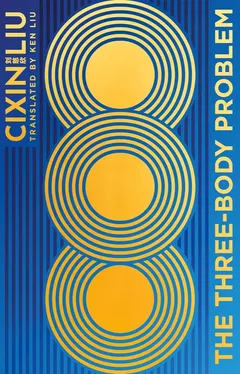
THE BOOK
The Three-Body Problem (三体), by Cixin Liu, translated from the Chinese by Ken Liu. Serialised in Science Fiction World in 2006 and published as a book by Chongqing Publishing Group in 2008; Tor Books, New York, 2014; Head of Zeus, London, 2015; Head of Zeus paperback, 2024, the edition read for this review. Thirty-five chapters in three parts, 424 pages, followed by an author’s postscript and a translator’s postscript. The first volume of a trilogy that continues with The Dark Forest and Death’s End. Hugo Award for Best Novel in 2015, the first translated novel to win it. This site’s Fermi Paradox bench has credited Liu for the dark forest since the day it opened, so it seemed time to read the book the trilogy starts with. It turns out not to contain the dark forest at all, and to be better for it.
Spoiler warning: this review discusses Ye Wenjie’s transmission and its consequences, the reveal in the Trisolaran chapters, and the ending.
It opens with a physicist being beaten to death for his method. Beijing, 1967, the exercise grounds of Tsinghua University, a struggle session two hours old. Professor Ye Zhetai is brought on stage in a steel hat with an iron oven door hung from his neck and interrogated about relativity, the Copenhagen interpretation and the big bang, and his answer is not a defence of any theory. He asks whether philosophy should guide experiments or experiments should guide philosophy, and four fourteen-year-old girls answer him with their belt buckles. His daughter, an astrophysics graduate student, is held back by two janitors and watches. That scene is not background colour, and the novel’s whole theory of science is in it: science is not destroyed by killing scientists, who are replaceable, but by confusing them. Da Shi, the policeman who understands none of the physics, says it plainly, by the Forbidden City moat: when a scientist dies another takes his place, but if his thoughts are confused, then science is over. The book opens with the 1967 version of that attack, done with belt buckles, and closes with the present-day version, done with two protons. Everything in between is the account of how the daughter who watched came to invite the second attack.
The shape is a braid, and it is worth describing because the usual complaint about this book is a complaint about the braid. One strand is a present-day thriller. Wang Miao, a nanomaterials researcher, is pulled into a military investigation of a wave of physicist suicides, among them Yang Dong, a string theorist whose last note, written on birch bark, says that physics has never existed and never will. A countdown appears on Wang’s photographic negatives, then in his own vision, then written across the cosmic microwave background, and three particle accelerators on three continents start returning different results for the same collision. The second strand is Ye Wenjie’s history, told out of order and partly as an interrogation transcript, so that you learn what she did before you learn why. Between them run six chapters inside a virtual-reality game about a world with three suns, and two late chapters that switch entirely to the alien side. The novel withholds its premise for roughly two hundred pages and then explains everything at once, in chapter 33, through a committee of aliens discussing a public works project. Chapter 13 stops the book dead for ten pages of declassified memoranda. Chapter 35 is two pages. Lumpy is a fair word for it. I am going to argue the lumps are the point, but a reader who wants a novel that moves like one should know before starting.
What the braid buys is Liu’s signature move, which is to deliver an abstraction as a physical demonstration you can picture. The best of them comes early. Ding Yi, Yang Dong’s partner, sets a white ball ten centimetres from a black ball beside a pocket, has Wang sink it, then carries the pool table across the living room and has him sink it again, and again, five times in five places at five different moments. Congratulations, he says: we have discovered a great principle of nature, the laws of physics are invariant across space and time, and beside two theorists who have just established it, Einstein and Hawking are mere applied engineers. Then he describes the version of the experiment where the ball goes somewhere different each time, and tells Wang that this is what the accelerators are now doing. Wang draws the conclusion himself, and it is the first half of the dead woman’s note. The same method builds the whole book: thirty million soldiers with flags drilled into a working processor, a cigarette filter to explain how a tiny high-dimensional object can hide an enormous low-dimensional one, a wheat field under locusts to explain survival. And it produces the two parables the novel runs on. In the shooter hypothesis, a marksman puts a hole in a target every ten centimetres, and the two-dimensional creatures living on it discover a great law of their universe. In the farmer hypothesis, a turkey scientist observes that food arrives every morning at eleven, until Thanksgiving. Either your laws of nature are somebody’s whim, or they hold right up to the morning they kill you. By the end of the book both have come true.
The reason this novel is on this site, though, is Red Coast, and I think it is the best thing in it. Red Coast Base sits on Radar Peak in the Greater Khingan Mountains, a twenty-five-megawatt transmitter with a cover story about cooking enemy satellites, and its real brief is laid out in chapter 13’s memoranda: a Chinese search for extraterrestrial intelligence in the late 1960s, argued into existence on the grounds that of all fields this is the one where a technology leap is most likely, and that others have already broadcast, so China must speak too. The documents are the most convincing thing in the book precisely because they are dull. There is a research report on Project Ozma and the Arecibo dish and the Pioneer plaques, a rumoured Soviet array, a channel plan, and four drafts of a message to the stars, the first of which announces that it comes from the country representing revolutionary justice on Earth and is rejected by the leadership as unfit to send. Ye Wenjie arrives as a political prisoner offered a lifetime on the peak instead of a sentence, and takes it. Working the base’s solar-interference problem, she notices in the operations log that the sun’s outages arrive sixteen minutes and forty-two seconds after two Jovian radio bursts recorded at Mount Wilson: exactly the extra path from Jupiter to the sun to Earth, rather than straight to Earth. The sun, she concludes, is amplifying whatever crosses a power threshold, by about a hundred million times. Red Coast’s own maximum crosses it. The commissar refuses her a test on the grounds that aiming a beam at the red sun has a political symbolism she has failed to consider. So on a clear autumn afternoon in 1971, during a routine test after an overhaul, with five colleagues not paying attention, she sets maximum power and the calculated frequency and tracks the setting sun until the transmission completes. The improvised receiver hears nothing. She eats a cold dinner of mantou and pickles alone at the cliff edge. The chapter’s last line tells the reader what she cannot know: at 12,000 megahertz, the sun was for that moment the brightest star in the galaxy. The most consequential act in the novel happens while nobody is watching, and the person performing it believes it failed.
Eight years later the reply comes in on a night shift, rated by the base’s software above anything it has ever heard, and the deciphering system, never once used, resolves it at once. The sender describes himself as a pacifist and calls it the luck of Earth’s civilisation that he was the one who heard. He warns her three times not to answer, because any reply will locate its source and the source will be invaded. She reads for four hours about a world destroyed and reborn two hundred times and planning to leave. Then she walks to the transmission room, aims the antenna at the rising sun, and sends, in a burst of no more than three seconds that the two men on duty do not notice, an invitation: come here, she will help them conquer this world, because human civilisation is no longer capable of solving its own problems. The same day she loosens a bolt on the receiver’s ground wire so that the fault can only be fixed by someone rappelling over the cliff, and when the commissar goes down and her husband unexpectedly shares his rope, she cuts it anyway. The novel reports all of this in an interrogation transcript, a register that strips out pleading. Asked how she felt, she says she was calm, and that she had finally found a goal she could devote herself to. It is the coldest confession I have read in a novel, and the book has spent a hundred pages making sure I understood it.
Because the novel takes her reasons seriously, which is what separates it from the alien-invasion shelf. In the Construction Corps she reads a restricted copy of Silent Spring and arrives at the idea that evil and humanity are an iceberg and the ocean it floats in, the same substance, so that no correction can come from within. The line the book gives her is that expecting a moral awakening from humankind is like expecting people to lift themselves off the ground by pulling on their own hair; it would take a force outside the human race. Then, and this is the part I admire, the novel gives her every chance to be reclaimed. Villagers who owe her nothing donate blood when the birth of her daughter nearly kills her. A hunter’s family takes her in for half a year, and his daughter-in-law nurses the baby and asks her why the stars do not fall down. Children climb the peak on New Year’s Eve with torches and a pot of dumplings. And none of it moves her, because when she tracks down three of the four Red Guards who killed her father, hoping for one sign of repentance, they give her a competing grievance and the verdict that everyone will forget all of it completely. Her hope goes out on the same grounds where he died. The book gives her the last word too. In the final chapter she climbs the peak alone to find the base dismantled so thoroughly that its foundations are buried, marked by a stone tablet so small that it reads less as a memorial than as an attempt to forget. She watches the sun go down and names it, in a whisper, her sunset, and humanity’s.
Now the argument, which is the one I keep coming back to. Ye explains to Wang that later research overturned the hopeful assumption that contact would unite humanity, and credits a sociologist the novel presents as Bill Mathers of the RAND Corporation with the theory that contact with an alien civilisation is only a symbol or a switch: whatever the content of the encounter, the result is the same. The mere confirmation that someone is out there, amplified by mass psychology, is enough to destabilise a civilisation, and a monopoly on that contact is worth an army. The second half of the novel is a demonstration. Across four light-years and four and a half centuries, Trisolaris sends Earth exactly one radio transmission and two subatomic particles, and by the last page humanity has split into factions that want their own species conquered, its best theorists are dead by their own hand, and its accelerators are producing nonsense. The narration says so in its own voice, calling it a confirmation of the theory, before the two protons are even disclosed. The movement that grows from Ye’s answer is drawn with a sociologist’s coldness: the Adventists, who want humanity punished and whose motto, supplied by the oil heir Mike Evans, is that we do not know what extraterrestrial civilisation is like but we know humanity; the Redemptionists, who worship a god in trouble and treat solving the three-body problem as a rite; the Survivors, who hope that serving the invaders now will buy their descendants a place. And the recruits are the educated, because, the narration argues, only people trained to look at humanity from outside can bring themselves to betray it.
That is the idea this station most needed to read. Our material, week after week, is claims about visitors, and this novel’s proposition is that the confirmation is the weapon, before anything lands. It is also precise about how the weapon works. The countdown on Wang’s film, the flickering sky, the collision data that will not replicate: the sophons are told to stage miracles, to push human thought toward superstition so that science caps itself. A novel in which the enemy’s opening move is a manufactured anomaly aimed at scientists is a novel about this site’s day job. And the responses it endorses are the ones we would endorse. Before the astronomer Sha Ruishan lets Wang believe the universe is flickering, he confirms the waveform on three satellites and by telephone with a second observatory. Ding Yi’s answer to a broken physics is to carry a pool table around the room. Da Shi’s ultimate rule, offered over tripe and cheap liquor, is that anything sufficiently weird must be fishy, and he is right about the conspiracy before any of the physicists are. The book’s epistemology, stripped of the aliens, is replication across instruments and a policeman’s suspicion of the too-strange, which is close to what this shelf runs on.
The game chapters are where the ideas turn into spectacle, and they are the reason the book travels. Wang logs into Three Body and finds a plain under a sun that rises and sets with no pattern, a population that dehydrates into rolled hides to survive the chaotic eras and is soaked back to life in the stable ones, and a civilisation numbered in the hundreds because it keeps dying. Each visit is a different theory of knowledge trying to forecast the suns: a shaman’s hypnosis, King Wen of Zhou casting the I Ching, Mozi’s copper model of the cosmos, then Wang’s own winning move as Copernicus, that there are three suns and the planet is their football. Then Von Neumann’s proposal, which is my favourite passage in the book: rather than mathematicians, use common labourers, at least thirty million of them, and do the mathematics by human wave tactics. Three months later Qin Shi Huang’s army is a motherboard thirty-six kilometres square, made of men with black and white flags, a faulty gate is repaired by riding in and beheading the soldiers who make it up, and the machine runs for over a year to forecast two years of weather that ends with the surface of the planet lifted into space. Einstein arrives as a homeless violinist to supply the relativistic correction. And at the end, beside a colossal pendulum described as both a monument to Trisolaris and its tombstone, a science adviser announces that the problem has been definitively proven to have no solution. Five models fail outright. The sixth is certified correct by the game itself and saves no one. The lesson is not that science is useless; it is that a correct model of a chaotic system still does not hand you control of it, which is what our own Gravity bench shows the moment you nudge its figure-eight. The one dissent is Wei Cheng’s, the lazy prodigy who reinvents the problem in a mountain temple and insists that sensitivity to initial conditions is not the same as being indeterminable, a real mathematical point that the game’s adviser closes over in a sentence.
The aliens themselves are never seen unmediated, and the refusal is elegant. Inside the game, Trisolaris is a pageant of pyramids and emperors that the novel tells you is a recruitment tool. In chapters 32 and 33 it is a nameless bureaucracy of consuls and listening posts that the novel tells you is Ye Wenjie’s imagination working on captured data that contains no description of Trisolaran bodies. Inside that second version is the book’s most direct human being, and he is not human. The listener at Post 1379 has no name, appears for eleven pages, and hears Earth’s message during a chaotic-era night on a shift he has held for most of a life spent, as he tells the princeps, alone, without wealth, status, love or hope. He sends the warning because a beautiful world moved him. The princeps, whose culture has bred out feeling as a survival trait, does not rage; he spares the listener so that he will live long enough to watch Earth lose all hope, and then has six thousand monitoring staff dehydrated and burned for the security lapse. It is the same argument the human-formation computer made, about whether disciplined masses under one will can produce wisdom, answered from the other planet. Then comes the sophon, the largest imaginative swing in the book: a proton unfolded from nine of its eleven dimensions into a plane the size of a planet, etched with circuits by thousands of ships, folded back up and fired at Earth at the speed of light to sit inside the accelerators and lie. The book stages it as a public-safety incident, with two failed attempts raining one-dimensional string on the capital and then coalescing into eyes and a mirror that burns it. The science consul’s summary is the book’s cruellest line: the hunter’s eyes have already been blinded by the prey he intends to catch. Whether any of this is defensible physics is a question the novel does not invite, and I will not pretend to adjudicate it. I will note that the one claim in the book with numbers attached is the sun as amplifier, and that by the novel’s own figures a hundred-million-fold gain on twenty-five megawatts comes to a few times ten to the fifteenth watts, which is the book’s own Kardashev Type I, not the Type II it announces. The plot does not turn on it. This shelf prices numbers stated with confidence, fiction included, and that one is now on the list.
The complaints, because a signed review owes them. Wang Miao carries a third of the book and is a camera: competent, frightened, moved by things, and changed by almost nothing. His wife is named once by a third party. His son exists to test whether the countdown is specific to his father. Chapters 19 and 33 deliver enormous quantities of information through characters who exist to be asked questions, and the information is interesting while the scenes are not scenes. The sociology of chapter 29, that species betrayal tracks education, is the novel’s most provocative claim and it is asserted in narration rather than tested against anyone who might refute it. The reveal is late and load-bearing; a reader who does not accept the alien committee meeting will find that little before it stands on its own. Ye Wenjie apart, the women are functions: Shen Yufei, who bankrolls a mathematician’s obsession and dies for it, is a plot mechanism with a gun. And Ye’s own account of raising her daughter, that she told the girl the field was not easy for women and that a woman should be like water, able to flow around anything, sits on the page without the novel visibly taking a position. I read it as characterisation, a survivor’s counsel from someone who has seen what an ideal costs, but the book leaves the reader to decide, and it should be said that it does. One more, from outside the novel: Liu’s postscript states that he does not use fiction as disguised criticism of the present, and a few paragraphs later that he can no more leave reality behind than his own shadow. Both cannot be fully true as stated. I find the gap interesting rather than damning, but it is there.
Then the ending, which refuses the mood the book has spent four hundred pages building. Trisolaris addresses humanity outside its cult exactly once, flashed into the eyes of everyone in the Battle Command Center for two seconds, two words long: you’re bugs. After that it never sends another message in the lifetime of anyone in the room. Wang and Ding get drunk on the conclusion: with the accelerators lying, there is no more fundamental science, and everything built on it is, in Wang’s word, bullshit. They toast the bugs and the end of the world. Da Shi calls them names, bundles them into his car with the bottle, drives west out of Beijing into Hebei and stops at a wheat field under a locust plague. He asks one question: is the technological gap between humans and Trisolarans really greater than the gap between locusts and humans? They think about the whole history of the human war on insects, the poison and the fire and the flyswatter in every home, and the fact that the insects are still here. The narration states it in its own voice, one of the few times it does: the Trisolarans who called humans bugs have forgotten that the bugs have never been truly defeated. Two physicists pour their wine on the ground as a toast to the insects, and say there is so much to do. Then the last chapter hands the book back to Ye on the cliff. It ends on both lines, and they do not cancel. The sunset is the line the novel is remembered for. The bugs are the line it means.
A word on why this is here, with the same honesty this site owed Annihilation and Project Hail Mary: this is fiction, it is evidence of nothing, and it would be diminished by pretending otherwise. But it earns its place three times over. First, the dark forest. Our Fermi Paradox bench credits Liu for the hypothesis that everyone stays quiet because speaking is fatal, and lists its weakness: it explains every observation and requires every civilisation to agree, so that one defector ends it. Liu argues the ethic in his own postscript, that toward anything beyond the solar system we should be vigilant and assume the worst, before the sequel argues it in plot. But this first volume already contains the defector. The listener at Post 1379 is the one who breaks unanimity, and the whole novel follows from his doing so. Second, the transmission. The site keeps a bench for the one deliberate message humanity has actually sent, the Arecibo message of 1974, and a bench for the one reply-shaped thing it has actually heard, the Wow! signal; this is the novel that dramatises the argument between those two benches, and it comes down, without a speech, on the side of not shouting. Third, the seams. Ken Liu’s postscript sets out his standard, that the best translations into English do not read as if they were written in English, and tells you he left some of the original’s rhythm in on purpose. He has also said, outside the book, that the English edition restores the order the author intended: the Chinese book of 2008 opened with the officers coming for Wang Miao and carried the Cultural Revolution as flashbacks. So the version I read begins with the beating on the exercise grounds, and I cannot imagine it beginning anywhere else. Read it for the pool table and the soldiers with flags. Keep it for three seconds at the rising sun.
Related wiki entries
The wiki entries below cover the novel, its author and its inventions, and the real record it draws on, published as a batch with this review.
- The Three-Body Problem
- Cixin Liu
- Sophon
- Trisolaris
- Dark Forest Hypothesis
- Shooter and Farmer Hypotheses
- SETI
- METI
- Arecibo Message
- Wow! Signal
- Fermi Paradox
- Drake Equation
- Brookings Report 1960
- Kardashev Scale
References and further reading
- The Three-Body Problem, Cixin Liu, translated by Ken Liu, Tor Books, New York, 2014; Head of Zeus paperback, London, 2024, the edition quoted here. Quotations and page references follow this edition
- 刘慈欣《三体》, serialised in 科幻世界 (Science Fiction World), 2006; Chongqing Publishing Group, 2008, the original
- The rest of the trilogy: The Dark Forest (2008; translated by Joel Martinsen, Tor, 2015), where the dark forest hypothesis is actually argued, and Death’s End (2010; translated by Ken Liu, Tor, 2016)
- The 2015 Hugo Award for Best Novel, the first won by a translated novel
- Ken Liu on the chapter order of the English edition, and Joel Martinsen on the 2006 serialisation running in that same order, as discussed at languagehat.com
- Rachel Carson, Silent Spring (1962), the book Ye Wenjie reads in the Construction Corps
- N. S. Kardashev, “Transmission of Information by Extraterrestrial Civilizations”, Soviet Astronomy 8 (1964), the scale the novel’s sun-amplifier argument rests on
- Adaptations, for the record: Three-Body (三体), the thirty-episode Tencent series, 2023; 3 Body Problem, Netflix, 2024
- On this site: the Red Coast Link Budget, the bench that prices the sun-as-amplifier sentence; the Fermi Paradox and Drake Equation benches, the Arecibo message and Wow! signal benches for the real transmit-and-listen record, and the Gravity bench, whose Three-Body scene shows what a nudge does to a stable three-body orbit