The Tremonton Film Rangefinder
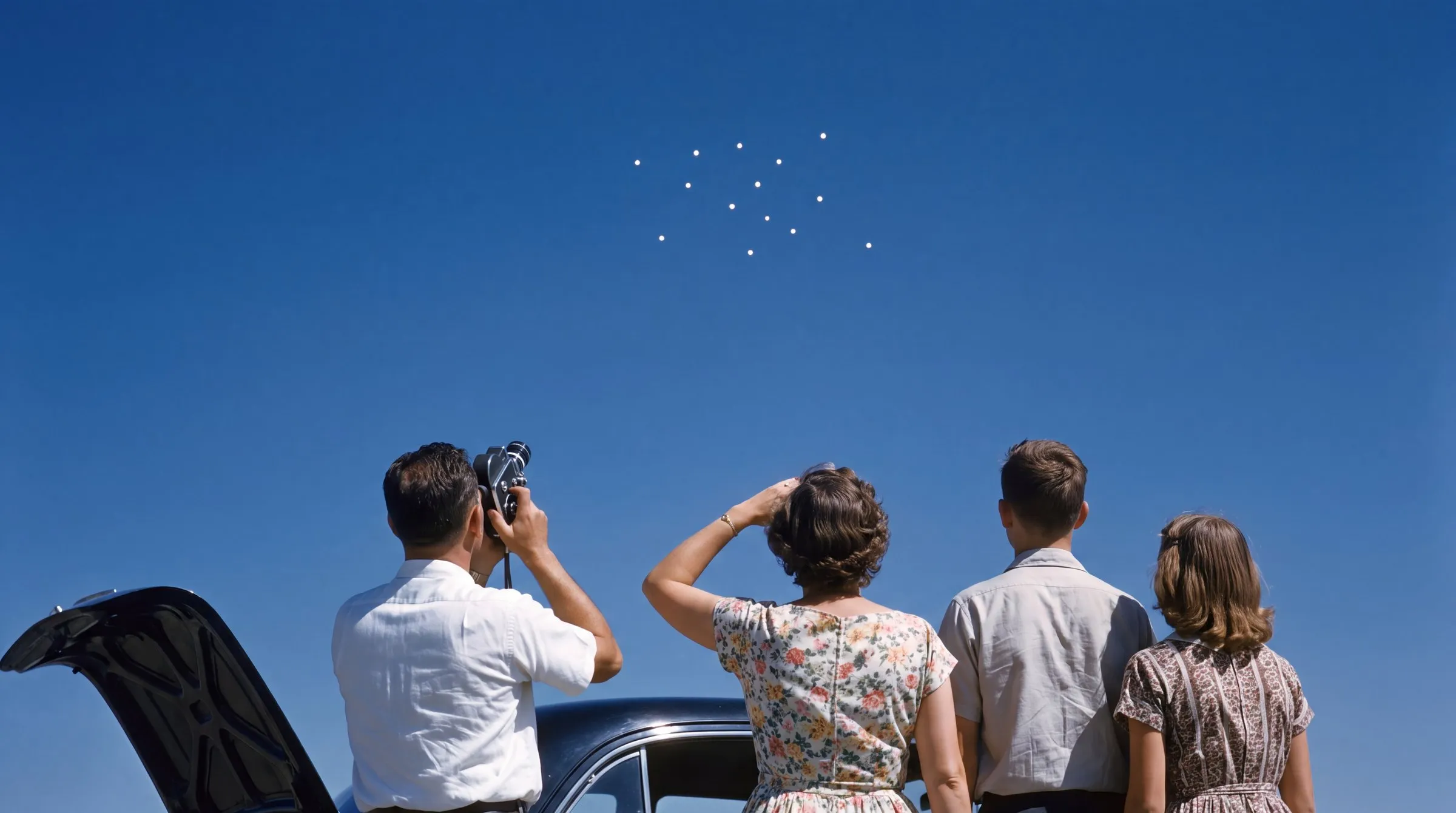
Stand beside the car and look up his 70°: the viewfinder shows a dot two pixels wide, and it is the same dot at every distance. At five miles the film's 0.0012 rad and 2.1°/s are a 32 ft object at 660 mph and the Navy's 965 g; at a thousand feet they are a 1.2 ft object at 25 mph and 37 g. The 3,780 mph the Navy printed comes back from the witness's 3 in lens at 16 frames a second, and its 'multiples of 12.5' are one reading step of its own screen. A gull at a herring gull's 29 mph sits 1,160 ft off by speed and, with a California gull's span, 1,221 to 3,664 ft by size; a 2 ft pillow balloon sits 1,667 ft off by size and needs 42 mph of wind where the day's soundings found calm to light air; a B-29 is 22 miles off by size and 2 by speed. Two verdicts hang at equal size. The angles are the record's.
Keep the signal
The station is free. No ads, no tracking cookies. If the files are worth your time, following is the support.
 Open the interactive ▸
 What you're looking at
The Valley is the Bear River valley on real relief, 50 km of it, with the filming site at the latitude and longitude Baker’s 1956 report gives, the car and the observer on the road, the sun where the Naval Observatory put it (64.5° up, azimuth 131°), the 3 in lens’s 7.7° frame pointed at the 70° elevation the interview gives, and the object hung on that line at whatever range the dial says. Stand at the observer’s eye, fly the object across the sky at the film’s 2.1°/s, hold the camera still as he did for the single object’s passes, and watch the viewfinder inset: the dot is 0.0012 rad wide at every range, and crosses the frame in 3.7 s at every range. Beside it, the ledger: the angles, the range, and what follows.
The Rulers is the two-ruler chart. For each candidate the record names, a gull, a pillow balloon, an aircraft, the Navy’s own 50 to 98 ft object, a bar by size (the candidate’s size over the film’s angular size) and a bar by speed (its speed over the film’s angular rate) on one logarithmic range axis, with Baker’s ‘within about one thousand feet’ and the Navy’s five miles marked. Where the bars overlap, one distance satisfies both angles. Below it, the g-ladder: the Navy’s eight accelerations as printed at five miles and again at the dial, each as a whole number of 12.5 g reading steps, with Baker’s 2.8 g from the same film beside them.
The Film shows frames from the 2026 transfer, DOW-UAP-PR159, with their frame numbers and times, and the film ledger: thirty feet is 1,200 frames, the Air Force lab’s table runs to 1,140, the Navy’s ninety seconds would be 1,440, and the transfer’s light stretch is 386 frames where the lab’s light sequences end at frame 386. The File runs the cards: the witness, the camera, the three assumptions, 3,780 decoded, the tick, the astronomers, the Air Force lab, Baker, the pillow balloons, the gulls, the sun, the missing original, the press release and the transfer, and then the two verdicts at equal size.
Why it is here
This film has briefings on the site: Release 06 Briefing 1 on the Project Blue Book folder, Briefing 2 on the 2026 transfer, and Release 05 Briefing 4 on the Navy's 1953 analysis; it has a wiki entry, and the photographer, Delbert C. Newhouse, has his own. The briefings lay the record out and do not rule on it. What they lay out has a shape, and the shape is one an instrument can take over: three laboratories measured the same film, all three measured angles and nothing else, and every mile, mile per hour and g the record gives the objects is one of those angles multiplied by a distance somebody assumed. The Navy chose five miles and wrote on the same page that the choice was arbitrary; Baker tabulated every distance from 100 ft to 10 miles; the Air Force lab computed no distance at all.
So the instrument does one thing: it makes the number nobody measured a dial. It replaces no angle; it multiplies the angles by the distance you choose, so that the Navy's 3,780 mph, 965 g and 98 ft, Baker's 2.8 g and the Air Force lab's 2.1°/s crossing take their places on one range axis. On the way it decodes two numbers the record left behind: 3,780 comes back from the witness's 3 in lens at 16 frames a second, and the report never names the lens; and 'multiples of 12.5 approximately' is the g-value of one 0.1 mm reading step on the Navy's 22× screen, a pattern the report saw and wrote that it had not studied. Then it gives every candidate the file names two rulers, one by its size and one by its speed, and shows whether the two meet on the range axis. The angles are the record's; the miles are the reader's.
How it works
Everything on the bench is arithmetic on angles the three laboratories printed: a per-frame shift on the film divided by the focal length is an angle, and an angle multiplied by a range is a size, a speed or an acceleration. The script that ships with the site re-derives every displayed number before the build is allowed to pass.
v = (s / f) · R · fps · a_tick = (0.1 mm / 22) / f · R · fps² · L = θ · R · v = ω · R · R_size = L / θ · R_speed = v / ω
The Navy’s scale. ‘Velocity is computed to be 3780 mph for a shift of 1 mm per frame if the object is five miles from the observer.’ With s = 1 mm, f = 76.2 mm, R = 26,400 ft and 16 frames a second the bench returns 3,779.5 mph; a 2 in lens would return 5,669 and a 1 in lens 11,339. The December report’s mean shift, 0.1729 mm per frame, gives its printed 653.5 mph the same way, and the same report wrote that other distances follow as x/5 times 653.5.
The tick. The Navy plotted on a 22× screen. One 0.1 mm step there is 0.004545 mm on the film, 5.965e-5 rad, 1.575 ft a frame at five miles, 25.2 ft/s in a sixteenth of a second, and 403 ft/s² = 12.53 g when differenced over the next sixteenth. 965 g is 77.0 steps, 50 g is 4.0, 1,479 g is 118.0, 12 g is 1.0; the Montana film’s 639, 576, 601 and 651 g are 51, 46, 48 and 52. The report noticed ‘multiples of 12.5 approximately’ and said no study had been made; the bench states the arithmetic and stops there.
The rulers, the sun and the film. A candidate’s size over the film’s angular size gives one range; its speed over the film’s angular rate gives another. The gull’s span and airspeed, the B-29’s span and the 16 mm frame are outside values on dials; the pillow’s wind comes from the Ogden radiosonde ascents of 08:00 and 14:00 MST that day, interpolated by vector to the height the size-range puts it at. The sun is the NOAA algorithm for 41°50′N 112°10′W at 18:10 UTC, which returns the Observatory’s 64.5° and 131°; the transfer’s counts are measured on the issued file.
Nothing is fitted. The only choices are the range, which is the dial the record never had, the exact angle within each laboratory’s bracket, and the candidates’ outside values; every finding is quoted across all of them.
The dials that decide the result
The range, the angular size, the angular rate; the candidate, its wingspan and speed, the aircraft’s speed, which ascent; the camera’s elevation and whether it is held still. Together they draw every version of the sky the record could mean.
- Assumed range. 100 ft to 20 miles on a logarithmic slide, with five presets: Baker’s bird at 1,000 ft, a 2 ft pillow by size at 1,667 ft, Baker’s ‘less than one mile’, the Navy’s five miles, Baker’s last row at ten. Every size, speed and g on the bench follows it.
- Angular size. 0.0004 to 0.0016 rad, Baker’s bracket; default 0.0012, his typical image, 0.09 mm on the film.
- Angular rate. 1.0° to 3.9°/s; default the Air Force lab’s printed 2.1°/s, with the Navy’s December mean (2.08) and Baker’s 1.8 to 2.2 beside it.
- The gull. Wingspan 1.00 to 1.60 m (a California gull is 1.22 to 1.37 m); airspeed 10 to 45 mph, default 29 (a herring gull’s 12.8 m/s, tracked by radar). The size ruler runs from a third of the span, Baker’s factor for a bird whose body is the principal reflector, to the whole.
- The aircraft, the ascent, the camera. A piston aircraft at 150 to 400 mph against a B-29’s span; the morning or the afternoon Ogden ascent; the camera’s elevation from 40° to 90° around the interview’s 70°; standard time or daylight time for the sun; the lens panning with the object or held still.
The claims, as they stand
The accounts and the explanations one by one, and where each lands when the angles are multiplied by a range and the outside values are entered.
| Ten or twelve bright objects milling about overhead, one reversing course; no reference point proposed by Newhouse, 11 August 1952; the 28th Air Division’s interview of 10 September 1952, teletyped on the 12th | CONTESTED | The film carries ten points by the Air Force lab's count; Newhouse wrote ten or twelve; the interview and Baker say twelve to fourteen. Three laboratories' angles agree within their brackets, 0.0012 rad and about 2.1°/s; the bench changes none of them, and none of them is a distance. |
| Light sources 'of a construction, design, and material not commonly known'; birds, aircraft and balloons ruled out proposed by the Naval Photographic Interpretation Center, 4 May 1953 | CONTESTED | Every figure the ruling rests on is the film's angle multiplied by five miles, which the same report calls arbitrary; its 965 g is 77 reading steps of its own 22× screen and its 3,780 mph decodes as a 3 in lens at 16 fps. Two astronomers said its brightness method was wrong. |
| 'multiples of 12.5 approximately. This may be of significance' proposed by the same report | MEASURED | One 0.1 mm step on the 22× screen, differenced over 1/16 s at five miles, is 12.53 g; all eight printed accelerations, Utah and Montana, are whole numbers of steps (77, 4, 118, 1; 51, 46, 48, 52). The bench states the arithmetic; the report states that no study was made. |
| Gulls: 'a bird within about one thousand feet'; 'indeed seagulls' proposed by Baker, 16 May 1956; Eriksen, 1 June 1956 | CONTESTED | By speed, a gull at a herring gull's 29 mph (12.8 m/s, rounded up) sits 1,160 ft off; by size, a California gull's span at 0.0012 rad is 3,664 ft and a third of it, Baker's factor for a bird whose body is the reflector, 1,221 ft: the rulers overlap between 1,221 and 1,451 ft, on outside values for the span and the airspeed. Baker also recorded no sign of flapping and no cumulus to betray a thermal. A page of the file records gull movies under similar lighting showing 'bright spots of light very similar to those in the movies' (D102 p. 80), place and date unrecorded. |
| Pillow balloons, 'These are "pillow balloons" 2' × 2'' proposed by Office of Naval Research officers; the Minnesota screening, 30 December 1952; the D103 mount sheet | CONTESTED | By size 1,667 ft; there the film's rate needs 42 mph across the sky. The interview's breeze was 3 to 5 mph; Ogden's two ascents that day give calm to 5 m/s from the surface to 700 hPa, 73 km away. A pillow rising from a nearby release, the screening's own suggestion, is not priced. |
| Aircraft proposed by left open by the Air Force lab and the February 1953 memorandum; ‘highly improbable’ on the ATIC worksheet; Baker’s discussion | CONTESTED | A B-29's span at 0.0012 rad is 22 miles off; 300 mph at 2.1°/s is 2.3 miles off, a factor of ten. The Navy and Baker both note that at those ranges identification would follow; the interview records no sound and no contrails. |
| 'the method used to measure the brightness of each spot was wrong, therefore, the results of the entire study were wrong' proposed by two astronomers at a Navy briefing, February 1953 | READING | Not testable on the bench: the original was never in the Navy's hands, the densities were read on a duplicate of a copy, and the release holds no frame the densitometer saw. The bench uses no brightness. |
| The sun at 64.5° elevation, azimuth 131° proposed by the Naval Observatory, October 1952 | MEASURED | The NOAA algorithm returns 64.5° / 131° for 1110 Mountain Standard Time and 55° / 111° for daylight time; the camera's 70° arc from east to west passes 5.5° from the sun at its azimuth. |
| The 2026 transfer carries one film frame per video frame proposed by this bench | READING | The light stretch counts 386 frames in the transfer and the Air Force lab's light sequences end at frame 386; the dark stretch is 23 frames short; no frame repeats its predecessor; the release states no cadence. A reading with the count beside it. |
| What the rangefinder amounts to proposed by this bench | READING | Two verdicts, one angle. Five miles gives the Navy's; Baker's thousand feet gives the Air Force's. The film cannot choose between them, and the bench does not. |
Try this
- Start at the overview. Read the ledger: angles, range, what follows. Click the object’s chip.
- Go to the observer. Press play with the camera held still: the dot crosses the viewfinder in 3.7 s. Now slide the range to 1,000 ft, then to 10 miles. The viewfinder does not change.
- Look at the sun. Its chip says 64.5° up at 131°; the arc passes 5.5° from it. Switch to daylight time and read the chip again.
- Go to the rulers. The gull’s two bars overlap between 1,221 and 1,450 ft. Slow the gull to 20 mph, or shrink the angular size to 0.0008, and watch them part.
- Pick the pillow balloon. By size 1,667 ft; the wind it needs 42 mph; the wind the ascent found, calm. Switch to the 14:00 ascent.
- Read the ladder. 965 g is 77 ticks. Slide the range to a thousand feet and read what 77 ticks are there.
- Finish in the file. The astronomers, the press release, the missing original, the transfer’s 386, then the two verdicts.
Accuracy
The honest line between what is measured, what is quoted, what is arithmetic on them, and what is a reading:
| Feature | Status | What that means |
|---|---|---|
| The angles, the sun, the soundings, the transfer | Measured | The Air Force lab's 2.1°/s ± 15 % (D102 p. 140); the Navy's December mean shift, 0.1729 mm per frame (p. 131); Baker's image diameters 0.0004 to 0.0016 rad and single-object rates 0.031 to 0.039 rad/s (p. 84); the Naval Observatory's 64.5° / 131° (D105 p. 26); the Ogden radiosonde ascents of 2 July 1952 (IGRA); the transfer's frame counts, measured on the issued file. Nothing on the bench changes them. |
| The arithmetic | Exact | A shift on the film over the focal length is an angle; an angle times a range is a size or a speed; a change of speed over 1/16 s is an acceleration; 0.1 mm on a 22× screen is one reading step; the NOAA solar position; the field of view of a 3 in lens on a 10.26 × 7.49 mm frame. No parameter is fitted. |
| The dials | Modelled | The range (the one number nobody measured); the exact angular size and rate within their brackets; the gull's span and airspeed, the aircraft's speed, the exposed-white fraction; which ascent; the camera's elevation and whether it was held still. The findings are quoted at the defaults, and the dials show where they part. |
| The 1952 to 1956 documents | Reported | Newhouse's letter and statement, the 28th Air Division's interview, the Navy's two reports, the Air Force lab's report, the Minnesota travel report, the memoranda on the press release, Baker's report, Eriksen's memorandum and the D103 mount sheet, quoted as they print; their computed figures (3,780 mph, 965 g, 98 ft, 2.8 g) are quoted as printed and re-run beside them. |
| What it amounts to | Reading | Whether the film shows gulls a thousand feet off, pillow balloons, light sources five miles off, or something the record does not name, is a reading, and the bench declines to make it for you. |
In one line: Every angle is a laboratory’s figure from the record, every distance is the dial, every size, speed and g is the product of the two, and the outside values sit on dials with their sources named; the 1952 documents are quoted as they print. The reading is yours.
Sources
- DOW-UAP-D098, "Film Analysis of Unidentified Objects, 1953", PURSUE Release 05, U.S. Department of War: the Naval Photographic Interpretation Center’s letter report of 4 May 1953 (pp. 3 to 9): the 22× screen, the three assumptions, 3,780 mph per mm per frame, 2,457 and 378 mph, the acceleration table and its "multiples of 12.5", 98 and 16 ft at five miles.
- DOW-UAP-D102, "Project Blue Book File on Tremonton Film Utah 1952", PURSUE Release 06: the record card (p. 2), the 28th Air Division interview (p. 6), the Minnesota travel report (p. 29), the memoranda on the press release (pp. 37 to 39), the Navy’s letter of 18 March 1954 (p. 45), Newhouse’s statement and letter (pp. 70, 113), the second copy of the Navy report (pp. 71 to 77), Baker’s Douglas Aircraft report of 16 May 1956 (pp. 83 to 88), the December 1952 progress report (pp. 129 to 133), the question list (pp. 134 to 135), the Air Force Photo Reconnaissance Lab report and its appendices (pp. 136 to 144), Eriksen’s memorandum of 1 June 1956 (p. 127).
- DOW-UAP-D103, "Project Blue Book Photo File Relating to Tremonton Film Utah 1952", PURSUE Release 06: the summary card (p. 2) and the General Mills mount sheet with the note "These are ‘pillow balloons’ 2′ × 2′" (p. 5).
- DOW-UAP-D105, "U.S. Air Force Flying Discs File September to December 1952", PURSUE Release 06: the memorandum of 24 October 1952 with the Naval Observatory’s sun position (p. 26), the copy of Newhouse’s letter (p. 28), the 28th Air Division teletype with the camera elevation, the arc and the weather (p. 31).
- DOW-UAP-PR159, "Historical Film of Reported UFOs, Utah, 1952", PURSUE Release 06, and DVIDS video 1023402 (DOD_111985807.mp4): the transfer measured here, 1,682 frames at 24 fps, the blue field at frames 214 to 1,330.
- Signals from the Periphery, Release 06 Briefings 1 and 2 and Release 05 Briefing 4, on the three records above.
- NOAA NCEI, Integrated Global Radiosonde Archive (IGRA) v2.2, station USM00072575 Ogden, Utah (41.18°N 112.02°W, 1,346 m): the ascents of 2 July 1952 at 15 and 21 UTC; retrieved 24 September 2026.
- NOAA Global Monitoring Laboratory, "Solar Calculator" equations (the solar position for 41°50′N 112°10′W at 18:10 UTC).
- Alerstam, T., Rosén, M., Bäckman, J., Ericson, P. G. P. & Hellgren, O. (2007) "Flight Speeds among Bird Species: Allometric and Phylogenetic Effects", PLoS Biology 5(8), Protocol S1: Larus argentatus, mean equivalent airspeed 12.8 m/s, 18 tracks.
- Wikipedia, "California gull", wingspan 122 to 137 cm (48 to 54 in), retrieved 24 September 2026: a general reference, entered on a dial.
- Loftin, L. K. (1985) Quest for Performance: The Evolution of Modern Aircraft, NASA SP-468: the B-29 Superfortress, span 141 ft 3 in, length 99 ft.
- 16 mm film: camera aperture 10.26 × 7.49 mm (0.404 × 0.295 in), 40 frames per foot (SMPTE 7 / Kodak).
- AWS Terrain Tiles (terrarium, zoom 11) from SRTM, for the 50 km sheet; OpenStreetMap contributors (ODbL) for the roads, railway, rivers and place names, queried 24 September 2026.
Stand beside the car. Then choose the distance nobody had.
Open the interactiveCompiled September 2026