三体世界台: 三颗太阳, 对着半人马座 α 标价
小说的游戏里, 一颗行星有三颗太阳: 绕着其中一颗时是恒纪元, 另一颗靠近时是乱纪元, 太阳远去时是飞星, 还有四十八年的长夜, 把地面抬起的三日连珠, 把行星撕成两半的大撕裂。小说把那个世界放在约四光年外, 红岸那一章把它叫作半人马座 α。本台拿小说写它的句子, 对每一句问: 它需要什么距离、什么速度、什么精度, 真实的星系有没有。太阳大小的恒星在 31.97 AU 以内是肉眼可辨的日轮, 再远是光点, 仍是满月的 423 倍亮。真实的 A 与 B 每 79.762 年在 11.20 到 35.40 AU 之间摆动一回, 离 A 1.5 AU 的行星在整整 2,000 年的运行里保持一个恒纪元。把同样三颗恒星摆到边长 10 AU 的三角形上, 离 A 1 AU 的行星经历 8 个恒纪元, 在 304.5 年时被抛出。潮汐只在恒星的洛希极限以内达到 g, 而行星在那里先被拆开。四十八年没有太阳, 海洋上结出 58.47 m 的冰, 地表 103.9 K: 水雪与干冰, 还没有第三种雪。每环一秒, 人列计算机算两年的预报要 6.667 个月, 小说是十四个月。本台不对这本书下判。
关注与订阅
本站免费,无广告,不设追踪 cookie。如果这些档案值得你花时间,关注就是对它最好的支持。
 打开互动演示 ▸
小说
这部小说是刘慈欣的《三体》(2008), 这里读的是刘宇昆
- 一天与纪元, 第 7 章。昼夜周期稳定在十八小时左右 (A day-night cycle began to stabilize around eighteen hours)。恒纪元短则一天, 长则一个世纪, 谁也无法预测它持续多久 (As short as a day or as long as a century. No one can predict how long one will last)。恒纪元以外的时间都属于乱纪元 (Other than Stable Eras, all other times belong to Chaotic Eras)。文明只能在恒纪元温和的气候里发展 (Civilization can only develop in the mild climate of Stable Eras)。
- 三颗太阳与足球, 第 15 章。我们的世界有三颗太阳, 在相互扰动的引力下运动无法预测 (our world has three suns. Under the influence of their mutually perturbing gravitational attraction, their movements are unpredictable), 三颗太阳是球员, 我们的行星是足球 (The players are the three suns, and our planet is the football)。另外两颗远的时候, 看上去是飞星 (When the other two are far away, they look like flying stars)。三颗飞星出现, 预示着漫长的严寒 (the appearance of three flying stars heralds a long period of extreme cold: because all three suns are far away)。一个文明看到两颗太阳, 随即被它们合起来的热毁灭 (One civilization saw two suns and was immediately destroyed by their combined heat); 看到三颗, 地表一秒之内变成熔炉, 热足以熔化岩石 (the surface of the planet would turn into a smelting furnace in a second, and the heat would be enough to melt rocks)。第 183 号文明毁于三日凌空 (Civilization Number 183 was destroyed by a tri-solar day)。
- 三日连珠与跳高, 第 17 章。三颗太阳排成一条直线, 以同样的角速度绕着行星转, 我们的世界在直线的末端 (The three suns are in a straight line, moving around our planet at the same angular speed! Thus, our planet and the three suns are in a straight line with our world at the end!)。一名士兵试着一跳, 轻易跳到三米高 (a soldier tried to jump up, and easily reached the height of three meters), 因为三颗太阳在行星上方排成一线, 引力相加 (the three suns are over our planet in a straight line, so their gravitational forces are added together)。一切没有固定的东西, 人、巨石、天文仪器、青铜大鼎, 先是缓缓升起, 然后加速 (Everything that floated … men, colossal blocks of stone, astronomical instruments, bronze cauldrons … began to rise slowly, then accelerated)。第 184 号文明毁于三日连珠叠加的引力 (Civilization Number 184 was destroyed by the stacked gravitational attractions of a tri-solar syzygy)。
- 人列计算机, 第 17 与 18 章。整个方阵排在一个边长六公里的正方形里 (The entire formation fit inside a square six kilometers on each side)。第一次运算要算出未来两年所有太阳的位置, 每组输出相隔一百二十小时 (Our first computation will calculate all the suns’ positions for the next two years. Each set of output values will be one hundred and twenty hours apart)。人列计算机运行了一年四个月, 除去调整程序的时间, 实际运算约一年两个月 (The human-formation computer operated for a year and four months. Subtracting out the time spent to adjust the programming, the actual processing time was approximately a year and two months)。结果精确描述了三颗太阳未来两年的轨道 (The results precisely described the orbits of the three suns for the next two years)。在聚会上, 潘寒设想每名士兵每秒举放黑白旗十万次, 总线上的轻骑兵能跑到声速的几倍 (suppose that of the thirty million soldiers forming the computer, each one is capable of raising and lowering the black and white flags a hundred thousand times per second, and suppose also that the light cavalry soldiers on the main bus can run at several times the speed of sound)。
- 长夜与三种雪, 第 7 章。现在的雪是冻结的二氧化碳, 干冰 (The snow is now composed of frozen carbon dioxide, dry ice)。雪花现在是固态的氧和氮, 大气正在凝华消失, 上面已接近绝对零度 (Those snowflakes are now composed of solidified oxygen and nitrogen. The atmosphere is disappearing through deposition, which means it’s near absolute zero above)。最下层是水雪, 然后是干冰, 最上面是氧氮雪 (The lowest layers were composed of water snow, then dry ice, and finally, on top, snow made of oxygen and nitrogen)。长夜持续了四十八年, 第 137 号文明毁于严寒 (The long night lasted forty-eight years. Civilization Number 137 was destroyed by the extreme cold)。
- 巨月、冻结的飞星与大撕裂, 第 19 章。巨月大约是行星的四分之一大, 已经不是卫星, 而是双行星系统里的伴星, 来自大撕裂 (since it’s about a quarter of the size of our planet, it’s no longer a moon, but a companion to our world in a double planet system. It resulted from the great rip)。巨月转到行星另一侧时, 摆锤的重量回升, 几乎回到大撕裂之前的水平 (almost to the level it would have had before the great rip)。第 191 号文明的天文学家很早就发现了一颗冻结的飞星 (the astronomers of Civilization 191 detected a frozen flying star early on): 几天后, 一颗太阳移到看得见外层气体的距离, 在宁静的夜里突然变成灼热的太阳, 另两颗隔约三十小时相继出现 (A few days later, one of the suns moved to a distance where its outer gaseous layer became visible. In the middle of a tranquil night, the star suddenly turned into a blazing sun. Separated by intervals of thirty hours or so, the other two suns also appeared in quick succession)。行星深入洛希极限, 三颗太阳加给三体世界的潮汐力超过了行星自身的引力 (well within the planet’s Roche limit, such that the tidal forces imposed on Trisolaris by the three suns exceeded the force of the planet’s gravitational self-attraction), 第三颗太阳把行星撕成两块 (the third sun ripped the planet into two pieces)。文明第一百九十二次重现, 整个过程花了九千万年 (civilization reappeared for the one hundred and ninety-second time. The entire process took ninety million years)。
- 四光年与半人马座 α, 第 20 与 23 章。游戏里说, 约四光年外有一颗带行星的恒星, 是离三体世界最近的恒星 (A star with planets about four light-years away … the closest star to the Trisolaran system); 汪淼回答, 离我们最近的恒星也在约四光年外 (The closest star to us is also about four light-years away)。在地球上: 凌晨四点, 来自半人马座 α 的传输结束了 (At four in the morning, the transmission from Alpha Centauri ended)。
真实的星系
半人马座 α 离太阳 4.344 光年: 两颗恒星 A 与 B 在一条紧密的轨道上, 比邻星远在外面。Akeson 等 2021 的表 8 给出 A 1.0788 与 B 0.9092 个太阳质量, 半径 1.2175 与 0.8591 R☉, 光度 1.5059 与 0.4981 L☉。它们的轨道半长轴 17.4930″, 视差 750.81 mas, 本台读作 23.299 AU, 偏心率 0.51947, 周期 79.762 年: A 与 B 在近星点相距 11.20 AU, 在远星点分开到 35.40 AU。按 L 与 R, 本台给 A 的有效温度是 5,795 K, B 是 5,232 K。
比邻星在 Kervella 等 2017 的表 1 里是 0.1221 M☉ 与 0.1542 R☉; 光度 0.001567 L☉ 取自比邻星页面 (同样的算术给出 2,925 K)。它绕 A 与 B 的轨道取 Akeson 的表 10: 半长轴 8.2 kAU, 偏心率 0.497, 周期 511 kyr, 远星点在 12.28 kAU 外。Kervella 的表 3, 8.7 kau、0.50、547 ka, 远星点 13.0 kau, 并列在案卷上; 比邻星今天离 A 与 B 12,950 AU。
行星的空间。Wiegert 与 Holman 1997 算出, 在双星的轨道面上, 行星从至少 0.15 倍半长轴 (3.5 AU) 到 3 倍半长轴 (70 AU) 都不稳定; Akeson 等写道 A 周围约 2.8 AU 以内有一个稳定区。星系里唯一已知的行星是比邻星 b, 轨道周期约 11.2 天, 离它的恒星约 0.05 AU, 至少 1.3 个地球质量
真实恒星自己的时钟。从相距 10⁻⁹ AU 的两个起点各运行 1,000 年, 真实的三颗恒星以 143 年的李雅普诺夫时间分开。对这样一个嵌套而规则的三体系统, 这是有限时间的数, 随窗口与输入而变; 案卷在它旁边写明了这一点。
本台做什么
一个问题。对每一句话, 本台问它需要什么距离、什么速度或什么精度, 以及真实的半人马座 α 有没有。小说没给它的太阳质量、半径与轨道, 所以本台用真实的三颗恒星 A、B 与比邻星, 摆成两种: 照它们本来的样子, 以及摆在一个让游戏里的足球踢得起来的三角形上。本台不说小说本该怎么写。
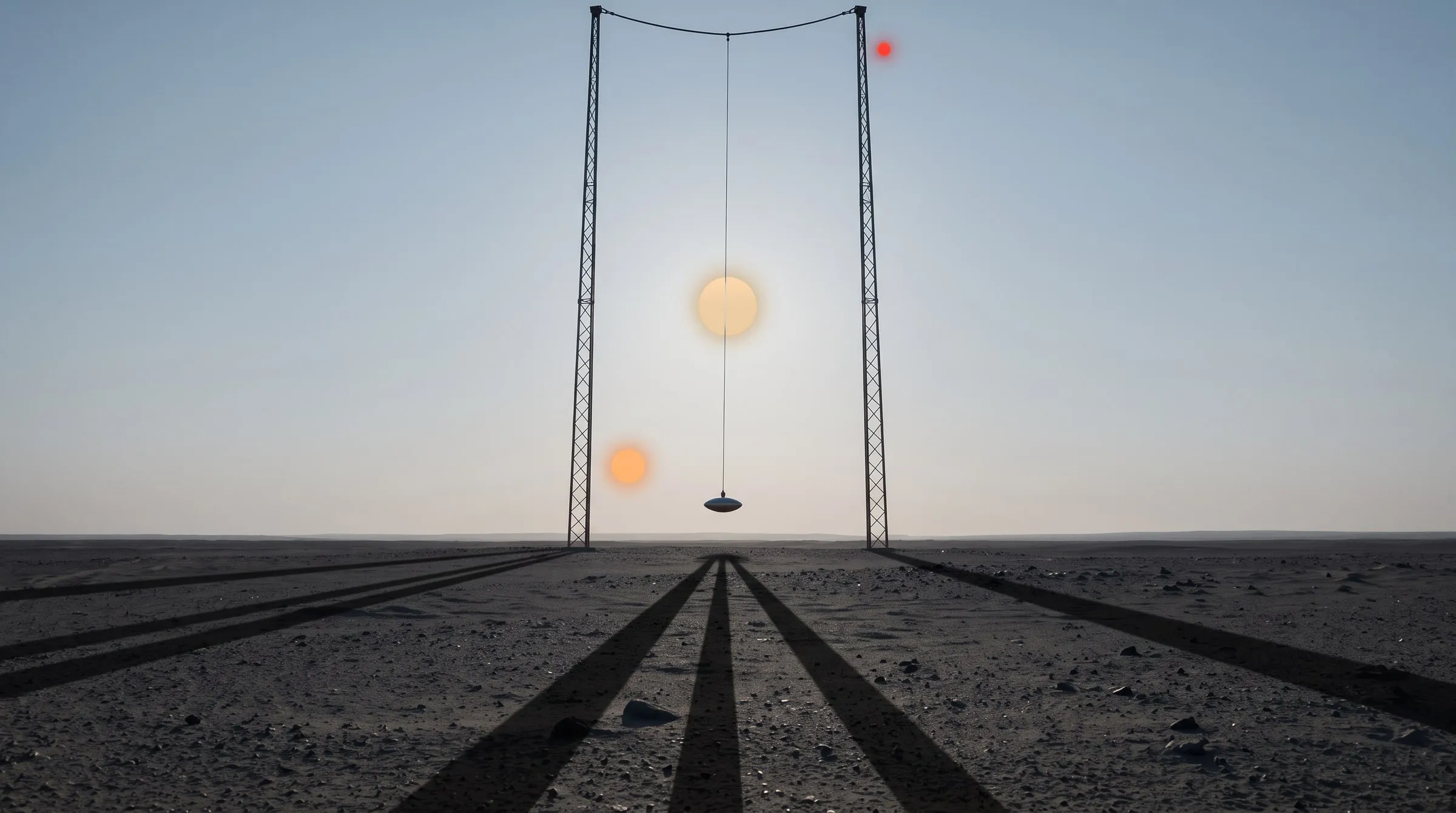
视图。天空是三维的黑暗平原, 即游戏里那片延伸到地平线的黑色荒漠 (Only a dark desert extended to the horizon, 第 20 章), 几百米外立着钟摆纪念碑, 三颗太阳在
恒纪元是本台自己的定义, 写在页面上: 行星的辐照度在 0.5 到 2 S0 之间, 持续 30 天或更久, 也就是给小说说的恒纪元温和的气候 (mild climate of Stable Eras, 第 7 章) 一个数。在范围内还不满 30 天时, 纪元显示为「待定」。行星进入恒星对地球密度的流体洛希极限即被吞没, 超出 500 AU 且不受束缚即被抛出; 两颗恒星的中心距小于半径之和时, 两颗太阳相撞。
布景, 都标明是布景。行星 18 小时自转一周, 即第 7 章的周期, 自转轴竖直, 观察者在纬度 30°, 天空的时刻取宿主太阳的太阳时; 各预设的方位; t = 0 时 A 与 B 在近星点、比邻星在远星点; 拉格朗日三角百分之 1 的扰动; 钟摆纪念碑的立柱, 小说说每根都有埃菲尔铁塔那么高 (each as tall as the Eiffel Tower, 第 19 章), 画成 300 m, 离观察者 400 m; 地球的夜空, 太阳在仙后座 ε 以东 1.5°; 屏幕把每颗太阳的光映射成影子与曝光的方式。小说自己写道, 钟摆纪念碑是游戏里少数在三体世界里真实存在过的东西之一 (the Pendulum Monument was one of the few objects in the game that really did exist on Trisolaris, 第 33 章)。
本台不模拟的东西。太阳的呼吸, 即外层气体的膨胀 (第 19 章), 在案卷上点名, 不标价; 游戏里的特殊光学作用 (special optical interaction, 第 15 章), 作为游戏自己的设定, 与 1′ 的算术并列点名; 平衡温度以外的大气与气候; 冰下海洋的深度与洋流; 地表多快变成熔炉 (a smelting furnace in a second); 脱水; INST-89 红岸链路预算台那个数以外的三体时; 八字形解, 由 INST-01 引力来画; 相对论, 因为除了相撞前的最后几步, 每次运行里恒星的速度都低于 10⁻³ c; 行星的质量; 潮汐加热; 人列计算机在给定规模的同步机器之外的逻辑。
d_point = R / sin(0.5′) · S = Σ L/(4πd²) · T_eq = (S(1 − A)/(4σ))^¼ · a_tide = 2GMR/r³ · d_Roche = 2.44 R (ρ_M/ρ_m)^⅓ · ρL dh/dt = εσT_s⁴ · t_h = τ ln(tol/δ₀)
天空
书里写道 (第 15 章), 另外两颗远的时候看上去是飞星 (When the other two are far away, they look like flying stars)。恒星张角在肉眼的 1′ 以上时是日轮, 超过 d = R / sin(0.5′) 就是光点: 太阳大小的恒星是 31.97 AU, A 是 38.9 AU, B 是 27.47 AU, 小小的比邻星是 4.93 AU。1 AU 处的太阳宽 31.97′; 1.2 AU 处的 A 宽 32.44′。
光点并不暗。32 AU 处的太阳给出 9.767 × 10⁻⁴ S0, 够让全球平均到 45.1 K, 地球是 255.1 K, 视星等 −19.3; 在光点自己的边界 31.97 AU, 它是平均满月的 423 倍亮。比邻星在变成光点的 4.93 AU 处给出 6.45 × 10⁻⁵ S0, 在比邻星 b 的 0.05 AU 处给出 0.627 S0。游戏里的伽利略要一颗随着远去渐渐缩成飞星的太阳 (gradually shrink into a flying star as it moves farther away); 游戏用一种特殊的光学作用回答 (special optical interaction), 让外层变得完全透明、看不见 (completely transparent and invisible), 那是它自己的设定, 本台点名, 不标价。
天空的预设把 A、B 与比邻星放在固定的距离上。恒纪元 (A 1.2, B 30, 比邻星 40 AU): 1.046 S0, 全球平均 258.0 K, 直射点 398.1 K, A 是 32.4′ 的日轮, B 与比邻星是光点。三颗飞星 (40, 50 与 60 AU): 1.141 × 10⁻³ S0, 46.9 K 与 72.3 K, 三个光点, 即小说说的漫长严寒的预兆 (heralds a long period of extreme cold)。双日 (A 与 B 在 1.0 AU, 比邻星在 40): 2.004 S0, 303.6 K 与 468.3 K。三日凌空 (A 0.5, B 0.7, 比邻星 0.3 AU): 7.058 S0, 415.8 K 与 641.6 K。三日连珠 (0.3, 0.6 与 0.9 AU, 排成一线): 18.12 S0, 526.4 K 与 812.1 K, 只看见一个日轮, 因为 A 的日轮挡在另两颗前面。
对热足以熔化岩石那一句 (the heat would be enough to melt rocks), 本台给出一道梯子: 一颗太阳在 0.0689 AU 处把直射点推到 1,500 K, 铁在 1,811 K 熔化, 3,134 K 沸腾。太阳的颜色来自它们自己的 L 与 R: A 5,795 K, B 5,232 K, 比邻星 2,925 K。
足球
书里写道 (第 15 章), 行星在稳定的轨道上绕一颗太阳转, 就是恒纪元 (When our planet revolves around one of the suns in a stable orbit, that’s a Stable Era), 三颗太阳是球员, 我们的行星是足球 (The players are the three suns, and our planet is the football)。在真实的星系里, 离 A 1.5 AU 的行星在整个运行里放在哪里就留在哪里; 在 4 与 6 AU 它被抛出。这颗 1.5 AU 的行星在轨道面上撑过整整 2,000 年的运行, 离 A 从不近于 1.345 AU, 光照在 0.5625 到 0.8372 S0 之间: 从头到尾一个恒纪元。在 3 AU 它也留着, 0.1315 到 0.3263 S0, 太冷, 进不了范围。在 4 AU, 它在 1,041 年时被抛出; 在 6 AU, 它以 0.487 AU 掠过 B, 在 3.108 年时被抛出, 落在 Wiegert 与 Holman 的不稳定区里。离 B 1 AU 的行星留着, 0.4569 到 0.5640 S0, 在范围的边上。
小说没给它的太阳间距, 所以拉格朗日预设把同样三颗恒星放在边长为 L 的等边三角形上, 以拉格朗日速率绕转, 每个起点扰动 L 的百分之 1 (布景)。在 L = 10 AU, 离 A 1 AU 的行星经历 8 个恒纪元, 最长的 85,570 天 (234 年), 有百分之 77.7 的时间在范围内; 它以 0.1029 AU 掠过比邻星之后, 在 304.5 年时被抛出。同样的 L 换别的种子, 结局也不同: A 与比邻星在 354.3 年相撞 (种子 2), 行星在 277.2 年被比邻星吞没 (种子 3), A 与比邻星在 34.09 年相撞 (种子 4)。在 L = 5 AU, 行星在 62.7 年被 B 吞没; 在 L = 30, 它在 20,000 年的运行里一直留在一个恒纪元里。
没有行星, 这个三体系统自己也会散: 比邻星在 L = 5 时于 185.4 年离开, L = 10 时 402.9 年, L = 30 时 1,957 年, A 与 B 留下来成为半长轴 3.999、7.257 与 22.53 AU 的双星, 周期 5.672、13.87 与 75.86 年。恒星的李雅普诺夫时间是 2.488、8.472 与 47.43 年。毕达哥拉斯预设把同样的恒星静止放在 30-40-50 AU 的直角三角形上, 以 A 与 B 在 20.5 年相撞告终。
小说自己的步调更长。书里写道 (第 11 章), 你离开的 36.2 万年里, 文明又重生了四次 (During the three hundred and sixty-two thousand years you’ve been away, civilization has been reborn four more times)。那是每个文明 90,500 年, 照这个步调 192 个文明是 1738 万年; 大撕裂之后的恢复花了九千万年 (took ninety million years, 第 19 章)。上面那个紧凑的三体系统里, 一颗行星能撑几十年到几百年。
三日连珠与大撕裂
三日连珠。书里写道 (第 17 章), 三颗太阳排成一条直线, 我们的世界在末端 (The three suns are in a straight line, moving around our planet at the same angular speed! Thus, our planet and the three suns are in a straight line with our world at the end!), 一名士兵轻易跳到三米高 (a soldier tried to jump up, and easily reached the height of three meters), 因为三颗太阳的引力相加 (the three suns are over our planet in a straight line, so their gravitational forces are added together)。太阳的直接引力同样作用在行星和站在它上面的一切上, 所以什么也抬不起来; 剩下的是潮汐, 2GMR/r³, 即行星两端的差。它在 (2GMR/g)^⅓ 处等于 g, 9.820 m/s²: 离太阳质量的恒星 0.7997 R☉, A 是 0.6737 R_A, B 是 0.9018 R_B, 都在恒星内部; 比邻星是它半径的 2.573 倍, 在恒星外面, 却在它对地球密度行星的流体洛希极限 4.983 以内。潮汐只在恒星的洛希极限以内达到 g, 而行星在那里先被拆开。三个 A 的质量放在一处, 需要 1.183 R☉。
离太阳质量的恒星 0.1 AU 时潮汐是 5.144 × 10⁻⁵ g, 1 AU 时 5.144 × 10⁻⁸ g; 三颗太阳在 0.1、0.2 与 0.3 AU 排成一线是 5.977 × 10⁻⁵ g, 三日连珠预设是 2.28 × 10⁻⁶ g。三米的跳高, 对一条在地球上跳过 0.5 m 的腿, 需要 g 为 1.637 m/s², 减少百分之 83.3。
巨月。密度相同时, 直径是行星四分之一的巨月质量是它的 1/64, 即 0.01563。这一对的流体洛希极限是 2.44 个行星半径, 刚体是 1.26。在 2 个半径处, 巨月让近侧与远侧的 g 都变化 3.906 × 10⁻³, 远侧也变轻, 摆锤的周期长 1.953 × 10⁻³, 巨月 3.945 小时绕一圈; 在 2.44 个半径处是 2.151 × 10⁻³ 与 5.317 小时; 在 3 个是 1.157 × 10⁻³ 与 7.248 小时; 在 5 个是 2.5 × 10⁻⁴ 与 15.6 小时。大撕裂之前, 密度相同, 行星的 g 是今天的 1.005: 小说那句几乎回到大撕裂之前的水平 (almost to the level it would have had before the great rip), 是百分之 0.5 的一步。
大撕裂。地球密度的行星在恒星的流体洛希极限处解体: 太阳密度的恒星是 1.548 R☉ (刚体极限 0.7994 R☉ 在恒星内部), A 是 1.305 R_A, A 的平均密度 842.7 kg/m³。在太阳的掠过处, 行星承受 19,300 S0, 直射点 4,639 K, 无反照的全球平均 3,280 K; 在 A 的掠过处是 27,600 S0 与 5,073 K。
赶到的速度。小说说, 几天后 (A few days later), 一颗冻结的飞星变成了灼热的太阳, 这需要一个速度: 3 天走完 31.97 AU 是 18,450 km/s, 30 天是 1,845 km/s, 而朝一个太阳质量的自由落体, 在那个距离是 7.449 km/s, 在掠过处是 496.4 km/s, 落到中心要 31.96 年。太阳相继出现之间的三十小时, 按掠过处的自由落体速度, 是 0.36 AU。
人列计算机与预报
方阵。书里写道 (第 17 章), 整个方阵在边长六公里的正方形里 (The entire formation fit inside a square six kilometers on each side)。三千万士兵在 36 km² 上, 每人 1.2 m², 间距 1.095 m, 六公里的一边排 5,477 人。它说就算地球全部人口排成这样的方阵, 也装得进上海的黄浦区 (even if the entire population of Earth were arranged into such a phalanx, the whole formation would fit inside the Huangpu District of Shanghai), 这句反过来标价: 地球的 83 亿人按这个间距要 9,960 km², 是黄浦 20.43 km² 的 488 倍 (按 2008 年的 67.07 亿人, 394 倍)。
运行时间。第一项任务: 算出未来两年所有太阳的位置, 每组输出相隔一百二十小时 (Our first computation will calculate all the suns’ positions for the next two years. Each set of output values will be one hundred and twenty hours apart)。那是 146.1 组输出。当作同步机器, 运行时间是步数 × 级数 × 路径 × 每环时间: 每环一秒、路径 100 环、每步 10 个相互依赖的级、步长 1 小时, 两年要 6.667 个月, 小说是约一年两个月 (approximately a year and two months); 步长 24 小时是 0.278 个月; 每环 0.25 s 是 1.667 个月; 按潘寒的每秒十万次 (a hundred thousand times per second, 第 18 章) 是 2.9 分钟。每个加法器 1,000 个门, 并行起来, 每环一秒时每秒 300 次加法, 按潘寒的速率是 3 × 10⁷, ENIAC 是 5,000。骑兵总线以声速 343 m/s 跑过 6 km 要 17.49 s, 三倍声速 5.831 s。
精度。预报的视界是
长夜
书里写道 (第 7 章), 长夜持续了四十八年, 第 137 号文明毁于严寒 (The long night lasted forty-eight years. Civilization Number 137 was destroyed by the extreme cold)。本台取一颗与太阳隔绝的海洋行星: 冰盖在 273.15 K 的水上, 以发射率 0.97 向没有太阳的天空辐射, 潜热穿过冰层散出, 冰层随之增厚。48 年后冰厚 58.47 m, 地表 103.9 K; 第 65 天起结干冰霜。
长夜的长度是一个拨盘。1 年后 6.507 m 与 162.0 K; 10 年 24.63 m 与 124.8 K; 100 年 86.97 m 与 95.29 K; 1,000 年 295.7 m 与 72.34 K; 3,000 年 525.6 m 与 63.34 K, 氮的 63.23 K 就在下面; 10,000 年 982.6 m 与 54.72 K, 氧的 54.36 K 仍在下面。氮雪要约 3,040 年的长夜, 氧雪要超过 10,000 年。
越冷的冰导热越好, 所以按 0 °C 的导热率 2.2175 W/(m·K) 算出的数是冷的下限: k 加倍时, 48 年给出 80.05 m 与 112.7 K。模型给出小说的雪层次序: 水雪, 然后干冰, 然后氧氮雪; 小说的四十八年换来前两种雪与接近 100 K 的地表, 换不来第三种。
证据
记录、列表、对它们的算术、选择与读法之间的界线:
| 特征 | 状态 | 含义 |
|---|---|---|
| 《三体》第 7 章 | 记录 | 十八小时的一天, 恒纪元与乱纪元以及它温和的气候, 四十八年的长夜与三种雪, 照英译本所印引用, 注明章节。 |
| 《三体》第 11、15 与 16 章 | 记录 | 36.2 万年里的四个文明; 三颗太阳与足球, 飞星, 伽利略的问题与游戏的光学设定, 两颗与三颗太阳, 三日凌空; 魏成关于敏感的那句话。 |
| 《三体》第 17 与 18 章 | 记录 | 人列计算机: 三千万人排在边长六公里的正方形里, 黄浦那一句, 两年的预报与它的运行时间; 三日连珠, 跳高与升起; 潘寒的旗与骑兵。 |
| 《三体》第 19、20、23 与 33 章 | 记录 | 巨月与摆锤, 冻结的飞星, 大撕裂与它的九千万年; 黑色荒漠; 四光年; 半人马座 α; 真实存在过的钟摆纪念碑。 |
| Akeson 等 2021 | 列表 | 表 8: A 1.0788 与 B 0.9092 M☉, 1.2175 与 0.8591 R☉, 1.5059 与 0.4981 L☉; a 17.4930″, 视差 750.81 mas, e 0.51947, P 79.762 年。表 10: 比邻星的轨道 |
| Kervella 等 2017 | 列表 | 表 1: 比邻星 0.1221 M☉ 与 0.1542 R☉; 表 3: 它的轨道 |
| Wiegert 与 | 列表 | 双星轨道面上从 3.5 到 70 AU 行星不稳定的区域; 较早的 AB 轨道, 在案卷上; 比邻星 b, 约 0.05 AU, 11.2 天, 在案卷上。 |
| 外部页面 | 列表 | CODATA 2022 的 G 与 σ; 天文单位与光年; NASA 的太阳与地球资料表 (g 9.820 m/s², S0 1,361.0 W/m², 邦德反照率 0.294); 肉眼的 1′; 星等与平均满月的 −12.74; 半人马座 α 在 4.344 光年外, 从那里看太阳是 +0.5 等; 铁的 1,811 与 3,134 K; 冰 (916.7 kg/m³, 0 °C 时 |
| 物理与算术 | 精确 | 角直径 2 arcsin(R/d) 与辐照度 L/(4πd²); 平衡温度与直射点温度; 由 L 与 R 得的有效温度; 潮汐 2GMR/r³ 与抬升距离; 流体与刚体洛希极限; 自由落体与开普勒周期; 李雅普诺夫视界 |
| 积分器与纪元 | 建模 | 吉田的四阶踢-漂-踢, 步长跟最近的一对绑定; 终局 (进入恒星的流体洛希极限被吞没, 超出 500 AU 且不受束缚被抛出, 两颗太阳相撞); 由相距 10⁻⁹ AU 的孪生运行得出的李雅普诺夫时间; 恒纪元, 本台的定义, 属于布景: 0.5 到 2 S0 之间持续 30 天或更久。 |
| 冰与人列 | 建模 | 海洋上的冰盖: 准稳态导热, 冰底的潜热, 向无日天空的辐射, 导热率是一个拨盘; 人列计算机当作同步机器, 步数 × 级数 × 路径 × 每环时间, 加法器每个 1,000 个门。 |
| 布景 | 建模 | 在案卷上标明是布景: 18 小时的一天, 竖直的自转轴, 观察者在纬度 30°, 时刻取宿主太阳的太阳时; t = 0 时的相位; 拉格朗日三角的扰动与它的种子; 各预设的方位, A 0°, B +14°, 比邻星 −20°; 钟摆纪念碑 300 m 的立柱立在 400 m 外; 地球的夜空, 太阳在仙后座 ε 以东 1.5°; 屏幕对每颗太阳的光的映射。 |
| 两种读法 | 读法 | 小说所说与算术所给, 在案卷里等大并列; 它们加起来算什么, 留给你。 |
两种读法
小说所说。小说借它的游戏写了一颗被三颗太阳抛在恒纪元与乱纪元之间的行星, 飞星, 以三种雪告终的四十八年长夜, 把士兵与石头抬起的三日连珠, 大撕裂留下的巨月, 以及一支用大约十四个月算出未来两年太阳位置的军队。它把那个世界放在约四光年外, 叫它半人马座 α。在游戏之外, 魏成说敏感并不等于完全不可确定 (sensitivity is not the same as being completely indeterminable, 第 16 章)。
算术所给。每句话标价成一个距离、一个速度、一个精度或一段时间: 飞星在 31.97 AU 以外是光点, 在那里仍是满月的 423 倍; 真实的 A 让 1.5 AU 处的行星留在一个恒纪元里, 同样的恒星摆在 10 AU 的三角形上, 在 304.5 年把行星抛出; 潮汐只在恒星的洛希极限以内达到 g; 48 年的长夜结出 58.47 m 的冰, 地表 103.9 K, 三种雪里的两种; 人列计算机每环一秒时用 6.667 个月算完两年, 起始精度 1″ 时, τ = 8.472 的视界是 64.65 年。
两种读法都不给这本书打分; 本台把两者都印出来, 留给你。
本站相关
本站对《三体》的署名书评把书里带数字的句子记在了待办上。INST-89 红岸链路预算台标价了第一句, 太阳是放大器, 并推导出本台案卷借用的三体时; INST-98 飞刃切割台标价了第二句, 横跨运河的丝。本台标价的是那次传输抵达的行星。INST-47 系外行星直接成像收着比邻星 b, 真实星系里唯一已知的行星; INST-01 引力画出本台留给它的八字形三体轨道; INST-19 德雷克方程收着 f_i 与 L, 一个文明的兴起与长短所落在的两项。
资料来源
Cixin Liu, The Three-Body Problem (三体), translated from the Chinese, Head of Zeus paperback, 2024 (Tor Books, 2014; Chongqing Publishing Group, 2008): chapters 7, 11, 15 to 20, 23, 32 and 33, quoted as the premise; the site's signed review for the reading. - Akeson, Beichman, Kervella, Fomalont and Benedict (2021), "Precision Millimeter Astrometry of the α Centauri AB System", The Astronomical Journal, arXiv:2104.10086: Table 8 ("Present work": the masses, radii, luminosities and the AB orbit) and Table 10 (Proxima's orbit).
- Kervella, Thévenin and Lovis (2017), "Proxima's orbit around α Centauri", Astronomy & Astrophysics 598, L7, arXiv:1611.03495: Table 1 (Proxima's mass and radius) and Table 3 (its orbit, on the File).
- Wiegert and Holman (1997), "The Stability of Planets in the Alpha Centauri System", The Astronomical Journal 113, 1445, arXiv:astro-ph/9609106: the zones in which planets cannot have survived.
- Anglada-Escudé et al. (2016), "A terrestrial planet candidate in a temperate orbit around Proxima Centauri", Nature 536, 437-440, arXiv:1609.03449: Proxima b, on the File.
- Pourbaix and Boffin (2016), "Parallax and masses of α Centauri revisited", Astronomy & Astrophysics 586, A90, arXiv:1601.01636: the earlier AB orbit, on the File.
- National Institute of Standards and Technology, CODATA 2022 recommended values, read 14 October 2026: G and σ. NASA, the Sun and Earth fact sheets, read 14 October 2026: the Sun's mass, radius, density and luminosity; Earth's mass, radius, density, surface gravity, solar irradiance and Bond albedo.
- Wikipedia, read 14 October 2026: "Astronomical unit", "Light-year", "Alpha Centauri", "Proxima Centauri", "Naked eye", "Apparent magnitude", "Angular diameter", "Planetary equilibrium temperature", "Tidal force", "Roche limit", "Three-body problem" and "Lyapunov exponent" (the definitions and formulas as stated).
- Wikipedia, read 14 October 2026: "Ice", "Calorie", "Enthalpy of fusion", "Emissivity", "Dry ice", "Oxygen", "Nitrogen", "List of thermal conductivities", "Stefan problem", "Iron", "ENIAC", "Huangpu, Shanghai", "World population" and "Speed of sound".