The Trisolaris Bench: Three Suns, Priced Against Alpha Centauri
In the novel's game a planet has three suns: a Stable Era while it circles one of them, a Chaotic Era when another comes near, a flying star when a sun is far away, a forty-eight-year night, a syzygy that lifts the ground, a rip that tears the planet in two. The novel places that world about four light-years away, and its Red Coast chapter names it Alpha Centauri. This bench takes the novel's sentences about it and asks of each one which distance, which speed or which precision it needs, and whether the real system has it. A Sun-sized star is a disc to the eye out to 31.97 AU and a point beyond, still 423 times as bright as the full Moon. The real A and B swing between 11.20 and 35.40 AU every 79.762 years, and a planet 1.5 AU from A keeps one Stable Era for the whole 2,000-year run. Put the same three stars on a 10 AU triangle and a planet 1 AU from A sees 8 Stable Eras and is ejected at 304.5 years. A tide reaches g only inside a star's Roche limit, where the planet comes apart first. Forty-eight years without a sun freeze 58.47 m of ice over an ocean, the surface at 103.9 K: water snow and dry ice, and not yet the third snow. At one second a link, the formation computer runs its two-year forecast in 6.667 months against the novel's fourteen. The bench rules on no book.
Keep the signal
The station is free. No ads, no tracking cookies. If the files are worth your time, following is the support.
 Open the interactive ▸
The novel
The novel is Cixin Liu's The Three-Body Problem (2008), read here in Ken Liu's translation, the edition this site's signed review was written from. Between its present-day chapters it runs a virtual-reality game set on a planet of three suns, and the game's chapters write that world down in sentences with distances, times and numbers in them. These are the sentences the bench prices, by chapter, as the translation prints them:
- The day and the eras, ch. 7. “A day-night cycle began to stabilize around eighteen hours.” Of a Stable Era: “As short as a day or as long as a century. No one can predict how long one will last.” “Other than Stable Eras, all other times belong to Chaotic Eras.” “Civilization can only develop in the mild climate of Stable Eras.”
- The three suns and the football, ch. 15. “our world has three suns. Under the influence of their mutually perturbing gravitational attraction, their movements are unpredictable” and “The players are the three suns, and our planet is the football.” “When the other two are far away, they look like flying stars.” Of the long cold: “the appearance of three flying stars heralds a long period of extreme cold: because all three suns are far away”. Of two suns: “One civilization saw two suns and was immediately destroyed by their combined heat”; of three, “the surface of the planet would turn into a smelting furnace in a second, and the heat would be enough to melt rocks.” “Civilization Number 183 was destroyed by a tri-solar day.”
- The syzygy and the jump, ch. 17. “The three suns are in a straight line, moving around our planet at the same angular speed! Thus, our planet and the three suns are in a straight line with our world at the end!” “a soldier tried to jump up, and easily reached the height of three meters”, because “the three suns are over our planet in a straight line, so their gravitational forces are added together”. “Everything that floated … men, colossal blocks of stone, astronomical instruments, bronze cauldrons … began to rise slowly, then accelerated.” “Civilization Number 184 was destroyed by the stacked gravitational attractions of a tri-solar syzygy.”
- The computer, ch. 17 and 18. “The entire formation fit inside a square six kilometers on each side.” “Our first computation will calculate all the suns’ positions for the next two years. Each set of output values will be one hundred and twenty hours apart.” “The human-formation computer operated for a year and four months. Subtracting out the time spent to adjust the programming, the actual processing time was approximately a year and two months.” “The results precisely described the orbits of the three suns for the next two years.” At the meet-up, Pan Han: “suppose that of the thirty million soldiers forming the computer, each one is capable of raising and lowering the black and white flags a hundred thousand times per second, and suppose also that the light cavalry soldiers on the main bus can run at several times the speed of sound”.
- The long night and the three snows, ch. 7. “The snow is now composed of frozen carbon dioxide, dry ice.” “Those snowflakes are now composed of solidified oxygen and nitrogen. The atmosphere is disappearing through deposition, which means it’s near absolute zero above.” “The lowest layers were composed of water snow, then dry ice, and finally, on top, snow made of oxygen and nitrogen.” “The long night lasted forty-eight years. Civilization Number 137 was destroyed by the extreme cold.”
- The moon, the frozen flying star and the Great Rip, ch. 19. The giant moon: “since it’s about a quarter of the size of our planet, it’s no longer a moon, but a companion to our world in a double planet system. It resulted from the great rip.” With it on the far side the pendulum's weight rose “almost to the level it would have had before the great rip”. Then “the astronomers of Civilization 191 detected a frozen flying star early on”: “A few days later, one of the suns moved to a distance where its outer gaseous layer became visible. In the middle of a tranquil night, the star suddenly turned into a blazing sun. Separated by intervals of thirty hours or so, the other two suns also appeared in quick succession.” The planet passed “well within the planet’s Roche limit, such that the tidal forces imposed on Trisolaris by the three suns exceeded the force of the planet’s gravitational self-attraction”, and “the third sun ripped the planet into two pieces”. “civilization reappeared for the one hundred and ninety-second time. The entire process took ninety million years.”
- Four light-years and Alpha Centauri, ch. 20 and 23. In the game: “A star with planets about four light-years away … the closest star to the Trisolaran system.” Wang Miao answers: “The closest star to us is also about four light-years away.” And on Earth: “At four in the morning, the transmission from Alpha Centauri ended.”
The real system
Alpha Centauri is 4.344 light-years from the Sun: two stars, A and B, on a close orbit, and Proxima far out. Akeson et al. 2021, Table 8, give A 1.0788 and B 0.9092 solar masses, radii of 1.2175 and 0.8591 R☉ and luminosities of 1.5059 and 0.4981 L☉. Their orbit has a semi-major axis of 17.4930″ at a parallax of 750.81 mas, which the bench reads as 23.299 AU, an eccentricity of 0.51947 and a period of 79.762 years: A and B come within 11.20 AU of each other at periastron and part to 35.40 AU at apastron. From L and R the bench gives A an effective temperature of 5,795 K and B 5,232 K.
Proxima is 0.1221 M☉ and 0.1542 R☉ in Kervella et al. 2017, Table 1; its luminosity, 0.001567 L☉, is the Proxima Centauri page's (2,925 K by the same arithmetic). Its orbit about A and B is Akeson's Table 10: a semi-major axis of 8.2 kAU, an eccentricity of 0.497 and a period of 511 kyr, which puts it 12.28 kAU out at apastron. Kervella's Table 3, 8.7 kau, 0.50 and 547 ka with apastron at 13.0 kau, sits beside it on the File, and Proxima is 12,950 AU from A and B today.
Room for a planet. Wiegert and Holman 1997 find the binary's plane unstable for planets from at least 0.15 of its semi-major axis (3.5 AU) out to three times it (70 AU); Akeson et al. write of a stable zone within about 2.8 AU around A. The one planet known in the system is Proxima b, on an orbit of about 11.2 days some 0.05 AU from its star, at least 1.3 Earth masses (Anglada-Escudé et al. 2016). Seen from Alpha Centauri, the Sun is a star of apparent magnitude +0.5 in eastern Cassiopeia.
The real stars' own clock. Run twice from starts 10⁻⁹ AU apart over 1,000 years, the real three stars part with a Lyapunov time of 143 years. For a nested, regular triple like this one that is a finite-time figure, which moves with the window and the inputs; the File says so beside it.
What the bench does
One question. Of each sentence the bench asks which distance, which speed or which precision it needs, and whether the real Alpha Centauri has it. The novel gives its suns no masses, no radii and no orbits, so the bench takes the real three stars, A, B and Proxima, and sets them up two ways: as they are, and on a triangle where the game's football can happen. It does not say what the novel should have written.
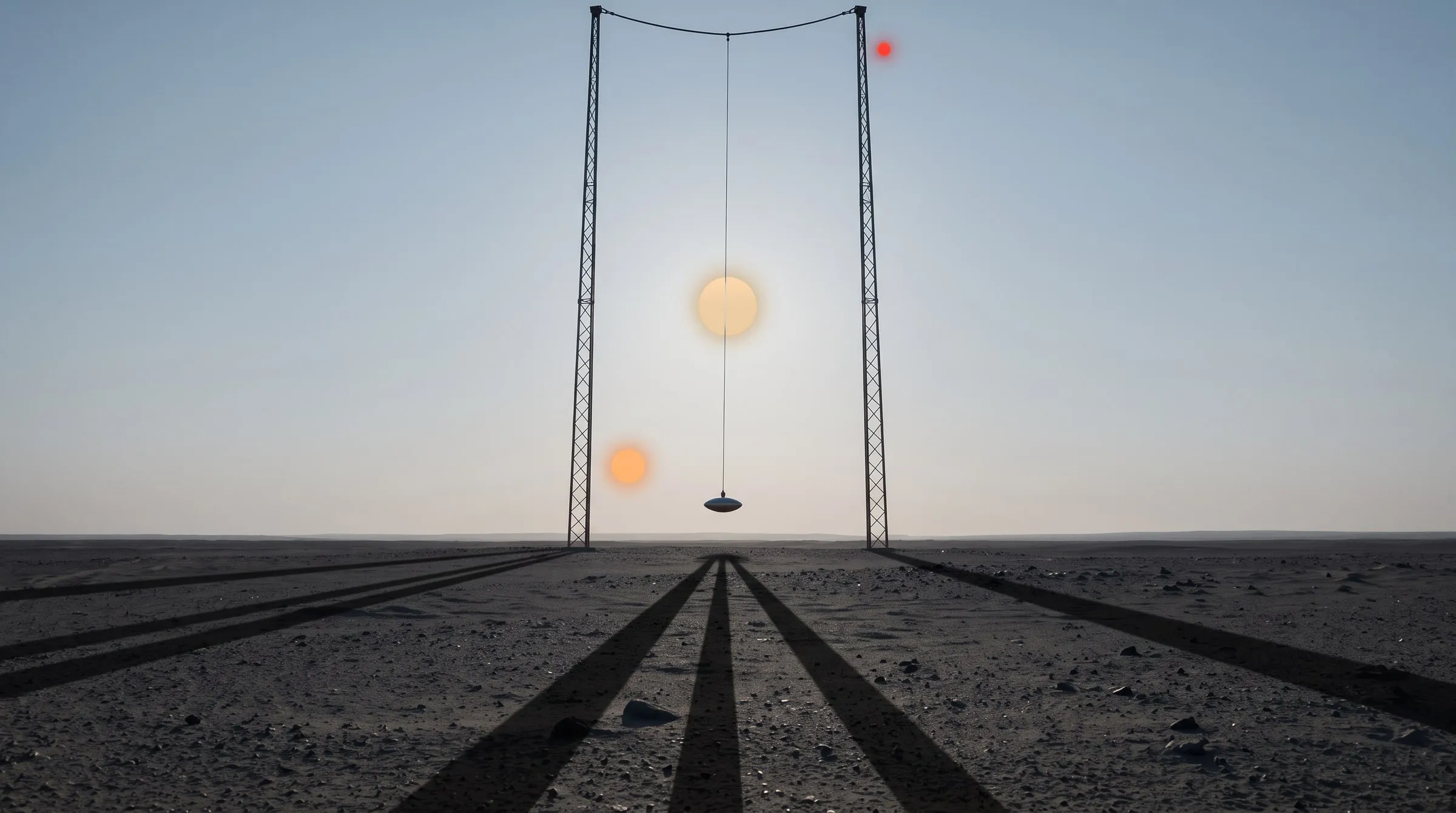
The views. The Sky is a dark plain in 3D, the game's “Only a dark desert extended to the horizon” (ch. 20), with the Pendulum Monument a few hundred metres off and three suns in a Sky.js sky: each sun a disc of 2 arcsin(R/d), or a point under the eye's 1′, the irradiance summed in S0, the planet-average and the substellar temperatures on the chips. Its presets are Stable Era, Three flying stars, Two suns, Tri-solar day and Syzygy; with the Link switch on, the suns come from the Orbits' run instead. The Orbits runs the three stars and a massless planet in 3D on a fourth-order integrator, with the era strip under it (green Stable, grey Chaotic, red the fate) and a fate card when the run ends: ejected, swallowed, or the suns collide. Its presets are Real, Lagrange and Pythagorean. The Tides lays out the syzygy (each sun's tide against g), the giant moon (the change in g on both sides, the pendulum, the pair's Roche limits) and the rip (a star's Roche limit, the light at the graze, the closing speed). The Forecast draws the precision a forecast needs against its length at the stars' Lyapunov time, and the formation computer as a synchronous machine on its dials. The Night freezes an ocean under no sun and draws the ice and the surface temperature against the night's length, with the snow lines. The File holds the novel's sentences by chapter, the real system's tables, the outside anchors, what the bench does not model and two readings at equal size.
The Stable Era is the bench's own definition, written on the page: the planet's irradiance between 0.5 and 2 S0 for 30 days or more, the novel's “mild climate of Stable Eras” (ch. 7) given a number. Before its first 30 days in the band an era reads “Settling”. A planet is swallowed inside a star's fluid Roche limit for Earth's density and ejected beyond 500 AU and unbound; the suns collide when two centres come within the sum of their radii.
Staging, named as staging. The planet turns once in 18 hours, the cycle of ch. 7, its axis upright, the observer at latitude 30°, the Sky's hour the host sun's solar time; the presets' bearings; A and B at periastron and Proxima at apastron at t = 0; the Lagrange triangle's 1 percent nudge; the Pendulum Monument's pillars, “each as tall as the Eiffel Tower” (ch. 19), drawn at 300 m and 400 m from the observer; Earth's night sky with the Sun 1.5° east of ε Cassiopeiae; the screen's mapping of each sun's light into shadows and exposure. The novel itself writes that “the Pendulum Monument was one of the few objects in the game that really did exist on Trisolaris” (ch. 33).
What it does not model. The suns' breathing, the expansions of their gaseous layers (ch. 19), named on the File and not priced; the game's “special optical interaction” (ch. 15), named as the game's own device beside the 1′ arithmetic; the atmosphere and the climate beyond the equilibrium balance; the ocean's depth and currents under the ice; how fast a surface would become “a smelting furnace in a second”; the dehydration; the Trisolaran hour beyond INST-89 The Red Coast Link Budget's figure; the figure-eight solution, which INST-01 Gravity draws; relativity, since the stars stay under 10⁻³ c in every run but the collisions' last steps; the planet's mass; tidal heating; the formation computer's logic beyond a synchronous machine of the stated size.
d_point = R / sin(0.5′) · S = Σ L/(4πd²) · T_eq = (S(1 − A)/(4σ))^¼ · a_tide = 2GMR/r³ · d_Roche = 2.44 R (ρ_M/ρ_m)^⅓ · ρL dh/dt = εσT_s⁴ · t_h = τ ln(tol/δ₀)
The sky
The novel says (ch. 15): “When the other two are far away, they look like flying stars.” A star is a disc while it spans the eye's 1′, and a point beyond d = R / sin(0.5′): a Sun-sized star at 31.97 AU, A at 38.9 AU, B at 27.47 AU and Proxima, a small star, at 4.93 AU. The Sun at 1 AU is 31.97′ across; A at 1.2 AU is 32.44′.
A point is not a dim thing. At 32 AU a Sun gives 9.767 × 10⁻⁴ S0, enough for a planet-average 45.1 K against Earth's 255.1 K, and shines at apparent magnitude −19.3; at the point's own edge, 31.97 AU, it is 423 times as bright as the mean full Moon. Proxima at 4.93 AU, where it becomes a point, gives 6.45 × 10⁻⁵ S0, and at Proxima b's 0.05 AU, 0.627 S0. Galileo, in the game, asks for a sun that will “gradually shrink into a flying star as it moves farther away”; the game answers with a “special optical interaction” that makes the outer layer “completely transparent and invisible”, its own device, which the bench names and does not price.
The Sky's presets put A, B and Proxima at fixed distances. Stable Era (A 1.2, B 30, Proxima 40 AU): 1.046 S0, 258.0 K planet-average and 398.1 K at the substellar point, A is a 32.4′ disc, B and Proxima points. Three flying stars (40, 50 and 60 AU): 1.141 × 10⁻³ S0, 46.9 K and 72.3 K, three points, the novel's “heralds a long period of extreme cold”. Two suns (A and B at 1.0 AU, Proxima at 40): 2.004 S0, 303.6 K and 468.3 K. Tri-solar day (A 0.5, B 0.7, Proxima 0.3 AU): 7.058 S0, 415.8 K and 641.6 K. Syzygy (0.3, 0.6 and 0.9 AU in a line): 18.12 S0, 526.4 K and 812.1 K, and one disc, since A's stands in front of the other two.
For “the heat would be enough to melt rocks” the bench gives a ladder: one Sun brings the substellar point to 1,500 K at 0.0689 AU, and iron melts at 1,811 K and boils at 3,134 K. The suns' colours come from their own L and R: A 5,795 K, B 5,232 K, Proxima 2,925 K.
The football
The novel says (ch. 15): “When our planet revolves around one of the suns in a stable orbit, that’s a Stable Era.” and “The players are the three suns, and our planet is the football.” In the real system a planet 1.5 AU from A stays where it is put for the whole run; at 4 and 6 AU it is ejected. The 1.5 AU planet, in the plane, lasts the whole 2,000-year run, never nearer A than 1.345 AU, its light between 0.5625 and 0.8372 S0: one Stable Era from start to end. At 3 AU it stays too, at 0.1315 to 0.3263 S0, too cold for the band. At 4 AU it is ejected at 1,041 years; at 6 AU it passes B at 0.487 AU and is ejected at 3.108 years, inside Wiegert and Holman's zone. A planet 1 AU from B stays, at 0.4569 to 0.5640 S0, on the band's edge.
The novel gives its suns no separations, so the Lagrange preset sets the same three stars on an equilateral triangle of side L, circling at the Lagrange rate, each start nudged by 1 percent of L (staging). At L = 10 AU a planet 1 AU from A sees 8 Stable Eras, the longest 85,570 days (234 years), and is in the band for 77.7 percent of its time; it is ejected at 304.5 years, after passing Proxima at 0.1029 AU. Other seeds give other ends at the same L: the suns A and Proxima collide at 354.3 years (seed 2), the planet is swallowed by Proxima at 277.2 years (seed 3), A and Proxima collide at 34.09 years (seed 4). At L = 5 AU the planet is swallowed by B at 62.7 years; at L = 30 it stays the 20,000-year run in one Stable Era.
With no planet the triple comes apart too: Proxima leaves at 185.4 years at L = 5, 402.9 at L = 10 and 1,957 at L = 30, and A and B remain a binary of 3.999, 7.257 and 22.53 AU with periods of 5.672, 13.87 and 75.86 years. The stars' Lyapunov times are 2.488, 8.472 and 47.43 years. The Pythagorean preset, the same stars at rest on a 30-40-50 AU right triangle, ends with A and B colliding at 20.5 years.
The novel's own pace is longer. It says (ch. 11): “During the three hundred and sixty-two thousand years you’ve been away, civilization has been reborn four more times.” That is 90,500 years a civilisation, and 192 of them at that pace are 17.38 million years; the Great Rip's recovery “took ninety million years” (ch. 19). A planet in the compact triple above lasts decades to centuries.
The syzygy and the rip
The syzygy. The novel says (ch. 17): “The three suns are in a straight line, moving around our planet at the same angular speed! Thus, our planet and the three suns are in a straight line with our world at the end!” and “a soldier tried to jump up, and easily reached the height of three meters”, because “the three suns are over our planet in a straight line, so their gravitational forces are added together”. The suns' direct pull falls on the planet and on everything standing on it alike, so it lifts nothing; what is left is the tide, 2GMR/r³, the difference across the planet. It equals g, 9.820 m/s², at (2GMR/g)^⅓: 0.7997 R☉ from a Sun-mass star, 0.6737 R_A for A and 0.9018 R_B for B, inside the star in each case; for Proxima 2.573 of its radius, outside the star but inside its fluid Roche limit for a planet of Earth's density, 4.983. A tide reaches g only inside a star's Roche limit, where the planet comes apart first. Three A-masses in one place would need 1.183 R☉.
At 0.1 AU a Sun-mass star's tide is 5.144 × 10⁻⁵ g, and 5.144 × 10⁻⁸ g at 1 AU; three suns at 0.1, 0.2 and 0.3 AU in a line give 5.977 × 10⁻⁵ g, and the Syzygy preset 2.28 × 10⁻⁶ g. The three-metre jump, for a leg that clears 0.5 m on Earth, needs g of 1.637 m/s², an 83.3 percent reduction.
The giant moon. At equal density a moon a quarter of the planet's diameter has 1/64 of its mass, 0.01563. The pair's fluid Roche limit is 2.44 planet radii, the rigid 1.26. At 2 radii the moon changes g by 3.906 × 10⁻³ on the near side and the far side alike, the far side losing weight too, the pendulum's period longer by 1.953 × 10⁻³ and the moon round in 3.945 hours; at 2.44 radii 2.151 × 10⁻³ and 5.317 hours; at 3, 1.157 × 10⁻³ and 7.248 hours; at 5, 2.5 × 10⁻⁴ and 15.6 hours. Before the rip, at the same density, the planet's g was 1.005 of today's: the novel's “almost to the level it would have had before the great rip” is a 0.5 percent step.
The rip. A planet of Earth's density comes apart at a star's fluid Roche limit: 1.548 R☉ for a star of the Sun's density (the rigid limit, 0.7994 R☉, lies inside the star) and 1.305 R_A for A, whose mean density is 842.7 kg/m³. At the Sun's graze the planet takes 19,300 S0, the substellar point at 4,639 K and the planet-average 3,280 K with no albedo; at A's, 27,600 S0 and 5,073 K.
The closing speed. The novel's “A few days later”, from a frozen flying star to a blazing sun, needs a speed: 31.97 AU in 3 days is 18,450 km/s, in 30 days 1,845 km/s, against a free fall toward a Sun mass of 7.449 km/s at that distance and 496.4 km/s at the graze, a fall that takes 31.96 years to the centre. Thirty hours between the suns' arrivals, at the graze's free-fall speed, is 0.36 AU.
The computer and the forecast
The formation. The novel says (ch. 17): “The entire formation fit inside a square six kilometers on each side.” Thirty million soldiers on 36 km² have 1.2 m² each, a pitch of 1.095 m, 5,477 across the 6 km side. Its line “even if the entire population of Earth were arranged into such a phalanx, the whole formation would fit inside the Huangpu District of Shanghai” prices the other way: the Earth's 8.3 billion at that pitch need 9,960 km², 488 times Huangpu's 20.43 km² (at the 2008 figure of 6,707 million, 394 times).
The run time. The first job: “Our first computation will calculate all the suns’ positions for the next two years. Each set of output values will be one hundred and twenty hours apart.” That is 146.1 output sets. As a synchronous machine the run time is steps × stages × path × time per link: at one second a link, a 100-link path, 10 dependent stages per step and a 1-hour step, two years take 6.667 months, against the novel's “approximately a year and two months”; at a 24-hour step, 0.278 months; at 0.25 s a link, 1.667 months; at Pan Han's “a hundred thousand times per second” (ch. 18), 2.9 minutes. Adders of 1,000 gates in parallel make 300 additions a second at one second a link and 3 × 10⁷ at Pan Han's rate, against ENIAC's 5,000. The cavalry bus crosses 6 km at the speed of sound, 343 m/s, in 17.49 s, and at three times it in 5.831 s.
The precision. A forecast's horizon is t = τ ln(tol/δ₀). At the Lagrange triangle's τ of 8.472 years a forecast good to 1 percent needs a starting precision of 7.897 × 10⁻³ for two years, 9.435 × 10⁻⁴ for twenty and 5.592 × 10⁻¹³ for two hundred. With positions known to 1″ at 1 AU (4.85 × 10⁻⁶) the horizon is 64.65 years at τ = 8.472, 18.99 years at 2.488 (L = 5) and 362.0 years at 47.43 (L = 30). The novel's two years sit inside every one of them. The horizon the arithmetic gives is what Wei Cheng's sentence (ch. 16) describes, sensitivity setting a horizon rather than a wall: “He only proved sensitive dependence on initial conditions, and that the three-body system couldn’t be solved by integrals. But sensitivity is not the same as being completely indeterminable.”
The long night
The novel says (ch. 7): “The long night lasted forty-eight years. Civilization Number 137 was destroyed by the extreme cold.” The bench takes an ocean world cut off from its suns: ice over water at 273.15 K, radiating at an emissivity of 0.97 into a sky with no sun, the sheet growing as the latent heat leaves through it. After 48 years the ice is 58.47 m thick and the surface 103.9 K; dry ice frosts from day 65.
The night's length is a dial. After 1 year, 6.507 m and 162.0 K; 10 years, 24.63 m and 124.8 K; 100 years, 86.97 m and 95.29 K; 1,000 years, 295.7 m and 72.34 K; 3,000 years, 525.6 m and 63.34 K, nitrogen's 63.23 K just below; 10,000 years, 982.6 m and 54.72 K, oxygen's 54.36 K still below. Nitrogen snow needs a night of about 3,040 years, oxygen snow one longer than 10,000.
Colder ice conducts better, so the figures at the 0 °C conductivity, 2.2175 W/(m·K), are a floor on the cold: with k doubled, 48 years give 80.05 m and 112.7 K. The model gives the novel's order of the snows, water, then dry ice, then oxygen and nitrogen; the novel's forty-eight years buy the first two snows and a surface near 100 K, not the third.
Evidence
The line between what is reported, what is tabulated, what is arithmetic on them, what is a choice, and what is a reading:
| Feature | Status | What that means |
|---|---|---|
| The novel, ch. 7 | Reported | The eighteen-hour day, the Stable and Chaotic Eras and their mild climate, the long night of forty-eight years and its three snows, quoted as the translation prints them, with the chapter. |
| The novel, ch. 11, 15 and 16 | Reported | Four civilisations in 362,000 years; the three suns and the football, the flying stars, Galileo's question and the game's optical device, two suns and three, the tri-solar day; Wei Cheng's sentence on sensitivity. |
| The novel, ch. 17 and 18 | Reported | The formation computer: thirty million on a square six kilometres a side, the Huangpu line, the two-year forecast and its run time; the syzygy, the jump and the rising; Pan Han's flags and cavalry. |
| The novel, ch. 19, 20, 23 and 33 | Reported | The giant moon and the pendulum, the frozen flying star, the Great Rip and its ninety million years; the dark desert; four light-years; Alpha Centauri; the Pendulum Monument that really existed. |
| Akeson et al. 2021 | Tabulated | Table 8: A 1.0788 and B 0.9092 M☉, 1.2175 and 0.8591 R☉, 1.5059 and 0.4981 L☉; a 17.4930″ at a parallax of 750.81 mas, e 0.51947, P 79.762 yr. Table 10: Proxima's orbit, a 8.2 kAU, e 0.497, P 511 kyr. The stable zone within about 2.8 AU around A. |
| Kervella et al. 2017 | Tabulated | Table 1: Proxima 0.1221 M☉ and 0.1542 R☉; Table 3: its orbit, 8.7 kau, e 0.50, P 547 ka, on the File. Proxima's luminosity, 0.001567 L☉, from the Proxima Centauri page. |
| Wiegert and Holman 1997; Pourbaix and Boffin 2016; Anglada-Escudé et al. 2016 | Tabulated | The zone unstable for planets in the binary's plane from 3.5 to 70 AU; the earlier AB orbit, on the File; Proxima b at about 0.05 AU and 11.2 days, on the File. |
| The outside pages | Tabulated | CODATA 2022 G and σ; the AU and the light-year; NASA's Sun and Earth sheets (g 9.820 m/s², S0 1,361.0 W/m², Bond albedo 0.294); the eye's 1′; the magnitude scale and the mean full Moon's −12.74; Alpha Centauri at 4.344 ly and the Sun from there at +0.5; iron at 1,811 and 3,134 K; ice (916.7 kg/m³, 2.2175 W/(m·K) at 0 °C, 333.55 kJ/kg, emissivity 0.97); dry ice 194.7 K, nitrogen 63.23 K, oxygen 54.36 K; ENIAC's 5,000 additions a second; Huangpu's 20.43 km²; the world's 8.3 billion; sound at 343 m/s. |
| The physics and the arithmetic | Exact | The angular diameter 2 arcsin(R/d) and the irradiance L/(4πd²); the equilibrium and substellar temperatures; the effective temperature from L and R; the tide 2GMR/r³ and the lift distance; the fluid and rigid Roche limits; free fall and Kepler's period; the Lyapunov horizon t = τ ln(tol/δ₀). Every figure is recomputed from the constants by the bench's tune, the longest runs under its full mode; the build runs the capped set. |
| The integrator and the eras | Modelled | Yoshida's fourth-order kick-drift-kick with the step tied to the closest pair; the fates (swallowed inside a star's fluid Roche limit, ejected beyond 500 AU and unbound, the suns collide); the Lyapunov time from a twin run 10⁻⁹ AU apart; the Stable Era, the bench's definition and staging: 0.5 to 2 S0 for 30 days or more. |
| The ice and the formation | Modelled | The ice sheet over an ocean: quasi-steady conduction, the latent heat at its base, radiation to a sunless sky, the conductivity a dial; the formation computer as a synchronous machine, steps × stages × path × time per link, with adders of 1,000 gates. |
| Staging | Modelled | Named as staging on the File: the 18 h day, the upright axis, the observer at latitude 30° and the hour as the host sun's solar time; the phases at t = 0; the Lagrange nudge and its seed; the presets' bearings, A 0°, B +14°, Proxima −20°; the Pendulum Monument's 300 m pillars 400 m away; Earth's night sky with the Sun 1.5° east of ε Cassiopeiae; the screen's mapping of each sun's light. |
| The two readings | Reading | What the novel says and what the arithmetic gives, at equal size on the File; what they amount to is left with you. |
Two readings
What the novel says. Through its game the novel writes a planet that three suns throw between Stable and Chaotic Eras, flying stars, a forty-eight-year night that ends in three snows, a syzygy that lifts soldiers and stone, a giant moon left by a rip, and an army that computes two years of the suns' positions in about fourteen months. It places that world about four light-years away and names it Alpha Centauri. Outside the game, Wei Cheng puts it that “sensitivity is not the same as being completely indeterminable” (ch. 16).
What the arithmetic gives. Each sentence prices to a distance, a speed, a precision or a time: a flying star is a point beyond 31.97 AU and still 423 times the full Moon there; the real A keeps a planet at 1.5 AU in one Stable Era, and the same stars on a 10 AU triangle eject a planet at 304.5 years; a tide reaches g only inside a star's Roche limit; 48 years of night make 58.47 m of ice at 103.9 K, two snows of three; the formation computer runs its two years in 6.667 months at one second a link, and a 1″ start gives a horizon of 64.65 years at τ = 8.472.
Neither reading grades the book; the bench prints both and leaves them with you.
On this site
This site's signed review of The Three-Body Problem put the book's numbered sentences on the list. INST-89 The Red Coast Link Budget priced the first, the Sun as amplifier, and derived the Trisolaran hour this bench's File borrows; INST-98 The Flying Blade Cut Bench the second, the filament across the canal. This bench prices the planet the transmission reached. INST-47 Exoplanet Direct Imaging holds Proxima b, the one planet known in the real system; INST-01 Gravity draws the figure-eight three-body orbit this bench leaves to it; INST-19 The Drake Equation holds f_i and L, the factors a civilisation's rise and length enter.
Sources
- Cixin Liu, The Three-Body Problem (
三体 ), translated from the Chinese, Head of Zeus paperback, 2024 (Tor Books, 2014; Chongqing Publishing Group, 2008): chapters 7, 11, 15 to 20, 23, 32 and 33, quoted as the premise; the site's signed review for the reading. - Akeson, Beichman, Kervella, Fomalont and Benedict (2021), "Precision Millimeter Astrometry of the α Centauri AB System", The Astronomical Journal, arXiv:2104.10086: Table 8 ("Present work": the masses, radii, luminosities and the AB orbit) and Table 10 (Proxima's orbit).
- Kervella, Thévenin and Lovis (2017), "Proxima's orbit around α Centauri", Astronomy & Astrophysics 598, L7, arXiv:1611.03495: Table 1 (Proxima's mass and radius) and Table 3 (its orbit, on the File).
- Wiegert and Holman (1997), "The Stability of Planets in the Alpha Centauri System", The Astronomical Journal 113, 1445, arXiv:astro-ph/9609106: the zones in which planets cannot have survived.
- Anglada-Escudé et al. (2016), "A terrestrial planet candidate in a temperate orbit around Proxima Centauri", Nature 536, 437-440, arXiv:1609.03449: Proxima b, on the File.
- Pourbaix and Boffin (2016), "Parallax and masses of α Centauri revisited", Astronomy & Astrophysics 586, A90, arXiv:1601.01636: the earlier AB orbit, on the File.
- National Institute of Standards and Technology, CODATA 2022 recommended values, read 14 October 2026: G and σ. NASA, the Sun and Earth fact sheets, read 14 October 2026: the Sun's mass, radius, density and luminosity; Earth's mass, radius, density, surface gravity, solar irradiance and Bond albedo.
- Wikipedia, read 14 October 2026: "Astronomical unit", "Light-year", "Alpha Centauri", "Proxima Centauri", "Naked eye", "Apparent magnitude", "Angular diameter", "Planetary equilibrium temperature", "Tidal force", "Roche limit", "Three-body problem" and "Lyapunov exponent" (the definitions and formulas as stated).
- Wikipedia, read 14 October 2026: "Ice", "Calorie", "Enthalpy of fusion", "Emissivity", "Dry ice", "Oxygen", "Nitrogen", "List of thermal conductivities", "Stefan problem", "Iron", "ENIAC", "Huangpu, Shanghai", "World population" and "Speed of sound".