This page sets out a proposal about what UAP would have to be doing, physically, for the reported observations to hold together. What follows is a theory, attributed to the physicist Hal Puthoff and set out in Luis Elizondo’s 2024 book Imminent. It is offered as a theory, built on published physics, and it makes predictions its proponents say can be tested.
The g-force problem
A craft changing direction at the accelerations reported for UAP should liquefy everything inside it, occupant and structure alike. The Five Observables put instantaneous acceleration above 2,000 g (see The Craft), and reported UAP appear to do it routinely: right-angle turns at speed, dead stops, acceleration that leaves nothing aboard any time to survive the forces involved.
The proposal frames the choice as follows: either every witness account and every sensor track is mistaken or fabricated, or the craft are not feeling the forces we would expect them to. The model takes the second branch, which requires a physics we do not currently have in hand. Hal Puthoff, the Stanford-trained physicist who advised the Pentagon’s AAWSAP and AATIP programmes, has spent years building a candidate for that missing physics.
The bubble
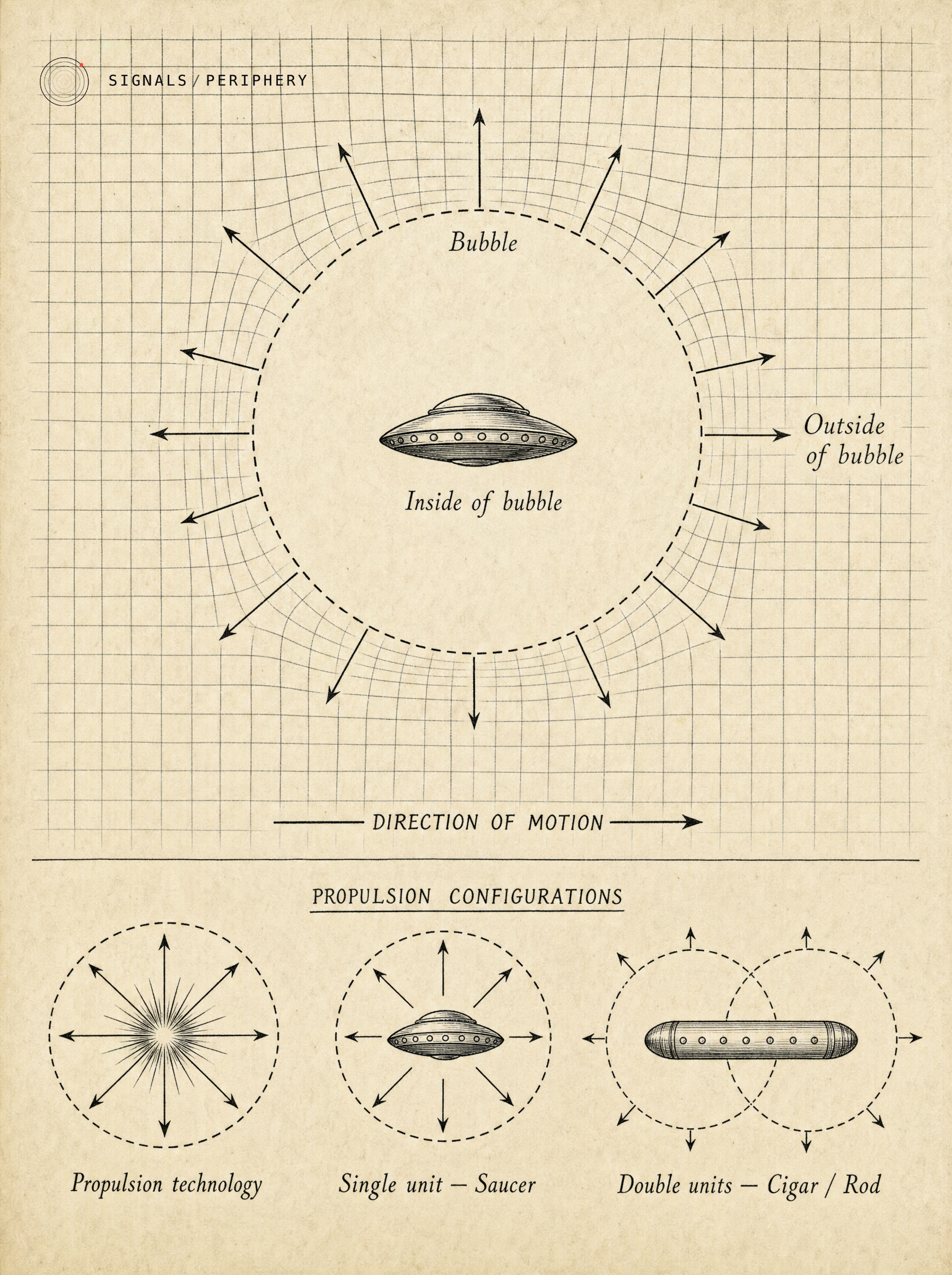
The proposal is that UAP do not push through space the way an aircraft does. The craft sits inside a small, local region of warped spacetime, a bubble, and it is the bubble that travels. Inside, the craft is effectively at rest: it feels no acceleration because nothing is accelerating it. The bubble moves, and the craft rides along.
This was not invented for UAP. Luis Elizondo sets the model out in his 2024 book Imminent, crediting it to Puthoff, and the underlying physics is older still: it builds on Miguel Alcubierre’s 1994 warp-drive paper, which sits in the peer-reviewed general-relativity literature, and on Puthoff’s 2010 metric-engineering reference document for the DIA. There are two known routes to warping spacetime, extreme mass or extreme energy, and E equals mc squared ties them together. Energy densities at particle-collider scale sit at the lower edge of what theory treats as “warp possible,” so the model holds that if a craft could generate and contain that kind of density locally, the bubble becomes, in principle, an engineering problem rather than an impossibility. The model also offers an account of an old witness puzzle, craft that look small at distance and large up close: on the model, as you approach the bubble you begin to experience time closer to the way it runs inside, which shifts the craft’s apparent size. On this reading it is not growing; the relationship between observer and craft is changing.
Distance and effects
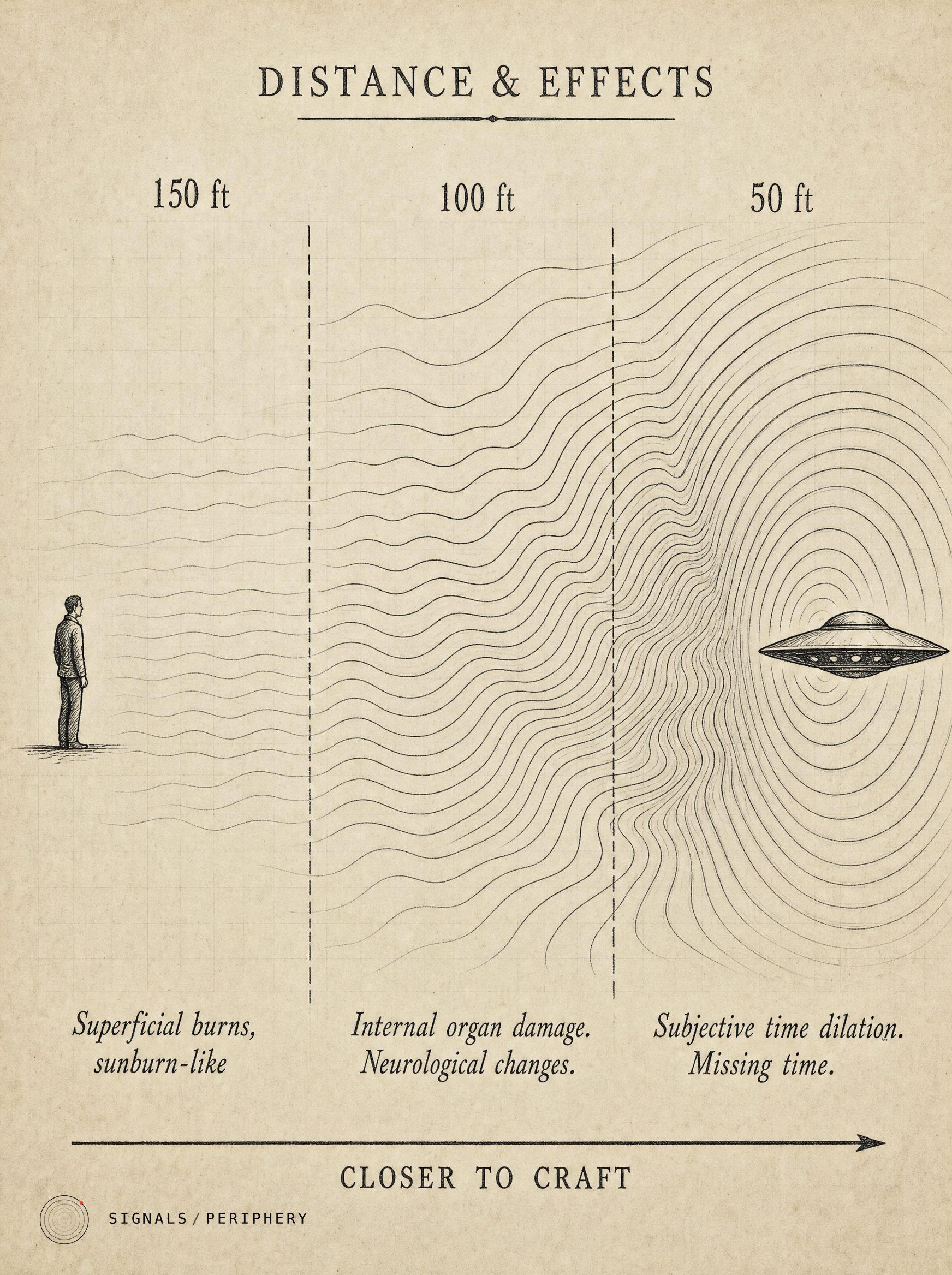
If the craft is wrapped in steeply warped spacetime, the model implies that approaching it should not be neutral. It predicts a graduated set of effects, and it is important to be clear that the tiers below are what the model predicts, not measured figures from a specific case. Treat them as an illustration of the logic, not data. At roughly 150 feet, superficial burns like sunburn. At roughly 100 feet, deeper damage to internal organs and the brain. At roughly 50 feet and in, the gradient steepens enough to affect the experience of time itself, one candidate explanation the model offers for the “missing time” so many close-encounter accounts describe.
UAP-related injuries appear in case files and, in Elizondo’s account, in classified medical records. The model does not prove those injuries were caused this way. What it offers is a physical mechanism they could be tested against, rather than leaving them as loose anomalies.
Shape follows the propulsion units
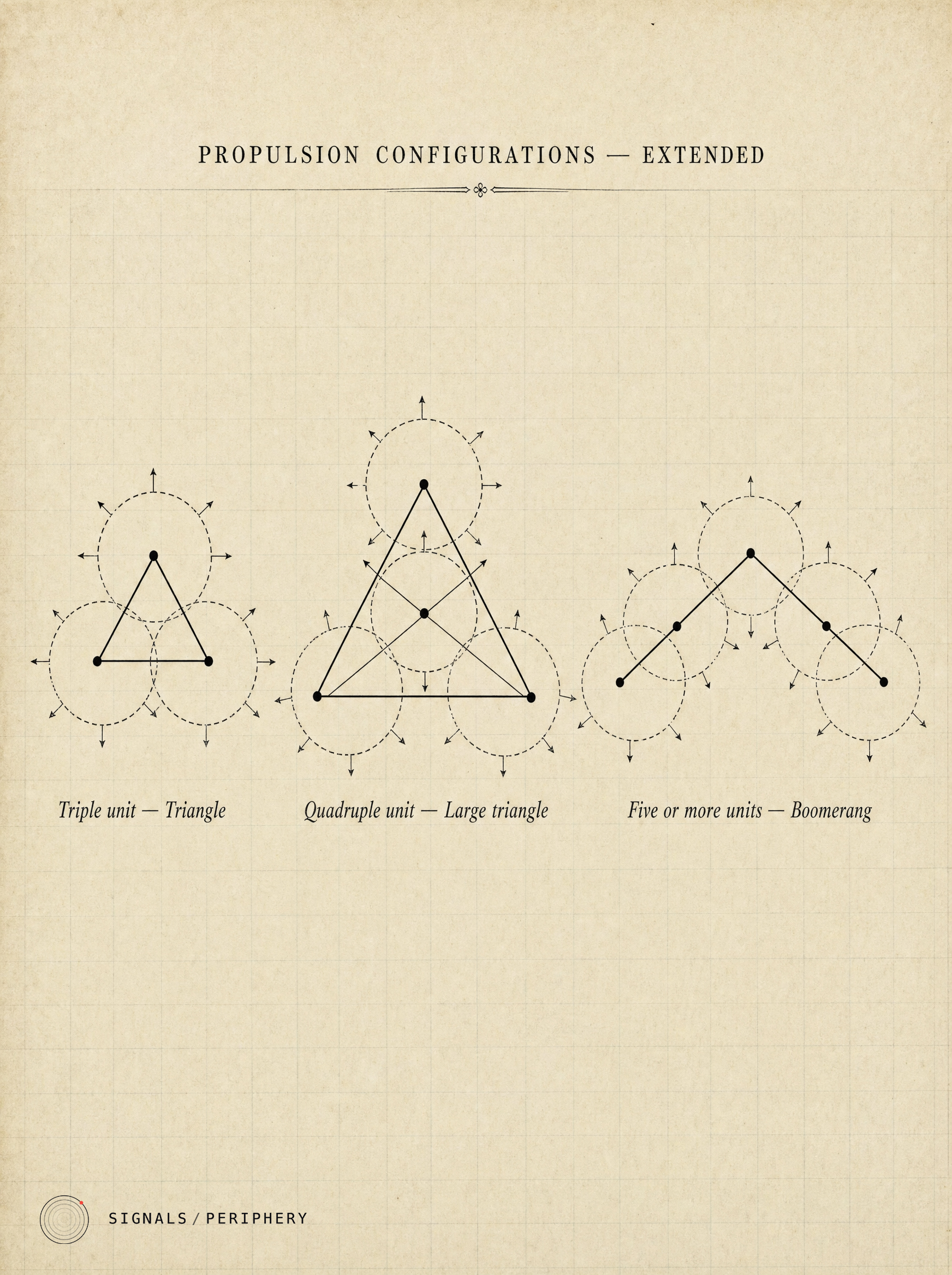
This is the part of the framework its proponents describe as most testable. On the model, if propulsion comes from units that each generate a warp bubble, then a craft’s shape is not a styling choice the way a wing is. It is a consequence of how many units are running and how their bubbles overlap. One unit makes a single roughly spherical bubble, and the shape that best fits inside it is a disc, a saucer. Two units make two overlapping bubbles, and the efficient envelope elongates into a cigar or rod. Three units sit at the points of a triangle, and the craft reads as a triangle. Four give a larger triangle with a unit in the middle, which the model maps to the centre light witnesses of large triangular craft so often describe. Five or more spread into the boomerang shapes also on record. On this principle, decades of reported geometries, saucer, cigar, triangle, boomerang, follow from one rule: use as few units as possible and contain their bubbles as efficiently as possible, and the shape follows.
The model also offers a reading of those lights at the points of triangular craft. On its account they may not be lights in the ordinary sense at all, but the propulsion units themselves, and what looks like illumination could be a Doppler shift at each bubble’s boundary. The model presents this as a falsifiable claim, because it predicts a spectral signature an instrument, not just an eye, could check.
What to watch
The model is offered as a theory, not as proof, and the page presents it as one. It makes three predictions on the public record: a pattern of injuries by distance; craft shape from propulsion-unit count; and a measurable spectral signature at the bubble’s edge. The last is the one that calls for an instrument reading rather than a disclosed document. As of writing, none of the three has been independently tested against the model.
Sources for this page
- Elizondo, L. (2024). Imminent: Inside the Pentagon’s Hunt for UFOs. The lead source; the bubble model, the distance tiers and the propulsion diagrams are all set out here, attributed to Hal Puthoff.
- Puthoff, H. E. (2010). “Advanced Space Propulsion Based on Vacuum (Spacetime Metric) Engineering,” DIA reference document.
- Alcubierre, M. (1994). “The warp drive: hyper-fast travel within general relativity,” Classical and Quantum Gravity, 11, L73.
- Hal Puthoff, public talks and interviews, 2018 to 2024.