Crop Circles
Stamp a formation. Watch the field lay over.
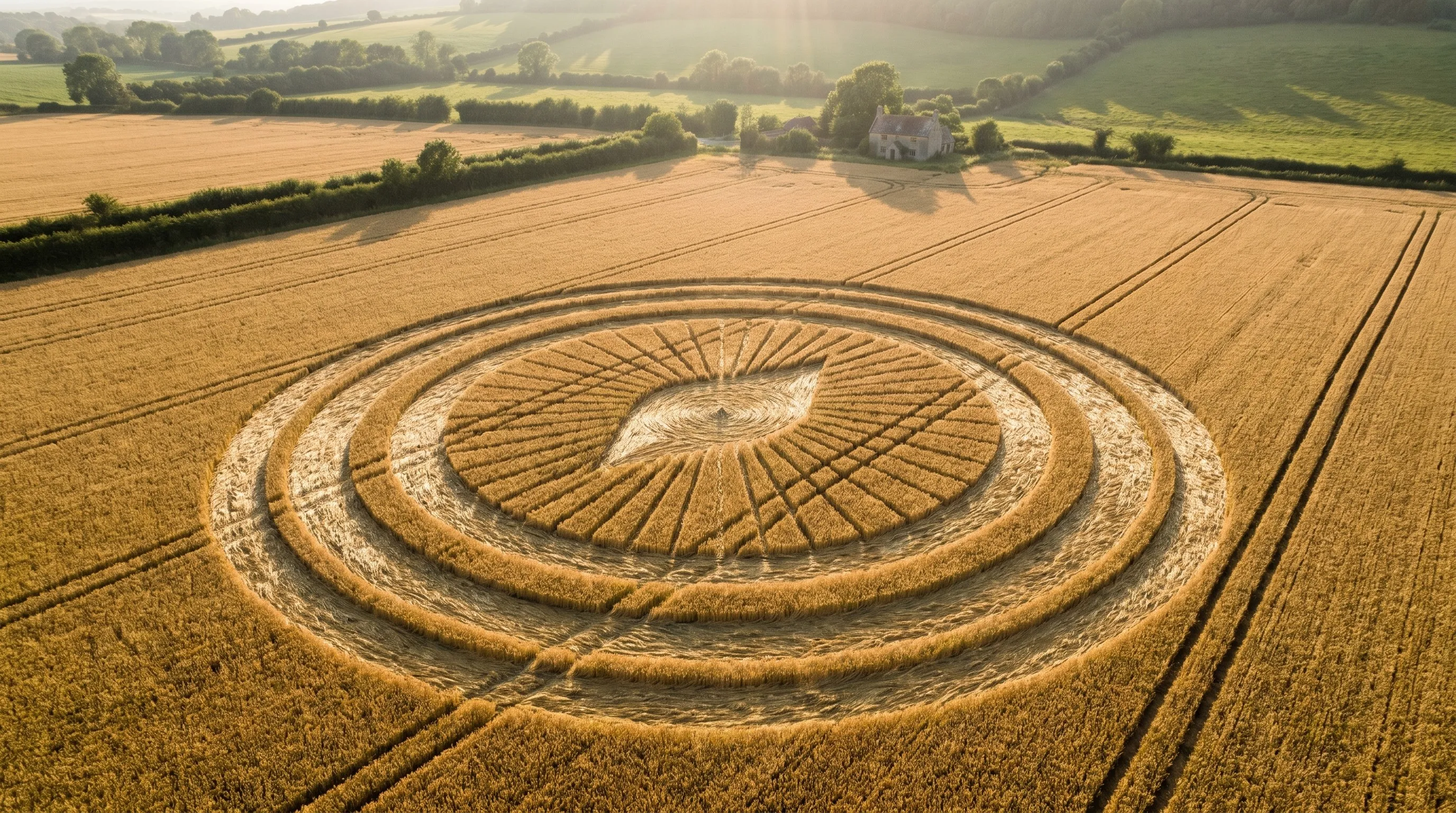 Open the interactive ▸
 What you're looking at
A field of wheat, around a hundred and twenty thousand individual stalks, each swaying in the wind. Click the ground and a pattern is pressed into it: the stalks inside the shape bend flat in a tangential swirl, sweeping outward from the centre as a wave, the way a real formation lays down. Nothing on the ground is painted on. Every flattened stalk is an individual blade, rotated about a horizontal axis toward its lay direction.
Choose from fifteen real formations, rotate and resize them, or upload your own design as a mask. It is a sandbox for the craft of the crop circle: the geometry itself, and the way standing wheat becomes a drawing when it is laid over.
Why it's here
Crop circles sit squarely on this site's territory: a phenomenon that is unambiguously real as an artefact (you can stand in one, photograph it, measure it) and unresolved as to cause. Thousands have appeared in fields since the late 1970s, concentrated in the chalk downland of southern England, growing from simple circles into geometry of startling complexity.
And planks and rope do not explain what the fields actually hold. Of more than ten thousand formations recorded worldwide, only a few hundred have ever been claimed by anyone. The genuine ones arrive in a single short night, in standing crop, with no tracks leading in or out and no dropped tools: hundreds of elements laid to mathematical precision in the dark. The known human teams work the opposite way, with daylight planning, survey lines, lamps and hours, and even then they reproduce the look and never the rest of it. Because the real signature is in the plants. In peer-reviewed work the biophysicist W. C. Levengood found stem nodes swollen and burst open from the inside, as though hit by a sudden intense heat, and Eltjo Haselhoff measured those changes fading from each circle’s centre outward exactly as they would under a single point source of energy above the field. Seeds from formed crop have grown several times faster than controls. No hoaxer has reproduced any of it.
So this site takes its position without hedging: the genuine formations are not the work of people with boards. The “it’s all fake” story rests largely on two hoaxers, Doug Bower and Dave Chorley, who in 1991 said they had been flattening circles since 1978 with a plank and a loop of rope. They were hoaxers, and they made real fakes, but they only ever claimed a couple of hundred of the simplest, and never one of the plant anomalies. What makes the rest, we do not claim to know, and we will not pretend the final proof is in hand. Open the interactive, read the anomaly research and its sources in the About panel, and judge for yourself what a board and a rope are really up against. (We keep the honest gaps in plain sight too: see Caveats for where the record is still unsettled.)
How it works
The field is one instanced mesh: the geometry of a single stalk drawn a hundred and twenty thousand times, each copy given its own position, height, phase and lay state on the GPU. The wind sway, the per-stalk yaw and the flattening all happen in a vertex shader, so the whole field animates in real time.
When you stamp, the pattern is read from a 512-pixel mask. For every stalk under the shape, the simulator sets a lay angle (a clockwise tangential swirl, the signature of a real lay, plus jitter), a flatten amount from how solidly that point is covered, and a start time, so the fall ripples outward from the centre rather than snapping flat at once. Lit from a low sun, the laid stalks catch a sheen along their lay direction, which is what makes a formation read from above.
It is a real-time visualisation built for the look and the geometry, not a physical model of how a real lay forms.
The formations
The fifteen presets are all real, verified formations, recreated procedurally rather than traced from anyone’s artwork. Each is captioned with month and year. They range from the simple classic ring to the Milk Hill galaxy and the Barbury Castle "Pi" formation.
- Real formations. Each preset corresponds to a real crop circle with a location and a date. They are regenerated in code rather than copied from existing vectors, because a pattern may be an artist’s work even though the formation itself was a public event.
- Upload your own. Any image can be used as a mask (black on white, or with transparency) to stamp your own design. An invert toggle handles images whose light and dark are reversed.
- Month and year. Captions give the month and year only, not the day, by the same convention the simulator uses throughout.
The claims, and the honest line
Keeping what is documented apart from what is claimed:
| Claim | Status | What that means |
|---|---|---|
| The formations are real | T1 Documented | You can stand in one, photograph it and measure it. As artefacts they are not in dispute. |
| It is all human hoaxing | T3 Contested | Some formations are admittedly made by people, and skilled teams have built complex ones for cameras. But claimed and demonstrated hoaxes number a few hundred against more than 10,000 on record, they are made with planning and time, and none reproduce the plant-node anomalies below. As an account of the whole phenomenon it does not hold up. |
| Plant node anomalies (Levengood) | T3 Contested | The BLT Research Team and W.C. Levengood reported elongated and bent nodes and "expulsion cavities", attributed to brief intense heating. Published, but disputed on sampling and controls. |
| A point-source EM model (Haselhoff) | T3 Contested | Haselhoff (2001) fitted node-length data to a point source about 4 m above the centre. It is a published comment, not an independent confirmation. |
| "Made by something non-human" | T4 Speculative | No mechanism has been established and nothing here is proven. This is the open question the rest of the page points to: not whether ordinary hoaxing explains it, but what actually does. |
In one line: the formations are real; some are admitted or demonstrated hoaxes, a few hundred against more than 10,000 on record; the plant-node findings are published but disputed on sampling and controls; and no mechanism is established here, so the open question is not whether ordinary hoaxing could explain the rest, but what actually does.
Sources
- Levengood, W. C. (1994). Anatomical anomalies in crop formation plants. Physiologia Plantarum, 92(2), 356–363.
- Levengood, W. C., & Talbott, N. P. (1999). Dispersion of energies in worldwide crop formations. Physiologia Plantarum, 105(4), 615–624.
- Haselhoff, E. H. (2001). Opinions and comments on Levengood & Talbott (1999). Physiologia Plantarum, 111(1), 123–125. The point-source electromagnetic model.
- Bower, D., & Chorley, D. (1991). The two self-confessed hoaxers who claimed the early English formations, flattening crop with a plank and rope; widely reported (e.g. Today, September 1991).
- Crop circle. Wikipedia. A mainstream overview of the phenomenon, its hoaxing history and the human-made consensus: en.wikipedia.org/wiki/Crop_circle.
- Nickell, J. (various). Skeptical analyses of the crop-circle phenomenon, Skeptical Inquirer. The counter-case to the anomaly claims.
- Irving, R., & Lundberg, J. (2006). The Field Guide: The Art, History & Philosophy of Crop Circle Making. An account of the craft from inside it.
A list of the real formations behind the presets ships with the simulator (famous-formations-reference).