Black Hole
Light, bent by gravity, in real time.
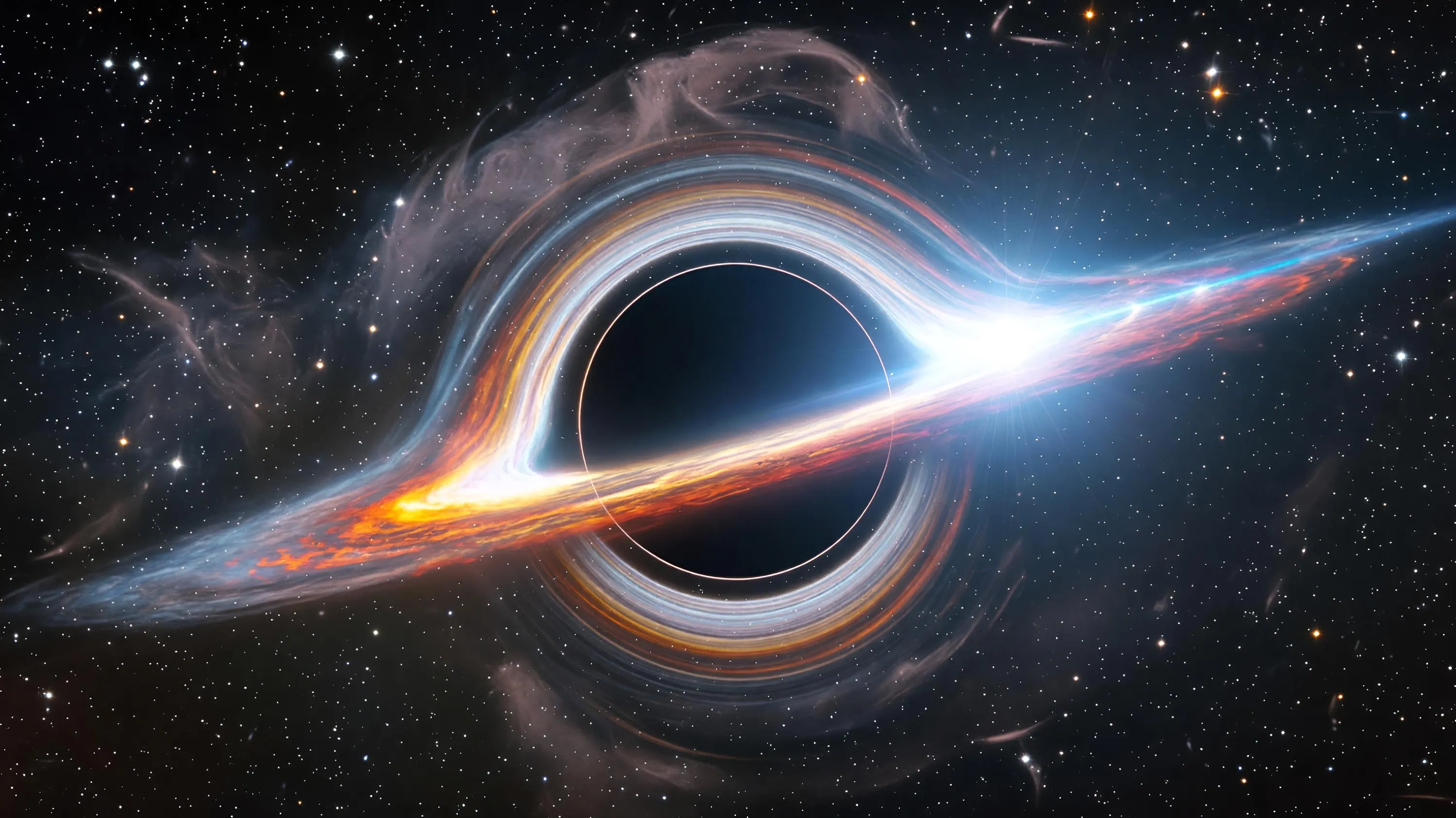 Open the interactive ▸
 What you're looking at
Point a camera at a black hole and you do not see a hole. You see the sky behind it, wrapped around it. Light that should have passed by is pulled into curves; the far side of the accretion disk is lifted over the top and folded under the bottom at once; a dark, perfectly round shadow sits where no light can escape. None of that is painted on. Each pixel here fires a ray of light backwards through curved spacetime and follows where gravity actually takes it.
It is, in the plainest sense, a picture of geometry: the same rules that hold a planet in orbit, taken to the edge where they bend light itself.
Why it's here
This site spends most of its time on claims at the edge of the evidence: craft that seem to move without moving, propulsion described as bending space rather than pushing against it. Those claims live in the speculative tiers, and they stay there. The Bubble topic on this site lays out the framework and names the two known routes to warping spacetime: extreme mass, or extreme energy. The propulsion speculation chases the energy route.
A black hole is the other route, taken to its limit: extreme mass. And unlike the warp-bubble proposals, it is not a hypothesis at the periphery. It is confirmed, central physics, photographed by the Event Horizon Telescope in 2019 and again in 2022. So before reaching for exotic ways something might bend space, it is worth seeing, exactly and honestly, what curved space already does to light when we run the real equations. This page is that baseline: the bedrock under the speculation, rendered so you can look straight at it.
Same discipline as everywhere else on the site: what is established, what is only suggested, and the line between them, drawn in plain sight. (Cross-link: see The Bubble for the warp-drive framework this is the confirmed counterpart to.)
How it works
Every frame, the visualisation traces a ray of light from your eye out into the scene and integrates its path as a null geodesic, the route light is forced to take through the curved spacetime around the mass. The integration uses a fourth-order Runge-Kutta scheme, so the bending is resolved accurately rather than approximated. Rays that cross the event horizon are swallowed and come back black; rays that graze it whip around and carry the sky with them.
The bright ring is an accretion disk: gas spiralling in, heating as it falls. Its colour follows a physical temperature profile (hot blue-white inner edge, cooler orange outer), and it is shifted by two real effects at once. The side rotating towards you is beamed brighter and bluer (relativistic Doppler), and all of its light is dimmed and reddened climbing out of the gravity well (gravitational redshift). Raising the spin control drags the surrounding space into rotation and pulls the inner edge of the disk inward, along the analytically correct innermost stable orbit for a rotating black hole.
The result sits in the same lineage as Jean-Pierre Luminet's first simulated black-hole image in 1979 and the renderer built for Interstellar in 2015. It is a real-time visualisation, not a research instrument.
The presets
The selector offers four starting points. Each is only a saved combination of spin, camera distance and disk settings: a place to begin, not a separate mode. Two are named after real or famous objects; two are simply moods. Where a preset borrows a name, it borrows the look, not the exact numbers.
- Classic. A non-spinning black hole, with the spin control set to zero: the textbook Schwarzschild case. Its shadow is a perfect, symmetric circle, and this is the one preset whose geometry is physically exact. It is the view in the direct lineage of Luminet's 1979 image. Start here to see the honest baseline before adding spin.
- Gargantua. A tribute to the black hole from Interstellar: high spin, with a broad, bright accretion disk seen close to edge-on. The film's Gargantua was modelled by Kip Thorne's team at near-maximal spin (about 0.999) and a mass around 100 million Suns; this preset evokes that appearance rather than reproducing those figures.
- Sagittarius A*. Named for the real supermassive black hole at the centre of our own galaxy: about four million times the Sun's mass, some 27,000 light-years away, and first imaged by the Event Horizon Telescope in 2022. A closer, dimmer, more restrained configuration. Its true spin has not been firmly measured (recent estimates lean high), so this is a gesture toward the object, not a data-driven reconstruction of it.
- Maelstrom. Not a real object. The dramatic extreme: near-maximal spin, a bright, fast, turbulent disk, and the camera pulled in close. This is the preset to play with.
Accuracy
The honest line between what is exact and what is stylised:
| Feature | Tier | What that means |
|---|---|---|
| Light bending (non-spinning) | T1 Established | The geometry is the correct general-relativistic result. The shadow size, the photon ring, and the lensed disk follow directly from the equations. |
| Event horizon & shadow | T1 Established | Emerges from the geodesics, not drawn in. |
| Accretion-disk lensing (far side over and under) | T1 Established | A direct consequence of the traced light paths. |
| Disk temperature & colour | T2 Physically modelled | A real thin-disk temperature profile rendered as blackbody colour; not a full radiative-transfer solve. |
| Doppler beaming & redshift | T2 Physically modelled | Real effects, combined and applied as a colour and brightness shift, softened for legibility; not frequency-resolved transfer. |
| Disk turbulence & texture | T3 Stylised | Noise-modulated emission, advected with the orbital shear so the disk reads as swirling gas; not a magnetohydrodynamic simulation. |
| Spin / rotating ("Kerr") mode | T3 Stylised | A convincing frame-dragging approximation with the correct horizon and inner-orbit radii, but not an exact rotating-spacetime solve: no ergosphere, no flattened shadow. |
| Star background | T4 Illustrative | Procedurally generated, then lensed by the same physics; not a real star catalogue. |
In one line: the non-spinning case is physically faithful in its geometry; the spinning mode and the disk's glow are physically motivated but stylised. It is an educational and artistic visualisation, not a research-grade simulation of the kind used for Event Horizon Telescope science.
Sources
- Luminet, J.-P. (1979). Image of a Spherical Black Hole with Thin Accretion Disk. Astronomy & Astrophysics, 75, 228–235. The first simulated black-hole image.
- James, O., von Tunzelmann, E., Franklin, P., & Thorne, K. S. (2015). Gravitational lensing by spinning black holes in astrophysics, and in the movie Interstellar. Classical and Quantum Gravity, 32(6), 065001. (Open access; arXiv:1502.03808.)
- Bardeen, J. M., Press, W. H., & Teukolsky, S. A. (1972). Rotating Black Holes. The Astrophysical Journal, 178, 347–369. The rotating innermost-orbit result used for the spin control.
- Novikov, I. D., & Thorne, K. S. (1973). Astrophysics of Black Holes. The thin-disk temperature model.
- Event Horizon Telescope Collaboration (2019), First M87 Event Horizon Telescope Results I, ApJL 875, L1; and (2022), First Sagittarius A* Results I, ApJL 930, L12. The first direct images.
- Kerr, R. P. (1963). Gravitational Field of a Spinning Mass. Physical Review Letters, 11(5), 237–238.