The Flying Blade Cut Bench
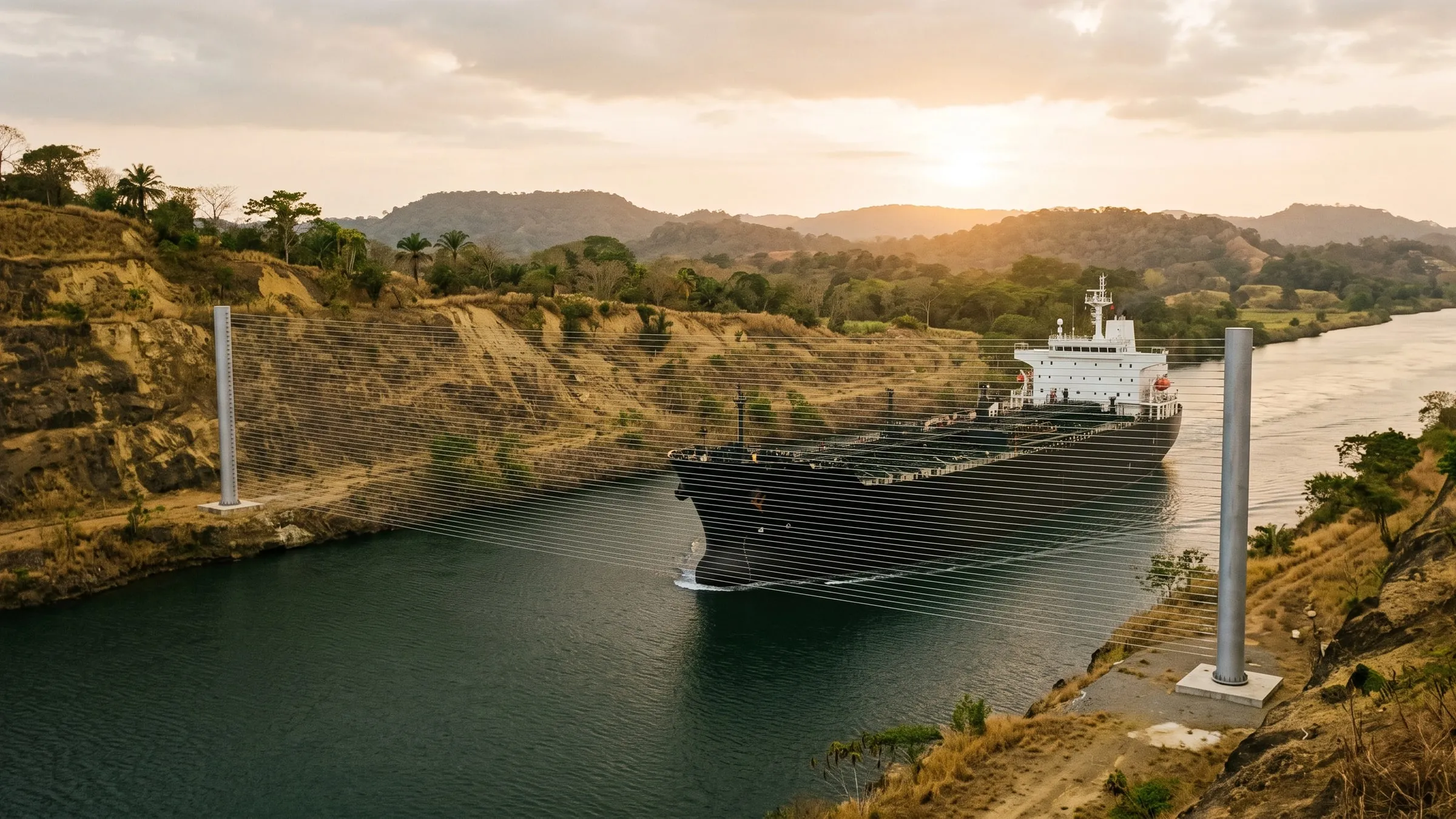
In the novel, a net nobody can see is strung across a canal: fifty filaments one-hundredth of a hair thick, half a metre apart, between two steel pillars. A sixty-thousand-ton ship sails into it and keeps its speed; on the bank it comes apart in more than forty slices. The novel gives the filament a code name and a thickness, and no strength. This bench computes the one it needs: the force to part steel, the tension that puts in a filament strung tight across 160 metres, the stress that is, set on a ladder of everything that has been measured. Dial the lag. Turn the plate. Read what the scene asks.
Keep the signal
The station is free. No ads, no tracking cookies. If the files are worth your time, following is the support.
 Open the interactive ▸
What you're looking at
The Cut is the Gaillard Cut in three dimensions at the span on the dial: the water, the banks with the yellow earth of the widening works the book describes, the hills, the two twenty-four-metre pillars, and the fifty filaments strung between them, drawn far thicker than their 0.75 µm so they can be seen. The ship is a tanker's hull of Panamax beam with the book's thirty-one metres above the water and eight below, black with a white superstructure; the giant antenna is gone, as the book has it, and a thin mast stands at the top. Press play and it runs the book's last kilometre at the dialled speed and passes the net; where the hull meets the filaments they bow back by the dialled lag, and behind the net the seams of the planes appear on the hull. Chips carry the net, the ship, the planes through hull and superstructure, the lag with its tension and stress, and a clock. Four cameras: the slope the book seats Wang on, the west pillar's top, the deck looking ahead at the net, and a plan from above.
The Filament is a ladder of tensile strength on a log axis, from a human hair's 200 MPa through structural steel, spider silk, Kevlar, carbon fibre and boron nitride nanotubes to the four measured rungs at the top: nanotubes at 63 GPa (Yu et al. 2000), bundles at 80 (Bai et al. 2018), nanotube shells above 100 (Peng et al. 2008), graphene at 130 (Lee et al. 2008). Against it, the marks the scene makes: the stress a filament needs folded fully back along the hull, at the dialled lag under the shear floor, under the 4340 rung and under the EH36 ceiling, and the book's own truck. Beside the ladder, the filament's ledger: the diameter and area, the force to part the dialled plate under both bounds, a transverse member met square-on, the tension and stress at the lag, the ratio to the dial, the break budget, the breeze and the truck.
The Ship is the ship in elevation to scale, the outline of the same model that sails the Cut, the waterline at the book's draught, the deck at the Kim et al. tanker's depth, the top at the book's thirty-one metres, and the fifty planes drawn across it from the pillar base up: how many cross the hull, how many the superstructure, how many slices they make. Its ledger prices the drag: the steel a horizontal plane meets per filament, the mean force under each bound, the total against the tanker's thrust at the dialled speed, the speed lost over the ship's own length, the cut's energy against the kinetic energy, the crankshaft and the attachment. The File runs its cards: the plan, the net as built, the material, the ship, the Cut written and real, the pass, the slices, the strongest things measured, the two cut models, the breeze, the pitch and what is not modelled, then two readings at equal size.
Why it's here
This site's signed review of The Three-Body Problem (Cixin Liu, 2008; Ken Liu's translation) put the book's numbered sentences on the list, and the Red Coast sentence became the Red Coast Link Budget. This bench is chapter 31, Operation Guzheng: Shi Qiang draws the canal on the table, stands a cigar on each bank and strings Wang Miao's 'Flying Blade' between them, 'about one-hundredth the thickness of human hair', half a metre apart; the canal is 'one hundred fifty meters wide' at its narrowest, the ship 'thirty-one meters tall, with a draft of eight meters or so'; the net as built is 'Fifty ultrastrong nanofilaments, each 160 meters long' on two twenty-four-metre steel pillars. Judgment Day passes through and 'continued to sail forward at the same speed', then comes apart on the bank 'into more than forty slices, each slice half a meter thick'. Every sentence carries a number, and the material carries none: the novel gives it a code name, a thickness by a hair and a method, molecular construction, and no strength.
It is here because the number the book withholds can be computed from the numbers it gives. The force to part a plate of steel is two terms in the wire-cutting literature, one that grows with the wire's diameter and one that does not; that force on a net winched tight across 160 m puts a tension in the filament that depends on how far behind the pillars the cut may run, which is geometry; the tension over the filament's area is a stress, and a stress can be set on a ladder of measured strengths, from hair to steel to nanotubes to graphene. The ship's side is the same arithmetic: the filaments through the hull times the steel each meets, against the tanker's thrust. The bench computes all of it, prints the two cut bounds side by side without averaging them, and does not rule on the book: one reading is that the scene asks of the material a stress more than a thousand times the strongest measured, the other that this is the specification the novel sets for a material it declines to describe. It sits on the fiction-pricing line after the Thermoptic Camouflage Bench and the Red Coast Link Budget (and the Astrophage Budget, on Project Hail Mary, before them), and on the materials line after the Ubatuba Magnesium and the Corso Ledger: the novel is quoted as premise, the numbers are priced, and the story is not reviewed; the review is next door, linked, not duplicated.
How it works
Everything on the bench is arithmetic on declared inputs: a hair, a plate, a lag, a span, a strength, a speed. The book's figures are entered as they stand and the script that ships with the site re-derives every displayed number before the build passes.
d = h/100 · A = πd²/4 · F_floor = τ·d·ℓ · F_ceiling = G_c·ℓ · tan θ = δ/a · T = F/(2 sin θ) · σ = T/A · F_max = 2σ_u A · f′ = 4πμU/(½ − γ − ln ½ka) · drag = N_hull · f · kerf · thrust = P/v
The filament. The book measures it by a hair, one-hundredth of its thickness; the page gives a hair 17 to 181 µm with 75 as a nominal, so the filament is 0.75 µm and its area πd²/4 = 4.42 × 10⁻¹³ m². Everything the scene asks of the material is asked of that area.
The cut. The wire-cutting literature reads the force per unit contact length as a fracture term plus a plastic term that grows with the wire's diameter. The bench prints the plastic term alone as the floor, τ·d·ℓ, with τ the shear strength (the 60 percent estimate on IACS Grade A's 400 N/mm², 240 MPa) across the kerf's width d and the member's contact length ℓ (a side plate's thickness; a transverse member's width, or its thickness over the sine of its skew); and the fracture term alone as the ceiling, G_c·ℓ, with G_c the EH36 ship steel's measured 926 kJ/m² by default and the 4340 alloy's 12.5 kJ/m² (from K_Ic = 50 MPa·m^1/2 through G = K²/E) as a rung. The two are bounds and are never averaged.
The tension. The net is winched tight. A filament pushed by the force F where it meets the hull carries it on two free segments a = (L − B)/2 long, 63.85 m for a 160 m span and a 32.3 m beam, at the angle θ the lag allows, tan θ = δ/a: T = F/(2 sin θ). The least tension at any lag is the fold-back bound F/2; the most transverse load a filament of strength σ_u can carry at any angle is the break budget 2σ_u A. The stress T/A is the mark on the ladder.
The breeze. Lamb's resistance per unit length of a cylinder in slow flow, 4πμU/(½ − γ − log ½ka) with ka = Ua/2ν, from his Hydrodynamics, Art. 343, pinned on his own check values; air is the ICAO standard atmosphere. The drag over the span against the break budget, and the sag wL²/(8T) at the pretension the cut needs.
The ship. A horizontal plane along the hull meets two side shells, a longitudinal bulkhead and a transverse web every 3.9 m (the Kim et al. frame spacing): a kerf length per filament of 57 mm at the defaults. The mean force is the bound times the kerf; the drag is that times the planes through the hull; the thrust is the Eagle S's 11,300 kW scaled by the cube of the speed over 14.5 knots and divided by the speed (both assumptions, marked); the speed lost over the ship's length is drag over mass times length over speed; the cut's energy is drag times length, against ½mv².
The planes. Fifty filaments at half a metre from the pillar base plus the lowest filament's height, against the freeboard (the 20.65 m depth less the book's 8 m draught) and the book's 31 m: the planes through the hull, through the superstructure and above the ship, and the slices they make. The crankshaft is a cylinder met along its axis, its chord 2√(r² − (z − h)²); the attachment is T/(dR) against mild steel's 120 HB.
Nothing is fitted. The only choices are the dials, each declared; the book's figures are entered as written and what follows is computed.
The dials that decide what happens
A hair, a strength and a lag on the filament; a steel grade, a shear ratio, a fracture energy, a plate and a transverse member on the cut; a wind; a speed, a mass, a draught, a height, a pillar base on the ship; a crankshaft and a wrap. Between them they draw every number the scene could mean.
- The hair. 17 to 181 µm, the page's range; 75 by default, its nominal. The filament is one-hundredth of it.
- The strength. Yu et al. 2000 (63 GPa), Bai et al. 2018 (80), Peng et al. 2008 (100, by default), Lee et al. 2008 (130, graphene). The ratio and the break budget follow it.
- The lag. 10 cm to 100 m on a log dial; 1 m by default. How far behind the pillars the cut may run; the tension is F/(2 sin θ) of it.
- The span. 150 to 200 m; 160 by default, the filaments as built. The book also gives 150 (the Cut) and 170 (the plan with slack).
- The steel. IACS Grade A's tensile strength, 400 to 520 N/mm², and the shear ratio, 0.60 (the common estimate) or 0.75 (the table's steel row).
- The fracture energy. 10 kJ/m² to 1 MJ/m² on a log dial: the 4340 rung at 12.5, EH36's measured 926 by default.
- The plate. 8 to 40 mm; 16 by default, the outer bottom's gross figure (13 mm net plus 3 mm corrosion addition). A transverse member's width, 1 to 32 m, and its skew, 0 to 10°.
- The breeze. 0 to 10 m/s; 2 by default. The book gives no wind.
- The speed. 2 to 14.5 knots, with 8 (the Notice's minimum full-ahead), 6 (the Regulation's six-knot areas), 12 (the Eagle S's service speed) and 4.6 (the book's hour, an upper bound) as buttons.
- The ship. 20,000 to 90,000 t (the book's sixty thousand by default), 6 to 14.5 m of draught (eight), 20 to 58 m of height (thirty-one), the pillar base 0 to 8 m above the water, the lowest filament 0 to 0.5 m up.
- The engine and the attachment. The crankshaft's radius, 0.2 to 0.6 m, and its axis above the keel, 2 to 6 m; the wrap radius at the pillar, 5 cm to 1 m.
The claims, as they stand
The novel's sentences, from the hair to the slices, with where each lands when the arithmetic is run.
| A filament 'about one-hundredth the thickness of human hair' parts a sixty-thousand-ton ship from the novel, ch. 31 | PREMISE | The premise. The page gives a hair 17 to 181 µm with 75 as its nominal, so the filament is 0.75 µm and 4.4 × 10⁻¹³ m² across; the bench takes it at its word and prices what follows. To part a 16 mm plate it needs 2.88 N at the shear floor and 14,800 N at the fracture ceiling; a 100 GPa filament of that area carries at most 0.088 N sideways. |
| The ship 'continued to sail forward at the same speed' from the novel, ch. 31 | CONTESTED | Holds at the floor, not at the ceiling. Twenty-five filaments cross the hull at the book's draught; at the shear floor they drag 258 N against 461 kN of thrust at 8 knots (0.06 percent, 0.2 mm/s lost over the ship's length), and 17,900 N at the 4340 rung (3.9 percent); at EH36's measured fracture energy they drag 1.32 MN, more than the thrust, and the ship would lose 1.2 m/s of its 4.1 over its own length. Which term a sub-micron filament mobilises in a ductile plate is on no page the bench fetched. |
| The cut runs at the pillar plane: the hose parts 'the moment that that section of the ship passed between the pillars' from the novel, ch. 31 | CONTESTED | Priced as a lag. For the cut to run no more than a metre behind the pillars, the floor's 2.88 N puts 92 N in a filament strung across 160 m, a stress of 2.1 × 10¹⁴ Pa, 2,081 times the 100 GPa measured on nanotube shells; at a ten-metre lag 211 times; folded fully back along the hull, still 33 times. The ladder of measured strengths has no rung there. |
| 'More than forty slices, each slice half a meter thick' from the novel, ch. 31 | PREMISE | Reproduced. Fifty filaments at half a metre span 24.5 m on 24 m pillars: 25 planes through the hull's 12.65 m of freeboard and 25 through the superstructure, 51 slices through 25 m of ship; more than forty of half a metre is at least 20 m. The antenna at the very top, 31 m up, is reached only if the pillar base stands 6.25 m above the water. |
| 'The narrowest point of the canal is one hundred fifty meters wide' from the novel, ch. 31 | READING | The Canal Authority's own page: the widening project took the Cut 'to at least 192 meters along straight stretches and 222 meters in the curves', finished November 2001; the book's scene has the widening works under way on the slopes. The width before the programme is on no page the bench fetched. The span is a dial from 150 to 200 m. |
| 'Judgment Day is built to Panamax specifications, just enough to fill the thirty-two-meter locks' from the novel, ch. 31 | PREMISE | Set beside the pages. The original chambers are 33.53 m wide and the Panamax width over the shell plating is 32.3 m; a real tanker of that beam, the Eagle S, is 228.6 m by 32.3 m with 11,300 kW at 105 rpm, and the bench's hull takes her length and beam, the Kim et al. tanker's depth, and the book's 31 m and 8 m. |
| 'A strand of that stuff could be used to lift up a truck' from Shi Qiang, as hearsay, ch. 4 | REPORTED | The book's own line, priced: ten tonnes on the filament's area is 2.2 × 10¹⁷ Pa, 2.2 million times the 100 GPa measured on nanotube shells. Carried as hearsay the book itself marks ('I heard'), not as a claim in the novel's voice. |
| 'Maybe the pillars would be sliced apart first' from the meeting, ch. 31 | PREMISE | Priced. The tension the cut needs, 92 N on a 0.75 µm line wrapped round a 0.5 m pillar, presses 245 MPa, under mild steel's 1,177 MPa; it meets the hardness at a 10 cm wrap. The book guards the attachment with flat sheets of the same material; the arithmetic says the sheets matter below a hand's-width radius. |
Try this
- Start on the Cut. Press play from the slope and watch the ship come down the Cut and into the net at eight knots; read the clock as the stern clears. Switch to the pillar's top and look east along the fifty lines.
- Turn the lag to 10 cm. The tension chip climbs to 919 N; turn it to its far end, 100 m, and read how little it falls: 1.7 N, still 39 times the dial.
- Go to the Filament. Find the dial's rung and the marks above it. Press 'Lee 2008' for graphene: the ratio drops to 1,601 and the marks do not move.
- Set the plate to 8 mm and the fracture energy to its floor. The ceiling falls to 80 N; the shear floor to 1.4 N; the stress at a metre of lag is still a thousand times the dial.
- Turn the wind to 10 m/s. The breeze alone loads the net with one and a half times what a 100 GPa filament can hold sideways.
- Go to the Ship. Read the three drag figures against the thrust; press '4.6 knots', the book's own hour, and read them again. Raise the pillar base to 6.25 m and watch the planes reach the antenna.
- End on the File. Its cards, then two readings at equal size.
Accuracy
The honest line between what is reported, what is measured, what is modelled on them, and what is a reading:
| Feature | Status | What that means |
|---|---|---|
| The ledgers | Exact | The filament's area from the hair; τ·d·ℓ and G_c·ℓ for a member of contact length ℓ; the tension T = F/(2 sin θ) from the lag and the free segments; the stress; the fold-back floor F/2 and the break budget 2σA; Lamb's drag over the span and the sag; the kerf a horizontal plane meets, the drag, the thrust at the speed, the speed lost over the ship's length, the energy against the kinetic energy; the planes through the hull and the superstructure; the crankshaft's chord; the contact pressure on the pillar. Closed-form on declared inputs, audited by a re-runnable tune script. |
| The record | Measured | Multiwalled nanotubes at 11 to 63 GPa (Yu et al. 2000) and above 100 GPa (Peng et al. 2008), bundles at 80 GPa (Bai et al. 2018), graphene's 130 GPa (Lee et al. 2008); EH36 ship steel's fracture energy, J = 926 kJ/m² (Zhu et al. 2021); and the tabulated world: a hair's 17 to 181 µm, IACS Grade A steel, the 60 percent shear rule, mild steel's 120 HB, the tensile-strength table, the tanker Eagle S, of Panamax beam, the Kim et al. tanker's section, the Culebra Cut and the Authority's 192 m, the Panamax limits, the Authority's 8 and 6 knots, the ICAO air. Carried with sources, as published. |
| The dials | Modelled | The hair inside its range (75 µm, the page's nominal); the material's strength (Peng et al.'s 100 GPa by default); the lag (1 m); the span (160 m, the filaments as built); the steel's tensile strength and shear ratio; the fracture energy between the 4340 rung and EH36; the plate (16 mm, the outer bottom's gross figure, since the side shell's own was not found); a transverse member's width and skew; the wind; the speed; the ship's mass, draught, height and depth; the pillar base; the crankshaft's radius and height; the wrap radius; the cube law on the rating and the thrust as power over speed; the hour and the scene's staging. Every finding is quoted at the defaults and the dials show where it moves. |
| The novel, as premise | Reported | The book is quoted only as the document under audit: fifty filaments 160 m long, half a metre apart, one-hundredth of a hair thick, on twenty-four-metre pillars; a canal 150 m wide; a sixty-thousand-ton Panamax ship 31 m tall with 8 m of draught; the same speed; more than forty slices half a metre thick; the engine's rotating parts cut. The material has no stated strength, so every figure about it is what the scene asks, never what the book states. The novel states no strength for it, and this bench returns the favour: it prices the figures without reviewing the story. The signed review next door does that, and is linked, not duplicated. |
In one line: The strengths, the fracture energy, the steel, the hair, the tanker and the canal are the record's; the forces, tensions, stresses, drag and planes are arithmetic on them at declared dials; the net, the ship and the same speed are the book's and say so. The reading is yours.
Sources
- Cixin Liu, The Three-Body Problem (
三体 ), tr. Ken Liu, Head of Zeus paperback, 2024 (Tor Books, 2014; Chongqing Publishing Group, 2008): chapter 31, "Operation Guzheng", with chapters 4, 6 and 24, quoted as premise; the site's signed review for the reading. - M.-F. Yu, O. Lourie, M. J. Dyer, K. Moloni, T. F. Kelly and R. S. Ruoff, "Strength and Breaking Mechanism of Multiwalled Carbon Nanotubes Under Tensile Load", Science 287 (2000), 637-640: 11 to 63 GPa on 19 nanotubes, modulus 270 to 950 GPa.
- B. Peng, M. Locascio, P. Zapol, S. Li, S. L. Mielke, G. C. Schatz and H. D. Espinosa, "Measurements of near-ultimate strength for multiwalled carbon nanotubes and irradiation-induced crosslinking improvements", Nature Nanotechnology 3 (2008), 626-631: a mean fracture strength above 100 GPa, the ladder's default.
- C. Lee, X. Wei, J. W. Kysar and J. Hone, "Measurement of the Elastic Properties and Intrinsic Strength of Monolayer Graphene", Science 321 (2008), 385-388: an intrinsic strength of 130 GPa and a modulus of 1.0 TPa.
- Y. Bai et al., "Carbon nanotube bundles with tensile strength over 80 GPa", Nature Nanotechnology 13 (2018), 589-595: centimetre-long bundles at 80 GPa (43 GPa engineering).
- I. Kamyab, S. Chakrabarti and J. G. Williams, "Cutting cheese with wire", Journal of Materials Science 33 (1998), 2763-2770: the cutting force against wire diameter yields a fracture toughness and a plastic term, the two bounds the bench prints; S. M. Goh, M. N. Charalambides and J. G. Williams, "On the mechanics of wire cutting of cheese", Engineering Fracture Mechanics 72 (2005), 931-946, cited by title.
- Q. Zhu, P. Zhang, X. Peng, L. Yan and G. Li, "Fatigue Crack Growth Behavior and Fracture Toughness of EH36 TMCP Steel", Materials 14 (2021), 6621: J = 926 kJ/m² and K = 464 MPa·m^1/2 for EH36 ship steel at 424 and 537 MPa, the ceiling's term.
- IACS Unified Requirement W11, Rev. 10 (September 2025), Tables 6 and 7: normal-strength Grades A to E at 235 N/mm² yield and 400 to 520 N/mm² tensile; the 36 grades at 355 and 490 to 630. Wikipedia, "ABS Steels", for the same grades as ASTM A131 prints them.
- D. K. Kim, H. B. Kim, X. Zhang, C. G. Li and J. K. Paik, "Ultimate strength performance of tankers associated with industry corrosion addition practices", International Journal of Naval Architecture and Ocean Engineering 6 (2014), 507-528: a Panamax double-hull tanker 219 m by 32.24 m with a 20.65 m depth, net plates of 8 mm on deck and 13 mm on the bottom, frames at 3,900 mm, and the CSR corrosion additions of 4, 3 and 3 mm.
- Wikipedia, "Eagle S" (read 5 October 2026): a crude and products tanker of Panamax beam, 74,035 DWT, 228.6 m by 32.3 m, 89,381 t at a 14.5 m draught, a MAN-B&W 5S60MC-C of 11,300 kW at 105 rpm, 14.5 knots maximum and 12 at service; "Wärtsilä-Sulzer RTA96-C" for a two-stroke's rotating parts at scale (960 mm bore, 2,500 mm stroke, 15 to 102 rpm, a 300 t crankshaft).
- Panama Canal Authority, "Gaillard Cut Widening" (the Authority's site as captured by the Wayback Machine, 2008; the Spanish page, 2009): the Cut widened to at least 192 m on the straights and 222 m in the curves, the major work ended November 2001. Panama Canal Authority, Regulation on Navigation in Panama Canal Waters (English compilation, as archived 2012) and OP Notice to Shipping N-1-2024: the six-knot areas, the five-knot handline floor, the 8-knot minimum full-ahead speed.
- Wikipedia (read 5 October 2026): "Culebra Cut" (12.6 km, 26 m above the sea, the 91 m American bottom width), "Panama Canal" (82 km, 11.38 hours in 2017, the 192 to 218 m item), "Panamax" (the 33.53 m chambers, 32.3 m over the shell, 12.04 m, 57.9 m, 65,000 to 80,000 DWT), "Centennial Bridge, Panama" (1,052 m, 80 m of clearance, inaugurated 15 August 2004), "Hair's breadth" and "Micrometre" (17 to 181 µm, 75 nominal), "Ultimate tensile strength" (the table's rows), "Carbon nanotube", "Shear strength" (steels at 0.75 and the 60 percent estimate), "Brinell hardness test" (mild steel 120 HB), "Carbon steel" (7,850 kg/m³, 200 GPa), "Fracture toughness" (4340 steel at 50 MPa·m^1/2) and "Fracture mechanics" (G = K²/E), "International Standard Atmosphere" (1.225 kg/m³, 1.7894 × 10⁻⁵ Pa·s, 1.4607 × 10⁻⁵ m²/s).
- The Cut's relief in the 3D view: Copernicus DEM GLO-30, tile N09_00_W080_00 (AWS Open Data, read 6 October 2026), 30 m posts around 9.077° N 79.675° W, resampled on the scene's grid; © DLR e.V. 2010-2014 and © Airbus Defence and Space GmbH 2014-2018, provided under COPERNICUS by the European Union and ESA. Ground textures: Poly Haven (CC0), forest_ground_04, aerial_grass_rock and rocky_terrain; the water's normal map from the three.js examples (MIT). The ship: a tanker model generated for this bench on Tripo (6 October 2026), scaled to the Eagle S's length and beam and to the book's heights, its paint taken to the book's black, drawn flat-shaded.
- H. Lamb, Hydrodynamics, 6th ed. (Cambridge, 1932; Dover, 1945), Art. 343, eq. (15): the resistance per unit length of a cylinder in slow flow, 4πμU/(½ − γ − log ½ka), with its own check values 4·31 μU at ka = 1/10 and 3·48 μU at 1/20.
- This site: the signed review of The Three-Body Problem; the Red Coast Link Budget on the same book; the Thermoptic Camouflage Bench and the Astrophage Budget on the fiction-pricing line; the Ubatuba Magnesium and the Corso Ledger on the materials line.