The Metric Appearance Bench: Table 1 and What the Observer Meets
Stand on a desert floor at night and look up at a dark sphere ten metres across, a hundred metres away. D132, a Defense Intelligence Reference Document of 29 March 2010, tabulates in its Table 1 (p. 9) how processes inside an altered spacetime appear to a remote observer, in two columns, and on pp. 12 to 14 applies the rows to 'an advanced aerospace craft'. The table runs on two coefficients, √g₀₀ and √(−g₁₁), and this bench turns both as dials, with a tie of its own choosing, g₀₀ · (−g₁₁) = 1, inside the pairing Table 1 prints for its columns as inequalities. At √g₀₀ = 1,000 the top of the hearing range arrives inside at 20 Hz, the floor of hearing, and beyond it the whole range lies below, the paper's 'redshift below the auditory range' (p. 12). A hull at 300 K peaks at 9.659 μm; from √g₀₀ = 12.88 to 25.42 that peak sits inside the visible, the paper's 'heat spectrum blueshifting up into the visible' (p. 12), and at 17.56, with the tie, the 10 m craft reads 175.6 m across. To read 'relatively small' (p. 13) it needs √(−g₁₁) = 10, which is the other column of the table. A point mass at its centre puts the Einstein ring on the rim at 14.09 Earth masses, and at 1.774 Jupiter masses the craft's own radius is its Schwarzschild radius; the wormhole paper D139 prints a rate the bench computes as 0.7094 Jupiter masses per metre of throat. The bench names which coefficient, which column and which setting each sentence needs, and rules on no craft and on no paper.
Keep the signal
The station is free. No ads, no tracking cookies. If the files are worth your time, following is the support.
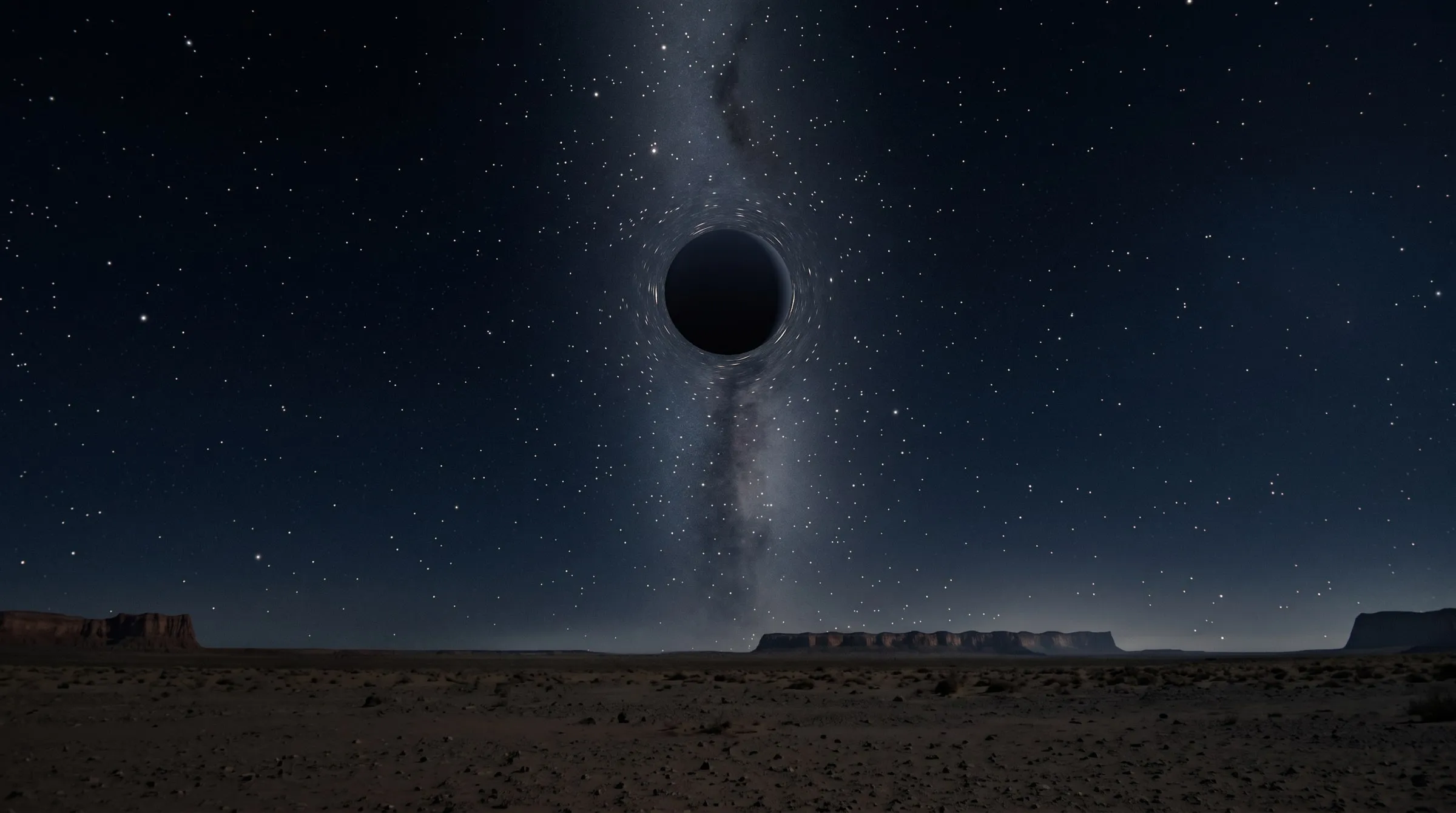 Open the interactive ▸
The record
D132 is a Defense Intelligence Reference Document dated 29 March 2010, control number DIA-08-1003-015, 17 pages, filed as DOW-UAP-D132 in the Department of War's PURSUE Release 06. Its own title is Advanced Space Propulsion Based on Vacuum (Spacetime Metric) Engineering. On p. 2 the author's name is replaced by the label AAP Person 57, and the bench names no author. Release 06 Briefing 13 summarises it beside three other gravity papers. The bench reads two parts of it: Table 1 (p. 9), and Section III (pp. 11 to 15), where the paper draws what it calls corollaries for a craft. Four of those sentences are what the bench prices, as the paper prints them:
- The ear, p. 12. 'A corollary would be that within the spacetime-altered region, normal environmental sounds from outside the region might cease to be registered, since external sounds could under these conditions redshift below the auditory range.'
- The glow, p. 12. 'Corollary to observation of such a craft is the possibility that there would be a brightening of luminosity due to the heat spectrum blueshifting up into the visible portion of the spectrum (see Figure 1).' Figure 1 is captioned 'Blueshifting of Infrared Heat Power Spectrum' and prints two curves and no numbers.
- The size, p. 13. 'As a corollary, metric engineering associated with an advanced aerospace craft to produce this effect could in principle result in a large craft with a spacious interior appearing to an external observer to be relatively small.'
- The lens, p. 14. 'Yet another possibility is the sudden "cloaking" or "blinking out," which would at least be consistent with strong gravitational lensing effects that bend a background view around a craft, though other technical options involving, for example, the use of metamaterials, exist as well.'
Two papers of the same release stand beside it. D128, the human tissue paper of 11 March 2010 (Release 06 Briefing 22), writes on p. 14 that 'there is the possibility that those are effects predicted by General Relativity Theory that would correlate with some of the reported data in which the blackbody heat spectrum of an object (an anomalous craft) would be blue-shifted (increased in frequency) under conditions of spacetime manipulation for lift and propulsion', and that for a person at relatively close range 'symptoms associated with broadband radiation - microwave, visible, UV, soft X-rays - could be expected'. D139, the wormholes paper of 6 April 2010 (Release 06 Briefing 14), writes its Equation (9) on p. 30 as Mwh = −λthroat c²/G, 'the (equivalent) mass required to build the wormhole', and prints it as −(1.35 × 10²⁷ kg) and −(0.71 MJ) for each metre of throat width.
D132 presents its list as consequences of its physics, not as observations, and Release 06 Briefing 13 reports it that way. It also says that 'the technical requirements for such are unlikely to be met in the foreseeable future (Reference 22)' (p. 15), of the Alcubierre warp drive it takes as its exemplar, and that 'it is premature to even guess about an optimum strategy' (p. 17).
The table
Table 1 is headed 'Metric Effects on Physical Processes in an Altered Spacetime as Interpreted by a Remote (Unaltered Spacetime) Observer'. It has seven rows and two columns, transcribed here as printed, with the factor the bench applies for each row:
| Variable | Typical Stellar Mass (g₀₀ < 1, |g₁₁| > 1) | Spacetime-Engineered Metric (g₀₀ > 1, |g₁₁| < 1) | On the bench |
|---|---|---|---|
| Time Interval Δt → Δt/√g₀₀ | Processes (for example, clocks) run slower | Processes (for example, clocks) run faster | ÷f |
| Frequency ω → ω√g₀₀ | Redshift toward lower frequencies | Blueshift toward higher frequencies | ×f |
| Energy E → E√g₀₀ | Energy states lowered | Energy states raised | ×f |
| Spatial Δr → Δr/√(−g₁₁) | Objects (for example, rulers) shrink | Objects (for example, rulers) expand | ÷s |
| Velocity v_L = c → c√(g₀₀/−g₁₁) | Effective v_L < c | Effective v_L > c | ×f/s |
| Mass m = E/c² → (−g₁₁/√g₀₀) m | Effective mass increases | Effective mass decreases | ×s²/f |
| Gravitational "force" f(g₀₀, g₁₁) | "Gravitational" | "Antigravitational" | printed, not computed |
The two coefficients. Write f = √g₀₀ and s = √(−g₁₁). f sits in the time, frequency and energy rows; s in the spatial row; the velocity and mass rows carry both, as f/s and s²/f. Each column is a direction of both at once: the stellar column has g₀₀ below 1 and |g₁₁| above it, so f < 1 and s > 1; the engineered column the reverse. The force row, f(g₀₀, g₁₁), the table prints as a word per column, 'Gravitational' and 'Antigravitational', and the bench prints it that way and does not compute it.
The paper's own example. On p. 8 the paper works the time row: an interval of 'say, 10 seconds' in undistorted spacetime 'would be judged by local (proper) measurement from within the altered spacetime to occur in a lesser time interval', 'say, 5 seconds'. That is f = 0.5, the stellar column, and the bench's Stellar preset. 'Conversely, under conditions (for example, metric engineering) for which √g₀₀ > 1, processes within the spacetime-altered region are sped up.' On the bench, 1 hour outside is f hours inside.
What the bench does
Two dials and a tie. f is a logarithmic dial from 0.001 to 10,000, s one from 0.0001 to 1,000, both at 1 by default. Table 1 pairs its columns as inequalities, g₀₀ < 1 with |g₁₁| > 1 and the reverse; the tie, on by default, is the bench's own choice inside that pairing: it holds g₀₀ · (−g₁₁) = 1, so s = 1/f, the product the Schwarzschild metric carries (the paper names the Schwarzschild form at its Equation (4) as its stellar example). With the tie off the two dials move alone, an extension that is the bench's own. The rows apply one at a time, as Section III applies them: time ÷f, frequency ×f, energy ×f, length ÷s, velocity ×f/s, mass ×s²/f.
The exits. For each of the five sentences (D132's four and D128's), the bench names the coefficient it lives on, the column of Table 1 its direction belongs to, and the setting it needs. It does not say whether such a craft exists or whether the paper is right.
The defaults. The paper gives no temperature, so the hull is a blackbody at 300 K, a dial from 200 to 2,000 K. The craft is a sphere of radius 5 m, 10 m across, the paper's 'spherical object' (p. 13), a dial from 1 to 50 m. The observer stands 100 m from its centre in a straight line from the eye, a logarithmic dial from 40 m to 10 km. The lens is a point mass at the centre with its own switch, off by default, from 10²² to 10²⁸ kg.
Six views. The Range is a desert floor at night in 3D under a star dome, the paper's own refractive-index example being 'heat waves off a desert floor' (p. 14): a matte sphere 40 m up, lifted when the drawn sphere needs the room, drawn at R/s with its proper size as a ghost ring, coloured by the hull's received spectrum, the stars around it remapped through the lens equation when the lens is on; three cameras, the observer, the rim and the plan. The Ear is a frequency axis from 0.1 Hz to 1 MHz with the hearing range, the voice band and their markers sliding with f, and the time strip. The Spectrum is a wavelength axis from 10 pm to 1 m with the bands named, the hull's Planck curve, the received curve and a true blackbody's curve at the same temperature. The Lens is the Einstein angle against mass with the rim's angle, the ladder of masses, D139's Table 2 as it prints it beside the bench's own rate for a throat the craft's width, and the cost line. The Ladder lays the five sentences on the f and s rails with the tie drawn between them. The File holds Table 1, the papers' sentences with their pages, the outside pages, what the bench does not model and two readings at equal size.
Eight presets. Flat (f = 1, s = 1, lens off); Glow (f = 17.56, tied: the peak at 550 nm); Sun-white (f = 19.24, tied: the hull reads as 5,772 K, the Sun's effective temperature), both with the observer at 1 km so the sphere the tie enlarges is seen whole; Silence (f = 1,000, tied); Small (s = 10, tied, so f = 0.1); Stellar (f = 0.5, tied: the p. 8 example); Lens (f = 1, the rim mass, 14.09 Earth masses); Black (f = 1, 1.774 Jupiter masses).
What it does not model. The energy of the Alcubierre bubble (INST-12 prices it); the Sun's deflection of starlight (INST-13); invisibility by metamaterial (INST-88); the 'waviness' and the light beam that may 'even terminate in mid-space' (p. 14), named and not priced; the 'hardened' materials and the impact on water (p. 13), where the energy row's factor f is printed and nothing more; the occupants and the flight path; the charge term of p. 7, named and not priced; the sources that would generate such a metric, which the paper says on p. 15 remain to be determined; how a pressure wave would cross the region's boundary; the lensing of the ground; D128's cases.
λ_peak = b/(fT) · P′(ν′) = f · P_T(ν′/f) · θ_E = √(4GM/(c²D)) · M_rim = c²R²/(4GD) · M_bh = c²R/(2G) · M_wh = −λ_throat c²/G
The ear
The paper says (p. 12) that 'external sounds could under these conditions redshift below the auditory range'. The bench applies the frequency row as that sentence applies it: a sound of frequency ν outside is heard inside at ν/f, and a sound of the craft is heard outside at ν·f. The hearing range is 20 to 20,000 Hz and the voice band 300 to 3,400 Hz, from the pages the File names.
At f = 1,000 the top of the hearing range, 20,000 Hz, arrives inside at 20 Hz, the floor of hearing, and beyond 1,000 the whole range lies below it. The top of the voice band, 3,400 Hz, arrives at 20 Hz at f = 170 and lies below beyond it, and a 1,000 Hz tone does so at f = 50. The other way, in the stellar column, the bottom of the range, 20 Hz, arrives inside at 20,000 Hz at f = 0.001, and below 0.001 the whole range lies above hearing. Near the glow setting, at f = 18, 20,000 Hz is heard inside at 1,111 Hz and 1,000 Hz at 55.56 Hz, both still inside the hearing range, lowered; 20 Hz arrives at 1.11 Hz, below it. A 50 Hz hum of the craft, heard outside at f = 1,000, arrives at 50,000 Hz.
So the silence and the glow sit on the same coefficient, on the same side of 1: the silence needs 1,000 and beyond, the glow 12.88 to 25.42. The bench follows the paper's row and makes no claim about how a pressure wave would cross the region's boundary.
The glow
The paper says (p. 12) that 'frequencies associated with the craft would for a remote observer appear to be blueshifted', and names the brightening that would follow. Its Figure 1 gives no temperature, so the bench takes a hull at 300 K, room temperature, and says so. Wien's law puts that hull's peak at 9.659 μm, in the near infrared. Seen from outside the peak sits at b/(fT): it reaches 750 nm, the red edge of the eye's range, at f = 12.88, where the hull reads as 3,864 K, and passes the violet edge, 380 nm, at f = 25.42, 7,626 K; the electromagnetic spectrum table's own 700 nm edge sits inside that range, at f = 13.80, 4,140 K. At f = 17.56 the peak is at 550 nm and the hull reads as 5,269 K; at 19.24 it reads as 5,772 K, the Sun's effective temperature.
By the frequency, energy and time rows together the observer receives a curve with the shape of a Planck curve at fT and f² times the hull's power: 308 times at f = 17.56. A true blackbody at that temperature would be brighter by f⁴, so the received curve sits at 1/f², 1/308 of it; the Spectrum view draws both curves, so the f² and the f⁴ are both on the page with their origin.
The colour is that of a Planck spectrum at fT, through the Wyman, Sloan and Shirley (2013) fit to the CIE 1931 colour matching functions and the sRGB matrix, checked against Kim et al.'s Planckian locus to within 0.0011: 255, 209, 159 at 3,864 K, an orange white; 255, 235, 218 at 5,269 K; 255, 241, 234 at 5,772 K; 232, 235, 255 at 7,626 K, a bluish white. The brightness is the power factor, printed apart. The Range draws no glow below fT = 800 K, a threshold for the screen and not a model of the eye.
D128 lists 'microwave, visible, UV, soft X-rays'. The peak enters the soft X-rays at f = 965.9; at f = 1,000, the silence setting, the hull reads as 300,000 K and peaks at 9.659 nm, the last word of D128's list. With the tie on, the glow setting also turns the ruler row: at f = 17.56 the 10 m craft reads 175.6 m across.
The size and the lens
The size. The paper says (p. 13) that 'The size of, say, a spherical object is seen to have its radial dimension, r, scale as 1/√(−g₁₁)', and that 'In the vicinity of a dense mass M, √(−g₁₁) > 1, in which case an object within the altered spacetime region appears to a remote observer to have shrunk.' That is the stellar column. A 10 m craft reading 1 m across needs s = 10; with the tie that is f = 0.1, where the hull reads as 30 K and mass reads 1,000 times larger. With the tie on, 'relatively small' and the glow sit on opposite sides of 1; with it off, the dials move apart, which is the bench's own extension. The Range draws the sphere at R/s with the proper radius as a ghost ring. On p. 14 the paper places other apparent changes of size or shape under 'changes in lensing magnification parameters', which the Lens view takes.
The lens. The bench takes 'strong gravitational lensing effects that bend a background view around a craft' literally: a point mass at the craft's centre, the stars at infinity, the observer at D. The Einstein angle is √(4GM/(c²D)). At D = 100 m, Earth's mass gives 0.7631°. The ring sits on the drawn rim, 2.865°, at 8.416 × 10²⁵ kg, 14.09 Earth masses, where the deflection at the rim, 4GM/(c²R), is 0.05 rad. Jupiter's mass gives 13.6°. At 3.366 × 10²⁷ kg, 1.774 Jupiter masses, the craft's own radius is its Schwarzschild radius. The rim mass falls as the observer steps back: 35.23 Earth masses at 40 m, the dial's floor, and 1.409 at 1 km.
D139's rate. D139 prints its Equation (9) rate as 1.35 × 10²⁷ kg, or 0.71 Jupiter masses, per metre of throat; computed from the constants, c²/G is 1.3466 × 10²⁷ kg, 0.7094 Jupiter masses. Its Table 2 has six rows: −709.9, −71, −7.1 and −0.71 Jupiter masses for throats of 1,000, 100, 10 and 1 m, then −22.6 and −2.3 Earth masses for 0.1 m and 0.01 m, at its own 1.90 × 10²⁷ kg for Jupiter and 5.98 × 10²⁴ kg for Earth. The rate from the constants gives 709.4 for 1,000 m and 70.94 for 100 m; a throat the craft's width, 10 m, is 7.094. D139 then writes two things on the same page: that 'Mwh is not the total mass of the wormhole as seen by remote observers', and that the field equation's non-linearity 'dictates that the total mass is zero', a zero it qualifies at once: '(actually, the total net mass being positive, negative or zero in the Newtonian approximation depending on the details of the negative energy configuration constituting the wormhole system)'. The Lens view marks Table 2's rows as D139 prints them, and the rate for a throat the craft's width as the bench's own, with both statements quoted.
The cost line. A lens mass pulls on the observer too. GM/D² at 100 m is 5.617 × 10¹¹ m/s² at the rim mass, 5.73 × 10¹⁰ g, printed beside the lens.
Evidence
The line between what is reported, what is tabulated, what is arithmetic on them, what is a choice, and what is a reading:
| Feature | Status | What that means |
|---|---|---|
| D132 | Reported | Table 1's heading, columns and rows (p. 9); the time example and the sentence on processes sped up (p. 8); the shrinking and expanding objects below the table (p. 9); the time flow, the sounds, the blueshift, the brightening and Figure 1's caption (p. 12); the hardened materials, the size, the small craft and the superluminal speed and the state of present technology (p. 13); the refractive index effects, the waviness, the bent and ending beam, the lensing and the cloaking (p. 14); the Alcubierre drive's requirements (p. 15) and the optimum strategy (p. 17). Each quoted as printed, with its PDF page. |
| D128 | Reported | The blue-shifted blackbody heat spectrum of 'an anomalous craft' and the list 'microwave, visible, UV, soft X-rays' (p. 14), quoted as printed, the paper's hyphens kept. |
| D139 | Reported | Equation (9) with its printed 1.35 × 10²⁷ kg and 0.71 Jupiter masses per metre of throat, the sentence on the 1 m wormhole, the two statements that M_wh 'is not the total mass of the wormhole as seen by remote observers' and that 'the total mass is zero', with the qualifier that follows them, and Table 2's six rows (p. 30). |
| The constants and the outside tables | Tabulated | The CODATA 2022 constants (c, G, h, k, σ and Wien's b), each value on its line of the NIST page; the electromagnetic bands of the Electromagnetic spectrum table, the eye's 380 to 750 nm, the hearing range 20 to 20,000 Hz and the voice band 300 to 3,400 Hz; the masses of Earth and Jupiter and the Sun's effective temperature from NASA's fact sheets; Kim et al.'s Planckian-locus splines, the check on the colours; the Wyman, Sloan and Shirley 2013 fit to the CIE 1931 colour matching functions and the sRGB matrix. |
| Standard gravity | Tabulated | 9.80665 m/s², the value ISO 80000 defines, as the Standard gravity page gives it: the g in which the cost line is printed. |
| The physics and the arithmetic | Exact | Wien's law, Planck's law and the Stefan-Boltzmann law; the Schwarzschild radius and the Schwarzschild metric's line element; the deflection angle 4GM/(c²b); the Einstein radius in its far-source form, and the lens equation as the page gives it; the rows of Table 1 applied at a setting; the received curve P′(ν′) = f · P_T(ν′/f) and its power f². The bench's figures are re-derived from the constants by a script before the build may pass. |
| The dials, the tie and the staging | Modelled | The two dials and the tie, the bench's own choice inside Table 1's pairing of the columns, which the table prints as inequalities; untied dials, the bench's own extension; the rows applied one at a time; the hull a blackbody at 300 K by default, because the paper gives no temperature; the lens a point mass at the craft's centre with the stars at infinity. Staging: the desert floor and the mesa line, the dome's latitude, 35° N, and sidereal time, 6 h, the craft's 40 m height, lifted when the drawn sphere needs the room, and the eye's 1.6 m; the Range does not lens the ground, and draws no glow below fT = 800 K. |
| The two readings | Reading | What the record says and what the arithmetic gives, at equal size on the File; what they amount to is left with you. |
Two readings
What the record says. D132 tabulates how seven quantities inside an altered spacetime appear to a remote observer, and on pp. 12 to 14 lists what would follow for a craft: outside sounds below hearing, a heat spectrum shifted into the visible, a large craft that looks small, a background view bent around it. It sets these out as possibilities that follow from its physics. Of the Alcubierre warp drive, its exemplar, it says the technical requirements for the shell of exotic matter 'are unlikely to be met in the foreseeable future' (p. 15), and on p. 13 that 'present technological facility is far from mature enough to support the development of warp drive and wormhole technologies'. D128 links a blue-shifted heat spectrum to its list of radiation; D139 prices a wormhole throat, writes that its Mwh 'is not the total mass of the wormhole as seen by remote observers', and that 'the total mass is zero', a total it qualifies as 'positive, negative or zero in the Newtonian approximation'.
What the arithmetic gives. Each sentence on one coefficient, in one column, at one setting, for a 300 K hull and a 10 m craft seen from 100 m: the silence on f, engineered column, 1,000 and beyond; the glow on f, engineered column, 12.88 to 25.42; the small craft on s, stellar column, 10, which is f = 0.1 with the tie; the cloaking on a mass, neither column, 14.09 Earth masses; D128's soft X-rays on f, engineered column, 965.9 or more. With the tie on, the four that live on a coefficient sit on one rail, three above 1 and one below it.
Neither reading rules on a craft or on a paper; the bench prints both and leaves them with you.
On this site
INST-13 Light Bending computes the Sun's deflection of starlight, the general-relativity example D132 names on p. 14, with the deflection law this bench uses at the rim. INST-12 The Warp Energy Problem prices the Alcubierre bubble, the exemplar of D132's p. 15. INST-88 The Thermoptic Camouflage Bench prices invisibility by metamaterial and display, the paper's 'other technical options'. INST-02 Black Hole is the Schwarzschild radius on its own, and INST-97 The Pais Patent Gravitational-Wave Bench follows the same pattern as this one: a document's own equation, run in its own units.
The records: Release 06 Briefing 13 on D132 and three other gravity papers, Release 06 Briefing 22 on D128, and Release 06 Briefing 14 on D139 and two other papers on warp drives, wormholes and negative energy. The wiki's Metric Engineering node gives background on the idea in general.
Sources
- DOW-UAP-D132, Advanced Space Propulsion Based on Vacuum (Spacetime Metric) Engineering, Defense Intelligence Reference Document DIA-08-1003-015, 29 March 2010, U.S. Department of War, PURSUE Release 06: PDF pp. 2 and 7 to 17, Table 1 (p. 9), Figure 1 (p. 12).
- DOW-UAP-D128, Anomalous Acute and Subacute Field Effects on Human Biological Tissues, Defense Intelligence Reference Document, 11 March 2010, U.S. Department of War, PURSUE Release 06: PDF p. 14.
- DOW-UAP-D139, Traversable Wormholes, Stargates, and Negative Energy, Defense Intelligence Reference Document DIA-08-1004-004, 6 April 2010, U.S. Department of War, PURSUE Release 06: PDF p. 30, Equation (9) and Table 2 (six rows).
- National Institute of Standards and Technology, CODATA 2022 recommended values, read 11 October 2026: c, G, h, k, σ and the Wien wavelength displacement law constant b.
- NASA, the Jupiter, Earth and Sun fact sheets, read 11 October 2026: the masses of Jupiter (1,898.13 × 10²⁴ kg) and Earth (5.9722 × 10²⁴ kg) and the Sun’s effective temperature (5,772 K).
- Wikipedia, read 11 October 2026: "Wien’s displacement law", "Planck’s law", "Stefan-Boltzmann law", "Schwarzschild radius", "Schwarzschild metric" (the line element), "Gravitational lens", "Einstein radius" and "Gravitational lensing formalism" (the formulas as stated); "Standard gravity" (9.80665 m/s², defined by ISO 80000).
- Wikipedia, read 11 October 2026: "Hearing range" (20 to 20,000 Hz), "Voice frequency" (300 to 3,400 Hz), "Visible spectrum" (380 to 750 nm), "Electromagnetic spectrum" (the table of bands), "X-ray", "Ultraviolet", "Microwave" and "Infrared".
- Wikipedia, read 11 October 2026: "Planckian locus" (Kim et al.’s cubic splines), "SRGB" (the 2003 matrix and the transfer) and "CIE 1931 color space". Wyman, C., Sloan, P.-P. and Shirley, P. (2013). Simple Analytic Approximations to the CIE XYZ Color Matching Functions. Journal of Computer Graphics Techniques 2 (2): the multi-lobe fit.