The Nazca Construction Bench
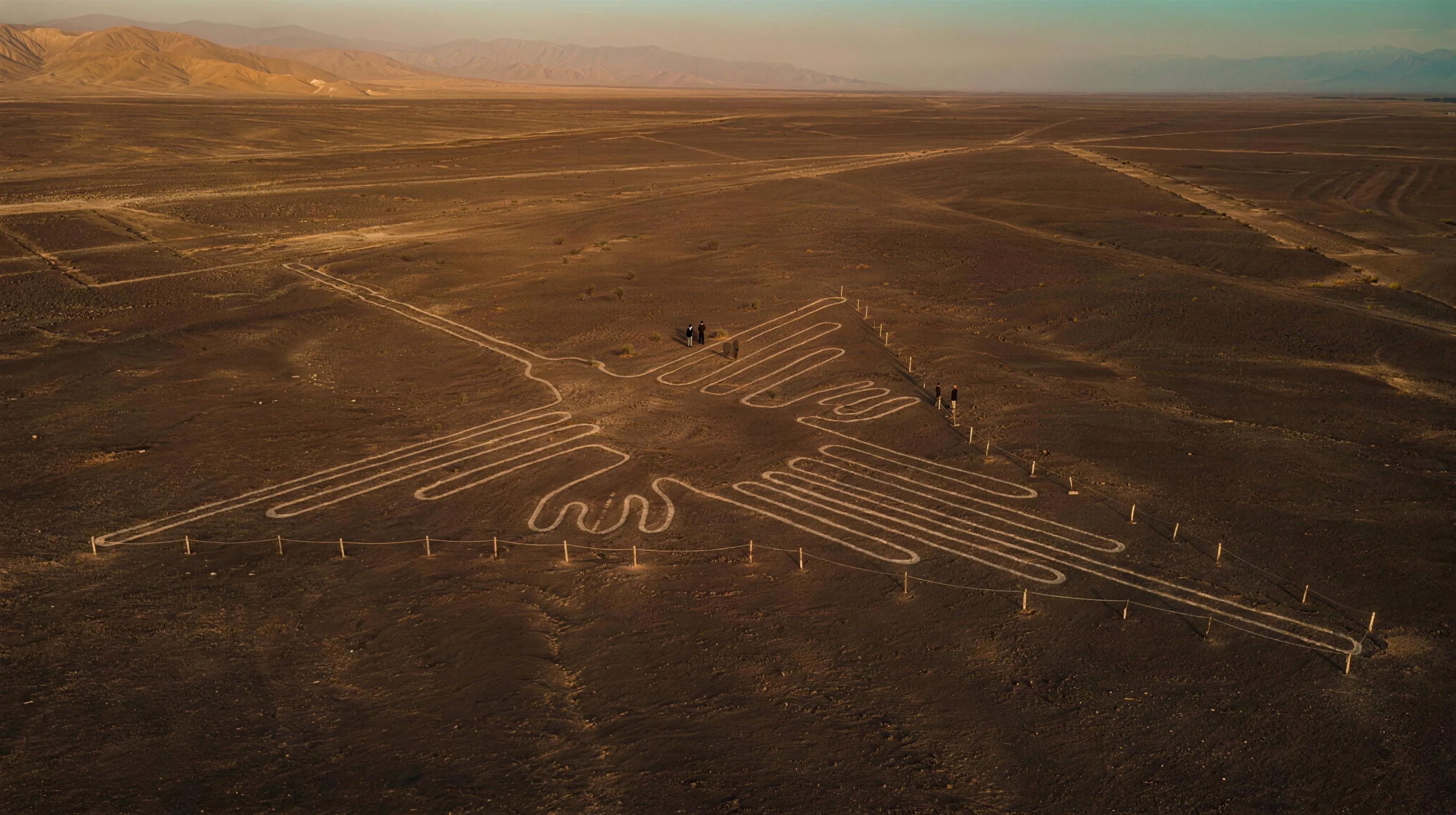
Somewhere between 500 BC and AD 500, people on a rainless plateau in southern Peru lifted dark stones off pale ground until the ground itself became a drawing: a 93-metre hummingbird, a 134-metre condor, trapezoids the size of airfields, and straight lines that run to the horizon without bending. The famous framing says they could never see what they were drawing, and hands the pampa to the sky: landing strips, balloons, star maps. This bench does what the framing never does: it prices the job. A sketch, a staked centre line and a knotted cord scale any figure to any size with no error penalty, because independent errors refuse to add up; a naked eye sighting over two stakes holds a kilometre straight to less than the width of a doorway; and at the clearing rate Aveni's volunteers measured with two sticks and a string, the entire pampa's thousand-year output is a village's spare time. Six people proved the point on a Kentucky landfill in 1982, staking a full-size condor in nine hours without ever leaving the ground. What the drawings meant is still genuinely open, and this instrument leaves it open. How they were drawn stopped being a mystery the moment anyone did the arithmetic.
 Open the interactive ▸
 What you're looking at
The Plot view is the bench's heart: a small gridded sketch, a staked centre line, and a crew driving stakes in real time. Choose the hummingbird, an average trapezoid or a kilometre straightaway; choose the centre-line coordinate method (the one Nickell demonstrated) or the sloppier peg-to-peg chain; dial the survey error σ and the stake count. Deviations draw at ×40 so you can see them at all; the readout carries the honest numbers, RMS = σ for coordinates, σ√k and a closure gap for the chain.
The Ground view is 3D because the claim it answers is spatial: the hummingbird at true 93 m scale on a staged pampa, with presets for every eye height the record names, standing, Reiche's ladder, the 13 m Mirador, the bordering rises (a labelled variable: no clean height is published), and the Cessna of Nickell's after-check. The foreshortening meter reads sin(grazing angle) live: 1:38 standing, 1:5 from the tower.
The Labour view is the clearing ledger: every job priced as area ÷ the 1984 Earthwatch measured rate, with a crew-size dial that turns person-days into calendar days. The reality anchor sits beside it: Nickell's six relatives, 165 points, nine hours. The counterpoint card is the balloon that flew for the joy of it.
The File view is the record on cards: six claims from runway to ritual pathway, each with its status; the sky-test card where tolerance and target dials feed the chance arithmetic under Hawkins' 39-of-186; and two verdicts at equal size, one closed, one deliberately open.
Why it's here
This bench is the third on the lost-civilisation line, kin to INST-39, The Piri Reis Map: both exist to price "the ancients couldn't have" claims. The hook is Culture 14's Fingerprints of the Gods source note: Hancock dismisses the alien-runway reading inside his first fifty pages, then substitutes another sky reading, Pitluga's spider-as-Orion. This station's Nazca wiki entry holds the same boundary: the leading archaeology reads ritual pathways and water, and the astronomical alignments never survived their statistics. What an instrument can pick up is the computable stratum underneath all of it: what tools scaling a drawing takes, what eye holds a line, what the clearing bill is in person-days, and what "alignment" is worth under luck alone.
It also lands a piece of physics that shakes hands directly with INST-35, Precession & the Orion Correlation: the grammar of correlation. Giza's question was "three pyramids onto three stars, how many free parameters"; Nazca's is identical, with "three lines chosen from fifteen" in its place. This bench's sky-test card runs that grammar to the end: 18 sky targets at ±1° paint a fifth of the compass, so chance hands 37 of Hawkins' 186 lines a hit for free, and he measured 39. At the other end, the Plot view joins the station's running error-propagation family: centre-line coordinates whose errors refuse to add, the same lesson as INST-50, the Blue Book statistics bench: before concluding anything, first compute what luck can do on its own.
How it works
Four closed forms, one measured rate, one conservative eye, and zero fitted constants. The panel tags every number exact, modelled, reported or reading.
RMS꜀ₒₒᵣ𝒹 = σ · RMS꜀ₕₐᵢₙ = σ√k · gap = σ√N · σₜ = 2εs · RMSₗₑₐₚ = σₜN³ᐟ²/√3 · squash = sin α · P(hit) = m·2t/180
The scale-up, exactly. The coordinate method fixes every point by distance-along + offset-out from one staked baseline, so each point carries one independent measurement error and the figure's RMS wobble equals σ whether the drawing is nine metres or three hundred. The chain method inherits each stake's error into the next: a random walk, σ√k, closure gap σ√N, eleven times worse at 120 stakes, and still only metres. Both are checked against 20,000-trial Monte Carlo in the tune script.
The dial's honesty. Every stake owns one unit-Gaussian noise pair drawn from a seeded stream; the σ dial multiplies that stream live. Turning the dial never re-rolls the crew, so what you compare across σ values is the same survey, scaled: an honest Monte Carlo you can steer.
The straightaway, exactly. Sighting over two stakes and planting a third mislays it by ~2εs, centimetres at 50 m spacing for a 1-arcminute eye. Leapfrogging that discipline down a kilometre integrates a heading random walk, σₜN³ᐟ²/√3, under two metres; sighting every stake from the original long baseline holds ε·L, under half a metre. The record's own hardware agrees: post remains at roughly mile intervals along real lines.
The labour, exactly on a measured rate. Aveni's 1984 Earthwatch crew cleared 35 m² in ninety minutes with two sticks and a string: 2.3 m² per person-hour. Every price on the bench is area divided by that number, nothing else: hummingbird ~12 person-days, average trapezoid ~1,100 (a month for a forty-person crew), the whole pampa's 3.6 million m² about 257,000, which across the ten drawing centuries is ~257 person-days a year.
The sky test, exactly. A line points both ways, so m targets at tolerance ±t cover m·2t of 180 azimuth degrees. Eighteen reasonable targets at ±1° cover 20%: of Hawkins' 186 lines, 37 hit for free, and he observed 39. The dials let you watch the free-hit count inflate as you admit more targets or loosen the tolerance, which is the entire grammar of correlation claims, here and at Giza.
What is deliberately not computed. No meaning for the lines; no probability across rival readings, because the priors do not exist; no pretence that the bordering hills have a published height (the foothill preset is a labelled variable); and no verdict on the one question the arithmetic cannot reach.
The error propagation, the sighting arithmetic, the foreshortening geometry, the labour division and the chance-hit fraction are exact and machine-checked; the hummingbird redraw, the pampa staging, the foothill height and the bookkeeping widths are labelled modelling; the dimensions, the pavement, the 1984 rate, Nickell 1982, Hawkins-Aveni and the balloon are reported as documented; and why they drew is a reading, for which the bench hangs two verdicts at equal size and adds no third.
The dials that decide what happens
A figure, a method, two error dials, five eye heights, a crew size and a sky-test tolerance: between them they hold every claim the file makes and every number the claims turn on.
- The subject. The 93 m hummingbird (a stylised single-stroke redraw, labelled), Aveni's average 16,000 m² trapezoid, or the kilometre straightaway where the real precision lived.
- The method. Centre-line coordinates versus peg-to-peg chain: the entire lesson of the bench in one toggle. One refuses to accumulate error; the other pays σ√N and still comes in under a metre at sensible σ.
- σ and the stakes. A log dial from 1 to 50 cm of cord error, and 40 to 240 stakes. Nickell used 165 points; he reckoned the Nazca used fewer.
- The eye heights. Standing 1.6 m, Reiche's ladder, the 13 m Mirador, the ~90 m foothill (labelled variable), the 300 m Cessna: the whole argument about visibility as five buttons.
- The crew and the sky dials. Six to two hundred workers repricing the ledger; tolerance ±0.5-3° and 6-30 targets inflating the free-hit count live.
The claims, as they stand
Five readings that orbit the pampa, from the leading pathways-and-water archaeology to the runway that began as a joke, with who carries each and where it lands once the arithmetic is done.
| Ritual pathways, walked, oriented on water carried by Aveni & Urton's survey; Reinhard, Silverman; the leading archaeology | BEST SUPPORTED | Best supported: the 762 mapped lines gather at 62 ray centres sitting on rises where water enters the valley; the figures are single unbroken paths a procession can walk without crossing its own trail; the 2024 PNAS survey's small relief figures cluster beside trails, an audience on foot. This is a reading about meaning, and the bench carries it as the leader without closing it. |
| The lines are an astronomical calendar carried by Kosok's first reading, developed by Reiche across her fifty years | DID NOT SURVIVE | Did not survive its test: Hawkins ran 186 lines against sun, moon, planets and stars and got 39 hits where chance alone predicts 37; he and Aveni closed the astronomical case jointly in 1990. The dignified ancestor of the sky readings, and the bench prices exactly why it failed: with 18 targets at ±1°, a fifth of the compass is a hit for free. |
| The spider maps Orion; lines track its belt through precession carried by Pitluga, carried into print by Hancock's Fingerprints of the Gods | READING | A reading resting on a personal communication, never published for checking; Aveni's audit: three lines chosen from the figure's fifteen, criteria undisclosed. The same correlation grammar INST-35 prices at Giza. Open in form, unpayable as evidence. |
| Building them required a view from the air carried by the premise underneath the ancient-astronaut reading, and the balloon's implicit brief | DID NOT SURVIVE | Did not survive arithmetic or demonstration: centre-line coordinates carry no scale penalty, a 1-arcminute eye holds kilometres straight, the labour is a village's spare time, and Nickell's crew of six staked the full-size condor in nine hours in 1982, from the ground, with the first aerial view as the after-check. The Condor I balloon (1975) proved a possibility and its own pilot said so: no evidence they flew, only that they could have. |
| The wide lines are landing strips for visitors carried by von Däniken, Chariots of the Gods? (1968) | DID NOT SURVIVE | Did not survive the record: the reading began as the 1947 surveyors' own joke (Kosok logs the nickname); the "aircraft parking area" photo is a bird figure's knee joint; and Reiche's rejoinder stands, the ground is soft, "I'm afraid the spacemen would have gotten stuck." Däniken's later tracks-preserved refinement concedes the construction to the Nazca. |
Try this
- Drive the stakes on the hummingbird at σ = 5 cm and watch the readout, not the picture. The picture wobbles because it draws error at ×40. The readout says RMS 5 cm, on a 93-metre bird. Now set σ to 30 cm, a hand-width of sloppiness: RMS 30 cm. The figure never gets harder as it gets bigger, and that sentence is the whole bench.
- Switch to the chain method and let it finish. The loop misses its own start by the red gap, σ√N, about half a metre at 5 cm and 120 stakes. Eleven times worse than coordinates, and still invisible from the Mirador. Even the bad method was good enough.
- Take the straightaway and compare the two disciplines. Leapfrog drifts under two metres per kilometre; the long baseline holds under half a metre. The reported straightness of the real lines is a couple of metres per kilometre. The eye was always sufficient, and the record kept the posts to prove it.
- Stand on the pampa in the Ground view, then climb. Standing: 1:38, the figure is gone, the line underfoot is obvious. The tower: 1:5, readable. The claim was never 'invisible from the ground'; it was 'invisible from an eye nobody was forced to use'.
- Set the crew dial to six and read the hummingbird's row. About two days. That is Nickell's crew, and his actual nine hours for the staking says the estimate is generous. Then set it to 10,000 and read the whole-pampa row against Aveni's decade.
- On the File view, drag the tolerance to ±2°. The free-hit count doubles past anything Hawkins observed. You have just manufactured an ancient observatory out of nothing, which is precisely why the astronomical reading needed statistics and failed them.
Accuracy
The honest line between what is exact, what is modelled here, what the record reports, and what is a reading:
| Feature | Tier | What that means |
|---|---|---|
| The scale-up arithmetic | T1 Exact | Error propagation in closed form, machine-checked against 20,000-trial Monte Carlo: centre-line coordinates carry an independent error per point (RMS = σ at any figure size); the peg-to-peg chain random-walks as σ√k with a σ√N closure gap, ~11× worse at 120 stakes and still only metres at figure scale. The dial multiplies one seeded unit-noise stream, so the picture is honest Monte Carlo and σ never re-rolls the crew. |
| The straightaway | T1 Exact | Sighting arithmetic at the conservative 1-arcminute eye: leapfrog discipline drifts as an integrated random walk to under 2 m per kilometre, a long baseline holds under 0.5 m. Post remains at roughly mile intervals along real lines (McIntyre 1975) are the record's own ranging poles. The real lines' "few yards every mile" figure is journalistic (Time 1974) and is carried with that label. |
| The labour and the sky test | T1 Exact | Every price is area ÷ the measured 1984 Earthwatch rate (10 people, 35 m², 90 minutes: 2.3 m²/person-hour): the hummingbird outline ~12 person-days, Aveni's average trapezoid ~1,100, the whole pampa's 3.6M m² ~257,000, i.e. ~257 a year across the drawing centuries. The chance-hit arithmetic hands 18 targets at ±1° a free 20% of all azimuths: 37 expected of Hawkins' 186, vs his observed 39. |
| The staging | T2 Modelled | The hummingbird outline is a stylised single-stroke redraw preserving the real property that matters (one unbroken, non-crossing line), not a survey tracing. The 3D pampa, its colours, the stake vignette and the bordering relief are staging; the record gives no clean foothill height, so ~90 m is a labelled variable. The 0.5 m working width and 6-hour day are labelled bookkeeping. |
| The record, whole | T3 Reported | Figure dimensions (hummingbird 93 m, condor 134 m; the monkey and largest-figure sizes are disputed across sources and quoted as ranges), the two-tone pavement and ~4 mm/yr rain, the C-14 stake at AD 525 ± 80, Nickell's 1982 reproduction (6 people, 165 points, 9 hours), Hawkins' 39-of-186 and the 1990 Aveni closure, the 762 lines and 62 ray centres, the 2024 PNAS survey, the Condor I balloon, Reiche's fifty years. |
| Why they drew it | T3 Reading | The meaning of the lines is carried as a reading and left open: ritual pathways, water and procession lead the archaeology; the sky readings failed their statistics; and the bench hangs two verdicts at equal size without voting. |
In one line: the error-propagation closed forms, the 1-arcminute sighting arithmetic, the sin α foreshortening, the labour division and the chance-hit fraction are EXACT and machine-checked against Monte Carlo, with no fitted constant anywhere; the hummingbird redraw, the pampa staging, the foothill height and the working widths are MODELLED and labelled; the dimensions, the pavement, the 1984 rate, Nickell 1982, Hawkins' 39-of-186, Aveni's ray centres and the balloon are REPORTED as documented; and why they drew is a READING, for which this bench hangs two verdicts at equal size and adds no third. Drive the stakes, climb the tower, and decide.
Sources
- Joe Nickell, "The Nazca Drawings Revisited: Creation of a Full-Sized Duplicate," Skeptical Inquirer 7(3), Spring 1983 (primary source, read in full): the 1982 condor reproduction, 6 people, 165 points, ~9 hours, centre line and knotted cord in "Nazca feet" of 12.68 in, the Cessna after-check, and the ground-recognition test.
- Anthony Aveni: Between the Lines (University of Texas Press, 2000); "Solving the Mystery of the Nasca Lines," Archaeology 53(3), 2000; the Discover retelling: the 1984 Earthwatch clearing experiment (10 volunteers, 35 m in ~1.5 hours, two sticks and a string), the 762 lines and 62 ray centres, the water-and-pathways reading, and the criticism of the spider-Orion selection.
- Gerald S. Hawkins, Ancient Lines in the Peruvian Desert (Final Scientific Report for the National Geographic Society Expedition, Smithsonian Astrophysical Observatory, 1969): 186 lines computer-tested against solar, lunar, planetary and stellar horizon positions; 39 hits, judged consistent with chance; the astronomical reading rejected, reconfirmed with Aveni in The Lines of Nazca (1990). Isbell (Scientific American, 1978) read the same numbers as twice chance; both readings are carried.
- Sakai et al., PNAS 121 (2024): the AI-assisted survey adding 303 figurative geoglyphs; relief-type figures averaging ~9 m, clustered beside trails.
- The record of the pampa: figures to ~285-305 m (largest disputed), hummingbird 93 m, condor 134 m, spider 47 m, monkey 93-110 m (disputed); >1,300 km of lines; ~3.6 million m² of cleared geoglyph surface; grooves 10-15 cm into iron-oxide varnished pavement over lime-rich silt; ~4 mm of rain a year; a wooden stake at one line terminus C-14 dated AD 525 ± 80; UNESCO listing 1994.
- Maria Reiche's five decades (1946-1998), the ladder, the broom, and the ~13 m Mirador tower by the Pan-American Highway (1976; tourism-source figures, labelled); her rejoinder on the soft ground via McIntyre, National Geographic, May 1975, the same article that records post remains at roughly mile intervals along the lines.
- Jim Woodman & Julian Nott, Condor I, 28 November 1975: the reed-and-cotton smoke balloon, ~90 m, briefly; Nott's own verdict that the flight proves capability, not history.
- Erich von Däniken, Chariots of the Gods? (1968) and after: the runway reading, its origin as Kosok's 1947 joke, the knee-joint photograph, and the later tracks-preserved refinement.
- Graham Hancock, Fingerprints of the Gods (1995): the source note this bench answers; Pitluga's spider-as-Orion carried as a personal communication; Hancock's own dismissal of the landing-strip reading.
- The eye: 1 arcminute as the conservative Snellen/Helmholtz alignment figure (modern foveal measurements run finer, ~0.64 arcmin; Ashraf, Chapiro & Mantiuk, Nature Communications 2025).
- All closed forms (RMS = σ, σ√k, σ√N closure, σ_t·N^1.5/√3 leapfrog, ε·L baseline, sin α foreshortening, the chance-hit fraction) are checked against Monte Carlo by scripts/nazca-tune.mjs, which is re-runnable and is the only source for every constant the instrument carries. This bench fits no constant anywhere.
- Cross-referenced instruments on this site: INST-35, Precession & the Orion Correlation, the same correlation grammar at Giza; INST-39, The Piri Reis Map, the sibling "ancients couldn't have" pricing bench; INST-50, Blue Book Special Report 14, what a statistics table actually says.
Drive the stakes. Climb the tower. Price the labour. Then decide what a drawing nobody needed to see is worth.
Open the interactiveCompiled August 2026