The Scorched Cap Bench
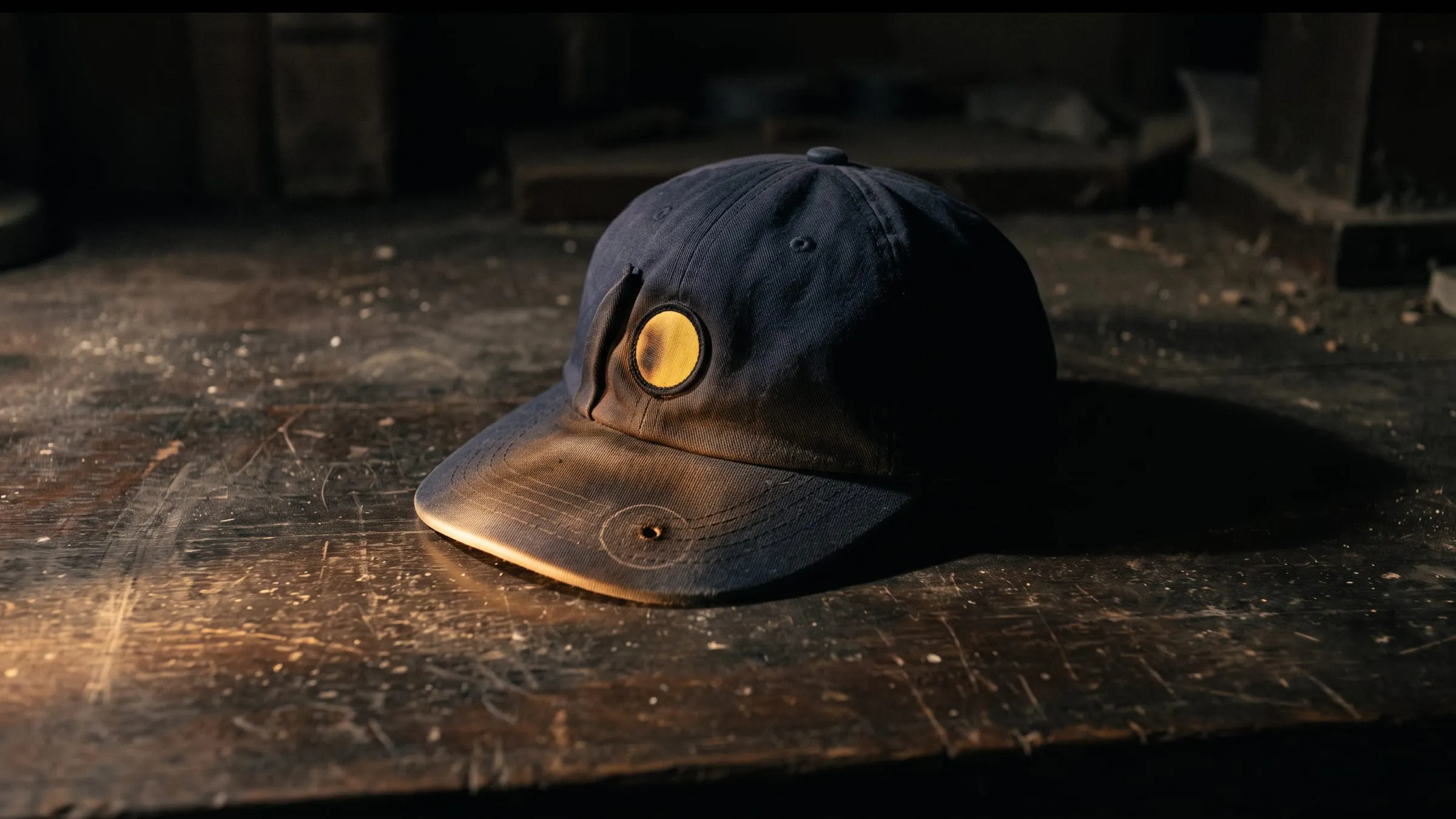
In a report of 3 September 1952 the FBI Laboratory gave the results of its examination of a cap from an alleged sighting near West Palm Beach, Florida: a cap with a bill and ‘the yellow and black emblem or insigne’, and three burned holes. Its report writes ‘The fact that the front edge of the cap bill is more severely scorched or singed than other portions of the cap suggests that the singeing could not have taken place when’ the principal was ‘fired upon from a position almost vertically above him’ (p. 176). Inside that sentence sits a piece of geometry: one source lights four faces of one cap, each by the cosine of its angle to the rays. At 85°, the bench's reading of ‘almost vertically above’, the bill's top and the crown's top each take 99.6 % of the full light, the emblem 42.3 % and the bill's front edge 0.0 %. With the bill tipped 10°, the edge receives more than the bill's top only below 35.0°, and more than the emblem only below 5.0°. The bench prints the laboratory's sentence beside the arithmetic and rules on neither.
Keep the signal
The station is free. No ads, no tracking cookies. If the files are worth your time, following is the support.
 Open the interactive ▸
What the record says
The record is DOW-UAP-D105, “US Air Force Flying Discs File September December 1952”, published in PURSUE Release 06 and read on this site by Release 06 Briefing 4. Its pp. 176 and 177 copy a laboratory report: ‘REPORT of the FBI LABORATORY’, ‘VIA LIAISON’, dated ‘September 3, 1952’, to the ‘Directorate of Special Investigations, The Inspector General, Department of the Air Force, The Pentagon, Washington, D. C.’, for the attention of ‘Mr. Gilbert R. Levy, Chief, Counter Intelligence Division’, signed ‘s/J. Edgar Hoover, JOHN EDGAR HOOVER, Director’. Its RE line reads ‘Unidentified Flying Object Allegedly Sighted’ by the principal, ‘West Palm Beach, Florida’; it carries ‘Your File No. 24-185’ and ‘Lab. No. PC-33720 DE’, answers ‘Reference: Letter dated 8-26-52’ and gives ‘Examination requested: Chemical Analyses’. Its one specimen is ‘Specimens: Q1 Cap’, the cap the principal ‘was wearing at the time of the alleged incident.’ (p. 176).
Under ‘RESULTS OF EXAMINATION’ the report writes ‘In answer to your specific inquiry, you are advised that the areas surrounding the three burned holes in the cap were examined for any residues which might indicate the nature of the incendiary material causing the burns, but no such residues were found.’ ‘Tests conducted on the sweatband of Q1 indicate that the residue from a glowing ember used to burn a hole in the cloth was easily dislodged and removed by handling and "roughing" the burned area.’ (p. 176). It goes on ‘Some observations made during the examination of Q1 may be of interest to you.’ ‘The major portion of the top side of the cap bill as well as the area surrounding the yellow and black emblem or insigne and the insigne itself have been subjected to the singeing action of a flame.’ ‘It is of interest to note that the singeing on these areas is not at all uniform as might be expected if the cap had been subjected to a single shot of a "red blob" of a fire of some kind.’ (p. 176).
The sentence this bench is built on comes next: ‘The fact that the front edge of the cap bill is more severely scorched or singed than other portions of the cap suggests that the singeing could not have taken place when’ the principal was ‘fired upon from a position almost vertically above him’ (p. 176). The paragraph ends on the fold, across the page break: ‘When the cap is observed from the front and left edge of the insigne and the fold in the blue cloth in the surrounding’ (p. 176) ‘areas are examined, the absence of singeing under the fold suggests the possibility that the cap was not being worn on the head when the singeing took place.’ (p. 177). The next line reads ‘It was noted that this fold "smoothed out" when the cap was placed on the head.’ (p. 177).
On the burned holes the report writes ‘As to what might have caused the burned holes in the cap, you are advised that on the cap bill there was noted an area of particular significance which has been circled with a pencil mark.’ ‘In this circle is a burned area approximately 1/32" in diameter.’ ‘It is believed to be too small to have been caused singularly and intentionally by’ the principal. ‘The appearance ofthe small burned spot suggests the possiblity that a small glowing ember of some kind, very hot but containing a small amount of heat, because of its size, fell on the cap bill, causing burns in two of the threads after which the glowing ember cooled off and fell off the cap bill.’ (p. 177). The 1/32 inch is 0.79 mm. The report ends ‘Specimen Q1 is being returned to you herewith.’ (p. 177).
Two papers of the Directorate of Intelligence sit beside it. The transmittal of ‘19 Sept 1952’ to the ‘Chief, Air Technical, Intelligence Center, Wright-Patterson AFB, Ohio’, signed ‘WILLIAM A. ADAMS, Colonel, USAF, Chief, Topical Division, Deputy Director for Estimates, Directorate of Intelligence, DCS/O’, says ‘Report of lab analysis performed by the Federal Bureau of Investigation on’ the principal's ‘cap is inclosed for your information and retention.’ ‘The cap is also returned herewith.’ It gives the reason the cap is not going back to its owner, ‘Since it was necessary to mark and cut the cap for analysis’, it is considered inadvisable to return it to the principal, and adds ‘It is believed preferrable to offer a replacement for it if there existed an agreement that it would be returned.’ (p. 175). The request stamped ‘SEP - 5 1952’, from the ‘Directorate of Intelligence, DCS/O’ to the ‘Counter Intelligence Division, Director of Special Investigations, The IG’ and signed ‘JOHN G. ERIKSEN, Colonel, USAF, Assistant Deputy Director for Estimates, Directorate of Intelligence’, opens ‘Subject was the principal in the alleged sighting of an unidentified flying object in the vicinity of West Palm Beach, Florida on the night of 19 August 1952.’ ‘A field investigation of a technical nature has been conducted by the Air Technical Intelligence Center, but no conclusive results have yet been obtained.’ It goes on that ‘there are indications of a possible hoax, viz. the results of the FBI lab analysis on’ the principal's cap, and the principal's actions ‘subsequent to the alleged sighting’ (p. 238). Those are the Directorate's words. The bench uses nothing else from that page.
What the bench computes
The bench draws the cap as four faces and one source. The source is far from the cap, so its rays arrive parallel and only their direction counts: ŝ = (cos α cos φ, cos α sin φ, sin α), with α the elevation above the horizon, 0 to 90°, and φ the azimuth from the wearer's forward, −90° to 90°, the front half only, so that no part of the cap shadows another. Each face has a unit normal n̂, and the share of light it receives is the Lambert cosine law, E = max(0, n̂ · ŝ), 100 % when the face is square to the rays. The crown's top faces straight up and takes sin α. The bill's top is tipped forward by the bill's tilt β and takes sin β cos α cos φ + cos β sin α. The bill's front edge faces forward and a little down and takes cos β cos α cos φ − sin β sin α. The emblem sits on the crown's front, leaning back by γ = 20°, and takes cos γ cos α cos φ + sin γ sin α. The bench works in these fractions of the full value because the laboratory's sentence compares portions of one cap, so no constant from outside the record enters.
At the bench's default, α 85°, φ 0° and β 10°, its reading of ‘almost vertically above’: the bill's front edge takes 0.0 %, the bill's top 99.6 %, the crown's top 99.6 % and the emblem 42.3 %. The edge receives nothing at all at and above 80.0°, where the rays arrive behind its face. With the source on the horizon straight ahead, α 0°, the order turns over: the edge takes 98.5 %, the emblem 94.0 %, the bill's top 17.4 % and the crown's top 0.0 %.
The edge and the bill's top receive the same where tan α* = cos φ · tan(45° − β): the crossing is 35.0° at β 10°, where each takes 70.7 %, and 45.0° with a level bill, β 0°. Below the crossing the edge takes more than the bill's top; above it, less. Straight ahead the edge takes more than the emblem too only below (γ − β) / 2, 5.0° at β 10°, where the two are level at 96.6 %. On the Ledger the band from 75 to 90° is shaded as the bench's reading of ‘almost vertically above’; across it, at the defaults, the edge takes the least of the four faces: 8.7 % at 75° and nothing from 80.0°.
The fold is the one place a face is hidden. Off the head the fold stands, and the bench gives the strip under it nothing from any direction; on the head the fold smooths out and the strip takes the crown top's share, 99.6 % at the default. The threshold, 10 to 100 % and 50 % by default, is where the Cap marks a face as scorched: a dial the bench sets, not a figure from the record. The cap's sizes in the bench's geometry are staging, a crown 9.5 cm in radius flattened to 0.85 of its height, a bill 7.0 cm forward by 17.0 cm wide, an emblem 2.5 cm in radius and a fold 4 cm by 1 cm: the figures come from the four normals alone, and the picture's 3D cap, taller and longer than that geometry, is fitted to its crown's width.
The bench's views are the Cap, the Ledger and the File. The Cap is a cloth cap from a 3D model, on a head form or resting on the laboratory bench, its shadow cast along the same direction, its cloth kept at its own colour and lifted a little where the light falls, its four faces labelled with the figures of the bench's four normals, the bill's top and the emblem marked as scorched by those figures, the source as a bulb on its arc with rays to the cap; its presets set the source almost vertically above, at the crossing, low and ahead, and on the horizon ahead. The Ledger draws the four faces against elevation at the current φ and β, with the band, the threshold and the crossing marked and the pointer reading the four values at any α. The File holds the record on cards, page by page. Not priced here: what burned the holes, what the source was, where it was, and whether the cap was worn.
Evidence
The record's sentences, the geometry and the bench's own choices, one row each, with the kind of claim each is and what the bench does with it.
| ‘In answer to your specific inquiry, you are advised that the areas surrounding the three burned holes in the cap were examined for any residues which might indicate the nature of the incendiary material causing the burns, but no such residues were found.’ ‘Tests conducted on the sweatband of Q1 indicate that the residue from a glowing ember used to burn a hole in the cloth was easily dislodged and removed by handling and "roughing" the burned area.’ stated by the FBI Laboratory's report, p. 176 | REPORTED | On the File with its page. The bench models no residue and no incendiary material: it works in the share of light each face receives. |
| ‘The major portion of the top side of the cap bill as well as the area surrounding the yellow and black emblem or insigne and the insigne itself have been subjected to the singeing action of a flame.’ ‘It is of interest to note that the singeing on these areas is not at all uniform as might be expected if the cap had been subjected to a single shot of a "red blob" of a fire of some kind.’ stated by the FBI Laboratory's report, p. 176 | REPORTED | The faces the bench draws: the bill's top, the emblem and the crown around it, with the bill's front edge beside them. One source shares its light unevenly among faces turned different ways; the bench does not say what the source was. |
| ‘The fact that the front edge of the cap bill is more severely scorched or singed than other portions of the cap suggests that the singeing could not have taken place when’ the principal was ‘fired upon from a position almost vertically above him’ stated by the FBI Laboratory's report, p. 176 | REPORTED | The sentence the bench prices: at 85° the edge takes 0.0 % and the bill's top 99.6 %; the edge receives more than the bill's top only below the crossing, 35.0° at β 10°. |
| ‘When the cap is observed from the front and left edge of the insigne and the fold in the blue cloth in the surrounding’ ‘areas are examined, the absence of singeing under the fold suggests the possibility that the cap was not being worn on the head when the singeing took place.’ ‘It was noted that this fold "smoothed out" when the cap was placed on the head.’ stated by the FBI Laboratory's report, pp. 176 and 177 | REPORTED | The fold on the Cap: standing off the head, where the strip under it receives nothing; smoothed out on the head, where the strip takes the crown top's share, 99.6 % at the default. |
| ‘As to what might have caused the burned holes in the cap, you are advised that on the cap bill there was noted an area of particular significance which has been circled with a pencil mark.’ ‘In this circle is a burned area approximately 1/32" in diameter.’ ‘The appearance ofthe small burned spot suggests the possiblity that a small glowing ember of some kind, very hot but containing a small amount of heat, because of its size, fell on the cap bill, causing burns in two of the threads after which the glowing ember cooled off and fell off the cap bill.’ stated by the FBI Laboratory's report, p. 177 | REPORTED | A File card, with 1/32 inch as 0.79 mm. The bench draws no hole and prices no ember. |
| ‘Report of lab analysis performed by the Federal Bureau of Investigation on’ the principal's ‘cap is inclosed for your information and retention.’ ‘Since it was necessary to mark and cut the cap for analysis’ stated by the Directorate of Intelligence's transmittal to ATIC, 19 September 1952, p. 175 | REPORTED | On the File as the Directorate's words, with its page. |
| ‘A field investigation of a technical nature has been conducted by the Air Technical Intelligence Center, but no conclusive results have yet been obtained.’ ‘there are indications of a possible hoax, viz. the results of the FBI lab analysis on’ the principal's cap stated by the Directorate of Intelligence's request, 5 September 1952, p. 238 | REPORTED | On the File as the Directorate's words, from the page's first paragraph and its identifying lines only. The bench adds nothing to it. |
| E = max(0, n̂ · ŝ), the Lambert cosine law, on the four faces' normals stated by this bench | EXACT | At 85°, φ 0°, β 10°: the edge 0.0 %, the bill's top 99.6 %, the crown's top 99.6 %, the emblem 42.3 %; the edge receives nothing at and above 80.0°. On the horizon ahead: the edge 98.5 %, the bill's top 17.4 %. |
| The crossing, tan α* = cos φ · tan(45° − β); the emblem bound, (γ − β) / 2 stated by this bench | EXACT | 35.0° at β 10°, each face 70.7 %; 45.0° at β 0°. Straight ahead the edge receives more than the emblem only below 5.0°. |
| The cap's shape: a crown 9.5 cm in radius flattened to 0.85, a bill 7.0 cm by 17.0 cm, an emblem 2.5 cm in radius, a fold 4 cm by 1 cm stated by this bench | MODELLED | Staging on the Cap; the record gives the cap no dimension, and the figures depend on the normals alone. |
| The bill's tilt β, 0° to 30° (10°); the emblem's tilt γ, 20° stated by this bench | MODELLED | A dial and a constant, each labelled modelled: the record gives the cap no angle. |
| The scorch threshold, 10 to 100 % (50 %) stated by this bench | MODELLED | Where the Cap marks a face as scorched. A dial, not a figure from the record. |
| ‘almost vertically above’ read as 85°, with the band from 75 to 90° stated by this bench | MODELLED | The default, a preset and the shaded band on the Ledger, each labelled as the bench's reading of the record's words. |
| That the singeing could not have taken place with the principal fired upon from ‘almost vertically above’ stated by the FBI Laboratory, p. 176 | READING | Shown as the laboratory's, beside the geometry it rests on: across the band, at the defaults, the edge takes the least of the four faces. The bench does not say where the flame was. |
| That the cap was possibly not being worn on the head stated by the FBI Laboratory, p. 177 | READING | Shown as the laboratory's, beside the geometry it rests on: the strip under a standing fold receives nothing from any direction. The bench does not say whether the cap was worn. |
Two readings
The two readings, at equal size:
WHAT THE RECORD SAYS · REPORTED
the laboratory's sentence: the front edge more severely scorched
The report finds no residue around the three burned holes, and singeing on the bill's top and around the emblem ‘not at all uniform’ (p. 176). It writes that ‘the front edge of the cap bill is more severely scorched or singed than other portions of the cap’, and draws from it that the singeing could not have taken place with the principal fired upon from ‘almost vertically above’ (p. 176); and from ‘the absence of singeing under the fold’ that the cap was possibly not being worn (p. 177). The bench repeats the sentences with their pages and adds no adjective. It does not say what happened on the night.
WHAT THE GEOMETRY GIVES · EXACT
four faces, one cosine law
E = max(0, n̂ · ŝ) on four normals. At 85° the bill's top and the crown's top take 99.6 %, the emblem 42.3 % and the edge 0.0 %; the edge receives more than the bill's top only below the crossing, 35.0° at β 10°, and more than the emblem only below 5.0°. Under a standing fold the strip receives nothing; on the head it takes the crown's share. These are what the cosine law gives; none of it says where the flame was or whether the cap was worn. The reading is yours.
The story
The interactive walks through the bench in this order:
- The specimen. The laboratory's report of 3 September 1952 examined one cap, with a bill and a yellow and black emblem, and found no residue around its three burned holes.
- One source, four faces. A far source sends parallel rays, and each face takes the cosine of its angle to them, so the crown's top, the bill's top, the bill's front edge and the emblem each take a share of their own.
- Almost vertically above. At 85°, the bench's reading of the laboratory's words, the bill's top and the crown's top take 99.6 % and the front edge 0.0 %.
- The edge heaviest. The edge receives more than the bill's top only below the crossing, 35.0° at β 10°, and more than the emblem only below 5.0°.
- The fold. Off the head the strip under the fold receives nothing from any direction, and on the head, where the fold smooths out, it takes the crown's share.
- The Ledger. The four faces are drawn against elevation, with the band from 75 to 90°, the threshold and the crossing marked.
- The File. The transmittal of 19 September and the request of 5 September stand beside the report, each in its own words and with its page.
Where the case connects
The case is on this site already. Release 06 Briefing 4 reads DOW-UAP-D105 and its paragraph on the laboratory's report, and the wiki keeps a node on the West Palm Beach Incident 1952. Both call him the principal, and so does this bench. The two inferences the bench sets beside its geometry, that the singeing could not have taken place with the fire from almost vertically above and that the cap was possibly not being worn, are the laboratory's, in its own words. The request of 5 September is the Directorate's, quoted above with its page; the bench uses its first paragraph and the lines that identify it, nothing else.
On the casework line it sits beside benches of the same kind. INST-63 The Ubatuba Magnesium prices a laboratory's analysis of an exhibit; INST-73 The Radiation Dose prices burns against a described source; INST-86 The Westall Two-Channel Bench prices a 1960s case on its witnesses' geometry.
Sources
- DOW-UAP-D105, “US Air Force Flying Discs File September December 1952”, PURSUE Release 06: p. 175, the Directorate of Intelligence's transmittal to ATIC of 19 September 1952; pp. 176 and 177, the FBI Laboratory's report of 3 September 1952; p. 238, the Directorate of Intelligence's request of 5 September 1952, its first paragraph and the lines that identify it only.
- On this site: Release 06 Briefing 4; the wiki node on the West Palm Beach Incident 1952; INST-63 The Ubatuba Magnesium, INST-73 The Radiation Dose, INST-86 The Westall Two-Channel Bench.
The bench needs no outside source: it works in fractions of one cap's own light, and no material constant enters.