Gravity
The orbits themselves, what gravity does to anything moving through space.
 Open the interactive ▸
 What you're looking at
A handful of bodies, each pulling on every other by the ordinary law of gravity, left to move however that law sends them. Drop a planet next to a star and it falls into an ellipse. Give two equal masses a sideways push and they chase each other around a common centre. Add a third and the whole thing becomes unpredictable, the famous three-body problem, where a tiny change in where you start sends the future somewhere else entirely.
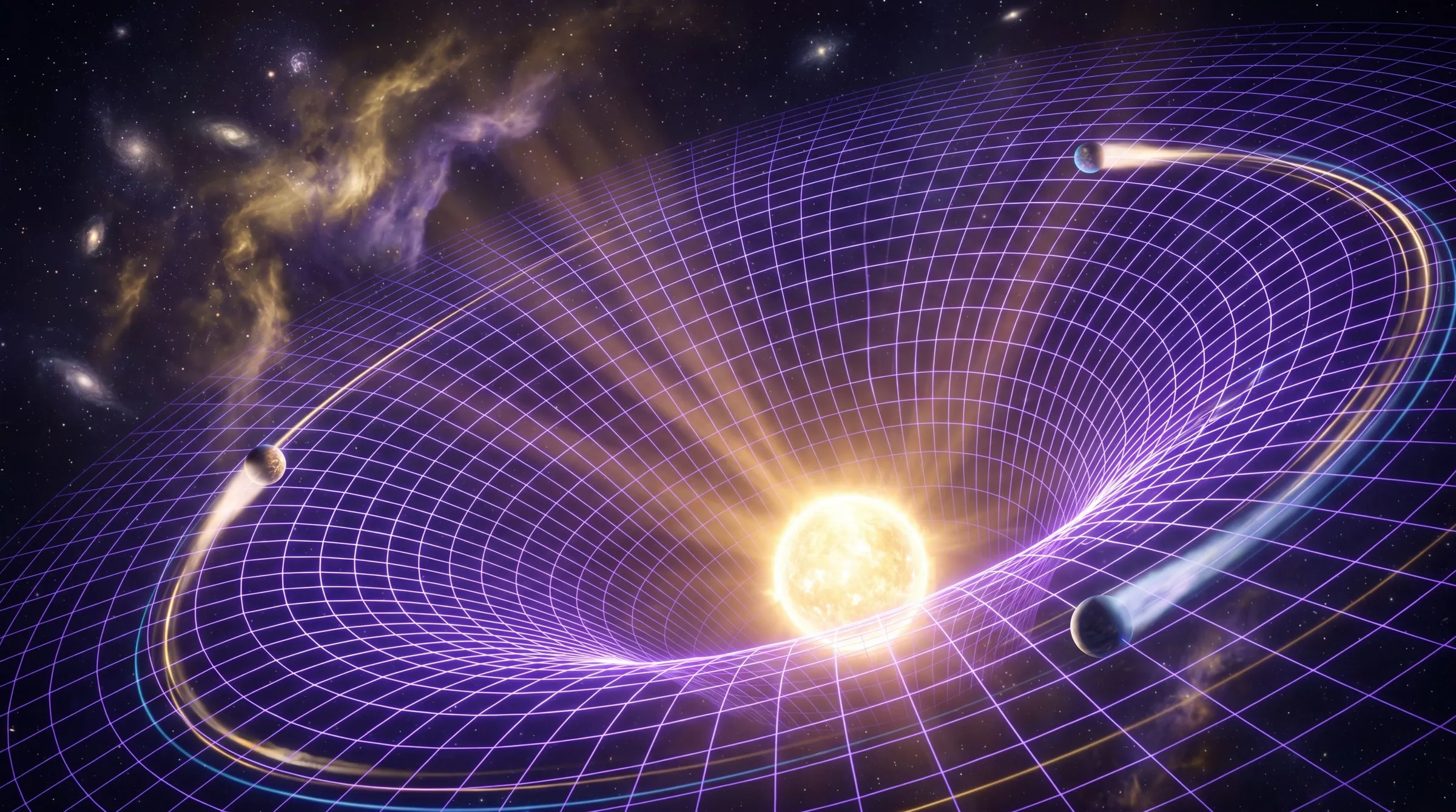
Underneath the bodies, a grid dips and glows: a picture of the gravity well they are moving through, deepest where the mass is greatest. None of the motion is animation. Each body's path is computed, frame by frame, from the summed pull of all the others.
Why it's here
This site spends most of its time at the edge of the evidence, on craft described as moving by bending space rather than pushing against it. The Black Hole page is the confirmed counterpart to that speculation: gravity taken to the limit where it bends light itself. But before light-bending, before relativity, there is the plain thing underneath, the same law that holds a planet in orbit. That law is the bedrock, and this is a picture of it running on its own.
It is here to be the honest baseline. The black hole shows you what curved space does at the extreme of mass; the warp drive shows you the speculative route of extreme energy. This shows you the floor both of them stand on: gravity as Newton wrote it, four centuries old, exact, and still the thing every orbit in the sky obeys.
(Cross-link: see The Bubble for the two routes to warping spacetime that the rest of the site is about.)
How it works
Every body attracts every other as G·m₁·m₂ / r², the inverse-square law. With several bodies that becomes the N-body problem: each one feels the combined pull of the rest, and its acceleration points along the sum of those pulls. The simulation steps that forward in time with velocity Verlet, a symplectic integrator chosen because it keeps the total energy from drifting, so orbits stay closed over long runs instead of slowly spiralling from numerical error. A live energy-drift readout shows exactly how faithful the run is staying; in practice it holds to a few thousandths of a percent over dozens of orbits.
Two practical guards keep the sandbox stable: a small softening length stops a near-direct hit from producing an infinite force, and bodies that overlap merge, conserving mass and momentum. The dipping grid is the gravitational potential drawn as a surface, the classic rubber-sheet, included as an honest analogy, not as the source of the motion. The bodies move by the law; the sheet just follows them. Switch it off and nothing about the orbits changes. The slider numbers are in sandbox units scaled so the orbits fit the screen; dropped objects carry real-world masses for flavour, mapped onto that same scale. It is the ratios that are physical, not the readings.
The scenes
The selector offers starting points. Each is only a saved arrangement of masses and velocities, a place to begin, not a separate mode.
- Kepler. One star, one planet, a clean ellipse. The textbook two-body case and the honest baseline. Start here.
- Binary. Two equal masses orbiting their shared centre, no fixed "sun," just a balance.
- System. A star with several planets at different radii, a miniature solar system, each on its own near-circular orbit.
- Earth. Our own backyard: Earth with the Moon on a wide, slow orbit and a satellite skimming close and fast. The same "closer is faster" rule that keeps the space station low and quick.
- Slingshot. A light probe falling past a heavy primary on a hyperbolic flyby, the geometry behind a real gravity assist.
- Three-Body. The famous figure-eight: the rare choreography where three equal masses share one stable orbit. It is the exception that proves the rule, because there is no general solution to the three-body problem. Nudge it, drop something into it, and watch the choreography tip into chaos. This is where the simulation earns its keep.
- Menagerie. A star ringed by everyday things, a person, a cat, a fridge, a car, an elephant, all in orbit. The point is that gravity only asks how much mass and where, never what the object is.
- Empty. A blank stage: just the grid, ready for you to drop objects and build a system from scratch.
You can also build your own: under Drop an object, pick something, then click on the sheet and drag to set a direction and speed before letting go. Adjust the gravity strength, the new body's mass, and the flow of time with the sliders.
Accuracy
The honest line between what is exact and what is stylised:
| Feature | Tier | What that means |
|---|---|---|
| Orbital motion (inverse-square gravity) | T1 Established | Newton's exact law, summed over every pair. The orbits are genuine solutions of the N-body problem, not animations. |
| Velocity-Verlet integration | T2 Numerical | A symplectic, energy-stable scheme with sub-stepping. Faithful within a small drift shown live on screen. |
| Close-encounter softening & merging | T3 Simplified | A softening length prevents infinite forces; overlapping bodies merge while conserving mass and momentum. Not how every real collision behaves. |
| The "spacetime well" grid | T4 Analogy | A teaching picture of the gravitational potential, not real spacetime. The rubber-sheet's known flaw is that it uses gravity to explain gravity; here it is decoration that tracks the field, and the motion is never derived from it. |
| Star background | T4 Illustrative | Procedurally scattered points, not a star catalogue. |
In one line: the motion is real Newtonian physics, integrated honestly; the rubber-sheet is an analogy laid underneath it so you can see the shape of the field the bodies are actually moving through. It is an educational and artistic visualisation, not a research-grade orbital integrator.
Sources
- Newton, I. (1687). Philosophiæ Naturalis Principia Mathematica. The law of universal gravitation.
- Verlet, L. (1967). Computer "Experiments" on Classical Fluids. Physical Review 159, 98–103. The integration scheme.
- Hairer, E., Lubich, C., & Wanner, G. (2006). Geometric Numerical Integration. Springer. Why symplectic methods conserve energy over long runs.
- Misner, C. W., Thorne, K. S., & Wheeler, J. A. (1973). Gravitation. Embedding diagrams and the limits of the rubber-sheet analogy.
- Poincaré, H. (1890). Sur le problème des trois corps et les équations de la dynamique. Acta Mathematica 13, 1–270. The roots of deterministic chaos.