The Bell Frame-Drag Bench
Spin the drums as described: two mercury drums of 3,670 and 2,713 kg, 6,383 kg in all, inside a bell about three metres tall, one at +10,000 rpm and one at −10,000. On the axis two metres away a gyroscope would precess at 1.5 × 10⁻²² rad/s, 9.8 × 10⁻⁷ milliarcseconds a year; Gravity Probe B measured the Earth's frame dragging at 37.2 ± 7.2 mas/yr, 3.8 × 10⁷ times more, and the bench recomputes its predicted 39.2 from the fact-sheet Earth before it prices a drum. Counter-rotation, the description's own word, cancels most of the far field; co-rotating, the same drums give 3.9 × 10⁻²². The outer rim moves at 628 m/s and presses 427 MPa on its wall. The drums' mass slows a clock at the probe by 2.4 × 10⁻²⁴, and Marckus's 'thousandth of one percent', taken one metre away (the bench's distance, not his), is the potential of 1.35 × 10²² kg, 0.18 of the Moon. Van Stockum's cylinder closes a timelike curve at this spin only beyond 143 km of radius with 2.6 × 10¹⁵ kg/m³ on its axis, infinitely long; at mercury's density the spin is one turn in 44 minutes and the radius 0.42 AU. The accounts' words stay on the cards as printed. The bench rules on no device.
Keep the signal
The station is free. No ads, no tracking cookies. If the files are worth your time, following is the support.
 Open the interactive ▸
 What you're looking at
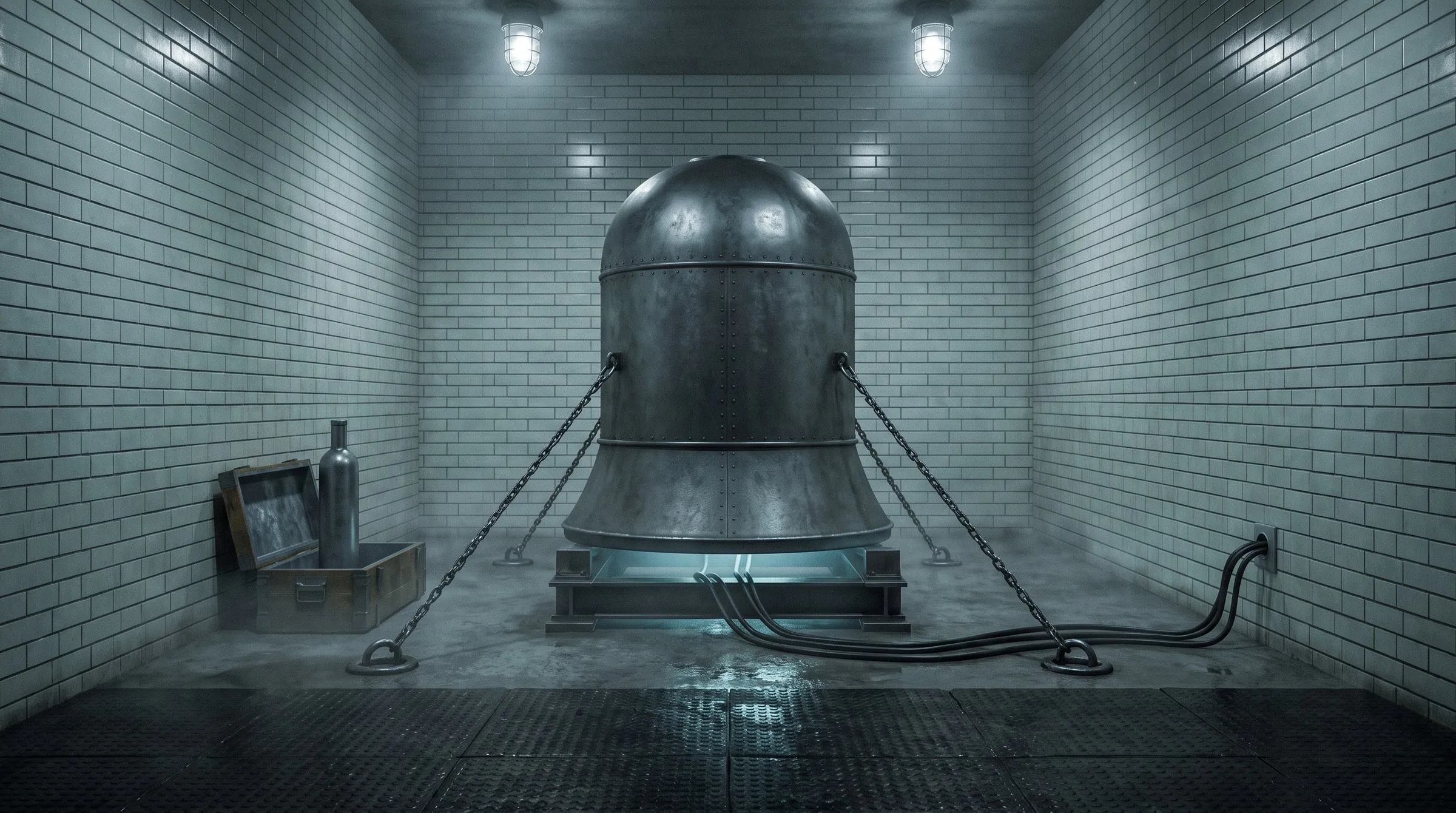
The Drums is the chamber in 3D: about 30 square metres of tiled floor and walls with rubber matting, as the testimony describes it, a bell of dark metal on a rig held down by chains, two drums spinning inside it at the dials’ rates (slowed for the eye), the frame-dragging field drawn as lines coloured by strength, and a probe gyroscope on the axis with its precession rate. The chamber, the bell, the chains and the pale glow at the base are staging from the accounts; the drums’ sizes are the bench’s inside the description’s nine to twelve feet. Drag to orbit, move the probe, click a chip.
The Sweep is the precession at the probe against the drums’ spin, both axes logarithmic, with the band Gravity Probe B measured and the dashed line it predicted, the same drums co-rotating, the outer drum alone, the spins at which the fill’s pressure reaches three tabulated steel yields, and the rotor the backlog row named. The field is linear in the spin, so every curve has slope one and no spin alone reaches the band.
The Clocks is one ladder of clock-rate offsets: what the drums’ mass does to a clock at the probe, what the rim’s speed does to its own, Marckus’s two figures and his extreme example, and Jorjani’s line, which carries no figure and is shown without one. The Threshold draws the radius and the axis density van Stockum’s infinite dust cylinder needs against spin, with the drum placed on both curves, mercury’s and the Earth’s densities as lines, and the caveats printed under the chart. The File holds the description, the testimony, the measured world and the formulas on cards, and two cards at equal size: what the accounts say, and what the arithmetic gives.
Why it is here
The Bell already has its pieces on this site: the signed review of Cook's The Hunt for Zero Point, the signed review of Jorjani's Closer Encounters, and Die Glocke in the wiki. Both reviews weigh the story; this bench does not weigh it again. It does something else. Inside the description sits one plain mechanical statement, "two counter-rotating drums" of a dense fill, and what a spinning mass does to the space-time around it is a question general relativity answered long ago and has since measured on the Earth. Lense and Thirring computed in 1918 that a rotating body drags the inertial frames around it; Schiff computed in 1960 how a gyroscope nearby would precess; Gravity Probe B flew four cryogenic gyroscopes for a year and measured the Earth's figure: 37.2 ± 7.2 milliarcseconds a year, against a prediction of 39.2. That is a ruler, ready made.
So the instrument does two things. First it calibrates the ruler: from the NASA fact sheet's Earth (mass, radius, I/MR², the sidereal day), Gravity Probe B's 642 km polar orbit and the declination of its guide star IM Pegasi, it recomputes the paper's predicted 39.2 milliarcseconds a year and gets 39.2; the tune does not pass until it does. Then it prices the drums: two drums spinning against each other as described, their sizes set by dials inside the "nine to twelve feet", their frame-dragging field summed over the mass current and checked against the Lense-Thirring dipole and the closed forms Tajmar et al. 2007 print for a ring and a shell, a probe gyroscope on the axis reading the precession with the ruler beside it. Then the rest of what the accounts say: time "flowing at a different rate", Marckus's "thousandth of one percent", a device that "had to be chained down". The bench puts what the drums' mass and the rim's speed do to a clock on one ladder with those figures, and takes the one rotating cylinder in general relativity that does close a timelike curve, van Stockum's, and computes from its condition the radius and density this spin would need. On the site's propulsion line it fills a gap no bench had touched: Electrogravitics prices Biefeld-Brown, The Podkletnov Impulse prices the spinning-superconductor claim, and rotating-mass general relativity had no bench. The accounts stay on the cards as printed, with their authors and footnotes; the bench rules on no device, and prints the numbers beside them.
How it works
Everything on the bench is arithmetic on general relativity’s weak field, the published measurements of the Earth’s frame dragging, and the printed condition of one exact solution; the drums’ sizes, fill, spin and the probe’s distance are dials. The script that ships with the site re-derives every displayed number, and reproduces Gravity Probe B’s prediction, before the build is allowed to pass.
Ω(x) = (2G/c²) ∫ ρv × (x − x′) / |x − x′|³ dV · far field (G/c²r³) [3(J·r̂)r̂ − J] · ring centre 4Gmω/(c²(R_o + R_i)) · shell axis 2GIω/(c²z³) · GP-B: GJ/(2c²a³) cos δ · p = ½ρΩ²(R² − R_i²) · ΩR/c > 1/2 · ρ₀ = Ω²/(2πG)
The field. Each drum is a shell of fill between R − t and R over its height, spinning rigidly with it: m = ρπ(R² − (R − t)²)h, I = ½m(R² + (R − t)²), J = Iω. In the weak field a gyroscope near a mass current precesses the way a compass needle feels a current: Ω(x) = (2G/c²) ∫ ρv × (x − x′)/|x − x′|³ dV, the Biot-Savart form with μ0/4π replaced by G/c² and the factor two that makes a spinning body’s far field the Lense-Thirring dipole, (G/(c²r³))[3(J·r̂)r̂ − J], 2GJ/(c²z³) on the axis. The bench sums the integral over rings of fill, analytically on the axis and in segments off it, and the tune pins it against the two closed forms Tajmar et al. 2007 print, 4Gmω/(c²(R_o + R_i)) at a ring’s centre (within 0.5 percent) and 2GIω/(c²z³) on a shell’s axis (within 1 percent at twenty radii), and against the equatorial −GJ/(c²r³).
The ruler. The Earth’s angular momentum from the NASA fact sheet, J = 0.3308 MR² · 2π/T = 5.85 × 10³³ kg m²/s; a circular polar orbit at 6,371 + 642 km; the dipole averaged over that orbit is GJ/(2c²a³) about the Earth’s axis (the tune derives the one half numerically), and a spin axis pointing at IM Pegasi, declination +16.84°, drifts west to east at that rate times cos δ: 39.2 mas/yr, against the paper’s 39.2 (the bench’s figure is 39.22). Gravity Probe B measured 37.2 ± 7.2; LAGEOS gave 99 ± 5 percent of the prediction. 37.2 mas/yr is 5.7 × 10⁻¹⁵ rad/s, the frame dragging Gravity Probe B measured, and the Sweep’s band hangs there.
The rim, the clocks and the threshold. The rim moves at ΩR; the fill presses p = ½ρΩ²(R² − (R − t)²) on the drum wall; the rim’s own clock runs slow by 1 − √(1 − v²/c²). A clock at distance z from the drums’ mass M runs slow by GM/(c²z); the mass that puts a fraction ε on a clock one metre away is εc²/G. Van Stockum’s rotating dust cylinder, read through Lobo’s 2007 review, closes a timelike curve in its exterior for ΩR/c > 1/2, so R_min = c/(2Ω); its dust is held by its own gravity, which on the axis is Newton’s balance 2πGρ₀ = Ω², so ρ₀ = Ω²/(2πG). Tipler 1974 read the infinite cylinder; a finite one is his suggestion, and Hawking 1992 is quoted beside it. Tajmar’s classical coupling for his niobium ring is eq. (4) at its centre with the ring’s printed dimensions and niobium’s tabulated density.
No constant is fitted to the accounts: they give the bench no number to fit, only a shape and a word, counter-rotating. The choices are the dials: each drum’s radius, height, fill and spin, the fill’s density, the probe’s distance; every finding is quoted at the description preset and across the dials.
The dials that decide the result
Four presets and two free drums. Together they draw the description, its opposite, the backlog row’s rotor and Tajmar’s ring, and the dials reach any other.
- The description. Two mercury drums, radii 0.60 and 0.45 m, 1.5 m tall, a 5 cm fill, +10,000 and −10,000 rpm, the probe 2 m up the axis. The default: net J 7.6 × 10⁵ kg m²/s, 1.5 × 10⁻²² rad/s at the probe, 628 m/s and 427 MPa at the outer rim.
- Co-rotating. The same drums turning the same way: net J 1.8 × 10⁶, 3.9 × 10⁻²² rad/s at the probe, 2.5 times the counter-rotating figure. Two drums of equal inertia spun oppositely leave no far field at all.
- The board’s rotor. The backlog row’s one solid mercury cylinder, 1 m across, 1,000 kg, 10,000 rpm, read 1 m from its centre: 1.5 × 10⁻²² rad/s by the exact sum, 1.9 × 10⁻²² by the far-field formula the row itself names. Neither is the row’s own figure (see the claims table).
- Tajmar’s ring. The paper’s niobium ring (outer diameter 150 mm, wall 6 mm, height 15 mm, 0.35 kg) at 400 rad/s, read at its own centre: a classical coupling Ω/ω of 7.2 × 10⁻²⁷ beside the 3 to 5 × 10⁻⁸ the paper reports.
- The drums. The outer drum’s radius 0.2 to 1.5 m and the inner’s 0.1 to 1.4 m, height 0.1 to 3 m, fill 1 to 50 cm, spin −20,000 to +20,000 rpm; the inner drum on or off; mercury, thorium or a dialled density; the probe 0.5 to 200 m up the axis, which reaches the testimony’s 150 to 200 m.
The claims, as they stand
The accounts’ sentences, the measured values and the formulas one by one, and where each lands when the drums are built and spun.
| 'It had two counter-rotating drums inside of it, filled with a Mercury-Thorium isotope' stated by Jorjani, Closer Encounters 3.4, p. 111 | REPORTED | Taken at its word. The description gives no size, mass or spin beyond a bell of nine to twelve feet; the bench stages two mercury drums of 0.60 and 0.45 m radius, 1.5 m tall, 5 cm of fill, at ±10,000 rpm, 6,383 kg in all, and every one of those is a dial. |
| 'it would open up a supermassive vortex that distorts the space-time continuum around the Bell' stated by Jorjani, 3.4, p. 112 | REPORTED | What general relativity gives for the drums described: a frame-dragging precession of 1.5 × 10⁻²² rad/s on the axis 2 m away, 9.8 × 10⁻⁷ mas/yr, 3.8 × 10⁷ times below the Earth’s measured 37.2 ± 7.2; at the testimony’s 150 m, 3.3 × 10⁻²⁸. At this order the model gives the drums’ spin nothing beyond that precession; their mass gives a clock offset of 2.4 × 10⁻²⁴. The sentence’s own meaning is not a number the bench can read. |
| 'the rapid spinning of two cylinders in opposite directions' stated by Sporrenberg’s testimony as Witkowski relays it, Cook ch. 20 | REPORTED | Counter-rotation subtracts the drums’ angular momenta: the far field follows the net J, 7.6 × 10⁵ kg m²/s, and the same drums co-rotating give 3.9 × 10⁻²² rad/s, 2.5 times more; two drums of equal inertia spun oppositely leave no far field at all. Counter-rotation, the account’s own word, lowers the far field the drums give. |
| 'time was flowing at a different rate for them inside the laboratory than for people outside'; 'perhaps of the order of a hundredth or a thousandth of one percent' stated by Jorjani, p. 112; Marckus as Cook quotes him, ch. 23 | REPORTED | The drums’ mass offsets a clock at the probe by 2.4 × 10⁻²⁴; the rim’s own clock runs slow by 2.2 × 10⁻¹². A thousandth of one percent one metre away is the potential of 1.35 × 10²² kg, 0.18 of the Moon; a hundredth, 1.8 Moons. Frame dragging moves no clock at this order. Jorjani’s sentence carries no figure and the ladder shows it without one. |
| 'it would produce a local gravitational field that caused it to levitate so rapidly that it had to be chained down in a specially designed rig' stated by Jorjani, 4.1, p. 136, footnoting Farrell | REPORTED | In the weak field the model gives the spinning mass no force from its own field; the acceleration its frame dragging gives a body passing at speed v is of order vΩ, which for v of 1 m/s at the probe’s Ω is 1.5 × 10⁻²² m/s² against g’s 9.8. The rig and the chains are drawn as staging and priced nowhere. |
| 'a frame-dragging drift rate of −37.2 ± 7.2 mas/yr, to be compared with the GR predictions of … −39.2 mas/yr' stated by Everitt et al. 2011, Phys. Rev. Lett. 106, 221101 | MEASURED | The bench recomputes the prediction from the fact-sheet Earth, the 642 km polar orbit and IM Pegasi’s declination: 39.22 mas/yr. The measurement, 5.7 × 10⁻¹⁵ rad/s, is the ruler every drum is read against. |
| 'it is 99 +/- 5 per cent of the value predicted by general relativity … we allow for a total +/- 10 per cent uncertainty' stated by Ciufolini and Pavlis 2004, Nature 431, 958 | MEASURED | Carried as printed, with Everitt et al.’s description of the LAGEOS laser-ranging analyses as a 10 to 30 percent measurement. Both results are the Earth’s, a body of 5.85 × 10³³ kg m²/s. |
| Ω = (G/c²r³) [3(J·r̂)r̂ − J]; a ring’s centre 4Gmω/(c²(R_o + R_i)); a shell’s axis 2GIω/(c²z³) stated by Lense and Thirring 1918 and Schiff 1960 as Everitt et al. cite them; Tajmar et al. 2007, eqs. 4 and 5 | ESTABLISHED | The bench’s Biot-Savart sum reproduces the ring formula within 0.5 percent and the shell formula within 1 percent at twenty radii, and the equatorial −GJ/(c²r³); the tune fails the build otherwise. |
| van Stockum’s exterior 'contains CTC provided ωR > 1/2'; 'a rapidly rotating infinite cylinder'; 'the averaged weak energy condition must be violated on the Cauchy horizon' stated by Lobo 2007 (arXiv:0710.4474); Tipler 1974; Hawking 1992 | ESTABLISHED | At 10,000 rpm the condition asks for R > 143 km and an axis density of 2.6 × 10¹⁵ kg/m³, and the cylinder is infinite; at mercury’s density the spin that fits is one turn in 44 minutes and the radius 0.42 AU. A finite cylinder is Tipler’s suggestion; Hawking’s condition is quoted beside it. The drums are finite and made of ordinary matter. |
| 'a relatively large coupling constant of 10⁻⁸ between the observed acceleration effect and the applied angular velocity' stated by DOW-UAP-D131, p. 14 (its own page 10), on Tajmar’s rings | REPORTED | Tajmar et al. 2007 give B_g/ω of 3 to 5 × 10⁻⁸ for their rings, 1.3 to 2.2 × 10⁻⁸ under their subtractions, and a Gravity Probe B upper limit below 10⁻⁹; their own eq. (4) gives the niobium ring a classical coupling of 7.2 × 10⁻²⁷. D131 writes "acceleration effect" and Tajmar writes B_g/ω; the bench quotes each as printed and equates nothing. D131: the effect "continued to approach the noise floor". |
| The pitch: 'a 1 m, 1 t mercury rotor at any plausible rpm gives about 1e-30 rad/s' and 'Tipler’s rotating-cylinder condition for closed timelike curves (neutron-star density, infinite length)' stated by the bench’s pitch on the backlog board | REPORTED | By the row’s own formula, 2GJ/(c²r³), that rotor at 10,000 rpm gives 1.9 × 10⁻²² rad/s one metre away, and the exact sum 1.5 × 10⁻²²; at 100 rpm, 1.9 × 10⁻²⁴. The row’s 10⁻³⁰ is not reproduced by any reading of its inputs. Van Stockum’s axis density depends on the spin, 2.6 × 10¹⁵ kg/m³ at 10,000 rpm, not a fixed "neutron-star density". The bench carries its own figures and quotes the row’s as the board’s. |
| What the bench amounts to stated by this bench | READING | One description, one testimony, one ruler. The accounts describe a vortex that distorts space-time, time at a different rate and a device that had to be chained down; for the drums they describe, the arithmetic that gives the Earth its 39.2 mas/yr gives 1.5 × 10⁻²² rad/s. The bench prints the number beside the accounts and rules on neither. |
Try this
- Start in the chamber. Watch the field lines: two loops run against each other where the drums meet, and the far field, which follows the net angular momentum, is the small difference the counter-rotation leaves.
- Switch the inner drum off. The far field grows to the outer drum’s own; switch to co-rotating and it grows again. Then set both drums to the same size and opposite spins and watch the probe read zero.
- Move the probe. Slide it from 2 m to the testimony’s 150 m: the reading falls as the cube of the distance, to 3.3 × 10⁻²⁸ rad/s.
- Sweep the spin. On the Sweep, run the outer drum to 20,000 rpm: the curve climbs with slope one and the band is still more than 10⁷ above; the dotted steel marks arrive long before.
- Read the clocks. Compare the amber marks with the gold: the rim’s own clock at 2.2 × 10⁻¹² is the largest time effect in the model, and it is on the metal.
- Find the threshold. On the Threshold, read off R_min and the axis density at 10,000 rpm, then at mercury’s density find the one spin that fits and the 0.42 AU the cylinder must then reach.
- Finish in the file. The description, the testimony, the measured world, Tajmar’s ring beside D131’s sentence, and the two cards at equal size.
Accuracy
The honest line between what is reported, what is measured, what is established, what is tabulated, what is arithmetic on them, what is a choice, and what is a reading:
| Feature | Status | What that means |
|---|---|---|
| The description and the testimony | Reported | Jorjani, Closer Encounters 3.4 and 4.1: the drums, the fill, the vortex, time at a different rate, the chained rig, the glow. Cook, The Hunt for Zero Point ch. 20 and 23: the testimony as Witkowski relays it (two cylinders in opposite directions, Xerum 525, the chamber, the tests, 150 to 200 m) and Marckus's figures. D131 p. 14 on Tajmar's coupling constant. Each quoted as printed, with its author and footnotes. |
| The Earth’s frame dragging | Measured | Gravity Probe B: −37.2 ± 7.2 mas/yr against a predicted −39.2, four gyroscopes, a 642 km polar orbit, August 2004 to August 2005 (Everitt et al. 2011). LAGEOS: 99 ± 5 percent of the prediction, ± 10 allowed (Ciufolini and Pavlis 2004). |
| The formulas and the condition | Established | Frame dragging in the weak field as Lense and Thirring 1918 and Schiff 1960 give it, cited through Everitt et al.; the closed forms for a ring and a shell as Tajmar et al. 2007 print them; van Stockum’s exterior condition ΩR/c > 1/2 as Lobo 2007 and Dutta et al. 2022 state it; Tipler 1974 and Hawking 1992 by their abstracts. |
| The constants | Tabulated | The Earth’s mass, radius, I/MR² and sidereal day and the Moon’s mass from the NASA fact sheets; G from CODATA 2022; IM Pegasi’s declination from SIMBAD; the densities of mercury, thorium and niobium and three steel yields from reference tables. |
| The arithmetic | Exact | The field summed over the drums’ mass current and its far field; the Earth calibration that returns 39.2 mas/yr; the rim speed, wall pressure and rim clock; the clock offsets; van Stockum’s radius and axis density for a given spin; Tajmar’s classical coupling by his eq. (4). Checked in the tune against the printed closed forms, the published prediction and the Newtonian balance. |
| The dials, and what is staged | Modelled | The drums’ radii, heights, fill thickness and spin, the fill’s density, the probe’s distance: the accounts give none of them. The chamber, the bell, the rig, the chains and the glow are staging. The electrical supply, the shocks, the fill’s composition, radiation and the biological effects are not modelled. |
| What it amounts to | Reading | What the distance between the accounts and the numbers means is a reading, and the bench declines to make it for you; the board row’s figures are quoted as the board’s, never as the bench’s. |
In one line: Every sentence of the description and the testimony is quoted as printed and attributed; the measurements are the published ones; the formulas are the published ones and the tune reproduces them; the drums’ sizes and spin are named as choices; and what the distance between the accounts and the numbers means is left with the reader, where the bench leaves everything about the device.
Sources
- Jorjani, J. R., Closer Encounters (2021), section 3.4 "The Saucer Airframe and Project Chronos", pp. 111 to 112 (the drums, the fill, the vortex, the time distortion), and section 4.1 "UFOs as Time Machines and Matrix Re-programmers", p. 136 (the rig, the chains, the glow, the "10- or 11-foot-tall" prototype); his footnotes to Cook (Century, 2001: pp. 182 and 191 to 192 on the description, p. 193 on the time sentence) and to Farrell, The SS Brotherhood of the Bell (2006), on the sentence before the description and on the 4.1 passage. The site’s signed review of the book.
- Cook, N., The Hunt for Zero Point (Broadway Books, 2002), chapter 20 (Witkowski relaying Sporrenberg’s testimony: the metal, the fill, the flask, the two cylinders, Xerum 525, the chamber, the tests, the 150 to 200 m, the samples) and chapter 23 (Marckus on time: the extreme example and "a hundredth or a thousandth of one percent"). The site’s signed review of the book and its wiki nodes on Die Glocke, Xerum 525, Jakob Sporrenberg, Igor Witkowski and the Wenceslas Mine.
- Everitt, C. W. F. et al. (2011) "Gravity Probe B: Final Results of a Space Experiment to Test General Relativity" Physical Review Letters 106, 221101 (arXiv:1105.3456): the abstract’s drift rates and predictions, the introduction’s account of Schiff 1960 and Lense and Thirring 1918, the 642 km polar orbit, the guide star IM Pegasi, Table II (the four gyroscopes), and its description of the LAGEOS result.
- Ciufolini, I. & Pavlis, E. C. (2004) "A confirmation of the general relativistic prediction of the Lense-Thirring effect" Nature 431, 958 to 960, the abstract (99 ± 5 percent; ± 10 percent allowed).
- Tajmar, M., Plesescu, F., Seifert, B., Schnitzer, R. & Vasiljevich, I. (2007) "Search for Frame-Dragging-Like Signals Close to Spinning Superconductors" (arXiv:0707.3806): eq. (4), the classical field at a ring’s centre; eq. (5), on a shell’s axis; the rings’ dimensions; the reported coupling factors (3 to 5 × 10⁻⁸; 1.3, 1.6 and 2.2 × 10⁻⁸); the Gravity Probe B upper limit; the systematics statement.
- DOW-UAP-D131, "AAWSAP DIRD The Role of Superconductors in Gravity Research March 23 2010", U.S. Department of War, PURSUE Release 06, p. 14 of 16 (the document’s own page 10): the Tajmar paragraph. The site’s Release 06 briefing on D131, D132, D135 and D152.
- Tipler, F. J. (1974) "Rotating cylinders and the possibility of global causality violation" Physical Review D 9, 2203, the abstract; Hawking, S. W. (1992) "Chronology protection conjecture" Physical Review D 46, 603 to 611, the abstract.
- Lobo, F. S. N. (2007) "Exotic solutions in General Relativity: Traversable wormholes and ‘warp drive’ spacetimes" (arXiv:0710.4474), section IV.A.1: the van Stockum interior metric (eq. 205), CTCs for ωr > 1 inside and ωR > 1/2 outside, the summary and its reservations; Dutta, A., Roy, D. & Chakraborty, S. (2022), arXiv:2208.14768, p. 1, the same condition. The axis density ρ₀ = Ω²/(2πG) is the bench’s own derivation from the Newtonian balance of rigidly rotating dust, checked in the tune.
- NASA/NSSDC Earth fact sheet (last updated 15 November 2024): mass 5.9722 × 10²⁴ kg, volumetric mean radius 6,371.000 km, I/MR² 0.3308, sidereal rotation period 23.9345 h, mean density 5,513 kg/m³; Moon fact sheet (11 January 2024): mass 0.07346 × 10²⁴ kg. CODATA 2022 (NIST), G = 6.674 30(15) × 10⁻¹¹ m³ kg⁻¹ s⁻². SIMBAD, IM Peg (HR 8703), ICRS declination +16° 50′ 28.30″. IAU 2012, 1 AU = 149,597,870,700 m.
- Reference tables, read 1 October 2026: the densities of mercury (13.546 g/cm³, room temperature), thorium (11.725 g/cm³ at 20 °C) and niobium (8.582 g/cm³ at 20 °C), and the yield strengths of ASTM A36 (250 MPa), ASTM A514 (690 MPa) and prestressing strands (1,650 MPa); tabulated, labelled so on the face.
- On this site: Electrogravitics (INST-32), The Podkletnov Impulse (INST-76) and The Vanishing Literature (INST-81), the propulsion-line benches this one sits beside; the technology topic page.