ECM Phantom Targets
A radar has to pay for the round trip: its pulse spreads on the way out, scatters, and spreads again coming home, so the echo falls as the fourth power of range. A jammer riding the target pays one leg only, and falls as the square. That single difference of exponent is the whole of electronic attack, and it means a few hundred watts on a pylon can beat several kilowatts in a nose. Everything that follows is built on it: noise that denies range while advertising bearing, a repeater that captures a tracking gate and walks it into empty air, a digital memory that replays the radar's own pulse as a formation that never existed. This instrument builds that bench, and then draws the line the subject usually blurs. Electronic attack writes to a receiver. It does not write to a lens, or to an eye.
 Open the interactive ▸
 What you're looking at
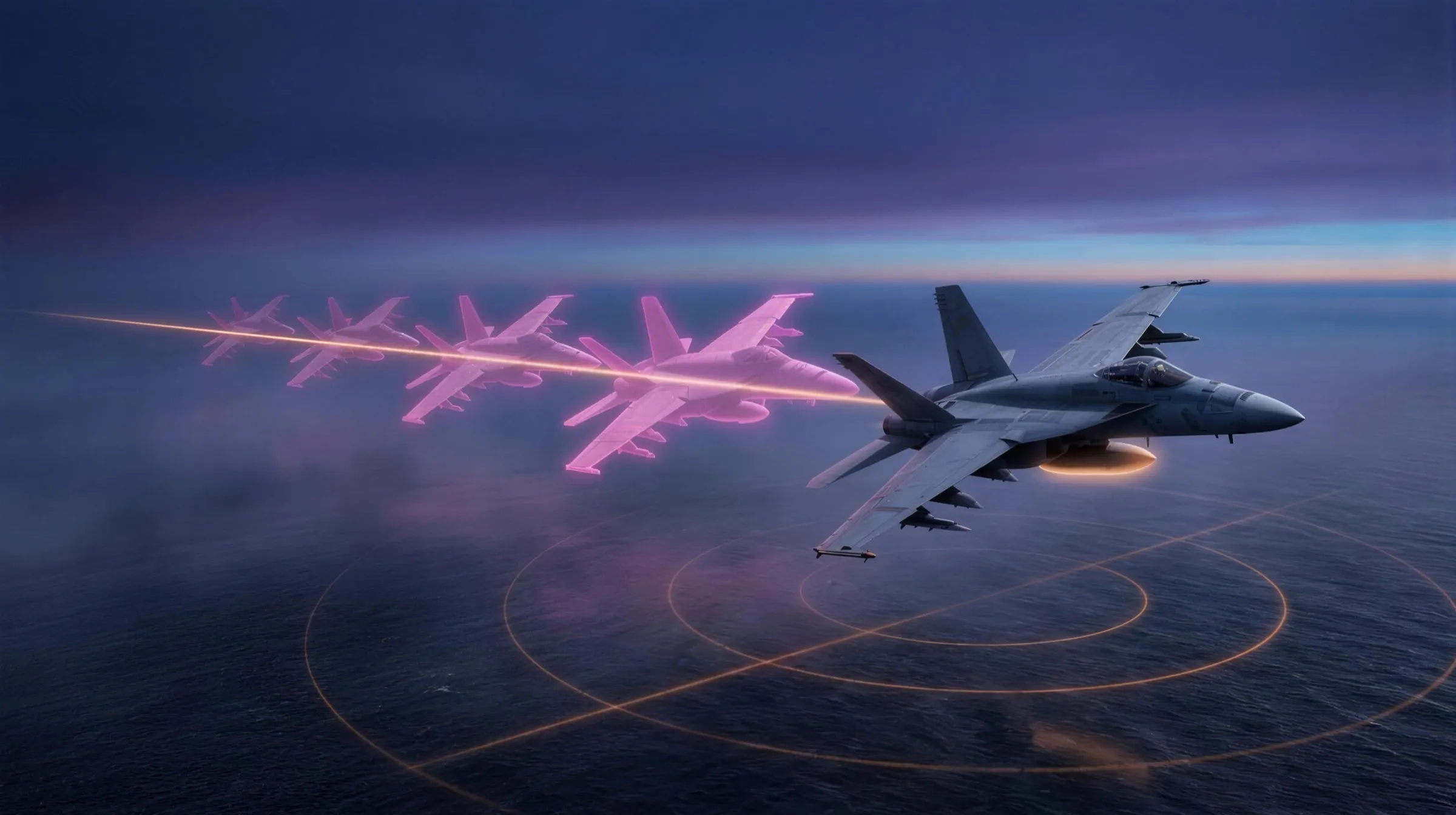
The Engagement view is the picture from outside, and it is built to make one point immediately: there is one aircraft out there. Everything pink is what the radar was handed. The real jet flies an ordinary trajectory the entire time while its phantoms stretch away down the bearing, the pod glows under the wing, and a mint ring floats at burn-through, the range inside which the radar takes the argument back. Range is compressed logarithmically and the aircraft are drawn hundreds of times oversized, both disclosed in the panel, because two 17 m jets 60 km apart are otherwise invisible.
The Scope view is the same seconds from the operator's seat: a B-scope with bearing across, range up, and a real phosphor persistence buffer, so the beam paints and the returns fade the way a scope actually behaves. Watch the tracking gate get captured and walked off the aircraft, then dumped with nothing in it. Watch a noise strobe deny every range on one bearing while advertising exactly where the jammer is. And click any two blips: the machine reports the speed a single object would have needed, next to the note that nothing accelerated, because a delay register changed instead.
The Duel view is the whole contest on one chart: the integrated skin return, the jammer's power at the receiver, the thermal noise floor, and the detection threshold the echo has to clear. The two power curves have different slopes, so they cross, and where the green climbs back over the red is burn-through. Drag anywhere to slide your range along it. Turn the pod up and the crossing moves out but never disappears, which is the honest summary of what jamming buys: a clock, not a cloak.
The Debrief view is why this instrument is on this site rather than in a radar textbook. Six cards set released Range Fouler language beside what on this bench makes that exact picture: the three contacts moving amongst each other, the contacts gone in a thirtieth of a second, the noise jamming the same crew logged, and the printed field asking whether electronic attack was indicated. Two of the cards run the other way, and they are kept deliberately: the file that records negative ES, and the sensor block that reminds you this bench cannot make an infrared image at all.
Why it's here
Two briefings on this site read the same piece of paper: the U.S. Navy's Range Fouler form, and three debriefs released with the video they describe. Between the trackfile fields and the shape checklist, that form carries a printed line asking whether electronic attack was indicated. Bureaucracies do not print fields for exotic possibilities. It is there because on a training range, ruling electronic warfare in or out is an ordinary thing you have to do every time. And in one released copy, DOW-UAP-D58, noise jamming is logged in the same encounter as the unidentified contacts.
This instrument is the tool that goes with that field, and the sister of INST-30, Washington 1952: that one is about how the atmosphere puts targets on a scope that are not in the sky, and this one is about how people do it deliberately. Together they are this site's full argument that a radar picture is not the same thing as an object. But the boundary has to be stated first, and stated louder than the conclusion: every technique here writes to a radar receiver. None of them puts a hot spot in an infrared image, and none of them puts anything in front of a human eye. GoFast and Gimbal work the optical and infrared layer; this bench works only the radar layer. So what it offers is never "that sighting was electronic warfare", but something smaller and more useful: a known engineering practice makes this picture too.
How it works
One exponent runs the whole instrument. Everything else is bookkeeping against it, and every number on screen computes live.
S = Pt G² λ² σ / ((4π)³ R⁴ L) · J = ERP G λ² / ((4π)² R² Lj) × min(1, B/Bj) · N = k Ts B · detection when n·S/(N+J) ≥ threshold · phantom range = R + cτ/2
The echo pays a round trip and the jammer does not. The transmitted pulse spreads over a sphere on the way out, a fraction of it scatters off the target, and that fraction spreads over a sphere again coming home: 1/R⁴. The jammer is on the target, so its energy makes one crossing: 1/R². Their ratio therefore grows as R², and at long range the contest is not close. This is why a self-protection pod of a few hundred watts is a serious problem for a radar of several kilowatts, and why nobody solves jamming by simply buying more transmitter.
Burn-through is arithmetic, not engineering. Detection is declared when the integrated echo clears the threshold above the raised floor, n·S/(N+J) ≥ 13 dB. Substituting the two power laws turns that into a quadratic in R², so this instrument solves burn-through in closed form rather than hunting for it. The consequence is the honest headline of the whole subject: because the slopes differ, the curves must cross, and no amount of jammer power deletes the crossing. It only pushes it inward.
Bandwidth is where a jammer throws its power away. Only the fraction of the jammer's spectrum that lands inside the receiver counts, so barrage noise spread over 400 MHz surrenders about 26 dB against a 1 MHz receiver, while spot noise parked on the frequency keeps all of it. That is the entire tactical trade: spot is far stronger and requires knowing the frequency, barrage is weaker and does not care. Switch on frequency agility in the panel and watch the spot jammer collapse to the barrage case, because it is now answering a radar that has moved.
A false target is a delay, and a delay has no inertia. A repeater receives the pulse, holds it, and retransmits, so the radar computes range from cτ/2 where τ was chosen. Grow τ steadily and the tracking gate walks off the aircraft; stop transmitting and the gate is left holding empty air. Because the phantom moves by arithmetic, its apparent speed is unbounded, which is exactly what the Scope view's speed machine is for. The equivalent radar cross-section this implies, 4π·ERP·R²·L/(Pt·G·Lj), grows as R² and gets absurd at long range, which is itself a giveaway and the reason real systems attenuate to look plausible.
And every move has a published answer. Leading-edge tracking defeats a pull-away outright, since a repeater's echo is always later than the skin return. A Doppler notch discards chaff once it has slowed to the air, about a second after launch. Home-on-jam converts the noise strobe into a bearing worth flying down. The toggles on the panel are not decoration: switch one on and the verdict line changes to tell you which side just won, and why. That symmetry is the reason this instrument concludes with a limit rather than an explanation.
The techniques are documented engineering, fielded and taught. The numbers are a generic radar and a textbook detection model, disclosed as such. The record quoted in the Debrief is primary, released by the U.S. Department of War, and includes at least one file this bench plainly cannot explain. What electronic attack can put on a scope is a question with an answer, and this instrument gives it. Whether it put anything on any particular scope is a different question, and this instrument leaves it exactly where the files leave it.
The six attacks on the dial
Each preset is a technique that exists, with the dials set where it is worth watching.
- No jamming. The baseline: the range equation on its own, and the one honest number that comes out of it, the range at which this target stops clearing the detection threshold. Everything else on the bench is an argument about where that number should sit.
- Barrage noise. Power spread across 400 MHz, of which the receiver sees one megahertz. Most of the pod is thrown away and it still works: the floor rises above the echo, range dies, and the scope keeps the one thing noise cannot hide. A strobe of noise on the jammer's exact bearing.
- Spot noise. The same pod, parked on the radar's frequency, with every watt in band. Far deeper denial, and brittle in one specific way: it has to know the frequency. Turn on frequency agility and watch it fall apart, which is precisely why agility is standard.
- Range-gate pull-off. The repeater answers each pulse louder than the aircraft, captures the tracking gate, then adds microseconds until the gate is walking through empty air, and finally stops. The tracker never reports an error. It reports a target, and then loses one.
- DRFM false targets. Sample the pulse, store the waveform, replay it as several coherent copies with any kinematics the software likes. They survive Doppler processing because they are the radar's own signal. Watch the signature the instrument draws honestly: they are all on one bearing, because a delay buys range, never angle.
- Chaff. A cartridge of half-wave dipoles: for a moment the cloud outshines the aircraft by more than an order of magnitude. Then it slows to the air within about a second, and a radar filtering on Doppler stops seeing it. The oldest technique here, and the one with the shortest clock.
The readings, as they stand
Four claims about what this bench shows, with who argues each and where it lands. Two are settled physics, one is the question the speed machine exists to sharpen, and one is the sweeping reading this instrument declines to endorse.
| The exponent: a jammer starts ahead because it pays one way argued by the radar range equation; every electronic-warfare text since Skolnik | LEADING | Settled physics, and the reason the whole field exists. The echo falls as 1/R⁴ and the one-way jammer as 1/R², so their ratio grows as R². Nothing on this bench is arguable at this level; the arguments start at what you can build on top of it. |
| Burn-through: the radar always wins eventually, and that is the catch argued by the same equations, read for their crossing point | LEADING | Also settled, and routinely under-stated. Because the two curves have different slopes they must cross, so jamming buys range and seconds rather than invisibility. Any account of electronic attack that leaves out burn-through is selling something. |
| Impossible kinematics on a scope are evidence of impossible kinematics argued by the intuitive reading, and a good deal of commentary | OPEN | Open, and the reason for the speed machine in the Scope view. A false target moves by having its delay changed, so its apparent speed is limited by arithmetic rather than by air, structure or crew. That does not make every impossible track a false target; it does mean "what could fly like that" is the second question, after "did anything fly". |
| Electronic warfare explains the released UAP record argued by a recurring skeptical reading of the Navy files | READING | Unpaid on the record as released, and this instrument is where that shows. It fits some scope descriptions well. It cannot touch DOW-UAP-D56, where the form records negative ES, negative radar track and negative IFF, and it cannot produce any of the infrared imagery the strongest files rest on. A candidate, sometimes a good one, never a general answer. |
Try this
- Watch a lock die and nothing happen. Load Range-gate pull-off, open the Scope, and follow the gate. It captures, walks off across empty sky, then drops with nothing in it. Now look at the Engagement view: the aircraft has been flying straight and level the entire time. The tracker never reported an error, only a target and then a loss.
- Set an impossible speed on purpose. Stay in pull-off, run the rate to 1,200 m/s, and read the value beside the dial in miles per hour. Then click two blips on the scope for the machine's verdict. Nothing accelerated; a number in a register grew.
- Find where the duel turns over. Open the Duel view with Barrage running and drag your range inward until the green curve climbs back over the red floor. That crossing is burn-through. Now raise the jammer ERP as far as it goes: the crossing moves out, and it never disappears.
- Break a jammer with one switch. Load Spot noise, note the burn-through range, then turn on Frequency agility. The jammer is now answering a radar that has moved, its power spreads across the hop span, and the denial collapses. The verdict line will tell you which side just won.
- Watch chaff work and then stop working. Load Chaff with the Doppler notch off, and the cloud is an enormous return. Turn the notch on and wait a second: the cloud slows to the air, the filter throws it out with the ground clutter, and the aircraft is alone again. Decoy for a moment, not a cloak for a minute.
- Look for the tell. Load DRFM with eight false targets and study the Scope. They can be given any speeds and any manoeuvres, but they cannot be given different bearings, because delay buys range only. Then open the Debrief and read the card that quotes three contacts moving amongst each other, together with the card that records negative ES.
Accuracy
The honest line between what is documented, what is modelled here, what the record reports, and what is a reading:
| Feature | Tier | What that means |
|---|---|---|
| Chaff works, and has since 1943 | T1 Measured | Strips cut to half the radar wavelength resonate and scatter. Britain and Germany each found the trick years before either used it, each withholding it because the enemy would copy it within days. The RAF dropped it over Hamburg on the night of 24 July 1943 and German night-fighter control lost the bomber stream in the returns. It is still fitted to aircraft today. |
| Range-gate pull-off and DRFM false targets are fielded equipment | T1 Measured | A repeater that answers a radar louder than the target itself can capture a tracking gate and walk it away; a digital RF memory can store the waveform and replay it as several coherent copies at chosen delays. These are described in the open engineering literature and taught in standard electronic-warfare texts. Nothing on this bench is speculative technology. |
| Every technique here has a published counter | T1 Measured | Leading-edge tracking defeats a pull-away, because a repeater can only answer a pulse it has already received. Frequency agility strands a spot jammer on a frequency the radar has left. A Doppler notch throws out chaff with the ground clutter. Home-on-jam turns the noise strobe into a bearing. The duel is symmetric and both sides of it are in the textbooks. |
| The radar on this bench, and every number it prints | T2 Modelled | A deliberately generic X-band set: 10 GHz, 33 dBi, 1 MHz receiver, 5 kW peak, 800 K noise temperature, 4 dB losses, 128 pulses integrated, detection at 13 dB. Those are textbook teaching figures chosen to land near published detection ranges against a few square metres, not the parameters of any fielded system, and the panel says so. |
| Burn-through as a closed-form answer | T2 Modelled | Detection is declared when n·S/(N+J) clears the threshold. Because the echo falls as 1/R⁴ and the jammer as 1/R², that condition is a quadratic in R² and burn-through is solved exactly rather than searched for. The result is only as good as the model above it, which is the honest caveat on every range this instrument prints. |
| Chaff as one cloud with one decelerating velocity | T2 Modelled | The cartridge is modelled as a single cloud whose radar cross-section is N × 0.15λ², the random-orientation average for a half-wave dipole, and whose radial velocity decays toward the air mass with about a 1.5 second time constant. Real chaff is a distribution of dipole lengths, orientations and settling rates. The shape of the story is right; the numbers are illustrative. |
| What the drawing exaggerates | T2 Modelled | The engagement view compresses range logarithmically and draws the aircraft hundreds of times oversized, or two 17 m jets 60 km apart would be invisible. The beam is far wider than 3.3°. The scope's phosphor, scan rate and blip sizes are chosen for legibility. Angle deception (cross-eye and its relatives) is not modelled at all, which is why every false target here sits on one bearing. |
| The Range Fouler form has an electronic-attack field | T2 Reported | Primary document. The printed template released in PURSUE Release 01 asks, among the sensor and tracking fields, whether electronic attack was indicated. The form establishes that the Navy treats this as a routine candidate to record, and nothing more than that. |
| DOW-UAP-D58 logged noise jamming; DOW-UAP-D56 logged negative ES | T2 Reported | One released debrief records noise jamming in the same encounter as its unidentified contacts. Another records negative ES, negative radar track and negative IFF for three contacts held visually. Both are in the released record, they point opposite ways, and this instrument shows both rather than the convenient one. |
| Whether any given sighting was electronic attack | T3 Reading | Not decidable from these files, and not claimed here. The instrument establishes that a documented practice produces certain scope pictures. It does not establish that any particular scope picture came from it, and where a report rests on infrared imagery or eyes-on, it has nothing to say at all. |
In one line: the techniques are real fielded engineering with published counters, from 1943 chaff to digital repeaters; the radar is a generic textbook X-band set and every number on screen is modelled from it, with the compressions and approximations disclosed; the quoted lines come from the Navy's released Range Fouler files, including one that logs noise jamming and one that logs no electronic signature at all; and whether any particular sighting was electronic attack is a reading this instrument refuses to make, not least because nothing here can produce an infrared image or a pair of eyes on a target. Run the attacks and decide for yourself.
Sources
- Skolnik, M. I. Introduction to Radar Systems. The range equation, detection thresholds, pulse integration, MTI and Doppler processing: the book every number on this bench is derived from.
- Adamy, D. L. EW 101: A First Course in Electronic Warfare (and its sequels). Burn-through, self-screening geometry, range-gate pull-off, and the counter-countermeasures, at the level this instrument teaches.
- Schleher, D. C. Electronic Warfare in the Information Age. The standard reference for deception jamming, repeaters and digital RF memory.
- Van Brunt, L. B. Applied ECM. The classic multi-volume treatment of deception techniques, including angle deception, which this instrument deliberately does not model.
- Neri, F. Introduction to Electronic Defense Systems. Chaff, decoys and the physics of dipole clouds, including the random-orientation cross-section approximation used here.
- Jones, R. V. Most Secret War. The first-hand account of the radar war, including why both sides sat on the Window idea for so long before Hamburg.
- Price, A. Instruments of Darkness: The History of Electronic Warfare, 1939-1945. The standard history of the period this instrument opens with.
- Operation Gomorrah, night of 24/25 July 1943: the RAF's first operational use of Window over Hamburg. German "Düppel" was the same discovery, independently made and equally withheld.
- DOW-UAP-D42, Range Fouler Debrief, Japan, 2023, hosted at war.gov. The three-contacts line quoted in the Debrief view.
- DOW-UAP-D56, Range Fouler Debrief, Arabian Sea, August 2020, hosted at war.gov. Negative ES, radar track and IFF: the counter-case.
- DOW-UAP-D58, Range Fouler Debrief, October 2020, hosted at war.gov. Radar lock, infrared contacts, and noise jamming logged in the same encounter.
- Presidential Unsealing and Reporting System for UAP Encounters (PURSUE), U.S. Department of War, war.gov/ufo. The publisher of the Range Fouler files read in this site's briefings.