Washington 1952
On two July nights in 1952, slow unknown blips crawled across the radar scopes of Washington National Airport, inside the prohibited airspace over the White House and the Capitol. Interceptors were scrambled; tower crews called out lights; a controller watched targets scatter, in his words, like they were listening; and by dawn the story owned every front page in America. Seventy-two hours later the Pentagon's answer was the air itself: temperature inversion, bending radar rays into the ground and folding the city back onto its own scopes. This instrument builds that answer as an exact, drivable machine: the atmosphere on dials, the rays integrated live, the ghosts landing on Washington's true bearings: and prints, beside it, the one measurement that never fit: the balloons said the inversions were weak.
 Open the interactive ▸
 What you're looking at
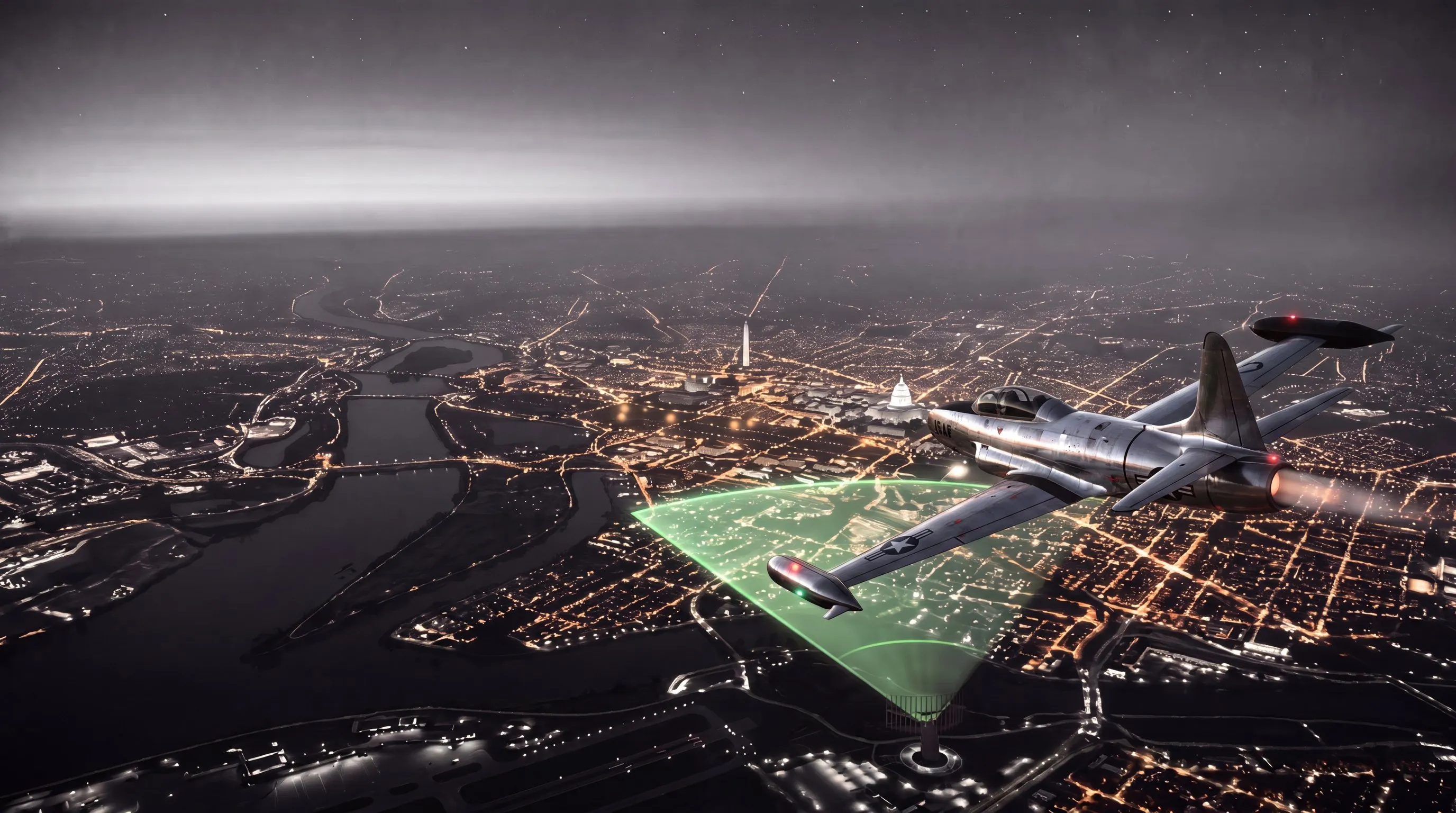
The Night view is 1952 Washington from above: the street-light grid, the dark Potomac, the Mall's string of lamps, the floodlit Capitol and Monument, and National's search antenna turning once every ten seconds with its phosphor-green fan. In the mirage world, green phantom rings hang where the scope CLAIMS objects are: the sky itself stays empty, which is the entire claim. In Barnes's world the same bearings carry solid amber lights, flown as he described.
The Scope view is the educational core: a rebuilt PPI with true phosphor memory: paint, persistence, decay. Every blip is computed from the atmosphere: ground clutter leaking through the MTI gate, duct ghosts landing at the city's bearings, marginal flickers when the gradient is almost-but-not-quite trapping. Click any two blips and THE SWEEP-TO-SWEEP SPEED MACHINE joins them, divides by ten seconds, and prints the impossible number, exactly as tired humans did in 1952.
The Duct view is the answer's anatomy: temperature and moisture dials on the left building the N(h) and M(h) profiles, the −157 N/km threshold chip turning amber when a duct opens, and the ray fan integrating live through the layers: green rays escaping, amber rays trapped, each ground strike beyond the clutter gate feeding a ghost. The Ledger view prices all of it against the record's six hardest claims, then lays out the dated public events.
Why it's here
This site's method trained on the modern files: Tic Tac audits a number that lives only in memory, Gimbal audits a rotation that may belong to the camera, Trans-Medium hands every claimed crossing a physics bill. This instrument carries the same discipline back to one of the origins: the first national-scale crisis of the UFO era, the radar nights over Washington in July 1952. Its official answer was not a brush-off but a complete lesson in atmospheric physics: temperature inversions bending radar rays, folding the city itself back onto the scopes. That lesson deserves to be built as a machine, because it is the template for every radar-UAP argument since.
It is also this site's first instrument to put the OFFICIAL explanation on the bench, rather than the anomalous claim. Every ghost on the scope is computed live from the atmosphere you dial; in other words, the party being audited this time is General Samford. The audit's finding is an honest dilemma: the mirage mechanism is real, elegant and cheap, and the atmosphere it needs at full power is steeper than the balloons measured those nights. The CAA's own engineers wrote down the same tension a year later. This page does not resolve it; it builds it into dials you can turn yourself.
How it works
One refractivity formula, one ray integral and one clutter map run the whole instrument; nothing else is asserted.
N = 77.6·p/T + 3.73×10⁵·e/T² · M = N + 0.157h · duct: dM/dh < 0 · "speed" = Δghost / 10 s
The atmosphere is built, not assumed. Your dials set surface temperature, the inversion's base, thickness and strength, and the moisture collapse across its top. From those the instrument computes pressure, vapour pressure and refractivity metre by metre: the same N and M profiles a propagation engineer would draw, refreshed every time you touch a slider.
The rays are integrated, ghosts included. Sixty-plus rays leave the 20 m antenna between −0.9° and +2°, each stepped through d²h/dx² = 10⁻⁶·dM/dh with up to three ground bounces. Rays that strike beyond the 9 km MTI gate illuminate a clutter map holding downtown, the bridges, the rail yards, Andrews and the river anchorage at their true bearings: and wherever illumination meets reflectivity, the scope grows a ghost. Nothing on the PPI is placed by hand.
The phosphor forgets nothing sideways. The scope's memory is a real persistence buffer: the sweep paints, the phosphor decays, and between passes nothing updates: which is precisely the machinery of the 7,000-mph trap. The speed machine lets you join any two returns and see what ten seconds of arithmetic builds out of two unrelated ghosts.
The counter-measurement stays live. The two historical scenarios are tuned to the era's soundings: gradients near −100 to −130 N/km, bending but short of the trap, producing exactly the intermittent, marginal returns weak AP honestly buys. The Textbook Duct scenario is the atmosphere the official answer needs at full strength. The distance between those two dial positions IS the controversy, and you can feel it with your hands.
The evidence is tagged as you go. The bottom-left table is the conscience of the sim: Barnes, the visuals and the correlations are REPORTED; the soundings and the press conference are MEASURED; the rays, ghosts and speed arithmetic are MODELLED; and the verdict is a READING. Rows flash as you touch what depends on them.
The events and the weak soundings are measured. The accounts, the lights, the correlations are reported. The bending, the ghosts, the manufactured speeds are modelled, exactly, from stated dials. And what crawled over the capital: weather or visitors: is the reading this site leaves where Blue Book's own chief left it. The instrument computes; you conclude.
The four scenarios on the dial
Four positions of the same instrument, so every corner of the argument has somewhere to land.
- Jul 19-20. Night one, with the atmosphere near that evening's sounding: bending, no trap. The scope shows what weak AP honestly buys: intermittent marginal returns, an extended horizon flickering in and out: enough to seed a mystery, short of the full mirage.
- Jul 26-27. Night two, jets up, press in the tower, sounding still modest. The default. Watch the phantom rings come and go over the city while the strip chart ties every flicker to the gradient readout: nothing appears without the atmosphere paying for it.
- Textbook duct. The atmosphere Samford's answer needs: a sharp, dry-topped inversion past −157 N/km. The fan collapses onto the city, the scope fills with a Washington that isn't where Washington is, and the whole 1952 phenomenology assembles in front of you: crawls, jumps, plausible-looking formations.
- Barnes's night. The blips flown exactly as the senior controller described them: coherent, slow, loitering, scattering when the F-94s close. This scenario is REPORTED choreography, not physics, and is tagged so: it exists because the man closest to the scope never accepted the weather, and his account deserves to be seen, not just quoted.
The readings, as they stand
Every serious reading of the Washington nights, with who argued it and where it lands today. One row is retired by the sheer weight of instrumentation; the file itself is open.
| Anomalous propagation, plus misread stars and meteors argued by Samford 29 Jul 1952; CAA study 1953; Menzel and the skeptical tradition | OPEN | Open, and the mechanically cheapest: the crawls, jumps and multi-scope cousins all fall out of a duct, as this instrument shows live. Its unpaid bill: the measured soundings were weak, and the optical half of the story has to be bought separately. |
| Coherent unknown objects over the capital argued by Barnes in print, 1952; the interceptor crews' readings | OPEN | Open. Purposeful motion, jet-shyness and moments of radar-visual overlap are its evidence: all REPORTED, none of it checkable against surviving tapes. Its unpaid bill: no instrumented record of any object, and a mechanism (the duct) that genuinely was in the air that week, at least weakly. |
| A mixed night: weak AP + ordinary traffic + saturated humans argued by Blue Book's working posture; most modern historical reviews | OPEN | Open and arguably strongest: nothing requires the whole night to have one cause. Weak ducting seeds ghosts, real aircraft wander through, a packed room under headline pressure joins the dots. Its unpaid bill: mixtures explain everything and predict nothing: exactly why the file never closed. |
| Hoax, panic without stimulus, or fabrication argued by contemporary editorials | RETIRED | Retired. Multiple professional crews on multiple instruments recorded returns across two separate nights, and the Air Force held the largest press conference since the war about it. Whatever the blips were, the record of them is real. |
Try this
- Open the trap slowly. In the Duct view, start at Jul 26-27 and drag INVERSION STRENGTH up a degree at a time. Watch M(h) develop its nose, the chip flip past −157, the amber rays fold onto the city. You are watching the official answer switch on: and noticing how much atmosphere it took.
- Manufacture 7,000 mph. In the Scope view under Textbook Duct, wait for a ghost to fade and another to bloom far away, then click both. The speed machine divides by ten seconds and prints the headline number. You have just reproduced the most quoted statistic of July 1952 with two mouse clicks and no object at all.
- Run the honest night. Switch back to Jul 26-27 and leave the dials alone. The returns get sparse, marginal, intermittent: this is what the MEASURED atmosphere buys. Whatever filled the scopes for hours on end needs either more atmosphere than the balloons found, or something the balloons could not see: thin sharp layers, or Barnes's reading.
- Watch the fade both ways. In Barnes's night, let the story's F-94s close on the lights and watch them dim, exactly as the pilots reported. Then remember the mirage reading explains the same fade geometrically. One observation, two mechanisms, zero discrimination: that is why testimony alone never closed this file.
- Compare the two worlds' skies. In the mirage world the Night view's sky is EMPTY: only green phantom rings mark the scope's claims. In Barnes's world the lights are solid amber. Toggle between them and notice which one the tower crews' reports fit: that seam is where the whole controversy lives.
- End at the record. In the Ledger, click the six dated cards: night one, night two, Samford, Barnes in print, the CAA study, Ruppelt's refusal to close. Six shelves: event, event, answer, testimony, counter-measurement, verdict withheld. The file's whole shape, in one row of cards.
Accuracy
The honest line between what is reported, what is measured, what is modelled here, and what is a reading:
| Feature | Tier | What that means |
|---|---|---|
| The events: two nights, jets, and a press conference | T1 Measured | That unknown returns appeared on the National ARTC, tower and Andrews scopes on 19-20 and 26-27 July 1952, that F-94s were scrambled, and that Maj. Gen. Samford answered with temperature inversion on 29 July at the largest Pentagon press conference since the war: all documented public record. |
| The soundings: inversions present, and weak | T1 Measured | The era's radiosonde data, examined in the CAA's technical study (Borden & Vickers 1953), showed inversions of roughly a degree or two on the relevant nights: real bending, short of the textbook trapping gradient. The awkward number inside the official answer, kept on screen here. |
| Barnes's account: coherent, evasive targets | T3 Reported | The senior ARTC controller published his first-person account within weeks: targets moving with apparent purpose, scattering when jets arrived, behaving "like they were listening." The most qualified radar witness in the room; still testimony. |
| The visuals: lights from the tower, the airliners, the jets | T3 Reported | Tower crews and airline pilots reported lights near blip bearings; interceptor pilots described lights that faded as they closed, one of being ringed. The official reading assigns these to stars and meteors distorted by the same hot night: a second story the mirage needs, tagged as such. |
| The correlations: two radars, sometimes agreeing | T3 Reported | Operators reported moments of multi-scope agreement; Blue Book's follow-up dissolved many into near-misses and different times, and the SA tapes are long gone. The strongest anomalous card, and the least checkable: REPORTED is exactly what it is. |
| The refractivity machine: N, M, and the −157 threshold | T2 Modelled | N = 77.6·p/T + 3.73×10⁵·e/T², M = N + 0.157h, duct where dM/dh < 0: standard propagation physics, computed from your temperature, moisture and layer dials every frame. The formula book is ITU-grade, not bespoke. |
| The rays and the ghosts: integrated, never scripted | T2 Modelled | Every ray is integrated through the dialed profile (d²h/dx² = 10⁻⁶·dM/dh, with ground bounces); every scope ghost sits where a trapped ray actually strikes the city's true bearings from National's antenna. Turn the dials and the whole conspiracy of geometry assembles or collapses, live. |
| The speed arithmetic: how 7,000 mph was born | T2 Modelled | A PPI remembers nothing between ten-second sweeps. Join a ghost that faded here to one that bloomed there and divide: the instrument's speed machine reproduces the famous impossible numbers from ordinary subtraction, the same trap this site audited in the Tic Tac file. |
| What the blips were | T3 Reading | Samford's inversion, Barnes's visitors, or a hot night's mixture of weather, traffic and tired eyes: Blue Book's own chief left the Washington nights unsettled in print. This page prices every reading and follows Ruppelt in declining to close the file. |
In one line: the two nights, the scrambles, the press conference and the weak soundings are measured record; Barnes's account, the lights and the correlations are reported; the refractivity, the bent rays, the ghosts and the sweep-to-sweep arithmetic are modelled, live, from stated dials; and whether the capital's scopes painted weather or visitors is a reading, the one Blue Book's own chief declined to settle. The scope repaints every ten seconds. The file stays open.
Sources
- Barnes, H. G. (Aug 1952). "Radar Expert Who Tracked Objects Tells Own Story" (syndicated first-person account). The senior ARTC controller's testimony, in print within weeks.
- Samford, J. A. (29 Jul 1952). Pentagon press conference transcript. The temperature-inversion answer, and "credible observers of relatively incredible things."
- Borden, R. C., & Vickers, T. K. (1953). A Preliminary Study of Unidentified Targets Observed on Air Traffic Control Radars. CAA Technical Development Report No. 180. AP effects confirmed; the soundings measured weak.
- Project Blue Book case files, July 1952 (NARA microfilm). The night-by-night record, correlation follow-ups, and the unknowns that stayed unknowns.
- Ruppelt, E. J. (1956). The Report on Unidentified Flying Objects. Blue Book's chief on the Washington nights: never settled to his satisfaction.
- Menzel, D. H., & Boyd, L. G. (1963). The World of Flying Saucers. The fullest classical statement of the mirage reading.
- Hall, M., & Connors, W. (2000). Captain Edward J. Ruppelt: Summer of the Saucers. The flap's inside chronology, from the office that owned it.
- Bean, B. R., & Dutton, E. J. (1966). Radio Meteorology. NBS Monograph 92. The refractivity formula and duct criteria this instrument computes.
- ITU-R Recommendation P.453. The radio refractive index: its formula and refractivity data. The modern standard for N and M.
- Skolnik, M. (ed.). Radar Handbook. Anomalous propagation, MTI clutter gating and PPI behaviour: the hardware assumptions used here.
- US Weather Bureau radiosonde archives, Washington DC, July 1952. The balloon record behind the MEASURED rows.
- Peebles, C. (1994). Watch the Skies! The 1952 flap in its press and policy context.