The Long Day at Gibeon
Freeze the sun over Gibeon and Teotihuacan's clock really does read 03:04, a night that never ends: the letter's geometry works. It works from half the planet, at every season, with a source that says the sun rose; the one laboratory date fell within five years; and the spin's ledger runs 2.1 × 10²⁹ joules out by afternoon and back by night. One noon, one calendar, one bill, two verdicts.
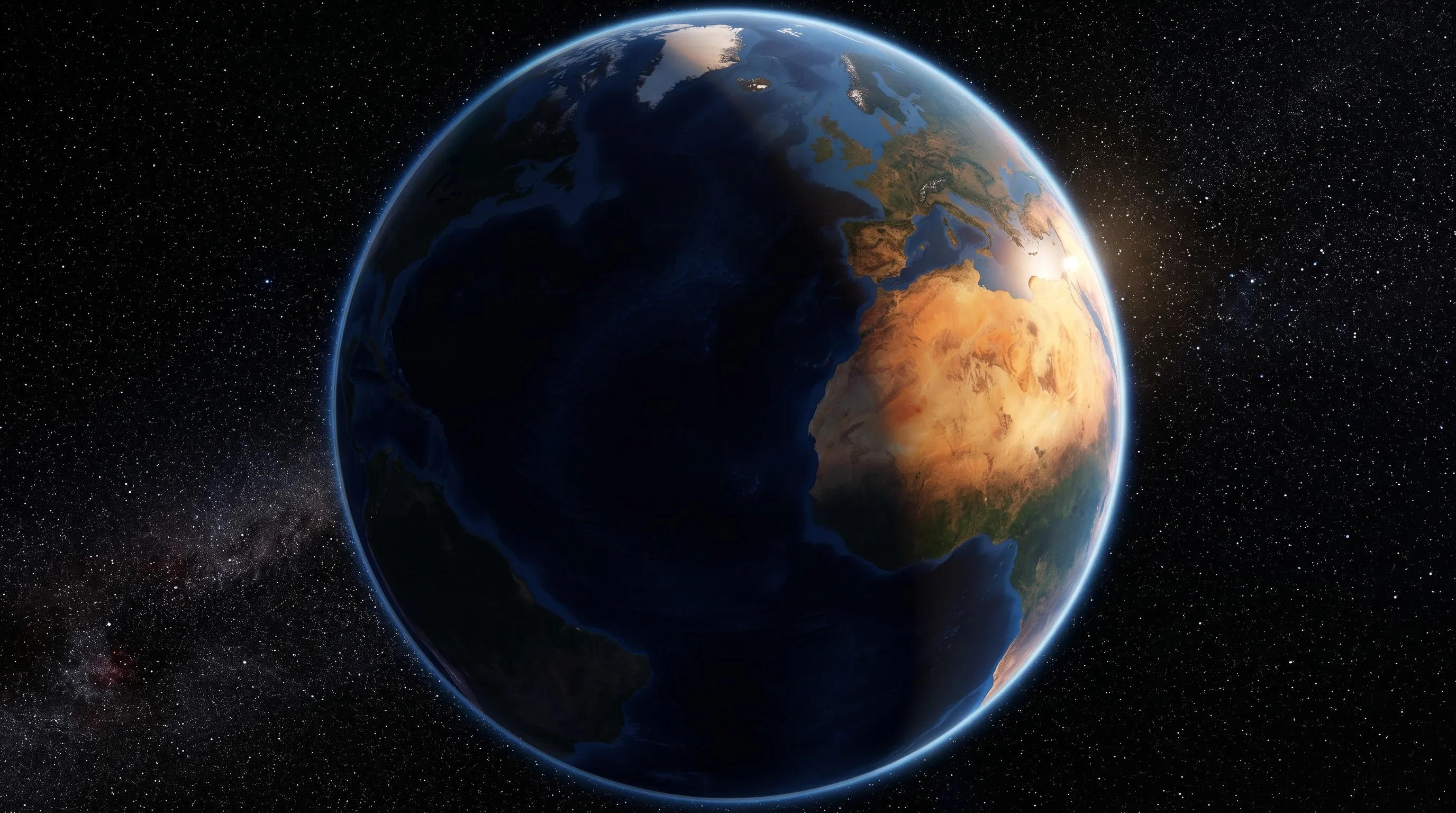 Open the interactive ▸
 What you're looking at
The Terminator is the Earth in three dimensions with one moving line on it. The sun sweeps west at 15° an hour; press stop and it stands over Gibeon. Pins at Gibeon, Teotihuacan and Cusco read their local clocks live: daylight running long on one side, sunrises going overdue on the other. A cross marks the point 'opposite parts of the world' actually names, open South Pacific 7,540 km from Teotihuacan, with the 134° equator arc drawn against the 180° the word wants. A toggle tints the corroborating zone: the entire night hemisphere, every point of which the freeze hands a long night. Dials set the freeze hour, the season and the duration, because the letter names none of them, and the window readout shows the pairing holding across all three dials.
The Calendar puts every dated pillar on one line: the letter's c. 1400 BC as an amber vertical, the Jericho radiocarbon band at the late 17th-16th century BC, the 1207 BC eclipse, Teotihuacan's actual urban span starting c. 100 BC, the Aztecs' arrival, and the writing dates of both American tales, 2,977 and 3,044 years downstream, with Velikovsky's 1950 prior run and the 1990-1995 Jericho exchange at the modern end. Nothing dated touches the claim's date.
The Ledger prices the literal reading. An energy ladder from the largest nuclear test up through Chicxulub to the stop itself (2.1 × 10²⁹ J) and the stop-plus-restart above it; a brake meter comparing the torque a stop needs against the entire tidal torque the Earth actually has; the honest-jolt row conceding that the deceleration itself is survivable; and four parking rows for the energy and momentum: oceans (+36,000 K), atmosphere (0.89 c winds), the Moon (a 48-day month, forever), and the real brake (20 hours in 3.1 billion years, one way only). The File runs twelve cards, the words first, then the sources, then the arithmetic, then two verdicts at equal size.
Why it's here
This site's source note on Sitchin's The Anunnaki Chronicles carries one methodological observation: Appendix I 'argues that the sun standing still at Gibeon in Joshua and a sunless day in Aztec and Inca tradition are the same event seen from opposite sides of the world, and that a contested date for the fall of Jericho confirms both'. The letter is two column-inches long, and it is the cleanest specimen of the whole method: three tales, one date, one sentence of mechanism. Its words: the sun at Gibeon 'rising but not setting for a whole day'; 'at about that same time, circa 1400 B.C., according to Aztec lore in Mexico, the sun failed to rise for a whole day in the City of the Gods, Teotihuacan'; 'likewise, it failed to rise for 20 hours in the Andes, according to Inca legends'; and 'since a day that does not end and a night that does not end are the same phenomenon in opposite parts of the world, the dating of the Israelite conquest at 1400 B.C., now corroborated by archeology at Jericho, would also confirm the tale of the sun's standing still in Gibeon'.
It is here because every pillar of the letter can be weighed separately, and the letter never weighed one. The mechanism sentence is spherical geometry and can be drawn: a frozen sun that gives Gibeon an unending day really does hand Teotihuacan a 03:04 that never reaches dawn, so the pairing holds, but it holds too cheaply, because the entire night hemisphere qualifies as a witness, and the point 'opposite' actually names is open South Pacific more than 7,500 km from either witness. The date is archaeology and can be looked up: the corroborating Jericho re-dating was answered by radiocarbon within five years, the named city is 1,300 years too late, and both American tales are written down three millennia downstream, one of them saying in its own text that the sun rose and then would not move. The physics is a ledger and can be priced: one stop of the spin is 2.1 × 10²⁹ joules that must leave and come back, against a real brake a trillion times too weak. After the Nibiru Orbit Bench and the Landing Corridor, this is the third bench priced against the same author, and the cheapest: one noon, one calendar, one ledger.
How it works
Everything on the bench is arithmetic on coordinates and published constants: spherical astronomy gives every clock and window, ½Cω² gives the bill, conservation gives the parking rows, and every date on the calendar is a citation. The script that ships with the site re-derives every displayed number before the build passes.
λ☉ = λ_G + 15°·(12 − h) · LST = 12 + (λ − λ☉)/15 · sin e = sin φ sin δ + cos φ cos δ cos(λ − λ☉) · KE = ½Cω² = 2.14 × 10²⁹ J · L = Cω = 5.86 × 10³³ kg m² s⁻¹
The clocks. Freezing the spin freezes the subsolar longitude; each witness's local solar time is then a fixed number, 12 + (λ − λ☉)/15, and its day/night state follows from the solar elevation formula. At a noon freeze over Gibeon: Teotihuacan 03:04 and 41° below the horizon, Cusco 04:51 and 17° below. The corroboration window scans freeze hours at one-minute steps for the hours at which Gibeon is lit and both American witnesses are in pre-dawn dark: 06:01-13:08 at equinox, a window at every season, 5.7 to 8.6 hours wide.
The zone. Day and night are hemispheres, so at any freeze the set of points handed a night-that-does-not-end is exactly half the Earth's surface, independent of every dial. That number, 50%, is the letter's evidential engine measured: the probability that some culture somewhere in the qualifying half of the planet has a long-night tale is not usefully below one.
The ledger. C = 8.034 × 10³⁷ kg m² (0.3307 MR², Williams 1994) and ω = 7.292115 × 10⁻⁵ s⁻¹ give KE = 2.136 × 10²⁹ J and L = 5.859 × 10³³ kg m² s⁻¹; the restart doubles the energy bill and reverses the torque. The tidal torque is C·ω·(2.3 ms/century)/86,400 ms = 4.9 × 10¹⁶ N m; a 12-hour stop needs 1.4 × 10²⁹ N m, a gap of 2.8 × 10¹². Moon parking uses L ∝ √a on its orbital momentum; atmosphere parking treats the air as a rigid shell ⅔mR². The deceleration concession is v/t: 465 m/s spread over 6 hours is 0.22% of gravity.
Nothing is fitted. The only choices are the three freeze dials the letter left blank and the rigid-Earth idealisation, which is the assumption most generous to the letter; every finding quoted survives the whole range of all of them.
The dials that decide what happens
The freeze hour, the season, the duration, the cameras and the overlays; the stop-spread dial on the ledger. Between them they draw every event the letter's sentence could mean, which is itself the exhibit.
- Freeze hour. 05:00 to 19:00 local apparent solar at Gibeon; noon by default, following 'in the midst of heaven'. The window chip turns red outside 06:01-13:08, when an American witness is already lit and the pairing breaks: the letter never names an hour, so nothing constrains it.
- Season. Solar declination, −23.4° to +23.4°. The window narrows to 5.7 h at the December solstice and widens to 8.6 h in June; it never closes.
- Freeze length. 12 to 36 hours; 24 by default for 'about a whole day'. On a rigid Earth this one number is every witness's delay, which is how 'a whole day' and '20 hours' contradict each other.
- Cameras. Both sides, Gibeon's frozen noon, the American witnesses, the antipode, and the terminator edge-on.
- Overlays. The corroborating zone (the tinted night hemisphere), the antipode cross with Rapa Iti, the 134° arc, labels.
- Stop spread (ledger). 0.5 to 24 hours. Gentler stops shrink the jolt to nothing and barely move the torque gap: it stays above 10¹² everywhere.
The claims, as they stand
The letter's pillars one by one, from the verse to the physics, with where each lands when its own sources and its own numbers are checked.
| 'The sun stood still at Gibeon, rising but not setting for a whole day' proposed by Joshua 10:12-13, as read by the letter | CONTESTED | The verse is quoted by its own narrative from the lost Book of Jashar; 'in the midst of heaven' puts the sun 58° high at a noon freeze. The bench takes the literal reading, a stopped spin, and prices exactly that. Alternative readings on the record: dôm as 'cease shining' (Wilson 1918; Holladay 1968), a celestial-omen idiom (Walton 1994), the annular eclipse of 30 Oct 1207 BC (Humphreys & Waddington 2017, contested). |
| 'Circa 1400 B.C., according to Aztec lore... the sun failed to rise for a whole day' at Teotihuacan proposed by the letter, citing no text | REFUTED | Sahagún's Book VII ch. 2, the only candidate source, is a creation myth set 'before there was day in the world', in which the sun rises and then will not move until sacrifice and wind push it on. No failed sunrise, no date of any kind; and the city itself rises c. 100 BC, thirteen centuries after the letter's date. |
| 'It failed to rise for 20 hours in the Andes, according to Inca legends' proposed by the letter, via Montesinos (1644) | REFUTED | The source says 'más de veinte horas', more than twenty, in year 3 of the fourteenth king of a hundred-king list Andeanists reject; a penitential tale ending in sacrifice and calendar reform. On a rigid Earth every clock's delay is one number, so the letter's own two witnesses ('a whole day', '20 hours') disagree by four hours. |
| 'A day that does not end and a night that does not end are the same phenomenon in opposite parts of the world' proposed by the letter, restating Worlds in Collision (1950) pp. 60-62 | READING | Gibeon's antipode is open South Pacific, 7,540 km from Teotihuacan; the longitude gap is 134.0°, not 180°. And the pairing survives, because hemispheres decide day and night: at a noon freeze both witnesses really are in pre-dawn dark. So is half the planet, at every season: a test that cannot fail selects nothing. |
| 'The dating of the Israelite conquest at 1400 B.C., now corroborated by archeology at Jericho' proposed by the letter, on Wood's BAR re-dating (1990) | REFUTED | Contested in BAR the same year (Bienkowski); answered by radiocarbon in five: cereal grains from the destruction layer date it to the late 17th-16th century BC (Bruins & van der Plicht 1995). Kenyon's c. 1550 BC stands; the letter's newest pillar fell first. |
| A stopped and restarted spin, as physics proposed by the literal reading, priced by this bench | REFUTED | 2.1 × 10²⁹ J out and back (9.3 minutes of the whole Sun; enough heat to boil the oceans off 58 times); 5.9 × 10³³ kg m² s⁻¹ with no destination that leaves the world as found (the Moon would keep a 48-day month; the air would need 0.89 c). The one real brake, tides at 2.3 ms/century, buys 20 hours in 3.1 billion years and cannot push back. The honest concession: spread over hours, the deceleration is under a percent of gravity; the jolt was never the problem. |
| The eclipse record as a referee proposed by Stephenson, Morrison & Hohenkerk (2016) | MEASURED | Usable eclipse records begin at Babylon, 720 BC, ~700 years after the letter's date, so the archive cannot rule on 1400 BC directly; what it shows is a smooth ΔT curve with no step, from a spin that has no mechanism for losing and exactly recovering its momentum. The bench states the limit rather than overclaiming. |
| What the pairing amounts to proposed by this bench | READING | The one leg that is geometry works from half the planet; the three legs that are testimony are written 2,977 to 3,044 years downstream or refer to a city not yet built; the one leg that was laboratory-datable dated against the letter. Corroboration or coincidence-by-construction: the bench prints both readings at the same size. |
Try this
- Let the day run. Watch the terminator sweep; watch dawn cross Mexico. Then press stop at noon and watch the pin chips change: Gibeon's daylight starts counting up, Teotihuacan's sunrise goes overdue.
- Press 'the antipode'. The cross is in open ocean; Rapa Iti, the nearest land, carries no cited tale. Turn on the 134° arc and read the missing 46°.
- Turn on the corroborating zone. Half the planet tints. Drag the freeze hour from 06:01 to 13:08 and watch the window chip stay green the whole way; drag the season dial end to end; the pairing never breaks.
- Go to the Calendar. Follow the amber line at 1400 BC upward: the radiocarbon band misses it left, the city span misses it right by 1,300 years, and the two writing marks sit three millennia away.
- Go to the Ledger. Read the gap between Chicxulub and the stop rung: six orders. Then the brake meter: twelve more. Then the parking rows: pick any account and read what the world would still show.
- End on the File. The letter, the verse, the two American legs, the city, the Jericho pillar, Velikovsky, the geometry, the free test, the bill, the brake, the other readings, then both verdicts.
Accuracy
The honest line between what is reported, what is measured, what is modelled on them, and what is a reading:
| Feature | Status | What that means |
|---|---|---|
| The coordinates and the dates | Measured | Gibeon (el-Jib) 31.85°N 35.19°E, Teotihuacan 19.69°N 98.84°W, Cusco 13.53°S 71.97°W, Rapa Iti; and every date on the calendar view: the Jericho radiocarbon result (Bruins & van der Plicht 1995), Teotihuacan's urban span (Cowgill), Sahagún c. 1577, Montesinos 1644, Velikovsky 1950, the 1207 BC eclipse, the eclipse-record edge at 720 BC. Each mark carries its source. |
| Every clock, window and joule | Exact | Local solar time, solar elevation and sunrise from spherical astronomy on the coordinates; the corroboration window scanned at one-minute steps across all seasons; the spin's energy ½Cω² and momentum Cω from C = 8.034 × 10³⁷ kg m² (Williams 1994); the stopping torque, the tidal comparison and the parking rows by conservation arithmetic. No parameter is fitted. |
| The freeze dials; the rigid Earth | Modelled | The letter names no hour, season or exact duration, so all three are dials, and every finding quoted holds across their whole range: that robustness is itself the finding. The Earth is treated as rigid, with oceans and air stopping in step with the crust, the assumption most generous to the letter; any slippage adds catastrophes to the bill rather than removing any. |
| The letter’s words and its sources’ words | Reported | Every quotation from the letter is given with its reprint pages (Appendix I, pp. 357-359); the Sahagún and Montesinos passages are quoted from their editions, including the two places where the letter's paraphrase and its source disagree (a sun that rose; 'more than' twenty hours). The bench prices the letter as written. |
| What it amounts to | Reading | A pairing that cannot fail, three witnesses that cannot testify, one date that fell, and a physical bill with no payer: whether that is corroboration or coincidence-by-construction is a reading, and the bench declines to make it for you. |
In one line: Every clock is spherical astronomy on surveyed coordinates, every date is a citation, every joule is ½Cω²; the only dials are the ones the letter left blank, and the findings survive all of them. The letter's words are quoted with their pages. The reading is yours.
Sources
- Zecharia Sitchin, letter to the New York Times, published March 17, 1990, under "How Jericho Fell and Alexandria Burned"; reprinted as Appendix I of "The Anunnaki Chronicles: A Zecharia Sitchin Reader", ed. Janet Sitchin (Bear & Company, 2015), pp. 357-359: every quotation of the claim.
- John Noble Wilford, "Believers Score in Battle Over the Battle of Jericho", The New York Times, Feb 22, 1990: the report the letter answers. Bryant G. Wood, "Did the Israelites Conquer Jericho?", Biblical Archaeology Review 16:2 (1990); Piotr Bienkowski's rebuttal and Wood's reply, BAR 16:5 (1990).
- H. J. Bruins & J. van der Plicht, "Tell es-Sultan (Jericho): Radiocarbon Results of Short-Lived Cereal and Multiyear Charcoal Samples from the End of the Middle Bronze Age", Radiocarbon 37:2 (1995), 213-220: the destruction layer at 3306 ± 7 BP, "late 17th or the 16th century BC"; also their "The Exodus Enigma", Nature 382 (1996).
- Bernardino de Sahagún, "Historia general de las cosas de Nueva España", Book VII ch. 2 (Florentine Codex, tr. Anderson & Dibble, University of Utah Press): the creation of the Fifth Sun at Teotihuacan; the sun that rises and will not move.
- Fernando de Montesinos, "Memorias antiguas historiales y políticas del Perú" (c. 1644), Libro II cap. x, ed. M. Jiménez de la Espada (Madrid, 1882), pp. 57-58; tr. P. A. Means, ed. C. Markham (Hakluyt Society, 1920): "no amaneció en más de veinte horas", and the editor's own verdict on the work.
- Immanuel Velikovsky, "Worlds in Collision" (Macmillan, 1950), pp. 60-62: the prior Joshua-Mexico longitude pairing, citing the Annals of Cuauhtitlan and the same Sahagún passage.
- George L. Cowgill, "State and Society at Teotihuacan, Mexico", Annual Review of Anthropology 26 (1997), 129-161, and "Ancient Teotihuacan" (Cambridge UP, 2015): the city's rise c. 100 BC-200 AD and fall c. 550-650 AD.
- J. G. Williams, "Contributions to the Earth's Obliquity Rate, Precession, and Nutation", Astronomical Journal 108 (1994), 711-724: C/MR² = 0.3307, hence C = 8.034 × 10³⁷ kg m² and the spin's energy and momentum.
- F. R. Stephenson, L. V. Morrison & C. Y. Hohenkerk, "Measurement of the Earth's rotation: 720 BC to AD 2015", Proc. R. Soc. A 472 (2016), 20160404: the +2.3 ms/century tidal rate, the +1.8 ms/century observed rate, and the 720 BC edge of the eclipse archive.
- C. J. Humphreys & W. G. Waddington, "Solar eclipse of 1207 BC helps to date pharaohs", Astronomy & Geophysics 58:5 (2017): the annular eclipse reading of Joshua 10, ~86% obscuration at Gibeon; presented here as contested. R. D. Wilson (1918) and J. S. Holladay, JBL 87 (1968) for dôm as "cease shining"; J. H. Walton, in "Faith, Tradition, and History" (Eisenbrauns, 1994) for the omen reading.
- J. V. Morgan, T. J. Bralower, J. Brugger & K. Wünnemann, "The Chicxulub impact and its environmental consequences", Nature Reviews Earth & Environment 3 (2022): the ~10²³ J impact energy used as a ladder rung. World energy from the Energy Institute Statistical Review (2025), ~592 EJ.
- NASA Earth Observatory, "Blue Marble: Next Generation" (public domain): the globe texture, served locally as baked for this site's Landing Corridor bench.
Freeze the sun over Gibeon. Then read every clock it stops.
Open the interactiveCompiled September 2026