The Tiamat Collision
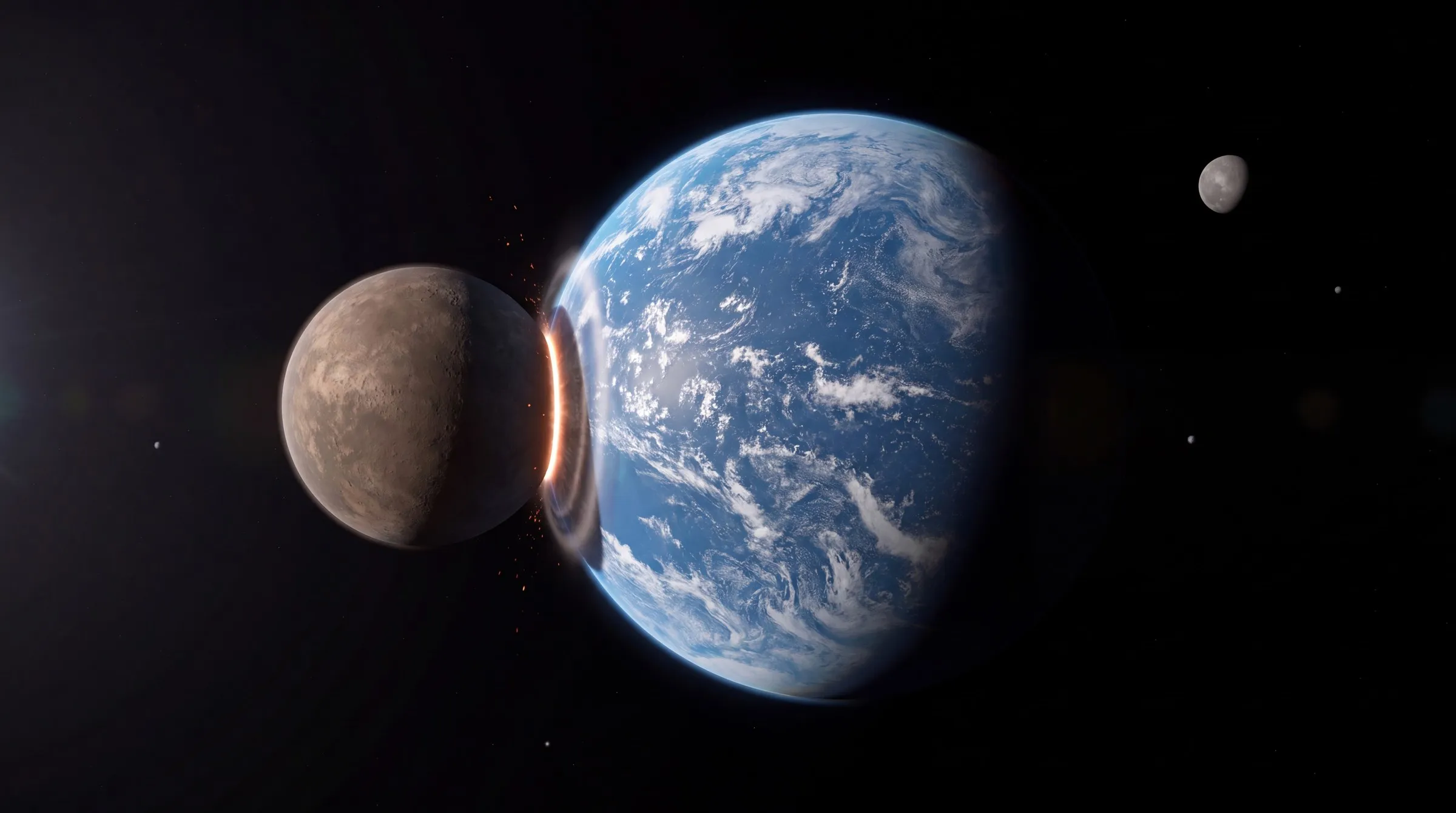
The whole scenario begins with a collision: Marduk's satellites strike Tiamat, the watery planet beyond Mars; 'as a mussel, he split her into two parts' (p. 113); the North Wind carries the upper half 'to an orbit where no planet had been orbiting before', nearer the Sun, and it becomes Earth; Kingu is pulled along as the Moon; the lower half is hammered into the asteroid belt. The book gives the sequence and never a number. This bench does the sums the book left out. To drop a circular orbit at 2.7 AU to a perihelion of 1 AU takes 4.9 km/s; at the 43 km/s closing speed of INST-70's retrograde Nibiru, momentum needs a satellite of 0.22 Earth masses, two Mars, and Leinhardt & Stewart's disruption scaling says that blow leaves 35 to 73% of her in one piece: the kick that moves her is the kick that breaks her, and the break is of the order of 'two parts'. Then the geometry: one impulse makes an ellipse, 1.0 to 2.7 AU, that returns to the point of impact every two and a half years; the 6.2 km/s that would round it must be paid at 1 AU, where a body whose perihelion is in the belt never is. Then the masses: the lower half should weigh an Earth; the belt weighs 1/2,500 of that, and the book concedes it. Then the Moon: Kingu survives the kick from one distance at one phase in four; the Moon's core is 1-2% where every self-accreted body's is 18-70%; and the Moon is 4.51 billion years old against a battle 'some four billion years ago'. Two verdicts at equal size.
 Open the interactive ▸
 What you're looking at
The Battle is 3D: Tiamat on her circular orbit beyond Mars, Nibiru coming in on its 3,600-year retrograde ellipse with its perihelion on that orbit, the satellite that hits, and the time scrubbed from days before to forty years after. After the hit the remnant leaves on its new ellipse, which is seen to come back to the point of impact; the lower half stays where she was and shears into a ring by Kepler alone. Zoom in and the bodies are spheres at true scale: Tiamat, Kingu, the incoming satellite, Nibiru passing sixty radii out.
The Halves stands every mass in the story on one logarithmic ruler: Earth's oceans, Ceres, the measured belt, the Kuiper belt, the Moon, her ten other moons, Mars, the satellite that moves her, Earth, her lower half as the book has it, the Oort cloud's range, Tiamat whole, Nibiru. The upper half's share is a dial; 'two parts' is half by default, and Lynn's 'size of Uranus' is a preset.
The Move is the impulse: the single-impulse orbit seen from above, with the point where the second burn would have to be paid; and the impactor curve, largest remnant and kick delivered against impactor mass, with the dialled satellite, the one that halves her, Mars and the Moon marked. The inclination dial flips the story's sign: prograde, the winds come from behind and push her outward.
The Moon maps Kingu's leash, survival by distance and kick direction, with Tiamat's Roche limit and the Moon's orbit today drawn across it, and sets three measured rulers beside it: oxygen isotopes, core fractions, and ages. The File runs eleven cards, the words first, then the arithmetic, then two verdicts at equal size.
Why it's here
This site's culture wing carries a source note on The Anunnaki Chronicles that lays out Sitchin's scenario in seven rings, and the first ring is this battle. The solar system held 'the Sun and only nine other planets' (p. 105); Tiamat, 'the Watery Monster', was 'beyond Mars' (pp. 99, 115); Marduk, which is Nibiru, came in retrograde with seven satellites, 'the winds' (pp. 105, 109). On the first pass 'it was the satellites of Marduk that smashed into Tiamat, and not Marduk himself' (p. 110), and she was left 'fissured and lifeless' (p. 111); ten of her moons became retrograde comets (p. 112). On the second, 'Marduk himself now hit the defeated planet, splitting Tiamat in two', the North Wind 'crashed into the separated half' and 'carried this part, destined to become Earth, to an orbit where no planet had been orbiting before' (p. 113), 'nearer the Sun' (p. 120); Kingu was 'pulled along' as the Moon (p. 119); the lower half, 'on the second orbit', was smashed and 'hammered to become a bracelet', the asteroid belt (pp. 113-114). 'Some four billion years ago' (pp. 173, 340). Neither book gives a mass, a speed, an angle or an energy for any of it. This bench supplies the arithmetic the book never did.
It also follows the note on The Anunnaki Connection, where Heather Lynn reports a different version: Tiamat 'between Mars and Jupiter about the size of Uranus' (Lynn p. 42), and a Moon that is either 'one of Nibiru's moons' captured by Earth (Lynn p. 21) or 'another moon of Tiamat' (Lynn p. 42), never Kingu; the bench makes Uranus's mass a preset. It follows INST-70, the Nibiru orbit bench: that bench read Nibiru's size and inclination from the same book, and this one borrows them for the closing speed and puts its perihelion on Tiamat's orbit; the one-screen ledger in that bench's Battle view is opened out here into three. And it follows INST-71, the Gold Shield, the same scenario's motive. As ever, the answer is not presupposed. A planet struck off its orbit by another's satellite is a real kind of event; a giant impact making the Moon is the mainstream account. The bench writes those down, and then the masses, the impulse, the geometry and the Moon's three rulers.
How it works
Everything on the bench is arithmetic on the book's sequence and on published values: two-body mechanics for the orbits and the impulse, momentum for the impactor, a published scaling law for the break, the leash from energy and angular momentum. A script that ships with the site re-derives every displayed number before the build passes, the ones the book gave and the ones it never did.
u² = v_T² + v_N² − 2v_Tv_N cos i · Δv = v_T − √(2GM☉q/(a₀(a₀+q))) · Δv = m·u/(M+m) + 2GM_N/(b·u) · Q_R = ½μv_i²/M_tot vs Q*_RD = c*(4/5)πρ₁GR_C1² · M_lr/M_tot = 1 − Q_R/2Q*_RD · bound iff |v_orb − Δv| < √(2GM/d)
The closing speed comes from the book's geometry. Tiamat circles at 2.7 AU at 18.1 km/s; Nibiru at its perihelion there, on the 3,600-year orbit, moves at 25.6; at Halley's inclination retrograde (162.3°, as INST-70 read it) the vector difference is 43.2 km/s, head-on 43.7, and at the prograde mirror only 10, pointing the wrong way. The braking impulse that drops her perihelion to 1 AU is 4.80 km/s tangential, 4.91 along the inclined closing line; Δ(1/a) is 0.63 AU⁻¹, a thousand times the nudge the same Nibiru gives a planet from a distance in INST-70.
The impactor is momentum, and the break is a published law. A perfect merger delivers m·u/(M+m): 0.22 Earth masses at 43 km/s, with Nibiru's own pull at 60 Earth radii adding 0.6 km/s; its kinetic energy is 1.6 times Tiamat's gravitational binding energy. Leinhardt & Stewart's catastrophic-disruption threshold, c* 1.9 for planet-scale bodies, puts the largest remnant at 73% of the total with the unequal-mass correction and 35% without; the bench draws both. The impactor that halves her exactly is 0.36 Earth masses and kicks her to a perihelion of 0.64 AU. Marduk himself, 12.7 Earth masses, does not split her: the largest remnant is 70% of the pair, Marduk with Tiamat inside it.
The geometry is exact and does not depend on the channel. After one impulse at 2.7 AU the orbit is 1.00-2.70 AU, e 0.46, period 2.5 years, and the impulse point is its aphelion: the remnant comes back there every circuit. A circular 1 AU orbit needs Hohmann's second burn, 6.2 km/s, at 1 AU. Nibiru's perihelion is at 2.7 AU; it and its satellites are never at 1 AU. The gravity channel, Nibiru passing 7.5 Earth radii from her (2.1 of its own radii, outside its Roche distance for her, tides 5% of her gravity), delivers the same 4.9 km/s and the same ellipse without a hit.
The leash is energy and angular momentum. A satellite at distance d stays when its primary is kicked by Δv at phase φ only if its new relative speed is below √(2GM/d), and it then needs a perihelion above the surface. At 4.9 km/s the bound limit is 31 Earth radii along Kingu's motion, 5.3 side-on, inside the planet against; over all phases, survival peaks near 20 R⊕ at about 25%, is 1% at 10 and zero at 60. The measured rulers beside it are not the bench's: Earth-Moon Δ17O within 5 ppm, the lunar core 1-2%, the Moon 4.51 Gyr.
What survives every dial is worth stating: the impulse that moves her is reachable in one blow from a retrograde Nibiru; the impact that delivers it breaks her to the order of 'two parts'; Nibiru's own gravity could do it without a satellite; Earth and Moon share their oxygen as a Tiamat-born Kingu would. What does not survive is the belt, 2,500 times too light and conceded by the book; the second burn, which no body with its perihelion beyond 1 AU can pay; the Moon's missing core; and the clock, which has the Moon and Earth's oldest rocks older than the event. Whether that is an origin story or a story is a reading the bench leaves to you.
The dials that decide what happens
Tiamat's orbit and her upper share, Nibiru's inclination and miss distance, the impactor's mass, Kingu's distance and the kick's direction, and for the 3D view the time and the debris spread. Between them they draw every battle the words could mean, which is the exhibit.
- Her orbit. 1.6 to 4.5 AU, Mars's to Jupiter's; 2.7 by default, the belt's heart. It sets her speed, the closing speed and the impulse: nearer the Sun the blow is smaller and faster.
- Her upper share. 6% to 95%; half by default ('two parts', p. 113), which makes her 2.0 Earth masses; Lynn's 'size of Uranus' preset makes her 14.5 and Earth a fourteenth of her. It sets her mass, radius, binding energy and Roche limit.
- Nibiru's inclination. 0 to 180°; Halley's 162.3° retrograde by default, the prograde mirror 17.7° and head-on 180° as presets. Below about 45° the satellites push her out; past it they start to brake her, but at the default 2.7 AU no impactor reaches 1 AU until about 101°.
- Nibiru's closest approach. 5 to 200 Earth radii, 60 by default: the satellite's orbit and the distance from which Nibiru's own gravity tugs her. At 7.5 it delivers the whole kick alone.
- The impactor. 0.005 to 3 Earth masses; by default the one that, with the flyby, reaches 1 AU. Presets: the one that halves her, a Mars, a Moon, Marduk himself.
- Kingu. Distance 2 to 80 Earth radii (20 by default) and the kick's direction relative to her motion (20°). The Moon view maps every combination.
- Time and spread. The 3D clock runs from forty years before the hit to forty after, resolving hours near it; the debris spread, 0.5 to 6 km/s, sets how wide the ring grows.
The claims, as they stand
Seven claims that make up the Celestial Battle, from the anthology's own sentences to Lynn's report of them, with where each lands against the arithmetic.
| Marduk's satellite, the North Wind, struck Tiamat's upper half and carried it 'to an orbit where no planet had been orbiting before', nearer the Sun proposed by Zecharia Sitchin, The 12th Planet (1976), in the 2015 anthology pp. 113, 120 | CONTESTED | Reachable in one blow: from 2.7 AU a 4.9 km/s braking impulse drops the perihelion to 1 AU, and at the 43 km/s closing speed of INST-70's retrograde Nibiru a satellite of 0.22 Earth masses, two Mars, delivers it by momentum, Nibiru's own pull helping. Prograde, the same satellites come from behind and push her outward. The kinder channel also exists: Nibiru itself passing 2.1 of its radii from her delivers the kick by gravity, no satellite needed. |
| 'As a mussel, he split her into two parts': the upper half became Earth, the lower half was 'hammered to become a bracelet', the asteroid belt proposed by Sitchin (pp. 113-114); Lynn reports the same (Lynn pp. 21, 42) | REFUTED | The disruption scaling says the impact that moves her leaves 35-73% of the total in one piece: the kick that moves her is the kick that breaks her, and the break is of the order of 'two parts'. But the half that should be the belt weighs 1.01 Earth masses and the belt, measured, weighs 4×10⁻⁴: 2,500 times short, 3% of the Moon, with Ceres 39% of it. The book says so itself: 'insufficient to account for even one whole planet' (p. 95). |
| Earth 'obtained its own orbit around the Sun' from the North Wind's blow proposed by Sitchin (pp. 116, 120) | REFUTED | One impulse at 2.7 AU leaves a 1.0-2.7 AU ellipse, e 0.46, that returns to the point of impact every 2.5 years and crosses Mars's orbit both ways. A circular 1 AU orbit needs a second burn of 6.2 km/s applied at 1 AU, and a body whose perihelion is in the belt, with its satellites, is never at 1 AU. Earth's orbit today has e 0.017. Nothing in the book rounds it. |
| Kingu, Tiamat's chief satellite, was 'pulled along' with the upper half and, 'shrunk to a smaller size', became the Moon proposed by Sitchin (pp. 118-119, 121); Lynn instead: a moon of Nibiru or another moon of Tiamat (Lynn pp. 21, 42) | CONTESTED | The leash is exact: at a 4.9 km/s kick a satellite stays only if its new speed is below escape at its distance and it then misses the planet; survival over all phases peaks near 20 Earth radii at one phase in four, is 1% at 10, zero at the Moon's 60. Possible from the right place at the right moment. Bodies do not shrink: atmosphere and oceans are a few parts in ten thousand of a planet. The Moon's core is 1-2% where every self-accreted body's is 18-70%, the classic objection to a satellite-born Moon; its oxygen matches Earth's, which a Tiamat-born Kingu would share and which the giant impact also explains. |
| The battle happened 'some four billion years ago'; 'half a billion years after the solar system reached this stage' proposed by Sitchin (pp. 173, 331, 340) | REFUTED | The Moon formed at 4.51 Gyr (Barboni et al. 2017), Earth's oldest zircon is 4.404 (Wilde et al. 2001), Mars's 4.43, Vesta's crust 4.56, the first solids 4.567. On the book's date, Earth's and the Moon's oldest rocks predate the event said to have made them by four to five hundred million years. |
| The Pacific bed is the 'deep cavity' of the split; 'all the asteroids have a single axial rotation, indicating they come from a single celestial body' proposed by Sitchin (pp. 115, 95) | REFUTED | No Pacific floor is older than 180 million years; the ocean basins are plate tectonics' work (Müller et al. 2008). The Light Curve Database lists thousands of asteroid spins from 2.2 hours to hundreds, on axes in every direction (Warner, Harris & Pravec 2009). |
| Ten of Tiamat's moons became the comets, 'sweeping in the reverse direction' proposed by Sitchin (pp. 111-112, 118) | REFUTED | Ten bodies, each smaller than Kingu, under 0.12 Earth masses together; the Oort cloud holds of order a trillion comets at one to forty Earth masses on every estimate. Long-period comets do arrive from every direction, half retrograde: isotropy, not a count of ten. |
Try this
- Start on the battle and press play. Nibiru comes in, the satellite converges, the flash, and the remnant leaves on its ellipse while the lower half shears into a ring where she was. Scrub to +30 years: the ring is complete, at 2.7 AU, not at 1.
- Press 'the bodies'. Tiamat at 1.2 Earth radii, the incoming satellite two Mars masses, Kingu the Moon's size. Press 'Nibiru passing': the planet that sheds seven of these, sixty radii out.
- Go to the halves. Read the lower half against the measured belt: 1,010 to 0.4 thousandths of an Earth. Press 'Lynn': Tiamat becomes Uranus, and Earth a sliver of her.
- Go to the move. The amber ellipse touches the blue circle at the red point and the dashed 1 AU circle at the amber one. Drag the impactor mass: the remnant falls as the kick rises; the two curves are the two forms of the law. Press 'prograde mirror': the kick points outward and nothing reaches 1 AU.
- Go to the Moon. Drag Kingu's distance and the phase across the map; watch the readout say stays, falls in, or lost. Then read the three rulers: the oxygen that does not separate the stories, the core that does, and the clock.
- End on the file. The words, the halves, the impulse, the impactor, the break, the gravity channel, the Moon, the rulers, the scar and the spins, Lynn, what is not in the book, then both verdicts.
Accuracy
The honest line between what is reported, what is measured, what is modelled on them, and what is a reading:
| Feature | Status | What that means |
|---|---|---|
| The book's sequence | Reported | The satellites hit, not Marduk (p. 110); the split 'as a mussel' (p. 113); the North Wind carrying the upper half to 'a new orbit nearer the Sun' (pp. 113, 120); the bracelet (p. 114); Kingu 'pulled along' and 'made to shrink' (pp. 118-119); the Pacific cavity (p. 115); the asteroids' single spin (p. 95); 'some four billion years ago' (pp. 173, 340); the belt 'insufficient to account for even one whole planet' (p. 95); Lynn's 'size of Uranus' (Lynn p. 42). Quoted with page numbers; no mass, speed, angle or energy anywhere. |
| The masses and the three rulers | Measured | The main belt (4.008 ± 0.029)×10⁻⁴ M⊕ and the Kuiper belt 0.0197 M⊕ (Pitjeva & Pitjev 2018); Ceres, Vesta, Pallas (Dawn); the Moon, Mars, Earth's oceans; Earth-Moon Δ17O within 5 ppm (Young et al. 2016) against Mars's 300; the lunar core 1-2% (Weber et al. 2011) against Mars 24% and Vesta 18%; the Moon 4.51 Gyr (Barboni et al. 2017), the Jack Hills zircon 4.404 (Wilde et al. 2001); Pacific floor younger than 180 Myr; asteroid spins from the Light Curve Database. |
| The orbits, the impulse, the leash | Exact | Two-body mechanics: the closing speed at the dialled inclination, the braking impulse to a 1 AU perihelion, the post-impulse ellipse from elements-from-state, its return to the point of impact, the second burn and where it must be paid, Δ(1/a), the impactor by momentum, the flyby impulse approximation, Kingu's leash and its survival over phase, every debris orbit. No free parameter stands between the inputs and these numbers. |
| The break | Modelled | Leinhardt & Stewart (2012) catastrophic-disruption scaling for the largest remnant, head-on, c* 1.9, with and without the unequal-mass correction (μ̄ 0.36): a published law at the edge of its fitted range for a two-Earth-mass target at 45 km/s, so both forms are drawn and quoted as a range. Oblique hits transfer less of both momentum and energy. |
| The borrowed geometry | Modelled | Tiamat's orbit (default the belt's heart), her upper share ('two parts' read as half; Lynn's Uranus as a preset), Nibiru's size, period and inclination from INST-70's reading of the same book, its perihelion placed on her orbit, its own miss distance, the debris spread, the phases of the other satellites. Every one is a dial or labelled. |
| What it amounts to | Reading | A sequence that is consistent in its own order of magnitude and fails on the belt, the second burn, the core and the clock: whether that is an origin story or a story is a reading, and the bench declines to make it. |
In one line: the book's sequence is REPORTED with page numbers; the masses, the oxygen, the cores and the ages are MEASURED; the orbits, the impulse, the impactor and the leash are EXACT two-body arithmetic on them; the break and the borrowed geometry are MODELLED, every choice on a visible dial, every number re-derived by scripts/tiamat-tune.mjs before the build passes; and whether a sequence that is consistent in its own order of magnitude and fails on the belt, the burn, the core and the clock is an origin story is a READING this bench declines to make.
Sources
- Zecharia Sitchin, ed. Janet Sitchin, "The Anunnaki Chronicles: A Zecharia Sitchin Reader" (Bear & Company, 2015): the pre-battle system and Tiamat beyond Mars (pp. 98-103), Marduk's seven satellites and retrograde approach (pp. 105, 109), Tiamat's eleven moons and Kingu (pp. 106-107), the first encounter (pp. 110-111), the comets (p. 112), the split and the North Wind (p. 113), the bracelet (pp. 114-116), the Pacific cavity and the waters (p. 115), Kingu as the Moon (pp. 118-121), the belt's shortfall and the asteroids' spin (p. 95), the date (pp. 173, 331, 340). Reviewed as a source note in this site's culture wing.
- Heather Lynn, "The Anunnaki Connection" (New Page Books, 2020): Tiamat 'about the size of Uranus' and the two-impact version (p. 42), one of Nibiru's moons striking and being captured (p. 21), first life four billion years ago (p. 43). Reviewed as a source note in this site's culture wing.
- E. V. Pitjeva and N. P. Pitjev, "Masses of the Main Asteroid Belt and the Kuiper Belt from the Motions of Planets and Spacecraft", Astronomy Letters 44 (2018): the main belt (4.008 ± 0.029)×10⁻⁴ M⊕, the Kuiper belt (1.97 ± 0.30)×10⁻² M⊕.
- R. S. Park et al., "A partially differentiated interior for (1) Ceres", Nature 537 (2016); C. T. Russell et al., "Dawn at Vesta", Science 336 (2012): the masses and Vesta's core fraction.
- Z. M. Leinhardt and S. T. Stewart, "Collisions between Gravity-dominated Bodies. I. Outcome Regimes and Scaling Laws", ApJ 745 (2012): the catastrophic-disruption threshold Q*_RD, the c* and μ̄ fits, the unequal-mass correction (eq. 23), the largest-remnant law (eq. 5) and the super-catastrophic regime (eq. 44), ported here.
- E. D. Young et al., "Oxygen isotopic evidence for vigorous mixing during the Moon-forming giant impact", Science 351 (2016): Earth-Moon Δ17O difference −1 ± 5 ppm. I. A. Franchi et al., Meteoritics 34 (1999): Mars +0.30‰. R. C. Greenwood et al., Nature 435 (2005): Vesta −0.24‰.
- R. C. Weber et al., "Seismic Detection of the Lunar Core", Science 331 (2011): a lunar core of radius about 330 km, 1-2% of the mass. S. C. Stähler et al., "Seismic detection of the martian core", Science 373 (2021): core radius 1,830 km.
- M. Barboni et al., "Early formation of the Moon 4.51 billion years ago", Science Advances 3 (2017). S. A. Wilde et al., Nature 409 (2001): the 4.404 Gyr Jack Hills zircon. J. N. Connelly et al., Science 338 (2012): CAIs at 4.567 Gyr. L. C. Bouvier et al., Nature 558 (2018): Martian zircons to 4.43 Gyr.
- R. D. Müller et al., "Age, spreading rates, and spreading asymmetry of the world's ocean crust", G³ 9 (2008): no oceanic crust older than about 180 Myr. B. D. Warner, A. W. Harris and P. Pravec, "The asteroid lightcurve database", Icarus 202 (2009).
- P. R. Weissman, "The Oort cloud", ASP Conf. 107 (1996), and P. J. Francis, "The demographics of long-period comets", ApJ 635 (2005): the range of Oort-cloud mass estimates quoted.
- D. Valencia, R. J. O'Connell and D. Sasselov, "Internal structure of massive terrestrial planets", Icarus 181 (2006): the rocky mass-radius exponent used for Tiamat and the impactor.
Wiki: Anunnaki · Zecharia Sitchin · Nibiru · Source note: The Anunnaki Chronicles · Source note: The Anunnaki Connection
Price the battle from the book's own sequence. Then watch the ring form where she was.
Open the interactiveCompiled August 2026