The King's Chamber Resonance Bench
The King's Chamber of the Great Pyramid really is strange: a hard granite box surveyed to hundredths of an inch, its plan exactly one to two, its walls shifted, its beams cracked, its coffer ringing when struck, its air humming at frequencies below hearing. In 1998 Christopher Dunn made it the power centre of a planetary machine, and the story has run on three numbers ever since: an F sharp chord measured in secret and announced on late-night radio, a shaft section matched to the wavelength of hydrogen, and a coupled oscillator drawing power from the Earth. All three are computable from the public record, and none of them had ever been computed. This bench does it with zero fitted constants. The room's actual fundamental is 16.38 hertz, exactly where the radio broadcast put the floor, and it is a C, not an F sharp; the ladder holds 89 modes below 120 hertz and hits every pitch class there is, so it contains any chord anyone goes looking for; the shaft section passes the hydrogen line four modes at once, which is how you do not build a waveguide; and the whole footprint of the pyramid, capturing every joule of a busy day's ground motion at one hundred percent, banks about a watt against the two kilowatts of one ultrasonic drill. What survives is a genuinely resonant room and a genuinely open question about its damage. What does not survive is the machine.
 Open the interactive ▸
 What you're looking at
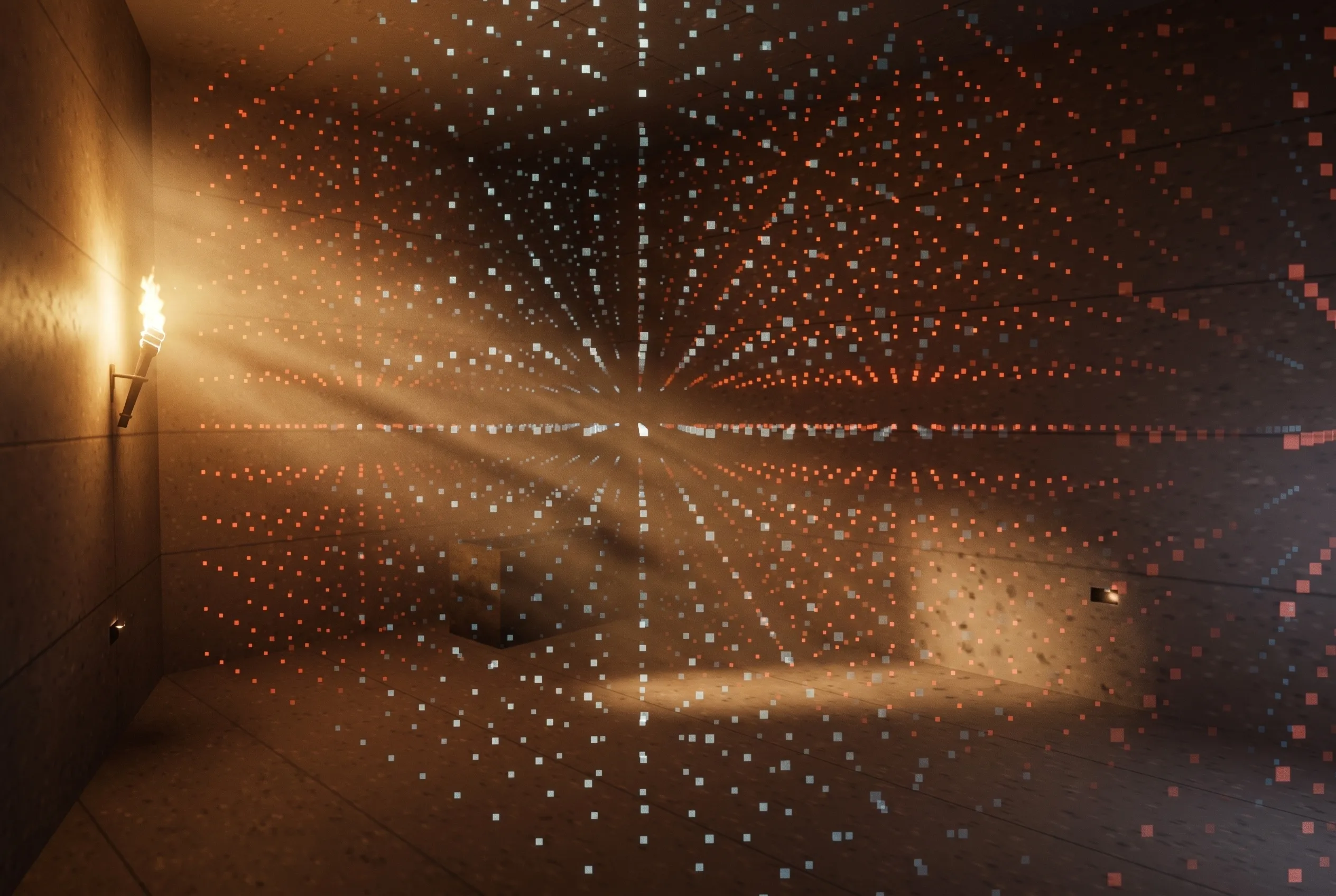
The Chamber view is 3D because the subject is a room. The King's Chamber stands at Petrie's dimensions, granite courses, nine ceiling beams, the coffer at the west end, the two shaft mouths, the entrance at the east end of the north wall; ghost the walls and the five relieving layers stack above the ceiling. The selected mode's pressure field breathes through the room as a particle grid, red where pressure runs high, blue where it runs low, with the nodal planes, where the air stands still, drawn on request. A button sounds the mode through your speakers; infrasonic modes are raised three octaves and say so.
The Mode Ledger is the chord test. Every computed resonance below 120 Hz stands as a tick on a frequency axis, sorted into axial, tangential and oblique lanes, over an equal-temperament lattice with every F sharp marked. Toggle the F sharp major or minor overlay and gold bands show which modes a chord-hunter would keep; the tally line counts how many of the twelve pitch classes the ladder hits within a quarter tone. The answer is all of them. Click any tick to select that mode in 3D.
The Waveguide bench prices chapter ten as stated. The duct section and frequency are dials; the axis shows every TE cutoff, the single-mode band, and the hydrogen line; the cross-sections of Dunn's 8.4 × 4.8, Gantenbrink's measured near-square 20.5 × 21.5 cm, and the real WR-650 stand to scale beside the 21.1 cm wavelength bar. The ohmic-loss line prices the conjectured lining in gold, copper or iron over the shaft's length.
The Energy Budget is one dial and a log axis: ground velocity from quiet Earth to damaging quake, with the three channel ceilings (seismic, tidal, Schumann) as bars at one hundred percent capture, and the demand ladder, one LED lamp, one workshop motor, one ultrasonic mill, a small town, as lines across them. The verdict line prints the shortfall live.
The File view is the case on ten cards, from the thesis to the one card the bench refuses to price, and two verdicts at equal size: the power plant, and a resonant room being a resonant room.
Why it's here
This batch's Culture 15 carries the station's book note on Christopher Dunn's The Giza Power Plant (1998): a machinist reads Petrie's survey, decides the granite was machine-cut, and rebuilds the Great Pyramid as a hydrogen maser driven by the vibration of the Earth. The strangest thing about that book is that its load-bearing claims are almost all computable, and the book computes none of them. The King's Chamber's dimensions were measured by Petrie to hundredths of an inch; the standing waves of a rigid rectangular cavity are a textbook closed form; rectangular-guide cutoffs are the first page of every microwave engineering course; and "drawing energy from the Earth" is a flux times an area. A theory built entirely of computable claims that were never computed is exactly what this station is for.
It also picks up old threads. INST-35, the Orion Correlation, already priced Giza's shaft angles and precession; this bench takes over the same building's interior. Its pricing move, "a dense enough ladder contains any pattern you go looking for", is the same craft INST-60, the Nuclear Lure, used on the bases correlation, except the ladder here is acoustic modes rather than military installations. Its batch sibling, the Core No. 7 feed-rate bench, handles the book's other half: the machining claim. Together the two benches are the complete pricing of the book's checkable core.
How it works
Four exact shelves and zero fitted constants run everything. The panel tags every number exact, modelled, reported or reading.
f = (c/2)·√((nx/L)² + (ny/W)² + (nz/H)²) · fc = (c/2)·√((m/a)² + (n/b)²) · P ≤ ρc·v²·A · E = ½Eε²V
The modes, exactly. A rigid rectangular cavity's resonances are fixed by three lengths and the speed of sound; Petrie supplied the lengths to hundredths of an inch and the chamber's reported constant 68 F fixes c at 343.2 m/s. His base-to-top survey spread moves any mode by less than a quarter tone, and the temperature dial shows a ten-degree swing moves the ladder 29 cents: no conclusion anywhere depends on the idealisation.
The notes, exactly. Twelve-tone equal temperament on A4 = 440 is a convention, which is precisely the point: the chord claim borrowed the convention, so the bench prices it inside the convention. The fundamental is C0 + 3¢. The first F sharp is the ninth rung. All twelve pitch classes are hit. A ladder that dense obliges every listener.
The guide, exactly. Cutoff frequencies, propagating-mode counts, guide wavelength and TE10 ohmic loss are the standard results every microwave text opens with. The bench runs them on Dunn's own numbers first, then on Gantenbrink's measured section, then on the engineers' WR-650, and lets the three cross-sections stand to scale next to the wavelength they were all supposedly built around.
The ceilings, exactly, and overpaid on purpose. Every energy channel is priced at one hundred percent capture with no conversion loss, the strongest assumption physics permits. The point of an upper bound is that generosity strengthens it: when the ceiling at full capture is a watt and the demand is two kilowatts, no efficiency argument can save the machine, because the machine already got efficiency for free.
What is deliberately not computed. No verdict on the chamber's structural damage, no model of the Grand Gallery's lost fittings, no reading of what standing in a 16-hertz room in the dark does to a visitor. Where the record is silent or human, the bench carries a label instead of a guess.
The mode ladder, the note map, the waveguide arithmetic and the three energy ceilings are exact and machine-checked in the tune script; the granite, the torchlight and the coffer's ring estimate are labelled staging; Petrie's survey, Gantenbrink's shaft geometry, the 68 F, the 438 Hz and the F sharp broadcast are reported as documented; and what the room does to the people who stand in it is a reading, for which the bench hangs two verdicts at equal size and adds no third.
The dials that decide what happens
Three mode integers, a temperature, a duct section, a frequency, and one log dial for the shaking ground: between them they hold the whole argument of chapters eight to ten.
- The mode integers. (1,0,0) is the room's deepest voice, 16.38 Hz, a C. (0,1,0) and (2,0,0) land on the same frequency because the plan is exactly 1:2. (2,1,0) is the first F sharp. (1,1,1) is the first oblique. The field in the 3D room rebuilds instantly for each.
- The temperature dial. The chamber's reported constant is 68 F. Slide 14 to 30 °C and the whole ladder shifts together, about 3 cents per degree: the C stays a C, the F sharp stays ninth, and nothing changes, which is the point of showing it.
- The chord overlay. None, F sharp major, F sharp minor. The gold bands are a chord-hunter's keep-pile; the tally underneath counts what the ladder hits anyway: all twelve pitch classes.
- The duct dials. Width, height, frequency, lining. At Dunn's own section the hydrogen line arrives overmoded four ways; squeeze the width below 6.9 in and the line finally travels alone, which is why the real WR-650 is 6.5 in wide. The snap button restores the book's exact numbers.
- The ground dial. Quiet Earth to damaging quake on a log scale. Watch the seismic bar chase the red mill line and never reach it: at 50 μm/s, ground you can feel, the ceiling is 829 W against 2,000.
The claims, as they stand
Six claims that orbit the King's Chamber, from the room's real strangeness to the coupled-oscillator power plant, with who made each and where it lands once the arithmetic is done.
| The King's Chamber is a genuinely resonant, acoustically strange room made by two centuries of visitors; Horn 1976; every acoustic anecdote since Napoleon | BEST SUPPORTED | Best supported, and computed here. A hard granite box of these dimensions cannot fail to hold 89 modes below 120 Hz with a 16.4 Hz fundamental and long reverberation. The reports and the arithmetic agree: the room is strange. Strange is what such a box does. |
| The chamber was tuned to resonate in an F sharp chord in harmony with the Earth made by Danley's tests as retold by Boris Said (Art Bell, 25 Jul 1997); Dunn 1998, ch. 8-9 | DID NOT SURVIVE | Did not survive the bench. The measurements were never published in any form; the computed fundamental lands on C0, not F sharp; the first F sharp mode is ninth on the ladder; and every one of the twelve pitch classes is hit within a quarter tone below 120 Hz, so finding F sharp in the ladder proves selection, not tuning. The Earth has no F sharp: the Schumann fundamental is 7.83 Hz, which is not a musical note. |
| The coffer was tuned, and rings at 438 Hz made by Horn's 1976 liner notes (via Ben Pietsch); Dunn's 1995 tuner reading | DID NOT SURVIVE | The reading is real and repeatable; the inference did not survive. A granite box with these walls must ring somewhere in the low hundreds of hertz, and every possible frequency sits within half a semitone of some equal-tempered note. 438 Hz is A4 minus 8 cents, which is not F sharp, and no modal survey of the box has ever been published. |
| The northern shaft is a waveguide dimensioned to the hydrogen line made by Dunn 1998, ch. 10: 8.4 × 4.8 in against the 8.309 in wavelength | DID NOT SURVIVE | Did not survive the standard formulas. The duct does pass 1420 MHz, four modes at once, with TE11 cutting on 4.4 MHz below the line: an overmoded feed, the opposite of design. Guides are sized to ~0.7λ (WR-650: 6.5 × 3.25 in), not to λ. Gantenbrink measured the shaft proper near-square at 20.5 × 21.5 cm with four bends; Dunn's section matches only the inlet; and the metal lining the argument requires has never been found. |
| The pyramid drew usable power from the Earth's vibration as a coupled oscillator made by Dunn 1998, ch. 8 and 13; the book offers no numbers | DID NOT SURVIVE | Did not survive the arithmetic it never did. At one hundred percent capture over the whole footprint, ambient ground motion delivers milliwatts to watts; the noisy-site envelope 16 W; a felt tremor 829 W; the tides ~1.4 mW; Schumann ~0.14 mW. One ultrasonic mill wants 2 kW. The machine cannot power the tool that inspired it, by three orders of magnitude on a good day. |
| The King's Chamber carries real, unexplained structural damage made by Petrie 1883: walls shifted outward, every ceiling beam cracked, plaster daubed by hand | CONTESTED | Contested and genuinely open. The displacement and cracks are in the survey record; earthquake, settling and Dunn's explosion all remain readings; no quantitative study has closed it. This bench prices the acoustics and the energy, and leaves the damage question standing, because that is where it stands. |
Try this
- Stand in the room at (1,0,0) and press Sound the mode. Three octaves up, that is the room's deepest voice. Now open the Mode Ledger and find where the green fundamental pin sits: 16.38 Hz, on the C0 line, three cents off, exactly at the '16 Hz' the broadcast reported. The measurement and the arithmetic agree; only the note name in the story was wrong.
- Turn on the F sharp major overlay and count the gold ticks. A respectable handful of modes fall in the bands, led by (2,1,0) at 46.4 Hz. Then read the tally line: twelve of twelve pitch classes hit. Now toggle to F sharp minor: still a handful. The ladder obliges every chord, which is why obliging one proves nothing.
- Ghost the walls at (3,2,1) and watch an oblique mode breathe through the whole granite volume with its nodal planes crossing like shelving. This is what 'the room resonates' actually looks like: not a machine humming, a box being a box, beautifully.
- In the Waveguide bench, press the snap button and read the verdict strip. Four modes at the line. Now drag the width down until the verdict flips to single-moded and look where you ended: near 6.5 in, the WR-650's width. You have just designed the guide the way engineers design guides, and it does not look like the wavelength.
- Slide the ground dial to 7 μm/s, the noisy-site envelope. Sixteen watts at one hundred percent capture. Then find what sixteen watts runs on the demand ladder: two LED lamps. The pharaoh's power plant, on the noisiest day the global models allow, lights the room it lives in.
- Read the File's last card, then the two verdicts. The card the bench refuses to price is the experience of standing in the room, and the second verdict does not take that away: a granite box that reverberates for seconds at sixteen hertz will do things to a visitor. That is evidence of a room, and the room is genuinely magnificent.
Accuracy
The honest line between what is exact, what is modelled here, what the record reports, and what is a reading:
| Feature | Tier | What that means |
|---|---|---|
| The mode ladder | T1 Exact | The rigid-wall closed form f = (c/2)·√((nx/L)²+(ny/W)²+(nz/H)²) on Petrie's mean dimensions, carried WITH his base-to-top survey spread (a band under 0.2%, smaller than a quarter tone). Fundamental 16.38 Hz; 89 modes below 120 Hz; the exact 1:2 plan makes whole mode families degenerate. Granite walls are the one case where the rigid idealisation is nearly honest. |
| The note map and the chord test | T1 Exact | Equal temperament on A4 = 440. The fundamental lands on C0 plus 3 cents; the first mode within a quarter tone of F sharp is (2,1,0) at 46.4 Hz, ninth on the ladder; and all twelve pitch classes are hit within 50 cents below 120 Hz, so the ladder contains every chord anyone cares to find. That last line is the whole pricing of the F sharp claim. |
| The waveguide arithmetic | T1 Exact | Standard rectangular-guide formulas on the book's own 8.4 × 4.8 in section: TE10 cuts on at 702.6 MHz, but TE20, TE01 and TE11 all cut on below the hydrogen line (TE11 just 4.4 MHz under it), so the duct is overmoded exactly where the design needs it clean. WR-650, the guide engineers actually use at 1.42 GHz, is 6.5 × 3.25 in and single-moded. A gold-lined straight shaft would lose only ~0.2 dB end to end: the loss is fine; the lining, the straightness and the section are the fiction. |
| The energy ceilings | T1 Exact | Plane-wave seismic flux ρcv² times the 53,061 m² footprint at one hundred percent capture: 0.1 mW at quiet-Earth ground motion, ~1.3 W at a busy site, 16 W at the noisy-site envelope of the Peterson models, 829 W during a just-felt tremor. Tidal strain energy of the whole masonry, fully released twice a day: ~1.4 mW. Schumann-band Poynting flux over the footprint: ~0.14 mW. One industrial ultrasonic mill, the tool the theory was invented to explain, draws ~2 kW. |
| The staging and the coffer estimate | T2 Modelled | The 3D chamber's granite grain, torchlight and coffer are scenery on real dimensions; the pressure field breathing inside them is the exact mode shape. The coffer's plate-mode figure (~190 Hz for the first strip mode) is an order-of-magnitude estimate whose only job is to show that a granite box of these dimensions must ring in the low hundreds of hertz. |
| The survey and the testimony | T3 Reported | Petrie's 1883 survey, the constant 68 F, Horn's 438 Hz and Dunn's 439-440, Gantenbrink's measured shaft geometry (near-square 20.5 × 21.5 cm, four bends), and the F sharp chord itself, which exists only in the Art Bell broadcast of 25 July 1997 and Boris Said's promotion, taken under NDA and never published. Carried as testimony, labelled, and priced against the exact ladder. |
In one line: the mode ladder on Petrie's dimensions (spread carried), the equal-temperament note map, the waveguide cutoffs, mode counts and ohmic loss, and all three energy ceilings at one hundred percent capture are EXACT and machine-checked, with no fitted constant anywhere; the 3D granite, torchlight and the coffer's ring estimate are MODELLED and labelled; Petrie's survey, Gantenbrink's shaft geometry, the constant 68 F, the 438 Hz readings and the F sharp broadcast are REPORTED as documented, the last of them never published at all; and what the room becomes to the people standing in it is a READING, for which this bench hangs two verdicts at equal size and adds no third. Pick a mode, read the ladder, run the budget, and decide.
Sources
- W. M. Flinders Petrie, The Pyramids and Temples of Gizeh, Field & Tuer, London, 1883: the King's Chamber survey (mean 412.45 × 206.13 × 230.25 in, carried here with the base-to-top spread), the coffer dimensions (outside 89.62 × 38.50 × 41.31 in; inside 78.06 × 26.81 × 34.42 in), the displaced walls and cracked beams, and the finger-daubed plaster. Research pass 2026-08-13: this survey is the primary source for every dimension on this bench.
- Christopher P. Dunn, The Giza Power Plant: Technologies of Ancient Egypt, Bear & Company, 1998, chapters 8-10 and 13: the coupled-oscillator claim, the F sharp retelling, the 8.4 × 4.8 in shaft section, the 1,420,405,751.786 Hz figure as printed, and the maser architecture. The station's Culture 15 note covers the whole book.
- The Danley/Said record: the Art Bell Coast to Coast AM broadcast of 25 July 1997 and Boris Said's promotional material for the Schor expedition tests of 1996. Taken under a nondisclosure agreement; no data, method or publication exists in either direction. Carried on this bench strictly as testimony, which is the only form in which it exists.
- Paul Horn, Inside the Great Pyramid, Mushroom Records, 1976, liner notes: the coffer struck at "A-438", tuned against a Korg tuner on Ben Pietsch's suggestion; Dunn's own 1995 Matrix-tuner reading of 439-440 Hz (Dunn 1998, ch. 8). No instrumented modal survey of the coffer or the chamber has ever been peer-reviewed, a gap the bench states rather than fills.
- Rudolf Gantenbrink, the Upuaut project findings (cheops.org, archived): King's Chamber shafts averaging 20.5 cm wide × 21.5 cm high with width varying under 5 mm and height up to 2 cm; the KC-N inlet at 21 × 14 cm (the section Dunn's figures match); the four bends the northern shaft takes around the Grand Gallery; exit heights at masonry layers 101-102.
- The waveguide arithmetic: standard rectangular-guide theory (cutoffs, mode counts, TE10 ohmic attenuation) as in Pozar, Microwave Engineering, 4th ed., Wiley, 2011, ch. 3. WR-650 band designation per EIA standard: 6.500 × 3.250 in, recommended 1.12-1.70 GHz. The hydrogen line at 1420.405751768 MHz (the book prints ...751.786; the difference changes nothing and is noted for the record).
- The seismic ceilings: Peterson, Observations and Modeling of Seismic Background Noise, USGS Open-File Report 93-322, 1993: the NLNM/NHNM noise models bounding ambient ground velocity at roughly 0.02 to 7 μm/s RMS in the 0.1-10 Hz band; plane-wave energy flux ρcv² with ρ = 2,500 kg/m³, c = 2,500 m/s for plateau limestone; Petrie's 9,068.8 in base side for the 53,061 m² footprint.
- The tidal and Schumann ceilings: canonical solid-Earth body-tide strain of order 3×10⁻⁸ (e.g. Agnew, "Earth Tides", Treatise on Geophysics, 2007) applied as ½Eε²V over the masonry volume, fully released twice daily; Schumann-band field strengths of order 1 mV/m (fundamental 7.83 Hz) applied as E²/η₀ Poynting flux over the footprint. Both channels are deliberately overpaid and still land in milliwatts.
- The demand side: industrial ultrasonic machining generators run roughly 0.2-2.4 kW with penetration rates below 1 mm/min in hard stone (Thoe, Aspinwall & Wise, "Review on ultrasonic machining", International Journal of Machine Tools and Manufacture 38, 1998). The comparison tool is the one Dunn's own argument is built on.
- The hero image is generated (Higgsfield Cinema Studio), with this instrument's own 3D render of the chamber and its live pressure field supplied to the model as the shape reference, then checked against the bench: the mote field keeps the planar banding and central nodal line of a computed mode, the walls are unbroken except for two tiny unlit shaft mouths, the coffer stands at the far end, and the only light is the staged torch, which the panel already labels scenery.
- Cross-referenced on this site: the Culture 15 book note on The Giza Power Plant; INST-35, the Orion Correlation, for Giza's shaft astronomy; the Core No. 7 feed-rate bench, this instrument's batch sibling, for the machining half of the book; and INST-60, the Nuclear Lure, for the statistics of finding patterns in dense ladders.
Sound the room. Read the ladder. Squeeze the duct. Shake the ground. Then decide what the chamber was tuned to, and what was only ever a box being magnificent.
Open the interactiveCompiled August 2026