The Core No. 7 Feed-Rate Bench
In 1881 Flinders Petrie carried a granite stump out of Giza: the waste core of an ancient tube drill, a shallow groove winding round its side. He read the groove as one continuous spiral sinking a tenth of an inch per turn, and concluded jewelled bronze under a couple of tons. In 1998 Christopher Dunn read the same groove, divided its feed by a modern diamond drill's, printed '500 times greater', and built an ultrasonic machine-tool industry, and eventually a power plant, on the quotient. This bench does what neither book did: the arithmetic. The division comes out at 450, not 500. The ratio compares feeds while ignoring speeds, and as an actual rate Petrie's spiral at a hand bow means nine metres of granite per hour, thirty times a powered diamond rig, a first clue that the groove may not be a feed mark at all. Meanwhile everyone who has ever measured the grooves, Dunn included, finds the same one-to-two-millimetre spacing; they differ only in the story: one helix, two helices, or, per the electron microscopy of 1983 and the full panorama of 2020, broken rings that follow the feldspar crystals and imply no feed whatever. And the experiment has been run: copper tube, quartz sand, three men, three millimetres of depth per hour, tapered core included. The stump is real, the drilling was real, and the question deserved better instruments. The bench renders all four readings and lets you turn the core yourself.
 Open the interactive ▸
 What you're looking at
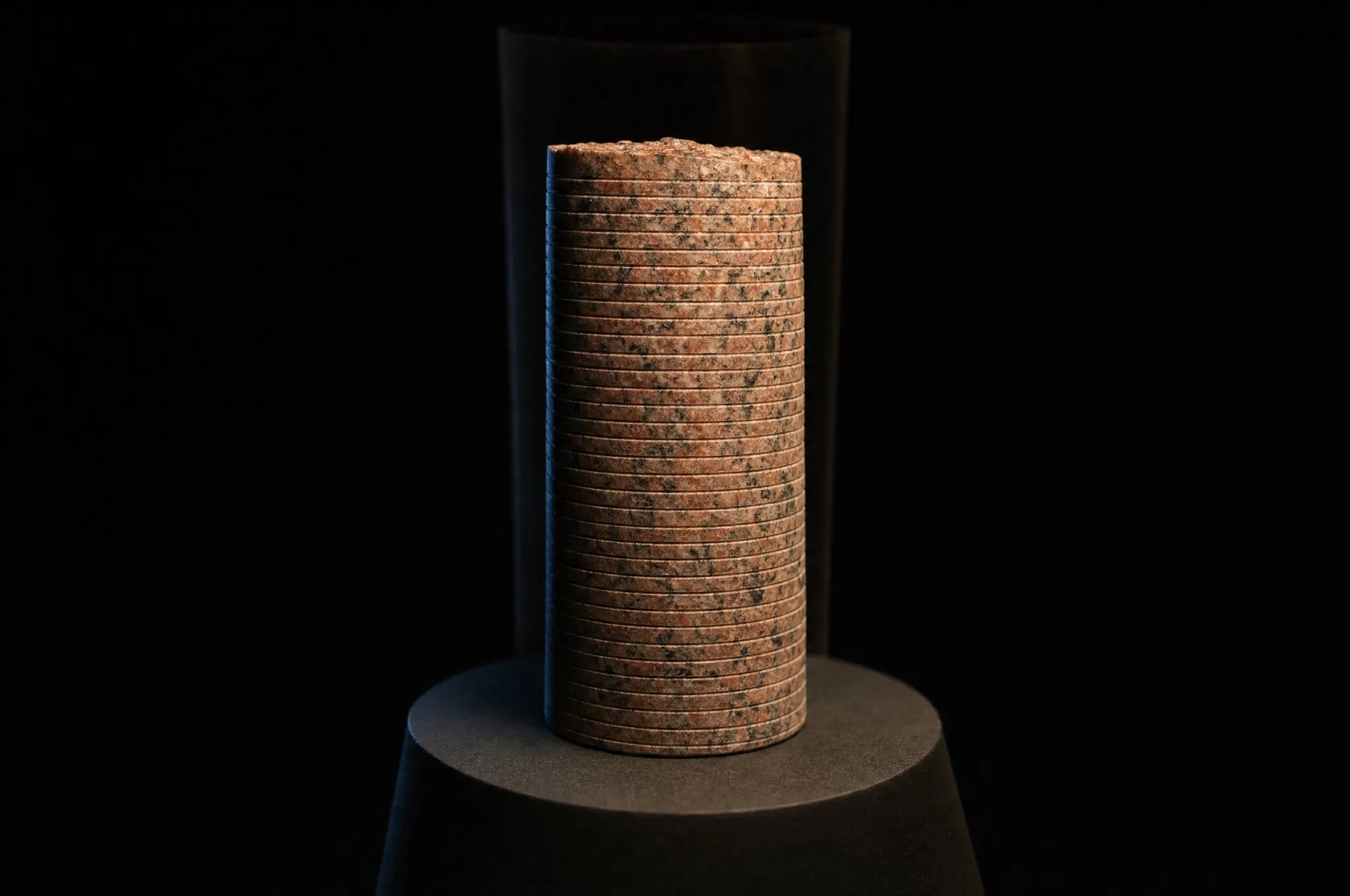
The Core view is 3D because the subject is an object in a museum case. The tapered core stands at Petrie's documented 6 inch circumference on a slow turntable, under key light, with the ghost of the tube drill around it. The groove pattern on the stone is the selected reading, drawn literally: Petrie's single helix, Dunn's two-start, the same spacing at one start, or the broken crystal-following rings of the sceptics' observations. Switching reading redraws the stone.
The Feed Ledger is one log axis, feed per revolution, with everything on it: Stocks's measured copper-and-sand feed (0.0000164), Dunn's own diamond anchor (0.000222), and the three helix readings of core 7 (0.060, 0.100, 0.110), with the measured-spacing band they all share and the note that the rings reading places no pin at all. The ratio line prints the selected reading against the diamond anchor, beside the book's printed 500 and its actual 450.
The Rate Ledger converts readings to reality. Bars for the measured machines, copper-and-sand at 0.3 cm/hr, ultrasonic at 6, diamond at 30, and a red bar for the implied ancient drill: the selected reading times the dialled rpm. At Petrie's reading and 60 rpm the red bar is 914 cm/hr and the verdict line says so.
The File view is the case on ten cards, from Petrie's 1883 observation to the missing profilometry, and two verdicts at equal size: the machine tool, and an abrasion mark.
Why it's here
This batch's Culture 15 carries the station's book note on Dunn's The Giza Power Plant. The book's technical heart is not the pyramid but a hand-sized granite stump: core No. 7, which Petrie carried out of Giza. Dunn's whole chain, ultrasonic machining, an advanced toolkit, and eventually the power plant, starts from one reading: that the groove on this stump is a feed mark of 0.1 inch per revolution. And every piece of arithmetic that reading depends on, spacing times starts, feed times rpm, and the famous division itself, goes unperformed in the book. One artifact carrying an entire theory, and a bench that draws all four published readings side by side, is exactly what this station is for.
It also picks up old threads. Its batch sibling, the King's Chamber Resonance Bench, handles the book's other half, the acoustics and the energy; together the two are the complete pricing of Culture 15's checkable core. The ledger INST-58, the Nazca Construction Bench, opened, ancient construction priced in labour and hours, continues here with Stocks's copper-and-sand experiments: 5.2 cubic centimetres per hour, three men, one bow. And the move this bench turns on, the same physical evidence, with the reading deciding the conclusion, is the materials line's old craft since INST-48, the Osmium Fingerprint: isotope ratios there, groove spacing and helix starts here.
How it works
Two identities and one division run everything. The panel tags every number exact, modelled, reported or reading.
feed = spacing × starts · rate = feed × rpm · ratio = feed / feed_diamond · 0.1 ÷ 0.000222 = 450
The helix arithmetic, exactly. A helix's feed per revolution is its groove spacing times its number of starts; there is nothing else to it. The bench's job is to hold that identity still while the readings swap, so the consequences of each assertion, one start, two starts, no helix, are computed rather than argued.
The rate conversion, exactly. Feed per revolution times revolutions per hour is depth per hour. The famous ratio never did this multiplication, and doing it is what exposes the claim: any reading above a few thousandths of an inch per revolution implies penetration rates no drill of any technology achieves in granite.
The division, exactly. The book's flagship number, printed as 500, divides its own two inputs to 450. The bench carries both, because catching a book's arithmetic with the book's own numbers is the fairest audit there is.
What is deliberately not computed. No adjudication between the four readings, because the instrument that could adjudicate, a profilometer on the object, has never been published; no torque or load model for the ancient drill, because nobody knows what drove it; and no verdict on the deeper-through-quartz claim, which is unverified on the object in both directions. Where the record is unmeasured, the bench says unmeasured.
The helix identities, the rate conversions and the 450 are exact and machine-checked; the 3D core, its grain and the four rendered groove patterns are labelled staging; every measured figure on the bench, Petrie's, Dunn's, the sceptics', Stocks's, is reported as printed, conflicts included; and what the stump proves about a civilisation is a reading, for which the bench hangs two verdicts at equal size and adds no third.
The dials that decide what happens
One reading selector and one rpm dial: between them they hold the whole argument of chapter four.
- The reading selector. Petrie's single spiral, Dunn's two-start, the same spacing at one start, and the rings. The 3D stone redraws, the feed pin moves, the ratio recomputes, and under rings the number vanishes, which is the honest rendering of the sceptics' claim.
- The rpm dial. A hand bow's 60, Stocks's 120, the diamond anchor's 900. The red bar in the Rate Ledger is reading × rpm, and it is the dial that turns '500 times better' into 'nine metres of granite an hour', which no one believes.
- The drill ghost and turntable. Staging toggles: the copper tube around the core, and the museum spin. Turn them off to study the groove pattern still.
The claims, as they stand
Six claims that orbit core No. 7, from the drilling nobody disputes to the machine-tool industry, with who made each and where it lands once the arithmetic is done.
| Fourth Dynasty workers tube-drilled granite, in quantity, with skill made by the artifact record; Petrie 1883; universally accepted | BEST SUPPORTED | Best supported: the cores, holes and hollowed coffers exist in quantity, and nobody on any side disputes that the drilling happened. The dispute is entirely about what drove the drill. |
| The groove is a single continuous spiral at 0.1 inch per revolution made by Petrie 1883 and 1884; adopted by Dunn 1998 as the flagship measurement | CONTESTED | Contested on the object itself. Petrie read one spiral by eye and hand in 1881; the 1983 SEM work found concentric striations in Egyptian drill holes generally, and the 2020 full-circumference panorama of core 7 traced grooves that converge, diverge, break, and follow the feldspar crystals. No instrumented profile of the core has ever been published, so the single-spiral reading is neither established nor dead: it is unmeasured. |
| The feed rate is '500 times greater' than modern diamond drilling, so the tool was ultrasonic made by Dunn 1998, ch. 4; repeated across the advanced-machining literature since | DID NOT SURVIVE | Did not survive the arithmetic. The book's own two numbers divide to 450, not 500. Worse, the ratio compares per-revolution feeds while ignoring rotation speeds: read as an actual rate, the claim means nine metres of granite per hour from a hand bow, thirty times a powered diamond rig, which is not evidence of a better tool but a sign the premise is broken. And modern ultrasonic machining, the proposed mechanism, penetrates hard stone at under a millimetre a minute, which no reading of the groove matches. |
| The groove cuts as deep through hard quartz as soft feldspar, which loose abrasive cannot do made by Petrie's observation; the load-bearing premise of Dunn's ultrasonic argument | CONTESTED | Contested. The 2020 mineral map reports the traces correlating with crystal boundaries, the signature of abrasion, not feed; and no published profilometry quantifies the depth-by-mineral claim on core 7. The observation that seeded the whole ultrasonic case is, on current evidence, unverified on the object. |
| Copper tubes with sand abrasive cannot produce these artifacts made by Dunn 1998, arguing the toolkit was inadequate | DID NOT SURVIVE | Did not survive the experiment. Stocks drilled Aswan granite with copper tube and dry quartz sand at 5.2 cm³ per hour, produced tapered cores in tapered holes, and published rates, loads and wear across two decades of trials. Slow is not impossible: slow is the workforce the Fourth Dynasty demonstrably had. |
| The core proves a lost machine-tool industry made by Dunn 1998-2024; the premise the rest of the book stands on | DID NOT SURVIVE | Did not survive the chain above it. The reading is contested, the ratio is miscomputed, the rate implication is physically absurd, and the reproduced hand process leaves the same class of mark. What the core proves is drilling; everything beyond that is carried by a choice of story about one groove. |
Try this
- Start on Petrie's reading and just look at the core. A single elegant helix winding down a granite cylinder: you can feel why a machinist saw a lathe-fed tool. Now switch to the rings. Same stone, same spacing, and the marks become weather rather than intent. That switch, one click, is the entire dispute.
- Open the Feed Ledger and find the shared band. The copper band at 1-2 mm is where everyone's measurements of the groove spacing sit: Petrie's, Dunn's, Kruglyakov's. The pins that differ are not measurements. They are multipliers: how many starts you assert.
- In the Rate Ledger, leave Petrie's reading on and slide the rpm from 60 to 900. The red bar runs from nine metres an hour to a hundred and thirty-seven. Somewhere along that slide, ask which ancient workshop this describes. The dial is the argument.
- Switch to the rings reading in the Rate Ledger. The red bar disappears, and what remains are the three measured machines: 0.3, 6 and 30 centimetres per hour. That remaining picture, slow copper at the bottom, is the one that has actually been reproduced with period tools.
- Read the 'missing instrument' card in the File. One profilometer trace would settle single against double against rings in an afternoon, and in 143 years nobody has published one. Hold that against every confident sentence ever written about this stump, from either side.
Accuracy
The honest line between what is exact, what is modelled here, what the record reports, and what is a reading:
| Feature | Tier | What that means |
|---|---|---|
| The helix arithmetic | T1 Exact | Spacing × starts = feed per revolution; feed × rpm = penetration rate; ratio = feed over Dunn's own diamond anchor (1 inch per 5 minutes at 900 rpm = 0.000222 in/rev). These are identities, not models, and the tune script checks every one. The bench's two headline results follow: the printed '500 times' is 450, and Petrie's reading at a 60 rpm bow implies 9.1 metres of granite per hour, thirty times a modern diamond rig. |
| The consistency traps | T1 Exact | Dunn's own 1999 spacing measurement (0.040-0.080 in) equals 1.0-2.0 mm and sits inside Kruglyakov's 1-3 mm field: every party measures the same grooves. Read as two starts the feed is 0.11 in/rev; the same spacing at one start halves it; as rings it vanishes. The famous number is a choice of story, and the bench computes each choice's consequences. |
| The core and its patterns | T2 Modelled | The 3D cylinder stands at Petrie's documented 6 inch circumference with his reported taper; its proportions above that, the granite grain, and the crystal field that steers the rings pattern are staging. Each groove pattern is a literal rendering of a published reading, not an adjudication between them: the adjudicating instrument, a profilometer on the object, has never been published. |
| Every measured number | T3 Reported | Petrie's 0.1 in per 6 in circumference and his 1-2 ton jewel-point load; Dunn's 1999 spacing and two-start reading; Gorelick & Gwinnett's 1983 SEM striations; Kruglyakov & Selivanov's 2020 panorama and mineral correlation; Stocks's 5.2 cm³/hr, 20-hour 6 cm core, 120 rpm and crew of three; the 1999 NOVA saw trial; the diamond and ultrasonic anchors. All carried as printed, conflicts included. |
In one line: the helix identities (spacing × starts = feed), the rate conversions (feed × rpm), and the division the book never performed (450, printed as 500) are EXACT and machine-checked, with no fitted constant anywhere; the 3D core, its grain and the four rendered groove patterns are MODELLED and labelled; every measured figure, Petrie 1883, Dunn 1999, the SEM of 1983, the panorama of 2020, Stocks's rates, the NOVA trial and both modern anchors, is REPORTED as printed, conflicts included; and what the stump proves about a civilisation is a READING, for which this bench hangs two verdicts at equal size and adds no third. Turn the core, switch the reading, run the rates, and decide.
Sources
- W. M. Flinders Petrie, The Pyramids and Temples of Gizeh, 1883, ch. 7, and "On the Mechanical Methods of the Ancient Egyptians", Journal of the Anthropological Institute 13, 1884: the 6 inch circumference, the "spiral of the cut sinks .1 inch", the <0.01 in irregularity, the deeper-through-quartz observation, and his own conclusion of jewelled bronze under a ton or two of load. Core No. 7 is Petrie Museum UC16036, University College London.
- Christopher P. Dunn, The Giza Power Plant, Bear & Company, 1998, ch. 4: the 500× claim and the ultrasonic proposal; and his 1999 re-examination of the core (gizapower.com/petrie.html): groove spacing measured at 0.040-0.080 in, groove depth 0.002-0.005 in, and the two-start helix reading at ~0.110 in/rev. The station's Culture 15 note covers the whole book.
- Leonard Gorelick and A. John Gwinnett, "Ancient Egyptian Stone-Drilling: An Experimental Perspective on a Scholarly Disagreement", Expedition 25(3), 1983: SEM of silicone impressions showing concentric, not spiral, striations in Egyptian drill holes.
- M. Kruglyakov and I. Selivanov, "#7, seventh of Petrie", 2020 (antropogenez.ru): the first full 360-degree photographic panorama of core 7 with groove tracing and a mineral map; traces converge, diverge, break, and correlate with feldspar crystal positions; field between traces 1-3 mm.
- Denys A. Stocks, Experiments in Egyptian Archaeology: Stoneworking Technology in Ancient Egypt, Routledge, 2003, and "Stone sarcophagus manufacture in ancient Egypt", Antiquity 73, 1999: copper tube + dry quartz sand in Aswan granite at 5.2 cm³/hr, a 6 cm core in a 20-hour run (8 cm tube, ~1 kg/cm², ~120 rpm alternating bow, crew of three), tapered holes and cores, and the granite-vs-limestone rate ratio.
- The 1999 NOVA Aswan trials (PBS, Lost Empires: Obelisk): a copper slabbing saw with sand cutting a 95 cm slot 3 cm deep in 14 hours, the blade losing 7.5 mm of depth.
- The modern anchors: Dunn's own diamond figure (1 inch in 5 minutes at 900 rpm, from Rahn Granite Surface Plate Co., 1983, confirmed to him by Tru-Stone Corp., 1996), and ultrasonic machining penetration under 1 mm/min in hard stone with 0.2-2.4 kW generators (Thoe, Aspinwall & Wise, International Journal of Machine Tools and Manufacture 38, 1998).
- What has never been published, stated as a source-shaped hole: no contact or optical profilometry of core No. 7 exists in the literature, from any party, in 143 years. Every reading on this bench is a reading of photographs and eyes.
- The hero image is generated (Higgsfield / GPT Image 2), with this instrument's own render of the core supplied to the model as the shape reference, then checked against the bench: the groove wraps the full flank at the measured millimetre-class spacing, the cylinder tapers toward its rough broken crown, and the ghost of the tube drill stands behind it. The photograph privileges no reading, because a photograph cannot settle what only a profilometer can.
- Cross-referenced on this site: the Culture 15 book note on The Giza Power Plant; the King's Chamber Resonance Bench, this instrument's batch sibling, for the book's acoustic and energy half; INST-58, Nazca, for construction priced in labour; and INST-48, the Osmium Fingerprint, for the materials line's reading-decides-conclusion craft.
Turn the core. Switch the reading. Run the rates. Then decide what fed the drill, and what was only ever a story about a groove.
Open the interactiveCompiled August 2026