The Shootdown Bench
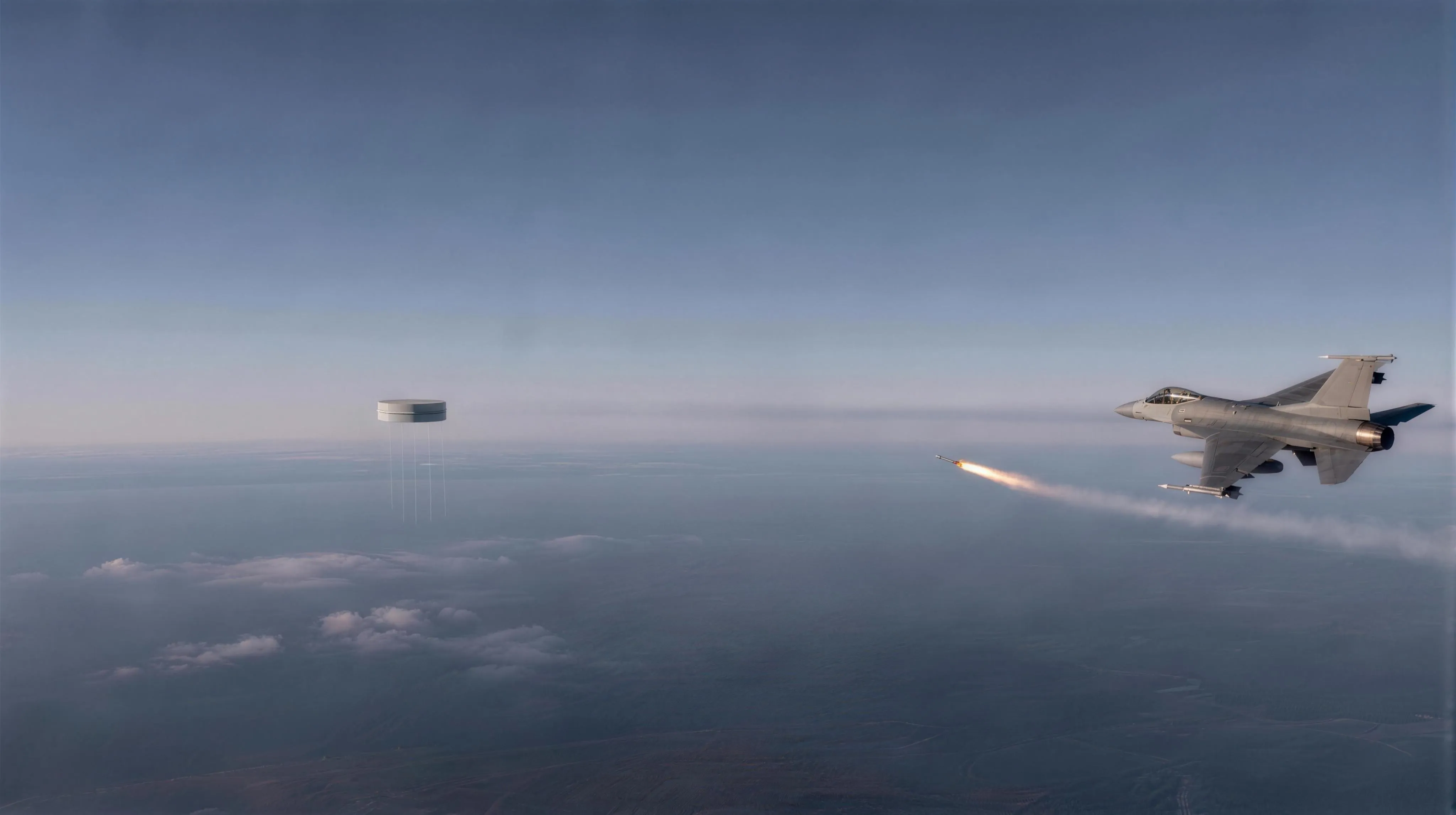
On 12 February 2023 an F-16 fired a $400,000-class missile at an octagonal object drifting over Lake Huron at the speed of a cycling commuter, and missed; the second shot connected, and the fragments fell toward a February lake. It was the fourth kill in nine days, and the first three began the day NORAD opened the radar filters that had been quietly deleting everything slow and small from its screens for years. This bench computes the machinery of that week honestly in both directions. It draws the filtered sky and the exact trigonometry of what a velocity gate cannot see; it integrates the Planck curves that make a cold balloon an order of magnitude harder for a heat seeker than a jet; it replays the two shots at true scale over the true six-kilometre drop; and it reconstructs the infrared clip that surfaced three years later with UAP typed into its title by an unknown uploader. No mystery is required at any step, which is the point the station's own briefing already made: a confirmed shootdown is not a confirmed mystery. What the week did prove, three objects engaged unidentified, two never recovered, a decade of blind bookkeeping, the bench prints at the same size.
 Open the interactive ▸
 What you're looking at
The Intercept view is 3D because the subject is an engagement in space. One scene unit is one metre: the object hangs at the origin with the part-frozen lake the true 6,096 m below, the February sun at its real afternoon height, and an F-16 at true scale lapping a target forty times slower than itself. Press Run and the reported sequence plays: shot 1 at launch, the miss, the compressed reposition, shot 2, and the radial burst the government's own file describes. Drag to orbit; the labels name what is reported and what is staged.
The Gate view is the week's mechanism. Ground speed against radar cross-section for everything that actually lives in the sky, birds, flocks, light aircraft, airliners, radiosondes, the hobby pico fleet, and two dashed lines: the velocity gate and the sensitivity gate. At standard settings the four February diamonds sit deep in the rejected region with most of the census around them. Throw the switch and you are looking at 11 February 2023: same sky, new bookkeeping. The inset carries the one exact result, the blind-heading fraction 2/π·asin(g/v).
The Seeker view is the miss's physics shelf. Two Planck curves, the target's skin and the sky behind it, integrated live over the AIM-9X's 3-5 µm band, with a 600 K tailpipe dashed in for scale. Contrast intensity comes out signed, a foil balloon reflecting cold sky can be darker than the horizon, and the lock ladder prices it: a tailpipe at 55 km, the octagon near 6 km, a pico balloon at snapshot range. One calibrated constant, printed on the face.
The Clip view reconstructs PR071: the 46-second infrared file whose uploader titled it a UAP shootdown. The sensor settles, focuses at eleven seconds, and at twenty the radial displacement pattern blooms, all timed from the government's published description, with the object drawn at the contrast the Planck bench computes. White-hot or black-hot; drag the timeline. It is a reconstruction and says so: the real clip shows a weapon working, which is all it shows.
The Ledger view is the week on nine cards: the real balloon that started it, the filter change, Alaska and Yukon, the octagon and the miss, the recovery table (three kills, two never found), the missing K9YO, the 1998 thousand-round gun run that explains the missiles, the bill, and the clip's 2026 return with a label. It closes on two verdicts at equal size: the object, and the system.
Why it's here
This instrument was pulled into existence by the station's own file line. PR071, the lead clip of PURSUE Release 02, is the Lake Huron shootdown's infrared footage, and this station's briefing on it already wrote the bench's spine: a confirmed shootdown is not a confirmed mystery. The briefing set the clip beside the public event; this instrument goes one step further and puts the event itself on the table: why the sky suddenly filled with objects in February 2023, what a heat-seeking missile sees in a target with no engine, and why a miss is physically unremarkable.
It also picks up two older threads of the casework line. INST-43, Project Mogul, computed how a train of balloons became a legend in 1947; this bench is the same machine's 2023 edition, except this time the legend lived four days before two missiles and a recovery document closed it. And INST-28 taught how to read a military infrared frame: PR071 is the same kind of image, and this bench's Clip view rebuilds it at the computed contrast, so a reader can see why a cold target in such footage should be a faint mark.
How it works
Four exact results and one calibrated constant run everything. The panel tags every number exact, modelled, reported or reading.
L(T) = ∫ B(λ,T) dλ · J = A·(εL(T_skin) + (1−ε)L(T_refl) − L(T_sky)) · R = √(|J|/E_min) · f_blind = (2/π)·asin(g/v)
The atmosphere, exactly. The International Standard Atmosphere gives temperature, pressure and density in closed form at any altitude on the dial. A drifting balloon's skin temperature is ambient plus a solar offset, so every seeker number downstream inherits the atmosphere exactly: at 20,000 ft the air is 248.5 K and the whole bench knows it.
Planck, integrated live. Band radiance is the Planck function integrated over 3-5 µm by Simpson's rule, checked against σT⁴/π to a tenth of a percent from 220 K to 600 K. The target's radiance is emission plus reflection, ε·B(T_skin) + (1−ε)·B(T_refl); the background is the sky's. The difference, times projected area, is the contrast intensity J, in watts per steradian, and it carries a sign.
One constant, printed. Lock range is R = √(|J|/E_min). Real E_min values are classified, so the bench fits exactly one: a legacy reticle seeker locking a standard 600 K, 0.3 m² tailpipe at 10 km, with the imaging array carried at 30× that sensitivity. Both are printed on the instrument. Move either and every bar scales together; the ratios between targets, which carry the argument, do not move.
The gate, exactly where it can be. The census is a labelled order-of-magnitude model, but the Doppler arithmetic is closed form: a radial-velocity filter rejects 2/π·asin(g/v) of headings, which is 100% for the Huron drifter against the standard gate and one heading in eight even for an airliner. The Mie series, the same exact code as INST-52, bounds the metallised pico balloon at half a square metre: brighter than a bird. The gate did the hiding, not stealth.
The intercept, staged honestly. The two shots and the miss are reported; the fly-out is a scripted reconstruction with class figures for everything unpublished, at true scale. The 44-second loop compresses what took hours and says so on the strip. The miss is reproduced without an animated cause, because the record gives none.
What is deliberately not computed. No radiative-transfer sky, no missile guidance internals, no claimed identification of the two unrecovered objects. Where the record is silent, the bench carries a dial and a label instead of a guess dressed as a number.
The Planck integrals, the standard atmosphere, the blind-heading fraction and the Mie bound are exact and auditable; the lock constant is modelled with its single calibration printed; the census counts, the backgrounds and the fly-out are labelled models; the timeline, the miss, the filter account, K9YO and the recovery documents are reported as documented; and what the uploader's title is entitled to mean is a reading, for which the bench hangs two verdicts at equal size and adds no third.
The dials that decide what happens
An object, a timeline, four seeker sliders and two gate lines: between them they hold the whole public argument about February 2023.
- The object: octagon, pico, cylinder. The Huron description, the K9YO class, and the Yukon description, switchable everywhere at once: the 3D scene, the seeker's defaults, the clip's blob. The pico is the one with a known size, 0.81 m, and it is held exact.
- The timeline, with Run. Shot 1 at T+8, the miss at T+13, shot 2 at T+24, impact at T+29, the four moments the record fixes, marked on the strip. Scrub anywhere; the minutes between passes are compressed and labelled.
- Skin ΔT and emissivity. The two dials that make or unmake an IR target. Sunlit plastic at +12 K and ε 0.75 locks kilometres out; bare foil at ε 0.1 barely radiates at all and can flip the contrast negative. The whole cold-target problem lives in these two sliders.
- The sky behind it, and altitude. Background temperature sets how much a warm target stands out; altitude sets ambient air by the standard atmosphere, exactly. Huron was 20,000 ft; slide to 40,000 and you are running the Alaska and Yukon cases.
- The speed and sensitivity gates. Two dashed lines that were, for years, the difference between a quiet screen and February 2023. Slide them yourself, or throw the switch to the 11 February setting and count the diamonds.
- White hot. The clip's polarity toggle, because a faint mark reads differently against both, and because the real file is black and white infrared with a settling sensor, which the reconstruction honours.
The claims, as they stand
Six claims that orbit the February shootdowns, from the press room to the fringe, with who made each and where it lands once the arithmetic is done.
| The Lake Huron object was a mundane balloon-borne package made by the descriptions, and documents public since late 2024 | BEST SUPPORTED | Best supported. Octagonal, strings, no payload, slow, radar-faint, IR-faint: every recorded property fits a small commercial or hobbyist instrument package, and the late-2024 recovery documents link debris to a company selling weather or monitoring equipment. Short of a formal government identification, but nothing on record pulls the other way. |
| February's objects appeared because the radar filters changed made by Gen. VanHerck, NORAD, in as many words | BEST SUPPORTED | Settled by the commander's own account, and computed here. Velocity and sensitivity gates that reject slow, small returns were opened after the Chinese balloon; the Gate view shows the standing population those gates hide, and the exact blind-heading arithmetic. Three objects in three days was a promotion, not an arrival. |
| The Yukon object was the hobby balloon K9YO made by the pico-balloon community, and the wind projections | CONTESTED | Contested, permanently. Last contact off Alaska on 11 February, NOAA winds projecting it over the Yukon when the F-22 fired, and a described cylinder-and-payload anatomy that is balloon-like but not a mylar sphere. Nothing was ever recovered, the club claimed nothing, and the overlap cannot be promoted beyond an overlap. |
| The first missile missed because the object was exotic made by a reading the footage's title invites | DID NOT SURVIVE | Did not survive scrutiny, and needs no exotic help. The miss is confirmed; its cause was never published. The Seeker view holds sufficient mundane physics, a cold, small, slow target is an order of magnitude harder to lock than a jet, and the bench keeps that candidate physics and the unexplained fact on separate shelves. |
| NORAD could not see slow small objects made by a natural misreading of the week | DID NOT SURVIVE | Did not survive the record. The radars could see them; the screens were told not to show them, because a picture with every bird and balloon in it is unusable. The blindness was a bookkeeping policy with good reasons and a decade of unexamined consequences, which is a different finding, and in some ways a harder one. |
| "Shoots Down UAP" means the government fought a true unknown made by PR071's uploader-typed title, read literally | READING | A reading the file itself disclaims. AARO assesses provenance only and does not endorse uploader titles; UAP in that filename records one user's uncertainty at upload time. The event it names was reported live by national press, and the balance of the record since points to the mundane. The clip shows a weapon working. |
Try this
- Press Run and just watch the whole loop once. Approach, shot, miss, reposition, shot, radial burst, debris. The four marked moments are the entire published record of the engagement; everything between them is staging, and the strip says which is which.
- Zoom all the way out in the Intercept. The object vanishes into six kilometres of winter haze long before the jet does. That disappearance is the honest scale of the problem: it is what a $65 million interceptor was cued onto by a filter change.
- In the Gate view, drag the speed gate slowly to zero. Watch which population crosses the line first: not the February diamonds but the radiosondes, whose jet-stream ground speeds already beat the gate. Official weather balloons were never reliably hidden; the drifters were.
- Throw the gates switch and read the count strip. The tracked number multiplies. Nothing arrived. That one toggle is the entire mystery of why February 2023 happened in February 2023.
- In the Seeker, set emissivity to 0.10. Foil. The contrast J flips sign and the lock bars collapse: a mirror ball reflecting cold sky is darker than the horizon behind it. Then remember the legacy-seeker bar is what 1970s missiles had, and be a little impressed the 2023 shots worked at all.
- Slide altitude from 20,000 to 40,000 ft. The air drops to 216.65 K and every curve and bar follows: you are now running the Alaska and Yukon engagements, where the objects were smaller and the sky colder.
- In the Clip, drag to 19 seconds and let it play. The file's own description says what happens at twenty. Watch it knowing that a balloon, a drone and a saucer would all draw the same radial pattern under that warhead: this is the frame where the footage stops carrying information about the object.
- End on the Ledger's recovery card. Three kills, two never found, one linked on paper to weather equipment. Then read the two verdicts and notice they do not fight: the object was probably mundane, and the system's blindness was real. Both are what the record supports.
Accuracy
The honest line between what is exact, what is modelled here, what the record reports, and what is a reading:
| Feature | Tier | What that means |
|---|---|---|
| Planck band radiance | T1 Exact | The seeker bench integrates the Planck function over the 3-5 µm band live, for target skin, reflected surroundings and sky background, and the integrator is checked against the Stefan-Boltzmann total to a tenth of a percent across the bench's whole temperature range. Every lock range on the instrument is this integral and nothing else. |
| The standard atmosphere | T1 Exact | Ambient air temperature, pressure and density at any altitude the dials allow, in closed form. At the reported 20,000 ft the air is 248.5 K (minus 24.6 °C); a drifting balloon's skin rides this number plus whatever the sun adds. |
| The Doppler blind fraction | T1 Exact | A filter keyed to radial velocity rejects the fraction 2/π·asin(gate/v) of headings, exactly. A 16-knot drifter never clears an 80-knot gate from any heading: 100% blind. A 450-knot airliner crossing the beam hides for 12.8% of headings. This one line of trigonometry is the mechanism of the entire week. |
| The Mie bound for the pico | T1 Exact | The full Mie series (the same exact code as INST-52) bounds a fully metallised 32-inch sphere at about 0.5 m² on radar in the optical regime, 54 times a textbook bird, lifting 2.6× at VHF resonance. The hobby fleet was never hidden by invisibility; it was hidden by the gate. |
| The seeker lock constant | T2 Modelled | Real seeker sensitivities are classified. The bench fits exactly one number, a legacy reticle locking a 600 K, 0.3 m² tailpipe at 10 km against a 220 K sky, carries the imaging focal-plane array as 30× that sensitivity, and prints both on the face. Ratios between targets, which is what the argument uses, are insensitive to both choices. |
| The sky census and backgrounds | T2 Modelled | The Gate view's population counts are order-of-magnitude figures from public sources (radiosonde launch schedules, aircraft aloft, the hobby balloon community), and the MWIR sky and reflected backgrounds are single dialled temperatures, not a radiative-transfer solution. Both are labelled on the instrument. |
| The intercept geometry | T2 Modelled | The two shots and the miss are the reported record. The object's size, the launch ranges, the miss distance and the drift speed were never published: all are dials or labelled class figures, drawn at true metre scale over the true 6,096 m drop. The miss is reproduced because the record says it happened; no cause is animated because none was given. |
| The week, K9YO, and the recovery | T3 Reported | The four events with their dates, altitudes and weapons; Gen. Milley's confirmation of the miss; Gen. VanHerck's account of the opened velocity gates; K9YO's last contact and projected track; the 1998 Canadian gun run; the missile's budget cost; and the late-2024 documents linking Lake Huron debris to commercial weather or monitoring equipment. All carried as reported, with the two unrecovered objects left exactly as open as the record leaves them. |
In one line: the Planck band integrals, the standard atmosphere, the Doppler blind-heading fraction and the Mie bound for the pico balloon are EXACT and machine-checked; the seeker's lock constant is MODELLED with its one calibration printed; the census, the backgrounds and the fly-out are MODELLED and labelled; the timeline, the miss, the opened gates, K9YO and the recovery documents are REPORTED as documented; and what a typed title containing UAP is entitled to mean is a READING, for which this bench hangs two verdicts at equal size and adds no third. Run the shots, open the gates, and decide for yourself.
Sources
- Department of Defense and NORAD press briefings, 12-16 February 2023, including Gen. Mark Milley's 14 February confirmation that the first missile "missed" and landed in Lake Huron, tracked to the water; the engagement altitude of about 20,000 ft; and the octagonal-structure-with-strings description. Contemporary coverage: The War Zone, Military.com, CNN, Detroit News.
- Gen. Glen VanHerck (NORAD/USNORTHCOM) on radar "velocity gates" that filter low-speed clutter, adjusted after 4 February 2023 to reveal smaller, slower objects (DefenseScoop, FlightGlobal, DoD transcript), with his earlier testimony that the large majority of raw radar returns went unanalysed.
- The February 2023 sequence: the PRC surveillance balloon downed off South Carolina on 4 February (F-22, AIM-9X); the Alaska object of 10 February (40,000 ft, "size of a small car"); the Yukon object of 11 February (US F-22 in Canadian airspace; the later-released description of a cylinder, top quarter metallic, 20-foot wire and package); the Montana radar anomaly of 11 February; and the Lake Huron engagement of 12 February by an F-16C of the Minnesota Air National Guard's 148th Fighter Wing, two AIM-9X fired.
- Recovery record: the joint US-Canadian Lake Huron search suspended 16 February 2023 for weather and low probability; Alaska and Yukon searches ended without recovery; and later-public documents (late 2024; KSTP and others) recording debris located and linking the Lake Huron object to a company selling weather or monitoring equipment.
- K9YO: the Northern Illinois Bottlecap Balloon Brigade's 32-inch silver mylar pico balloon, 123 days aloft on its seventh circumnavigation, last heard near Hagemeister Island, Alaska in the early hours of 11 February 2023, with NOAA HYSPLIT projections carrying it over the Yukon that day (NBC Chicago, Washington Post, CBC, Aviation Week). The club's own position, that nothing is confirmed without recovered debris, is carried verbatim in spirit.
- The 1998 precedent: the runaway Canadian ozone research balloon of August 1998, engaged by RCAF CF-18s with over 1,000 rounds of 20 mm cannon fire, which stayed aloft roughly six further days and crossed to northern Europe before coming down (CBC, Military.com retrospectives). The reason every 2023 engagement used a missile.
- AIM-9X Sidewinder Block II: length 3.02 m, mass 85 kg, 9.4 kg WDU-17/B annular blast fragmentation warhead, imaging infrared focal-plane seeker; unit cost roughly $381,000-472,000 across recent US budget years (budget justification documents; Newsweek's February 2023 cost summary).
- President Biden's 16 February 2023 statement that the three objects were "most likely balloons tied to private companies, recreation or research institutions"; no further objects have been engaged since.
- DOW-UAP-PR071, PURSUE Release 02, war.gov/ufo: the 46-second infrared clip, its uploader-defined title, AARO's provenance-only assessment, the chain-of-custody caveat carried on the release, and the published beats (focus near 11 s, the "radial displacement pattern that suggests a high-energy event" near 20 s). This station's briefing on the clip is Release 02 Briefing 1, and this instrument is its bench.
- Physics: the Planck function and Stefan-Boltzmann law (any radiometry text); the International Standard Atmosphere; MWIR/LWIR band conventions and emissivity class figures for plastics and metallised films; the monostatic Mie series for a conducting sphere (Ruck et al., Radar Cross Section Handbook, and the same implementation as INST-52); Doppler/MTI velocity gating as described in standard radar texts.
- All constants are solved and checked in scripts/lake-huron-tune.mjs, which is re-runnable and prints every number the instrument is allowed to carry: the Planck-vs-σT⁴ checks, the ISA anchors, the blind-heading values, the Mie bounds for the pico balloon, and the derived lock ranges with their single printed calibration.
- Cross-referenced instruments on this site: INST-28, Gimbal, for how to read a military infrared track; INST-43, Project Mogul, for the 1947 edition of balloons becoming legends; INST-34, ECM Phantom Targets, for the other way a scope can lie; and the Lake Huron briefing in the Files, where this bench's verdict sentence was first written.
Run the two shots. Open the gates yourself. Then read the ledger, and decide what a confirmed shootdown confirms.
Open the interactiveCompiled August 2026