Project Mogul
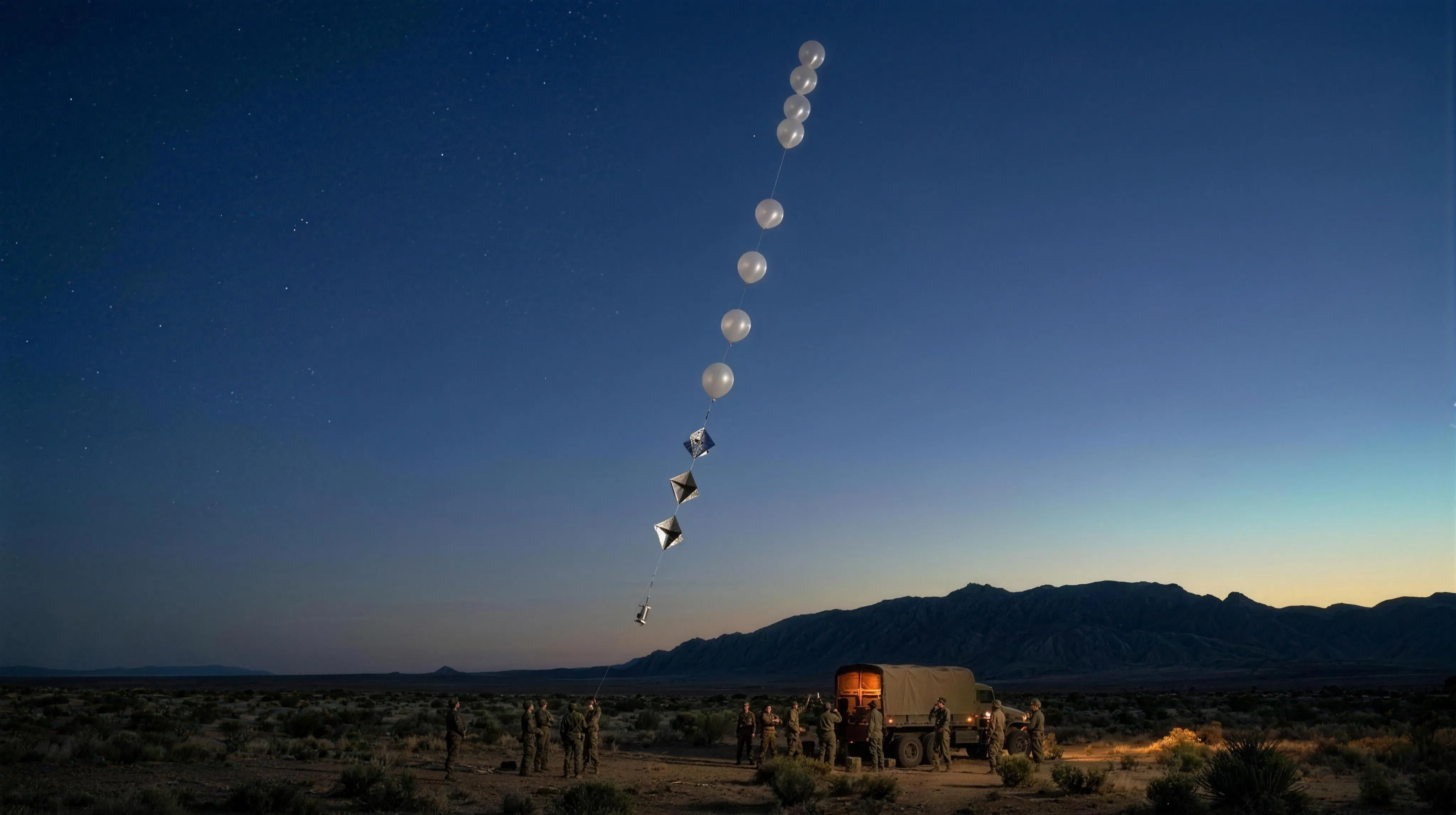
In the small hours of June 4th, 1947, a train of neoprene balloons six hundred feet tall rose from Alamogordo Army Air Field and drifted northeast into the dark. It was a service flight for a project so secret it had no name on the base: microphones in the stratosphere, listening for Soviet atom bombs. The crew tracked it to Arabela and lost it, still flying, seventeen miles short of a sheep ranch. Ten days later, by his own account, a rancher named Mac Brazel began finding rubber strips, tinfoil, tough paper, sticks and flower-printed tape; within a month, the most retracted press release in Air Force history. This instrument builds the machine under the argument: the cluster physics of a neoprene train, the three-storey winds of June 4th, the solid line where the record watched and the dashed line where a contested model takes over, and the two inventories that match on seven lines out of eight. Fly it, break it, read the file. The verdict is yours.
 Open the interactive ▸
 What you're looking at
The Map view is the drift integrator on a New Mexico map: Alamogordo to the Foster Ranch country, with the winds-aloft column showing the three storeys live and the altitude strip keeping the clock. Flight 4 draws solid to Arabela, where the tracking batteries died, and dashed beyond: the seam between record and reconstruction is a visible pixel, not a footnote. Flight 5, the control, and a single weather balloon, what Ramey's office actually showed the press, are one click away.
The Train view is the machine to scale: six hundred feet of line, 23 balloons at 20-foot spacing, three ML-307B corner reflectors, the AN/CRT-1 sonobuoy, a black battery box, ballast and parachutes, with a four-pixel person at the bottom for honesty. Beside it, the altitude-time profile: the pre-dawn shading, the sunrise line where neoprene starts dying, the balloon-count stair-step, and the descent onset when lift finally loses.
The Debris view is two inventories: Brazel's newspaper list on the left, the NYU bill of materials on the right, matched line by line. Seven lines connect; the eighth, "no strings or wire" against a train rigged on hundreds of feet of twine, draws a warning-coloured ≠ at the same size as the matches. A toggle adds the post-1978 strip: memory metal, hieroglyphics, indestructibility, a gouge, bodies, each marked with what it lacks: a 1947 counterpart, and a balloon explanation.
The File view lays fifty years on a broken-scale timeline: the diary entry that reads both ways, Brazel's find, the one-day flying disc, the 1978 return, the 1994-95 federal reports, and the 1995-97 reconstruction with its audit. Below hang the two verdict cards at equal size: what Mogul delivers, and where the explanation stops.
Why it's here
This station's case line has walked 1948 (INST-36, Mantell: a Skyhook balloon misread, fatally) and 1948-51 (INST-38, Green Fireballs) while circling the genre's founding file: July 1947, Roswell. This instrument does not adjudicate Roswell; it builds the physical machine both sides of the argument need. How a constant-level balloon project's train flies: 23 neoprene sounding balloons strung 600 feet at 20-foot spacing, climbing at 600 feet a minute into the 46,000-60,000-foot shelf, killed balloon by balloon by ultraviolet after sunrise, sinking at the recorded 800-1,000 feet a minute once lift fails. And where it flies: June 4th's atmosphere is a three-storey building, troposphere blowing northeast, the transition layer above the tropopause blowing northwest, the summer stratosphere drifting west. A cluster that climbs, floats and sinks rides each storey in turn and flies an S-shaped course with no engine anywhere on it.
There is a harder reason to pick it: the Mogul case is the tightest interlock of explanation and archival gap anywhere in the file. Flight 4, the flight the Air Force named in 1994, has no row in NYU's own tables; the best evidence it flew is two adjacent sentences in Crary's diary, one saying "no balloon flights again on account of clouds," the next "flew regular sonobuoy up in cluster of balloons." Moore's 1995 trajectory reconstruction lands the train on the Foster Ranch, while Rudiak and Sparks, re-running his tables, argue it overshoots. Meanwhile Brazel's 1947 debris inventory matches the train's bill of materials line by line except one ("no strings or wire") that refuses, and everything that entered the story after 1978 (memory metal, hieroglyphs, bodies) is beyond what any balloon delivers. This instrument puts all of it on the bench, seam between solid and dashed included. The verdict, case by case, belongs to the reader.
How it works
One integrator runs every view, and the panel tags each number as measured, reported, modelled or read.
dh/dt = +600 ft/min (lift > weight) | −800-1,000 ft/min (lift fails) · dN/dt = −rate after sunrise · dx/dt = W(h): NE below | NW at the tropopause | W above
The vertical model is the recorded rates. Climb at 600 ft/min while total lift beats payload weight; float on the 46-60 kft shelf; lose balloons to ultraviolet after sunrise; sink at 800-1,000 ft/min when lift fails, gentler below 25,000 ft. Every one of those numbers is quoted from the NYU record via the 1995 USAF report, and Flight 5's recorded endpoint (5 h 50 min, 12 of 29 balloons intact) is what pins the attrition rate.
The horizontal model is a wind table. dx/dt = W(h): the balloon goes where the layer it currently occupies sends it. The layer structure is Moore's published method (Orogrande pilot-balloon winds below 46,000 ft, Flight 5's own measured winds above); the magnitudes are tuned so the integrator reproduces the recorded endpoints, because the archival pibal sheets are not published as data. The table wears a MODELLED tag on the bench for exactly that reason.
The launch hour is the hidden dial. Neoprene dies in sunlight: Moore described sun-killed balloons as grey flakes or ashes with an acrid smell. A train launched at 0300 banks nearly three dark hours before the attrition clock starts, which is why the reconstruction's Flight 4 outlives Flight 5 by hours. Slide the launch time and watch the whole flight stretch and shrink around sunrise.
The seam is drawn, not smoothed. The SCR-584 and theodolite followed Flight 4 as far as Arabela; the batteries died with the train still flying, seventeen miles from the ranch. The map switches from solid to dashed at that exact sample, because that is where knowledge switches from tracking to arithmetic, and the arithmetic is the contested part.
And the one-balloon preset prices the difference. A single 350-gram balloon with one foil target climbs, bursts near 49,000 feet and is down in about ninety minutes, tens of kilometres out. That is what hung in Ramey's office on July 8th. The gap between that hop and a 600-foot train that flies all morning is the gap in which every argument about the Foster Ranch lives.
The train's parts list, the climb and descent rates and Flight 5's clock are used as written; the diary, the inventory, the tape and the office identification are quoted; the wind magnitudes are tuned to published endpoints and tagged MODELLED; the path past Arabela is a reconstruction whose audit is stated wherever the path is drawn. What the bench refuses to do is turn a drift integral into a verdict. The materials match seven lines out of eight; the flight itself is a model with real gaps; the post-1978 testimony is beyond any balloon. Two verdict cards hang at equal size, and the file stays open.
The dials that decide the morning
Four flights and five dials, each a physical quantity with a real-world anchor, not a mood.
- Flight 4 / Flight 5 / One balloon / Custom. The contested reconstruction, the tracked control, what Ramey showed the press, and a free bench. Every preset is a set of dial positions pinned to the record where the record has numbers, and to Moore's model where it does not; the tier chip under the selector says which is which.
- Balloons at launch, 1 to 30. The June configuration ran as many as 23; Flight 5 lifted 29. More balloons is more lift, a longer float, and a longer stair-step down: the whole flight plan is this number against the sun.
- Payload, 1.5 to 40 lb. Targets, sonobuoy, rigging. The service flights flew light, which is one reason the reconstruction's Flight 4 stays up so long: less weight for the shrinking cluster to lose against.
- Sun attrition, 0.5 to 8 balloons per sunlit hour. The neoprene-death dial. Before sunrise it charges nothing. Flight 5's recorded 12-of-29 landing is what pins the default.
- Launch time, 0000 to 0900 MST. The most argued number in the file: Moore's later position was ~0300, his earlier one after 0500, and Randle notes the CAA rules argue for daylight. The dial runs the whole range, and the flight duration answers live.
The claims, as they stand
Five claims from the record, with who established each and where it lands. One is as solid as this file gets, two are contested in exactly the way that teaches, and two are readings that run the whole case.
| The debris matches a Mogul service train, item by item established by Weaver & McAndrew, USAF 1995; Thomas, Skeptical Inquirer 1995 | SOLVED | The strongest plank: smoky grey rubber, foil on tough paper, glue-hardened balsa, brass eyelets, flowered toy-factory tape, five pounds over 200 yards. Seven of eight inventory lines line up with a parts list published by the people who flew the trains. The eighth ("no strings or wire") does not, and this instrument shows it at full size. |
| Flight 4 flew on June 4 and is the source established by Charles B. Moore's reconstruction, 1995; Saler, Ziegler & Moore 1997 | CONTESTED | Contested. The flight has no NYU table row and no altitude record; its existence rests on one diary entry that also says "no balloon flights." Moore's wind integration lands it on the ranch; Rudiak and Sparks audit the same tables and argue it overshoots. This bench reproduces the published endpoints and labels every dashed pixel MODELLED. |
| Flight 4 was cancelled; the tables mean what they say established by Kevin Randle, from the same documents | CONTESTED | Contested, symmetrically. The diary's first sentence, the skipped number, and Flight 5's billing as the first successful heavy-load flight are real features of the record. The counter-reading (a service flight flown without altitude gear would generate exactly this paper trail) is also internally consistent. Both cases stand on the same page of the same journal. |
| The 1947 identification covered what fell; the 1978+ testimony describes something else established by the debris view of this instrument | READING | The bench keeps the two records separate: everything Brazel and Cavitt described in 1947 sits in the matching game; everything that entered after 1978 (memory metal, glyphs, indestructibility, gouge, bodies) sits in a violet strip with no counterpart on any balloon train. Which record you weight is the whole disagreement, and it is a weighting, not a computation. |
| The GAO found the records destroyed established by GAO/NSIAD-95-187, 28 July 1995 | READING | Real but narrower than usually quoted: some RAAF outgoing messages were destroyed, and the disposition form does not say what, by whom, when, or under what authority; some records survived. Both camps cite the finding for opposite purposes. This instrument renders it exactly as written. |
Try this
- Watch the S-curve build. Flight 4, map view, playback on. Northeast up the basin, the turn past the tropopause, the northwest float, the stair-step back down to the northeast. Then open the winds-aloft column and match each leg to its storey. No engine anywhere: the whole shape is W(h).
- Find the seam. Pause the playback and look at Arabela: the X where the tracking batteries died, solid line before, dashes after. Everything anyone claims about the last seventeen miles is arithmetic. That one pixel is the entire Flight 4 controversy, drawn.
- Run the control. Flight 5: launched 0516, down near Roswell at 5 h 50 min, twelve balloons still tugging. This is the same machine with the record intact, and every stratospheric wind in the Flight 4 model was measured here. Compare the two flights' float durations and note why: sunrise.
- Move the launch hour. Custom flight, launch-time dial from 0300 to 0530. Watch the float shorten by hours as the dark hours vanish. The single most argued number in the file is also the single most powerful dial on this bench, which is not a coincidence.
- Play the matching game. Debris view. Read Brazel's side first, then the train's. Hover the lines: seven connect, one draws ≠. Then flip the retellings toggle and read the violet strip: everything there entered the story after 1978 and has no balloon explanation. The toggle is the whole historiography, in one switch.
- End at the file. The diary card first, then the reconstruction card, then both verdicts. Moore's own closing is a double negative; Randle's case stands on the same page. If you leave this instrument certain, you have read it more confidently than the record does.
Accuracy
The honest line between what is measured, what the record reports, what is modelled here, and what is a reading:
| Feature | Tier | What that means |
|---|---|---|
| The train and its rates | T1 Measured | The bill of materials (23 × 350 g neoprene at 20-ft spacing, 3-5 ML-307B targets, a 13-lb AN/CRT-1 sonobuoy) and the climb and descent rates (600 ft/min up; 800-1,000 ft/min down, gentler below 25,000 ft) are quoted from the NYU record via the 1995 USAF report and used as written. |
| Flight 5, the control | T1 Measured | Launched 0516 MST on June 5th, tracked end to end, down near Roswell at 5 h 50 min with 12 of 29 balloons intact. The bench reproduces that endpoint, and Flight 5 is what pins the attrition rate and the stratospheric winds the Flight 4 model borrows. |
| The 1947 record | T2 Reported | Crary's diary sentences, Brazel's Roswell Daily Record inventory, the toy-factory flowered tape, Newton's identification in Ramey's office, Cavitt's square sticks and black box: quoted as the record states them, tagged REPORTED. |
| The wind tables | T2 Modelled | Moore's published layer structure (Orogrande pibal below 46,000 ft, Flight 5's measured winds above), with magnitudes tuned so the integrator reproduces the recorded endpoints: Flight 5 near Roswell, Flight 4 at Moore's claimed landing. The archival pibal sheets are not published in machine-readable form, and the bench says so. |
| Flight 4's path past Arabela | T2 Modelled | The tracked leg ends at Arabela, where the tracking batteries died 17 miles short of the ranch. Everything beyond is Moore's reconstruction, drawn dashed, with Rudiak and Sparks's arithmetic audit stated in the same breath. |
| The terrain and the ellipse | T2 Modelled | The relief is a sketch to make the geography legible; the debris-field ellipse is drawn oversized to be clickable. The real 200-yard find would vanish at map scale, which is itself worth knowing. |
| The mismatch and the retellings | T3 Reading | The bench shows the one inventory line that fails ("no strings or wire") at the same size as the seven that match, and lists the post-1978 additions (memory metal, glyphs, indestructibility, gouge, bodies) as exhibits it does not model and cannot explain. |
| Whether the debris was Flight 4 | T3 Reading | Moore's own last word is a double negative: difficult to exclude. Randle's case stands on the same diary. Two verdict cards hang at equal size, and the bench adds no third. |
In one line: the train's bill of materials, the recorded climb and descent rates and Flight 5's tracked clock are physics and archive you can audit on the bench; the diary, the ranch inventory, the flowered tape and the Fort Worth identification are quoted, tagged REPORTED; the wind tables and the path past Arabela are Moore's method with tuned magnitudes, tagged MODELLED, with the standing audit stated; and whether the Foster Ranch debris was Flight 4 is a per-case reading on which this bench hangs two cards at equal size and adds no third. Fly the morning, find the seam, and decide for yourself.
Sources
- USAF, "The Roswell Report: Fact versus Fiction in the New Mexico Desert" (1995), Col. Richard L. Weaver & 1Lt James McAndrew: the Mogul programme, the train configuration (23 × 350 g neoprene at 20-ft intervals, 3-5 ML-307B targets, the AN/CRT-1 sonobuoy), the missing service flights 2, 3, 4 (and 9) in NYU Technical Report No. 1 Table VII and Technical Report No. 93.02, Crary's journal, Moore's neoprene-degradation account, and the toy-factory targets.
- Albert P. Crary's field diary, 3-4 June 1947, as quoted by both camps: "Up at 0230 am to fly balloon but abandoned due to cloudy skies" (June 3); "No balloon flights again on account of clouds. Flew regular sonobuoy up in cluster of balloons..." (June 4).
- Dave Thomas, "The Roswell Incident and Project Mogul", Skeptical Inquirer 19(4), July/August 1995: Moore's reconstruction method (Orogrande pibal winds below 46,000 ft interpolated between the June 3-4 soundings; Flight 5's measured winds for 46,000-60,000 ft), the tracking loss near Arabela ~17 miles from the debris field, the landing ~85 miles NE of Alamogordo, the 600-ft train figure, the flowered-tape recollections, and Moore's closing "difficult to exclude".
- Benson Saler, Charles A. Ziegler & Charles B. Moore, "UFO Crash at Roswell: The Genesis of a Modern Myth", Smithsonian Institution Press, 1997: the full trajectory reconstruction and its data tables.
- David Rudiak's and Brad Sparks's audit of the 1997 trajectory tables (backward-carried wind values, shortened descent), and Kevin Randle's cancellation case (the diary sentence, the skipped flight number, Flight 5 as "first successful flight carrying a heavy load"): the standing critiques, as published by their authors.
- Mac Brazel's interview, Roswell Daily Record, 9 July 1947: found 14 June; rubber strips, tinfoil, a rather tough paper, sticks, tape, brass eyelets; no strings or wire; about five pounds over about 200 yards; "not any weather observation balloon".
- NYU Flight 5 records via the USAF report and McAndrew's synopsis: launched 0516 MST 5 June 1947 (Table VII's "1517" corrected as a typo), 5 h 50 min, landed near Roswell, descent at 800-1,000 ft/min, 12 balloons intact at landing.
- GAO/NSIAD-95-187, "Government Records: Results of a Search for Records Concerning the 1947 Crash Near Roswell, New Mexico", 28 July 1995: the destroyed-records finding, rendered with its own qualifications.
- James McAndrew, "The Roswell Report: Case Closed", 1997: the crash-test-dummy answer to the later bodies testimony.
Fly the train the argument is about. Then read where the explanation stops.
Open the interactiveCompiled July 2026