Light Bending
The Sun bends starlight. Newton's theory says by 0.87 arc-seconds at the edge; Einstein's completed relativity says exactly twice that. On 29 May 1919 two expeditions photographed the stars beside an eclipsed Sun to decide, and by morning Einstein was the most famous scientist alive. This is that measurement, rebuilt to be held in the hand.
 Open the interactive ▸
 What you're looking at
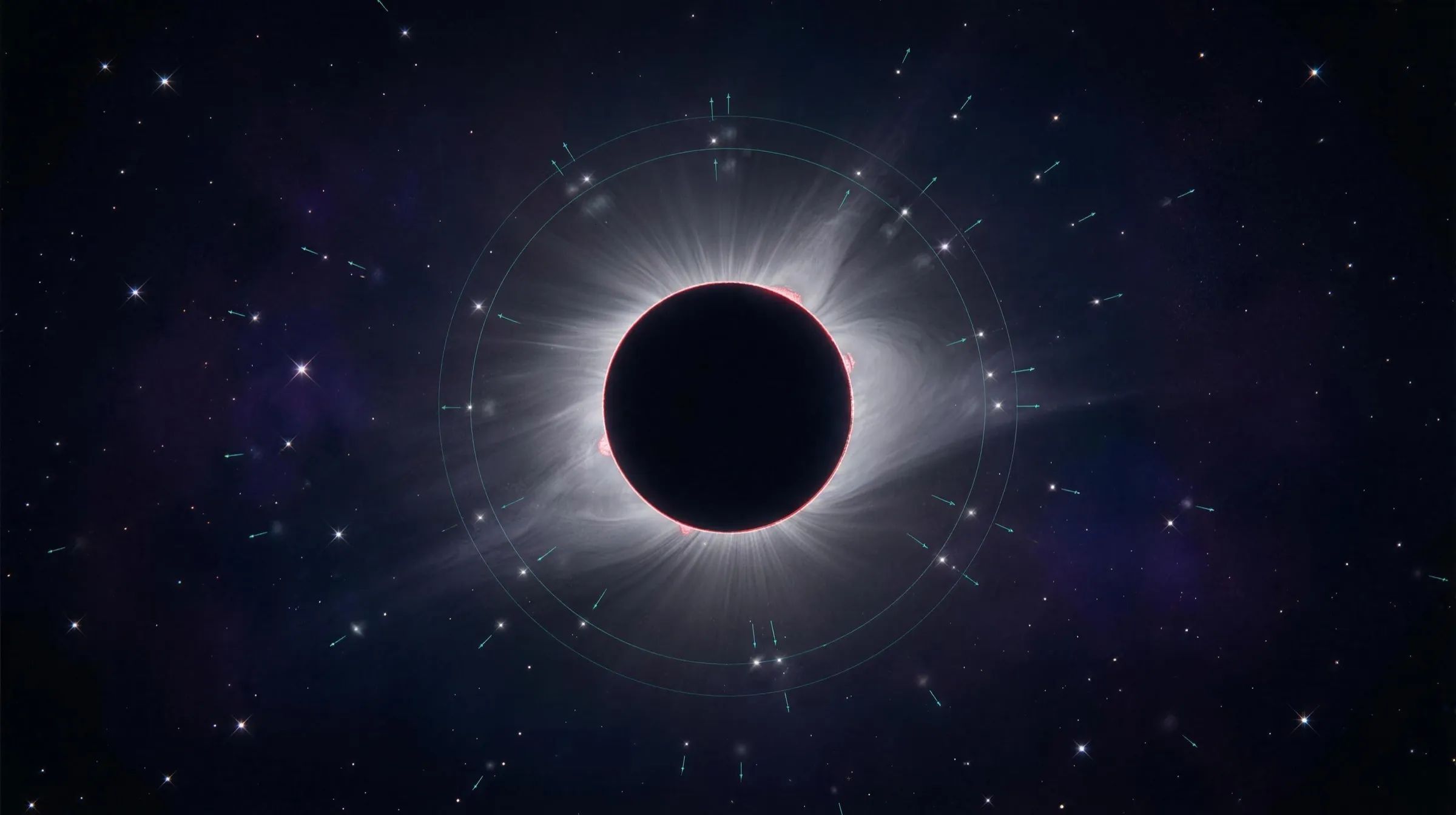
The Eclipse view is the observation: a patch of sky around the Sun during totality, the black disc ringed by its corona, stars scattered across the field. Drag the Sun and every star is pushed gently outward, away from its centre, because its light is bent by the Sun's gravity on the way to you. Stars near the rim shift most; far stars hardly move. None of it is canned animation: each star's shift is computed from the exact deflection law for its distance from the Sun. You are watching a real gravitational lens, with the Sun as the mass.
The Rays view is the mechanism, side on: photons stream from a distant star, dive through the curved region near a granulated Sun, and continue to Earth. The dashed line traces the arrival direction backwards to where the sky seems to hold the star: the apparent position, displaced outward. A wireframe sheet dips under the Sun as a guide for the eye. Slide the impact parameter b and the bend sharpens as 1∕b; switch to Compare and Newton's half-bend runs alongside in amber.
Everything else is the usual instrument furniture: a live deflection equation computing α for the nearest star, a telemetry column with the limb values, the 1919 results and today's VLBI precision, click-anywhere explainer cards, and an eight-chapter story that runs the whole argument from the 1915 claim to lensing as a modern tool. The exaggeration factor is displayed at all times, because the honest size of this effect is invisible.
Why it's here
Most of this site lives out at the edge of the evidence, on craft said to move by bending space rather than pushing against it. This page is the part of that idea that is not speculation at all. Mass bends spacetime, spacetime bends light, and that bending was photographed in 1919 and measured ever more precisely every decade since. It is as settled as physics gets.
It is the confirmed bookend to the rest of the site. Gravity is the Newtonian floor underneath it; the Black Hole page is the same mass-bending taken to the extreme where it makes rings and shadows; the Warp Drive page is the speculative energy route that has never been measured at all. This one has, over and over.
How it works
One law draws the whole page:
α = 4GM ∕ c²b (Einstein · 1.75″ at the limb)
Each star sits at its apparent position: its true position displaced outward by α, where b is how close its light passed to the Sun's centre. The bend falls off as 1∕b, so the law draws itself across the field as you drag the Sun: a steep shift right at the limb, fading to nothing a few solar radii out.
Newton bends light too, at exactly half:
α = 2GM ∕ c²b (Newton · Soldner 1801 · 0.87″)
Treat light as a falling corpuscle and Newtonian gravity gives a real deflection; Einstein himself got the same half-value from the equivalence principle in 1911. The completed theory of 1915 doubles it, because space is curved as well as time and light, moving at c, is the one traveller that feels both halves fully. Two numbers, no room to fudge between them: that is what made the eclipse a clean kill.
The catch is that the real effect is tiny: 1.75 arc-seconds is about a thousandth of the Sun's width, invisible at any honest scale. So the shift on screen is multiplied by an exaggeration factor you control, and the panel always shows both the true arc-seconds and the factor. The physics is exact; only its size is turned up so you can see it.
The lens zoo
The same law, α = 4GM∕c²b, run across the universe. More mass bends more; a closer ray bends more.
- Earth. A grazing ray bends ≈ 0.0006″. Nothing.
- Jupiter. ≈ 0.017″. Measurable with heroics.
- The Sun. 1.75″: the 1919 test. A whisker, but a photographable whisker.
- A white dwarf. Solar mass in an Earth-sized ball: ≈ 85″. Easily measured.
- A neutron star. Tens of degrees: the gentle weak-field law hands over to full strong-field relativity.
- A black hole. At the photon sphere, light orbits. The bending closes into a ring around a shadow.
- A galaxy cluster. Arcs, multiple images, full Einstein rings: the 1919 whisker grown into a telescope that maps dark matter and finds exoplanets.
Every one of these is the 1919 deflection with a heavier lens. The Sun manages only a faint nudge because, for all its mass, its surface sits a long way from its centre; that is why Eddington measured a splay of whiskers rather than photographing a halo.
Try this
- Drag the Sun slowly across a dense patch of stars and watch the field part around it. That parting is the lens.
- Compare the two theories. The whole of 1919 was deciding between these two ghost positions, and the outer one, Einstein's, won.
- Scroll the exaggeration down toward ×1 to feel just how small the real shift is, then back up until the pattern snaps into view.
- Remove the Moon to end the eclipse: the Sun blazes, daylight floods in, the stars drown. That is why the measurement needed totality.
- Switch to Rays and pull the impact parameter b down toward 1 R☉: the bend sharpens as 1∕b, and the apparent-position ghost slides away from the true star.
- Run the story: eight chapters, from the 1915 claim to the headlines and the modern lensing toolbox.
Accuracy
The honest line between what is exact and what is stylised:
| Feature | Tier | What that means |
|---|---|---|
| Deflection law α = 4GM∕c²b, falling off as 1∕b | T1 Established | Exact weak-field general relativity. Sets every star's shift on screen and the bend of every ray. |
| Limb value 1.75″, exactly twice Newton's 0.87″ | T1 Established | The grazing-ray deflection and the factor of two are standard, exact results. |
| 1919 measured values (Sobral 1.98″, Príncipe 1.61″) | T1 Established | The published results of Dyson, Eddington & Davidson (1920), with their real error bars. |
| Modern confirmation to ~0.02% (VLBI; Cassini) | T1 Established | Radio interferometry and spacecraft tracking have pinned the value far tighter than 1919 could. |
| Exaggeration factor | T4 Illustrative | The real shift is ≈1.75″, ~1/1000 of the Sun's width. Invisible. Multiplied so the pattern can be seen; the true arc-seconds are always shown. |
| Eclipse corona, daytime glare | T3 Stylised | A qualitative picture of why totality is needed, not a scattered-light model. |
| Rays view (the mechanism scene) | T4 Illustrative | A schematic of the bend: the angle is exaggerated like the eclipse view, the curved sheet is a guide for the eye, and the b and α it reports are the true values. |
| Star field & Hyades arrangement | T4 Illustrative | Procedurally scattered points, not a star catalogue. |
In one line: the way each star shifts, and the factor of two between Einstein and Newton, is exact measured physics; only the size of the shift on screen is dialled up so you can see it.
Sources
- Soldner, J. G. von (1801). The Newtonian (corpuscular) deflection of light, ≈0.87″.
- Einstein, A. (1911). The incomplete equivalence-principle value: the same half-deflection.
- Einstein, A. (1915/1916). The completed general theory; space-curvature doubles the bend to 1.75″.
- Dyson, F. W., Eddington, A. S., & Davidson, C. (1920). A Determination of the Deflection of Light by the Sun's Gravitational Field… Phil. Trans. R. Soc. A 220, 291–333.
- Will, C. M. (2014). The Confrontation between General Relativity and Experiment. Living Reviews in Relativity. Modern tests and the PPN parameter γ.
- Bertotti, Iess & Tortora (2003), Cassini; ESA Gaia: light bending across the whole sky.
- Bartelmann & Schneider (2001), Weak Gravitational Lensing; Treu (2010), Strong Lensing by Galaxies: lensing as a modern tool.