The Lubbock Thirty Degrees a Second Bench
Lie back in the yard and time them. At 60 miles an hour, the speaker's speed for ducks, the professors' 30 degrees per second puts the lights at 168 ft if it is the rate overhead, 132 ft if it is the average over the arc Ruppelt gives, 45° above the north horizon to 45° above the south in three seconds, and 102 ft on Hart's 120° in four; the speaker's own 'about 75 to 80 feet' needs an arc from about 21° above each horizon, and the transcript does not say which arc he took. Ruppelt's assumed 10,000 feet gives 3,570 mph, his 'about 3,600', Mach 4.7 at Lubbock's height, and a formation 1,750 feet wide is 10.0° across. The speaker's office found the negatives 'just a little bit more' dense than a bright planet's: at 132 ft that is 0.026 to 0.152 cd, a fraction of a candle; at 10,000 ft, 147 to 875 cd. A duck's underside of 0.03 m² under 2 lux of city light gives back 1.72 × 10⁻³ cd, a point of magnitude +0.7 at 132 ft, and the record lit none of those dials. The Kodak 35's 50 mm frame is 39.6° wide; a tenth of a second untracked at 30°/s smears 2.62 mm of 36. The stars are the catalogue's for 21:20 on 25 August 1951. The bench rules on nothing.
Keep the signal
The station is free. No ads, no tracking cookies. If the files are worth your time, following is the support.
 Open the interactive ▸
 What you're looking at
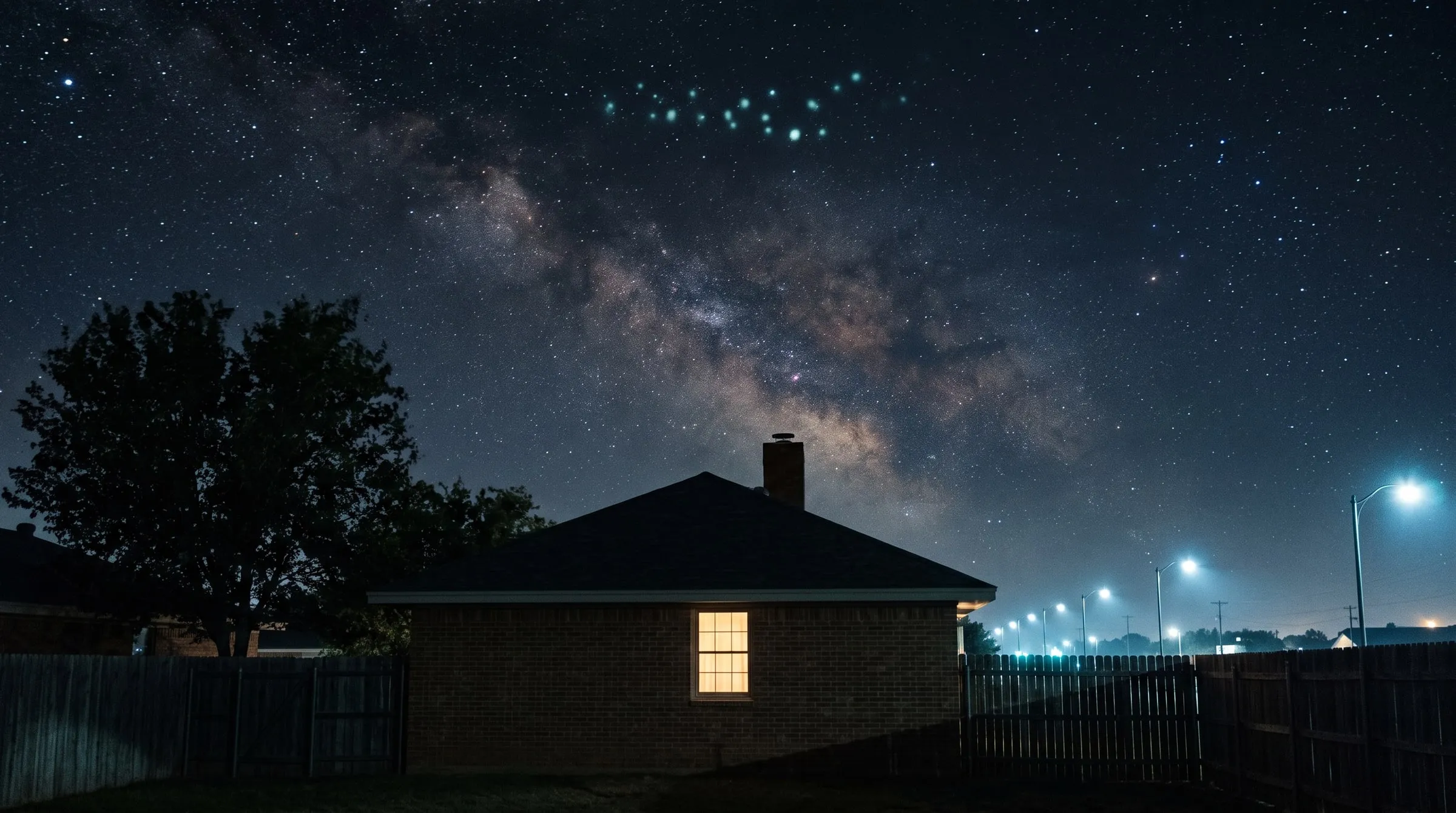
The Sky is the backyard in 3D at the dialled hour of the dialled night, under the real stars of the Yale Bright Star Catalogue placed by sidereal time for Lubbock, Vega near the zenith, the Milky Way through Cygnus, no Moon (between last quarter and new by the USNO table). A formation of lights crosses north to south at the dialled height and speed, appearing and going out at the dialled elevation, with a stopwatch and the live rate across the sky; the yard, the houses and a boulevard of mercury-vapour lamps are staging from the sources’ words, the fence the bench’s own. Four cameras: lying back in the yard, the street, the side (the height drawn, the two sight lines) and the plan.
The Arc is height against speed, both logarithmic, with the three readings of 30 degrees per second as lines (the rate overhead, Ruppelt’s arc, Hart’s four seconds), the sources’ own marks (the speaker’s ducks at 75 to 80 feet, Ruppelt’s 10,000 feet) and the speed of sound at Lubbock’s height; the dials’ point moves on it. The Light is a magnitude ladder: the bright-planet band the negatives matched, Saturn as its dim end, the urban and dark naked-eye limits, the dialled duck, and the candela a light needs at the dialled height.
The Camera lays the Kodak 35’s 24 × 36 mm frame on the sky at the dialled rate, with the smear of one exposure for the dialled shutter and pan, the time a light takes to cross the frame, and the exposure card: Hart’s three pictures in four seconds, Ruppelt’s re-enactment’s two. The File holds the transcript and the book on cards, the tables beside them, and two cards at equal size: what the record says, and what the arithmetic gives.
Why it is here
The case already has its pieces on this site: the Release 06 briefing on the Ruppelt tape and transcript, and the wiki's Lubbock Lights and Edward J. Ruppelt. The briefing records what the transcript says; this bench does not retell the case. It does something else. One number on the record is a measurement, "30 degrees per second", and a rate across the sky is a speed over a height, which neither source measured. The casework line already holds benches of that shape: Kenneth Arnold 1947 divides one timed interval by one unmeasured distance, and The Tremonton Film Rangefinder multiplies a film's angles by an assumed distance. Lubbock joins them: the angle and the time are measured, the height is free.
So the instrument does two things. First it makes the height a dial, and lets every reading of "30 degrees per second" give its own number: the transcript gives the rate; Ruppelt's 1956 book gives the arc (appearing 45° above the north horizon, going out 45° above the south, 90° in 3 s) and Hart's 120° of open sky in four seconds; the speaker gives ducks at 60 miles an hour "about 75 to 80 feet"; Ruppelt gives "about 3,600 miles per hour" at an assumed 10,000 feet. The bench prints the readings side by side, 168, 132, 102 and 75 to 80 feet for 60 mph and 3,570 mph for 10,000 feet, and ranks none. Then it treats the negatives as a light meter: the speaker's office shot some bright planets with the same exposure and film and found the lights' density "just a little bit more than that of a bright planet", which is an apparent magnitude, so a light at any height has a candela it must give, and a duck lit from below by a city has a candela it can give back. Both are on the bench, beside what a Kodak 35 can record in a tenth of a second. The sentences stay on the cards as printed, with page and chapter; the bench does not say what the lights were.
How it works
Everything on the bench is arithmetic on the two sources’ figures, the magnitude tables, the star catalogue and the camera the record names; the height, the speed, the arc, the formation, the duck’s inputs and the hour are dials. The script that ships with the site re-derives every displayed number, and re-parses the committed catalogue lines, before the build is allowed to pass.
dθ/dt = v h / (h² + x²) = (v/h) sin² e · ω₀ = v/h · T = 2h / (v tan e₁) · h = v/ω₀ · h = v·3 s·tan 45°/2 · E = 2.08 μlx × 10^(−0.4 m) · I = E d² · I_duck = ρ_b A ρ_g E_g / π · smear = p f ω t · field = 2 atan(w/2f)
The pass. A light on a level straight line over the observer at height h and ground speed v is at elevation e = atan(h/x) when its ground distance is x, and its rate across the sky is vh/(h² + x²) = (v/h) sin² e: fastest overhead, where it is ω₀ = v/h, half that at 45°. Between two symmetric elevations e₁ it sweeps 180° − 2e₁ in 2h/(v tan e₁). Three readings of "30 degrees per second" are three of those, and the speaker’s figure is solved as a fourth: (a) the rate overhead, h = v/ω₀; (b) Ruppelt’s arc, 45° to 45° in 3 s, where the ground between the two points is 2h and so h = 1.5 v; (c) Hart’s 120° in 4 s, 30° to 30°, h = 2 v tan 30°; (d) the one symmetric arc on which a 30°/s average puts the speaker’s 60 mph duck at 77.5 ft, solved for its elevation. The same lines read the other way give a speed for a height, which is how Ruppelt’s 10,000 feet becomes 3,570 mph.
The light. A star of magnitude 0 gives 2.08 μlx at the ground, so a magnitude m gives 2.08 × 10⁻⁶ × 10^(−0.4 m) lux and a point source of I candela at d metres gives I/d². The record’s calibration is the negatives’ density beside a bright planet’s under the same exposure and film, read as the illuminance at the lens and treated as a floor, since a pan that smeared the lights more than the planets would make them brighter than the density says; the band is Jupiter’s mean −2.20 to Venus’s mean −4.14. The duck is a flat underside of area A and albedo ρ_b over a ground of albedo ρ_g lit at E_g: the ground sends up ρ_g E_g and the underside returns I = ρ_b A ρ_g E_g / π. Every one of those is a dial with no figure from the record; the lux table gives the marks.
The camera and the sky. A 50 mm lens on a 24 × 36 mm frame sees 2 atan(18/50) = 39.6° by 27.0°; the image of a light moving ω across the sky runs fω on the film, so an exposure of t seconds untracked smears fωt, and a pan that follows all but a fraction p of the motion leaves p fωt. The sky is Greenwich mean sidereal time (IAU 1982) plus Lubbock’s longitude at the dialled hour, Central Standard Time assumed because the record names no zone; the catalogue’s stars are placed by the same transform the tune audits, the Sun and the Moon by Meeus’s series, and the one Mach mark is the standard atmosphere’s sound speed at the city’s 976 m from the site’s shared atmosphere module.
No constant is fitted to the sources: they give the bench a rate, an arc, a speed for ducks and a planet to compare with, and the bench computes from those. The choices are the dials, and every finding is quoted at the arc preset and across them.
The dials that decide the result
Five presets and the free dials. Together they draw every number the two sources attach to the rate, and the dials reach any other.
- Ruppelt’s arc. The default: 60 mph, 132 ft, appearing and going out at 45°. The arc is crossed in 3.00 s at 30.0°/s on average; the rate overhead is 38.2°/s; the formation at Ruppelt’s 10° is 23 ft across.
- The rate overhead. 60 mph at 168 ft: 30°/s at the zenith, the rate taken at the zenith. Over the 45° arc the crossing then takes 3.82 s.
- Hart’s four seconds. 60 mph at 102 ft, the arc set to 30°: 120° of open sky in four seconds, Ruppelt’s re-enactment in Hart’s backyard.
- The speaker’s feet. 60 mph at 77.5 ft, the middle of his "about 75 to 80 feet": overhead the rate is 65°/s, and a 30°/s average fits only an arc from about 21° above each horizon.
- Ruppelt’s 10,000 feet. 10,000 ft at 3,570 mph, the overhead reading of his "about 3,600 miles per hour"; on his own arc the same height needs 4,545 mph.
- The dials. Speed 5 to 20,000 mph and height 20 to 100,000 ft, both logarithmic; the arc’s elevation 5° to 85°; the formation’s width 2° to 40°, its count 15 to 30, its shape (a V, a line, a group, a semicircle: the sources’ words); the city’s illuminance 0.001 to 50 lux, the ground’s albedo, the underside’s area and albedo; the shutter and the pan; the night and the hour; the pass’s visual rate.
The claims, as they stand
The sources’ sentences and the tables, one by one, and where each lands when the height is a dial.
| 'they did get their angular measurement across the sky, and it came out to be 30 degrees per second. Now, that's the only measurement we've got on these things.' stated by the speaker, DOW-UAP-D154 p. 7 | MEASURED | Carried as a measurement, the one on the record. A rate across the sky is a speed over a height; the record measured neither, so the bench makes the height a dial and reads the rate three ways. |
| 'The lights usually suddenly appeared 45 degrees above the northern horizon, and abruptly went out 45 degrees above the southern horizon.' '90 degrees of sky in three seconds.' stated by Ruppelt 1956, chapter 8 | REPORTED | The arc the rate was averaged over. At 45° the ground distance equals the height, so the two points are 2h apart and h = 1.5 v: a 60 mph duck is at 132 ft, the rate overhead there 38.2°/s. The default preset. |
| 'I think it comes out to be about 75 to 80 feet, the ducks would have to be that low to be flying 60 miles an hour and go through that angle at that certain time.' stated by the speaker, D154 p. 9 | REPORTED | For 60 mph the bench gets 168 ft from the rate overhead, 132 ft from the book’s arc, 102 ft from Hart’s 120° in 4 s; a 30°/s average gives 77.5 ft only on an arc from about 21° above each horizon, where the rate overhead is 65°/s. The transcript does not say which arc his figure took; the bench prints the four heights beside the sentence and names no error. |
| 'If you assumed that the objects were flying at an altitude of 10,000 feet you could easily compute that they were traveling about 3,600 miles per hour, or five to six times the speed of sound. The formation would have been about 1,750 feet wide.' stated by Ruppelt 1956, chapter 8 | REPORTED | 30°/s overhead at 10,000 ft is 3,570 mph, Mach 4.7 at Lubbock’s height in the standard atmosphere (753 mph); on his own 45° arc it would be 4,545. 1,750 ft at 10,000 ft is 10.0° across, the width dial’s default; his 100 ft is 0.57°. His own arithmetic, reproduced. |
| 'we used the same exposure and the same film and went out and took a couple pictures of some bright planets, and it's, the density of the negative is just a little bit more than that of a bright planet at night.' stated by the speaker, D154 p. 8 | REPORTED | Read as the illuminance at the lens and treated as a floor: the band from Jupiter’s mean −2.20 to Venus’s mean −4.14. A point source overhead sits in it at 0.026 to 0.152 cd from 132 ft and 147 to 875 cd from 10,000 ft; a candle is about 1 cd. Which planets the lab shot, the record does not say. |
| 'although the photos were taken on a clear night no images of the stars could be found in the background. This proved one thing, the lights, which were overexposed in the photograph, were a great deal brighter than the stars' stated by Ruppelt 1956, chapter 8 | REPORTED | The band sits 5.2 to 7.1 magnitudes above the +3 urban naked-eye limit, a factor 120 to 718 in light. The bench prints the gap beside the lab’s sentence and reads it no further. |
| 'We tried, and the people in Lubbock tried to see whether or not you could take a picture of ducks at night just from the reflection of the city lights, and that's impossible.' stated by the speaker, D154 p. 8 | REPORTED | Priced as dials: an underside of 0.03 m² at albedo 0.6 over ground of albedo 0.15 lit at 2 lux gives back 1.72 × 10⁻³ cd, magnitude +0.7 at 132 ft; at a moonless sky’s 0.002 lux it falls below +6.5, at a lit boulevard’s 20 lux it climbs toward the planets. The record gives none of those numbers and the bench picks none. |
| 'They set up this baseline and got at each end with two-way radios and some homemade, well, you might call them theodolites or measuring, angle measuring devices, and tried to get an altitude. Well, they were unsuccessful on that.' stated by the speaker, D154 pp. 6 to 7; Ruppelt 1956: "neither team ever saw the lights" | REPORTED | Two simultaneous elevations across a baseline b give the height b/(cot e_A + cot e_B): at 132 ft a 1,000 ft baseline reads 14.8° at each end, at 10,000 ft 87.1°, and at 132 ft a 1° reading error moves the height by 134 ft. The bench prints what the baseline would have given and adds no reason it did not. |
| 'He tracked them, and consequently, we don't know whether this blur is due to the movement of the object or the movement of his camera since he shot them at 1/10th of a second.' stated by the speaker, D154 p. 7 | REPORTED | A 50 mm lens on a 24 × 36 mm frame sees 39.6° across; at 30°/s the image runs 26.2 mm/s on the film, a tenth of a second untracked smears 2.62 mm, and a light crosses the frame in 1.32 s. The pan-error dial is the sentence made adjustable; the record gives it no value. |
| 'The lights that the professors saw--the backbone of the Lubbock Light series--have been positively identified as a very commonplace and easily explainable natural phenomenon.' 'It is very unfortunate that I can't divulge exactly the way the answer was found' stated by Ruppelt 1956, chapter 8 | REPORTED | Quoted as his, with his own "I can't divulge exactly the way the answer was found" and his "Officially all of the sightings, except the UFO that was picked up on radar, are unknowns." Nothing on the bench is computed from it. |
| A star of magnitude 0 provides 2.08 μlx; +3 is the faintest a naked eye sees in an urban neighbourhood; Jupiter’s mean brightness is −2.20 and Venus’s −4.14; a common candle is about 1 cd; the Kodak 35’s f/3.5 lens is the 50 mm Anastigmat Special stated by reference tables, read 2 October 2026 | TABULATED | Carried as tabulated and used as read; the tune checks that 1 lux comes back as magnitude −14.2, the table’s own row. |
| What the bench amounts to stated by this bench | READING | One measurement, three readings, two sources. The rate is the professors’; every height, speed and size attached to it since is the rate times a choice; the negatives ask for a bright planet’s light from whatever height. The bench prints the readings beside the sentences and rules on none of them. |
Try this
- Lie back in the yard. Watch the formation appear at 45° in the north, cross the zenith and go out at 45° in the south in three seconds; read the live rate on its label as it climbs to 38°/s overhead and falls away.
- Switch to the side camera. The height is the amber line under the zenith crossing, the two sight lines meet the pass at the 45° points, and the ground between them is twice the height. Then raise the height dial and watch the speed the arc needs climb with it.
- Open the Arc. Three lines, one rate. Slide the speed to 60 mph and read 168, 132 and 102 ft off the rows; set the preset to the speaker’s feet and find the 21° arc; set it to Ruppelt’s 10,000 feet and read 3,570 mph against the speed of sound.
- Price the light. On the Light, read the candela the band asks for at the dialled height, then turn the city’s illuminance from a moonless sky to a lit boulevard and watch the duck cross the +3 line and climb toward the planets.
- Load the camera. On the Camera, set the pan error to zero and the smear vanishes; set it to a hundred and a tenth of a second draws 2.62 mm across the frame at the record’s rate.
- Change the night. Set the date to 31 August and the hour an hour on: the stars turn, the Sun and the Moon stay below the horizon, and nothing in the arithmetic moves.
- Finish in the file. The transcript’s sentences and the book’s, the plover, the streets, the closing whose working Ruppelt would not divulge, and the two cards at equal size.
Accuracy
The honest line between what is reported, what is measured, what is tabulated, what is arithmetic on them, what is a choice, and what is a reading:
| Feature | Status | What that means |
|---|---|---|
| The transcript and the book | Reported | DOW-UAP-D154 pp. 6 to 9: the speaker's account of the professors, the baseline, Hart's camera, the office's planet test, the ducks and the city's two sides. Ruppelt, The Report on Unidentified Flying Objects (1956), chapter 8: the arc, Hart's four seconds, the 10,000 feet, no stars on the negatives, the plover, the mercury-vapour streets, his closing. Each quoted as printed, with page or chapter. |
| The rate | Measured | 30 degrees per second across the sky, the professors' measurement with a stopwatch and the angles of their houses, as both sources report it: 'the only measurement we've got on these things'; '90 degrees of sky in three seconds'. |
| The constants | Tabulated | The lux of a magnitude-0 star (2.08 μlx), the planet magnitudes, the urban (+3) and dark (+6.5) naked-eye limits and the lux table from reference tables; a candle's candela; Lubbock's latitude, longitude, elevation and 1950 population; the Yale Bright Star Catalogue; the USNO phases of the Moon; the Kodak 35's 50 mm f/3.5 lens and the 135 frame; the standard atmosphere. |
| The arithmetic | Exact | The pass geometry, the three readings and the speaker’s arc; the speeds for a height; the formation's width; the baseline's angles; the magnitudes from intensities, the candela the band needs, the duck's return; the frame, the smear and the crossing time; the sidereal time and the stars' places. Checked in the tune against the closed forms, the Wikipedia rows and the committed catalogue lines. |
| The dials, and what is staged | Modelled | The height, the speed, the arc's elevation, the formation's count, width and shape; the city's illuminance, the ground's and the underside's albedo and area; the shutter and the pan; the hour and Central Standard Time: the sources give none of them. The yard, the fence, the houses, the boulevard and the glow are staging. The Albuquerque wing, the radar target, the Matador object and the photographs themselves are not modelled. |
| What it amounts to | Reading | What the lights were, and what the distance between the readings means, is a reading, and the bench declines to make it for you; Ruppelt’s closing is quoted as his and computed from nowhere. |
In one line: Every sentence of the transcript and the book is quoted as printed and attributed; the one measurement is carried as a measurement; the tables are the published ones; the height, the speed, the arc, the formation and the duck’s inputs are named as choices; and what the lights were is left with the reader, where the bench leaves everything about the case.
Sources
- DOW-UAP-D154, "Transcript of a Presentation by Captain Edward J Ruppelt 1952", U.S. Department of War, PURSUE Release 06, pp. 6 to 9 (the document’s own pages): the professors, the backyard, the baseline, the 30 degrees per second, Hart’s camera and film, the sworn statement, the office’s density beside a bright planet, the duck flight and the duck photographs, the 75 to 80 feet, the city’s two sides. The site’s Release 06 briefing on D154 and PR160.
- Ruppelt, E. J. (1956) The Report on Unidentified Flying Objects, chapter 8 "The Lubbock Lights, Unabridged" (Project Gutenberg ebook 17346): the four professors named, the 9:20 P.M., the 45° to 45° arc and the three seconds, the baseline teams, Hart’s Kodak 35 and his five pictures, the 120° in four seconds, the Photo Reconnaissance Laboratory’s findings (near pinpoint sources; no stars), his own re-enactment’s two shots, the 10,000 feet arithmetic, the plover, the game warden, the mercury-vapour boulevards, Menzel’s reading, his official conclusion on the photographs and his closing.
- Hoffleit, D. & Warren, W. H. Jr. (1991) The Bright Star Catalogue, 5th revised edition (CDS V/50): J2000 right ascension, declination and V magnitude for every star the Sky draws (V ≤ 2.5), extracted by scripts/lubbock-stars.mjs with the catalogue’s ReadMe byte positions; the lines kept are committed with the bench and re-parsed by the tune.
- U.S. Naval Observatory, Astronomical Applications API, phases of the Moon (read 2 October 2026): Last Quarter 24 August 1951 10:20 UT, New Moon 1 September 1951 12:50 UT. The Sun and the Moon on the bench are computed by Meeus’s low-precision series as INST-64 carries them, now in the site’s shared sky module.
- Reference tables, read 2 October 2026: "Lux" (a star of apparent magnitude 0 provides 2.08 microlux at the Earth’s surface; the illuminance table’s rows for a moonless sky, a quarter and a full Moon, civil twilight and public areas with dark surroundings); "Apparent magnitude" (1 lux at −14.2; +3 and +6.5 as the urban and dark naked-eye limits; the planets’ maximum and mean brightness); "Candela" (a common candle emits light with roughly 1 cd luminous intensity); "Lubbock, Texas" (33.585° N, 101.845° W, 3,202 ft, 71,747 in 1950); "Kodak 35" (the f/3.5 Anastigmat Special, 50 mm 1938 to 1949 and 51 mm 1947 to 1948); "135 film" (the 24 × 36 mm frame).
- The International Standard Atmosphere, as the site’s shared module public/lib/boom-trace.js carries it (first built for the Skyquake Bench): the sound speed at Lubbock’s 976 m, 753 mph.
- On this site: Kenneth Arnold 1947 (INST-61) and The Tremonton Film Rangefinder (INST-90), the casework benches of the same shape, and The Westall Two-Channel Bench (INST-86); the wiki nodes Lubbock Lights and Edward J. Ruppelt.