Mantell 1948
On the afternoon of 7 January 1948 the tower at Godman Field, Kentucky watched a white object hang to the south-west for over an hour, and asked four passing F-51s to look. The flight was a low-level ferry hop; the leader's oxygen bracket was empty. Capt Thomas Mantell climbed after something the tower had measured only as an angle, about a quarter the width of the full moon, and radioed that he would go to 20,000 feet. The physiology table is not subtle about what happens above that without oxygen. His wingmen stopped near 22,500 feet and went home. His wristwatch stopped at 3:18. This instrument replays that afternoon with the arithmetic showing: the climb against the published limits of consciousness, the angle against every assumed diameter from a 300-foot disc to a 70-foot secret balloon, and the record against the legends that grew over it. The first death in the file deserves to be shown exactly, and exactly is enough.
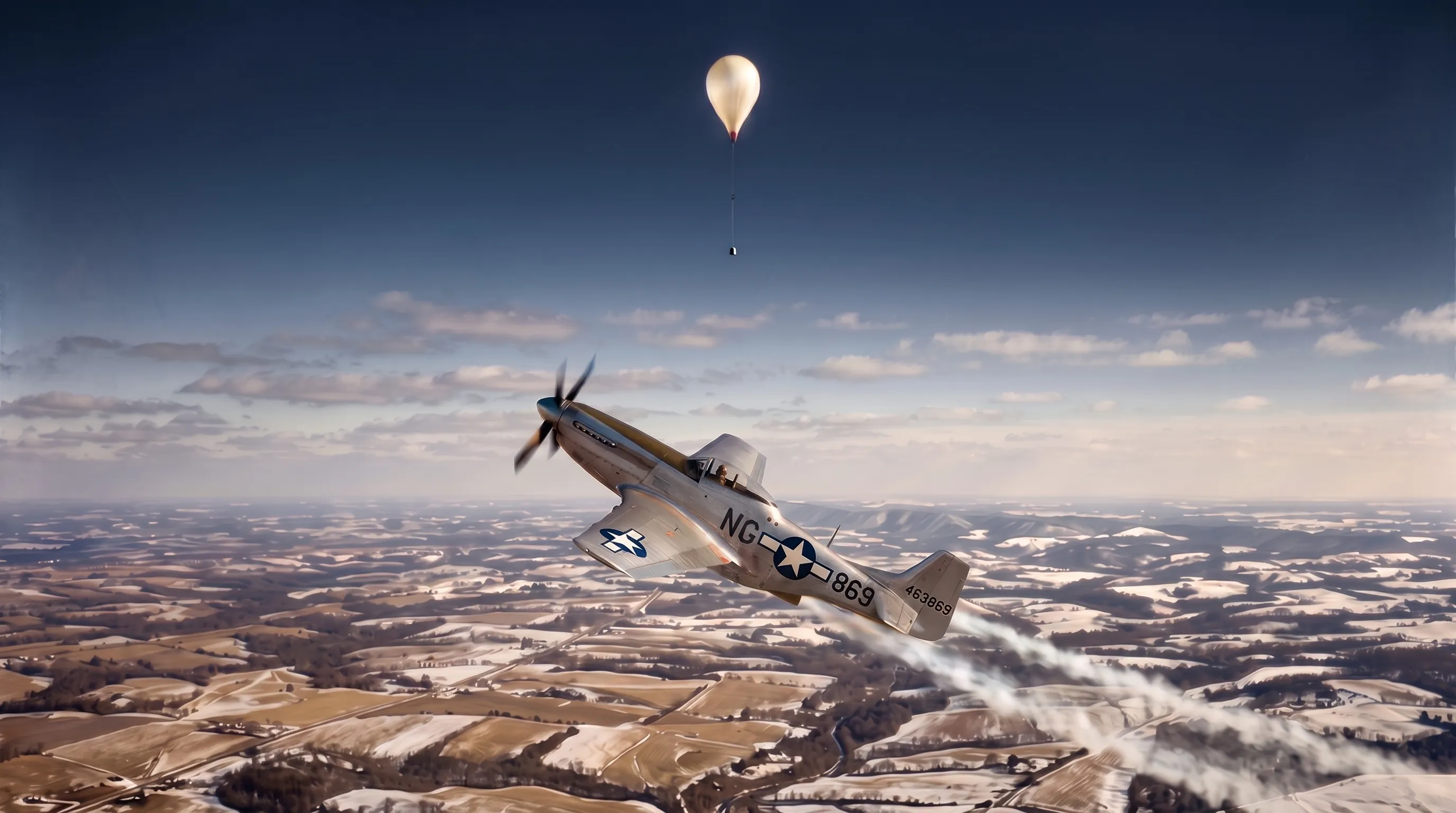 Open the interactive ▸
 What you're looking at
The Chase view is the afternoon replayed. A winter sky, Kentucky streaming past below, and a bare-metal Mustang climbing toward a sunlit shape that never gets closer. The reported anchors drive the replay: the 15,000-foot transmission, the wingmen peeling away at their rail, the coral line at 25,000 where the report puts the blackout, and the trimmed aircraft carrying on to 30,000 before the left spiral begins. A consciousness reserve drains in the status bar as the published table says it must. Switch on Pilot's eyes and the tunnel closes as the reserve does. The replay ends at the ground, at 3:18, without dramatising what the dive did to the airframe.
The Sight view is the machine the entire case runs on. The tower measured an angle: about a quarter of the full moon. An angle only becomes a size when you assume a distance, so the machine lets you assume the other way round: pick a diameter and read the distance it implies. The highway patrol's 250-300 feet puts the object some 23 miles away; Ruppelt's 100-foot balloon, 8 miles; Sparks's 70-foot figure, 6. A red ring marks the one-arcminute naked-eye limit, and a Venus preset shows what twelve arcseconds actually look like against a quarter moon. The witnesses never disagreed about what they saw, only, without knowing it, about how far away it was.
The Climb view lays the reported profile over the physiology of thin air. The bands are the published time-of-useful-consciousness table; the strip below integrates it along the climb, and the reserve runs dry before 25,000 feet without ever being fitted to that answer. The oxygen regulation sits at 14,000 feet as a quiet dashed line the whole flight crossed. Both break-off versions are plotted, the report's 22,500 and Ruppelt's 15,000. And a mint line invites the counterfactual: drag a turn-back altitude and run the afternoon he did not fly.
The Record view is the case laid out card by card, each tagged for what kind of claim it is. The famous "tremendous size" line, present in exactly one written statement; the best-attested last words about going to 20,000 feet; the accident report's reconstruction and its finding that the object bore no responsibility for the death; Venus, argued down by the file that proposed it; the Skyhook identification with its missing launch record and Sparks's 140-mile dissent; and one card for the legends, the holes and the missing body and the voice, kept precisely because the file never contained them.
Why it's here
One of this site's briefings reads Project Sign's first progress report: DOW-UAP-D097, the tabulation of one hundred numbered incidents. In that table, the evening of 7 January 1948 produces a whole cluster of entries at Godman Field, Kentucky and across Ohio. This instrument opens the afternoon behind that cluster: the first death in the official American UFO record. A tower measured an angle, a pilot treated it as a size, and the difference between those two things was settled by the air at 25,000 feet.
It also belongs to this site's line of solved mirrors, beside LGM-1 and Washington 1952: a case with a mainstream answer that still carries one honest seam. The consensus identification is a then-secret Navy Skyhook balloon, which fits the descriptions almost perfectly and has never produced a launch record, so Sparks's geometry dissent still stands on the page. But the weight of this instrument deliberately sits in the cockpit, not the sky: whatever the white dot was, it did not kill Mantell. Altitude did, together with an oxygen bracket that was empty because the flight plan said low level, and a decision to keep climbing. The accident report says exactly that, and this bench just lays its conclusion out as arithmetic you can run.
How it works
Three small models run the bench, every one disclosed, and the panel tags which numbers are measured, reported, modelled or read.
TUC(h): published table · reserve dR/dt = −1/TUC(h) · replay: monotone cubic through reported anchors · sight: R = D / (2 tan(θ/2)) · naked-eye limit 1′ · Venus 12″
The replay is anchored, not invented. Contact near 14:45 around 10,000 feet, the 15,000-foot transmission, the break-off near 22,500, the consensus blackout near 25,000, the top near 30,000, impact at 15:18 by the watch. A monotone cubic runs through those anchors so the curve overshoots nothing; everything between anchors is drawing, and the panel says so. The horizontal chase is a treadmill and the vertical axis is log-compressed, because sixty thousand feet of sky and a 32-foot fighter cannot otherwise share a frame.
The reserve is the published table, integrated. Time of useful consciousness: 20-30 minutes at 18,000 feet, about ten at 20,000, three to five at 25,000. The bench integrates dR/dt = −1/TUC(h) along the reported climb, minute by minute. The reserve hits zero before 25,000 feet. That number was not tuned in: it falls out of arithmetic the Air Force had already printed, and it lands where the accident report independently put the blackout. The garbled request logged in the report had asked for ten minutes at 25,000; the table gives three to five.
The sight machine is one line of trigonometry. R = D / (2·tan(θ/2)). The tower's quarter-moon is θ; every candidate object is a D; the machine prints the R each candidate implies, plus where that candidate shrinks below the naked eye's one-arcminute resolution, which is the hinge of Sparks's dissent: a 70-foot balloon stops being resolvable beyond about 45 miles, and the only documented balloon that afternoon was 140 miles away.
The counterfactual is the same arithmetic run mercifully. Set a turn-back altitude and the profile descends at 2,500 feet a minute from that point while the reserve recovers below 12,000. Turn back anywhere near the regulation altitude and the afternoon is a logbook entry. The gap between that afternoon and the real one is not physics; it is one decision, which is why the dial exists.
And the record is quoted, not summarised. The radio lines exist only as statements written two days later by the tower crew, so the bench presents them that way: attributed, dated, and disagreeing where they disagree. The one perfectly hard number in the case is a stopped wristwatch. Everything else on screen carries its tag, MEASURED, REPORTED, MODELLED or READING, and the tag is the instrument's actual thesis.
The physiology is measured, the aircraft is documented, the timeline is relayed testimony, the curves are modelled and say so, and the balloon is a reading with a seam in it. What this bench refuses to do is blur those layers, because the case itself is what happens when an angle is mistaken for a size and a plan is mistaken for a ceiling. The first death in the file is not a mystery about the sky. It is a solved accident wrapped around an unsolved sighting, and the instrument keeps the two exactly apart.
The dials that decide the case
Two scenarios and five sight presets, each a published position, not a mood.
- The record. The afternoon as reported: the anchors from the statements and the accident file, the reserve draining as the table demands, the watch stopping at 3:18. This is the default, because the default should be what the record says.
- Turn back. The same afternoon minus the last decision. Drag the mint line: anywhere near the 14,000-foot regulation and the story ends at Standiford Field as a logbook entry about a balloon.
- 250-300 ft, the patrol relay. The first size anyone attached to the object, phoned in from Maysville. The machine prices it at some 23 miles: a disc that big, that far, hangs still for hours exactly the way the tower described.
- 70 and 100 ft, the Skyhook figures. Sparks's 1948 vehicle and Ruppelt's remembered giant. Six and eight miles respectively at a quarter moon, both an easy fit for an object that outwaits fighters, and both invisible from 140 miles, which is the dissent in one number.
- Venus. Twelve arcseconds, drawn honestly against the quarter-moon reference. The preset exists so you can see with your own eyes why Sign's own file walked its first answer back.
The readings, as they stand
Five claims about that afternoon, with who argues each and where it lands. One is settled and owns the death; two are live and share the sky; one was retired by its own file; one is a reading the record never paid for.
| What killed the pilot: hypoxia, in an aircraft that outclimbed its pilot argued by the AAF accident report; settled aviation physiology | LEADING | Settled, and stated by the file itself: "the UFO was in no way directly responsible for this accident." The consensus reconstruction needs no object at all: a full-power climb without oxygen, unconsciousness near 25,000 ft, trim to 30,000, a left spiral, break-up in the dive, canopy lock still fastened. |
| What hung over Godman: a then-secret Skyhook balloon argued by Ruppelt (1952-56); Greenwood & Todd (1994); Clark; Randle | OPEN | The consensus reading, and a strong one: shape, brightness, slow drift and secrecy all fit. Its cost is stated plainly here: no launch record has ever been produced, and the Clinton County version Blue Book leaned on was refuted by C. B. Moore's own dates. |
| The Sparks dissent: the documented balloon was 140 miles away, hence invisible argued by Brad Sparks, in the NICAP re-investigation (2006) | OPEN | The strongest published counter-geometry. The only balloon actually observed that afternoon was telescope-logged near Nashville; at that range a 70 ft envelope is far below the naked eye's one-arcminute limit. It presumes the Seyfert balloon and the Godman object were one object, and it keeps the identification honest rather than closed. |
| Venus argued by Project Sign's initial analysis (Hynek, 1948) | RETIRED | Half-retracted by its own file, which computed the geometry, then conceded a twelve-arcsecond pinpoint is "very unlikely" to be found casually in daylight and preferred the balloon "if this can be established". Retained today mainly for the separate evening sightings in Ohio. |
| The saucer reading: the object was exotic and the crash suspicious argued by the 1948-1950s press and later saucer literature | READING | Unpaid on the record. Every dramatic detail it rests on, the holes, the missing body, the radioactivity, the final transmission about occupants, is absent from the statements and the accident file, and was checked in print by 1956. What remains without the legends is a real unresolved sighting and a fully resolved death. |
Try this
- Run the afternoon once without touching anything. Press play and watch the status bar rather than the aircraft: the clock, the altitude, and the reserve. The moment the wingmen peel away at their rail, check how much reserve is left. It is already mostly gone, and the climb has eleven minutes still to run.
- Watch the reserve find 25,000 feet on its own. Open the Climb view and follow the strip under the chart. The coral moment lands short of the 25,000-foot line, where the accident report put the blackout. No parameter in the panel was fitted to make that happen; the published table does it unassisted.
- Price every explanation with one slider. In the Sight view, drag the assumed diameter from 10 feet to 300. The implied distance runs from under a mile to 25; the object never changes, only where it is. That slider is the entire historical argument about this case, run forwards and backwards.
- See the Sparks dissent as a picture. Load the 70 ft preset and read the naked-eye limit: about 45 miles. The documented balloon that afternoon was near Nashville, 140 miles out. Either there were two balloons, or the Godman object was something else sunlit and patient. That open seam is drawn, not narrated.
- Fly the afternoon he did not fly. Drag the turn-back line to 15,000 feet and play it again. The reserve dips and recovers; the flight lands. Then set it to 24,000 and watch how little the table forgives above the low twenties. The gap between the two afternoons is one decision wide.
- Read the two most honest cards last. In the Record view, read the accident report's reconstruction, then the legends card beside it. The first needs no object in the sky at all; the second needed one badly enough to invent transmissions. The case's weight sits entirely in the space between those two cards.
Accuracy
The honest line between what is measured, what the record reports, what is modelled here, and what is a reading:
| Feature | Tier | What that means |
|---|---|---|
| The physiology of thin air | T1 Measured | Time of useful consciousness is settled aviation medicine, printed in FAA and USAF physiology references: 20 to 30 minutes at 18,000 ft, about 10 at 20,000, 3 to 5 at 25,000, 1 to 2 at 30,000. The bands drawn behind the Climb view are that table, not this site's invention. |
| The aircraft and the watch | T1 Measured | F-51D-25-NA serial 44-63869, call NG 869, 174 airframe hours, service ceiling 41,900 ft. The wristwatch entered by the coroner stopped at 3:18 pm, and it is the one number in this case with no error bar worth arguing about. |
| The timeline, the altitudes, and every radio quote | T2 Reported | Nothing was recorded. The quotes exist as written statements made by the tower crew on 9 January, two days after the event, and they disagree with each other in places. The famous "metallic, of tremendous size" line appears in exactly one statement; the accident report and Ruppelt's 1956 account even disagree on where the wingmen broke off, 22,500 ft against 15,000, and both versions are plotted. |
| No oxygen aboard the leader | T2 Reported | The accident report is explicit: the flight was planned and scheduled as a low-level ferry trip, Lt Clements was the only pilot equipped with an oxygen mask, and Regulation 60-16 required oxygen above 14,000 feet. This is the load-bearing fact of the whole case. |
| The replay curve and the consciousness reserve | T2 Modelled | The altitude/time replay is a monotone cubic through the reported anchors; everything between anchors is a drawing choice. The reserve integrates dR/dt = −1/TUC(h) along that curve. It is not fitted to the answer: run the arithmetic and it runs dry before 25,000 feet, which is where the accident report independently put the blackout. |
| The angular-size machine | T2 Modelled | R = D / (2·tan(θ/2)), with the naked-eye resolution limit at one arcminute and Venus at twelve arcseconds of full diameter. The sun and Venus positions in the Sight view are computed for 15:00 CST; the object's track is redrawn from the bearings and elevations in the tower statements. |
| What the drawing exaggerates | T2 Modelled | World height in the Chase view is logarithmically compressed and the balloon is drawn dozens of times oversized, because at true scale a 70 ft envelope beyond 25 miles is a single white pixel, which is the Sight view's whole argument. The final spiral is choreographed from the accident report's narrative, not simulated aerodynamics, and the replay ends at the ground without dramatising the break-up. |
| The Skyhook identification | T3 Reading | Skyhook was a classified Navy program in January 1948: 70 to 100 feet of polyethylene near 60,000 feet, unknown to any Air Guard pilot. Greenwood and Todd's Camp Ripley launch of 6 January is the consensus answer, endorsed by Clark and Randle. It has never produced a launch record, and Sparks's dissent, that the only documented balloon that afternoon was 140 miles away and below naked-eye resolution, is part of the published record too. |
| Venus | T3 Reading | Project Sign's first answer. The planet really sat 33 degrees up in the SSW, but its whole disc is twelve arcseconds and the file itself called casual daylight detection very unlikely, preferring an unconfirmed balloon report. Venus survives mainly as the explanation for that evening's separate Ohio sightings. |
| The legends | T3 Reading | The holes in the body, the missing body, the radioactive wreckage, the radar track, and the "I see people in this thing" transmission are all absent from the statements and the accident file. Ruppelt checked and said so in print in 1956; the voice line first appears in a privately circulated 1953 text. The instrument keeps them in one card, tagged as what they are. |
In one line: the physiology table and the aircraft's numbers are measured; the timeline, the altitudes and every radio quote are reconstructions written down two days later, and the bench quotes them as such; the replay curve, the consciousness reserve and the angular-size machine are disclosed models, with the reserve running dry before 25,000 feet straight out of the published table; the Skyhook identification is the consensus reading and still lacks a launch record, with Sparks's geometry dissent drawn beside it; and the legends, the holes, the missing body, the radioactive wreck, the voice about occupants, are absent from the file and tagged that way. Run the afternoon and decide for yourself.
Sources
- The 9 January 1948 written statements of the Godman Field tower personnel (Blackwell, Oliver, Orner, Carter, Hix, Wood), as reproduced in the NICAP compilation and Randle's analysis. The primary layer of the case.
- AAF Report of Major Accident, 7 January 1948: the oxygen finding, the 22,000 ft break-off, the consensus reconstruction, the canopy lock, and the watch at 3:18. Reproduced in Randle's analysis.
- Randle, K. "An Analysis of the Thomas Mantell UFO Case" (nicap.org). The document-by-document reconstruction this instrument leans on most, including the myth checks.
- "Mantell: An Anatomy of an Investigation" (nicap.org, 194 pp.): the full compilation, including the 2005-06 re-investigation thread with Brad Sparks's geometry dissent and the Seyfert observation.
- Ruppelt, E. J. The Report on Unidentified Flying Objects (1956), ch. 3: the provenance of the radio quotes, the Skyhook reconstruction, and the debunk of the wreck legends, from inside the project.
- Project Sign / Blue Book file (MAXW-PBB3): the Venus analysis, the "preferred" balloon note, and "the UFO was in no way directly responsible for this accident".
- Greenwood, B. & Todd, R. "The Mantell UFO" (1994): the Camp Ripley Skyhook launch of 6 January 1948. C. B. Moore, via Clark's UFO Encyclopedia: no Skyhook flew from Clinton County before July 1951.
- Aviation-safety.net wikibase 174114: F-51D-25-NA 44-63869 / NG 869, airframe history, crash location.
- FAA AC 61-107B and standard USAF physiology references: the time-of-useful-consciousness table drawn behind the Climb view.
- Wikipedia, "Mantell UFO incident" and "Skyhook balloon": the consensus framing, program history (ONR / General Mills, first launch 25 September 1947), and the classification status in January 1948.
- Signals from the Periphery, Release 04 Briefing 2, on DOW-UAP-D097: the Project Sign tabulation in which the 7 January 1948 evening appears as a cluster of entries.