Pulsar LGM-1
In August 1967 a 24-year-old PhD student noticed a quarter inch of anomaly in 96 feet of daily chart paper. It kept the time of the stars, it ticked every 1.3373 seconds without fail, and for a few honest weeks the file was labelled LGM: Little Green Men. Then the timing came back flat, a second source appeared across the sky, and the aliens resolved into something stranger: a dead star the size of a city, spinning, sweeping a radio beam like a lighthouse. This instrument rebuilds the discovery, the tests, and the machine.
 Open the interactive ▸
 What you're looking at
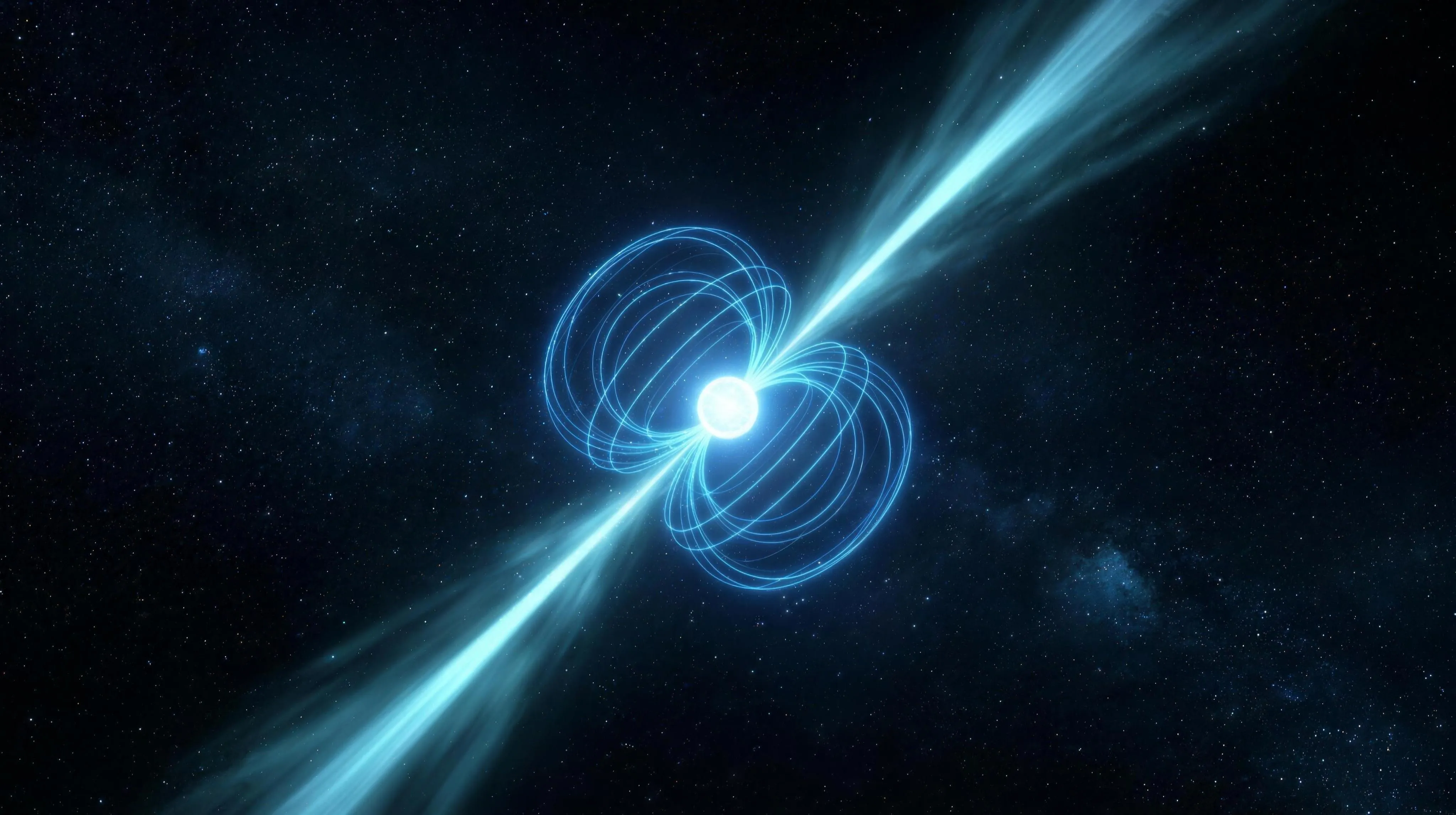
The Lighthouse view is the model that settled the case, drawn honestly. A neutron star turns about its spin axis at the true period, in real time for B1919+21; its magnetic axis leans away by the inclination α, and two radio beams ride the magnetic poles, so they sweep the sky as the star turns. A dashed line runs to Earth at your viewing angle ζ. The instant a beam crosses that line, the Earth marker flares and the strip at the bottom, a chart-recorder pen trace, draws a pulse whose very shape is the beam profile, computed from the geometry each frame.
The two angle sliders hold the whole physics. Drag α to zero and the pulses die: an aligned lighthouse blinks for nobody. Drag ζ away until the cone misses your line of sight and the strip goes silent while the star burns on: most of the galaxy's pulsars are invisible for exactly this reason. The presets swap in the Crab at 33 ms and a millisecond pulsar at 1.4 ms, run in labelled slow motion, because a star spinning 716 times a second is not something an eye can follow.
The Chart view is Cambridge, 1967, in ink: four days of survey paper stacked so the scruff lines up in one column at the same sidereal time, circled the way a discovery gets circled; below it, the 28 November fast recording, pulses of drunkenly varying height at rigidly fixed spacing, annotated 1.3373 s; beside it, the roll of second sources, CP 1133, 0834, 0950, that turned one impossible transmitter into a population of natural clocks. Click any of them for the story.
Why it's here
This instrument is the mirror of the Wow! Signal. Both stories are radio, both begin with an anomaly on paper, and both put "aliens" on the table in earnest. They fork at exactly one point: Wow! rang once and never again, so forty-nine years later it stays open; LGM-1 came back every 1.3373 seconds, so it was solved within months. A signal that repeats can be tested, and a signal that can be tested eventually has an answer. The two pages hang side by side here because together they are one complete lesson: how to take an astonishing hypothesis seriously, and how to let it go gracefully.
It also picks up threads from two other instruments. The compact bodies that spiral together in Gravitational Waves are this page's protagonists, neutron stars; today, pulsar timing arrays use these millisecond-perfect clocks to listen for the gravitational-wave background on galactic scales. As for the Drake Equation: the winter of 1967 was the first moment its N seemed, in serious data, to be non-zero, and this instrument stages exactly the testing procedure that walked N back down. SETI has run on that founding lesson ever since.
How it works
One geometric idea runs the whole instrument: a tilted beam on a turning star is visible only when it crosses your line of sight, and everything observable follows from two angles.
cos γ(t) = cos α · cos ζ + sin α · sin ζ · cos(2πt/P) · pulse when γ ≲ ρ · ρ ≈ 5.8°/√P
The period is the rotation. B1919+21 turns once every 1.3373 s, and on this screen it really does: the render clock and the pulsar clock are the same. The Crab, Vela and millisecond presets run in slow motion by a stated factor, because rotation at up to 716 turns per second reads as a blur. Nothing else about the timing is theatrical: the pulse rate you see is the pulse rate.
The pulse profile is geometry, not animation. Each frame the engine computes the angle γ between the beam axis and your line of sight from the formula above and lights the beam, the Earth marker and the pen trace from it. The Gaussian-ish pulse you see on the strip is the beam's cross-section swept past your eye. Change α or ζ and the profile widens, narrows, doubles (catch the interpulse from the far pole) or vanishes.
The timing test is the LGM killer, restaged. A civilisation transmits from a planet; a planet orbits; the orbit stretches and squeezes the observed period by ΔP/P = v/c over the months. Toggle it on and the pulse train visibly breathes while a sinusoid draws below; toggle back to the measured case and the residual line is flat. The 1968 analysis found exactly one wobble, the Earth's own, and nothing else.
The selection effect is built in, not narrated. The sweep condition |ζ − α| < ρ decides everything you receive. The beam widens for fast pulsars (ρ ≈ 5.8°/√P), which is why millisecond pulsars are easier to catch; for the slow ones the cone is a few degrees wide and almost every alignment misses. Surveys see the lucky geometry, and this panel lets you feel how lucky.
The evidence is tagged as you go. The bottom-left table is the conscience of the sim: the charts, the period, the flat timing, the second sources and the Crab are MEASURED; the lighthouse drawing is MODELLED; LGM is a READING, presented as the honestly tested, honourably retired hypothesis it was. Rows flash as you touch the matching control.
The scruff, the period, the flat residuals, the second sources and the Crab are measured. The lighthouse is a model, and says so on the panel. The only reading left in the story is the one history retired in the winter of 1967, and it is kept here, labelled, as the best worked example SETI has: the extraordinary hypothesis, seriously entertained, cleanly closed by data.
The four pulsars on the dial
Four real objects, one geometry, all run through the same lighthouse so you can compare them fairly.
- B1919+21. The first. 1.3373 s, in real time; the beam is a few degrees wide, the duty cycle a few percent, and the characteristic age about 16 million years. The default view is the discovery, as geometry.
- The Crab. 33 ms, in a supernova wreck dated to AD 1054, spinning thirty times a second. The measurement that made the neutron star unavoidable: white dwarfs shatter far below this speed. Runs at 1/20 speed.
- Vela. 89 ms, the second supernova-remnant pulsar, the southern confirmation that the Crab was no fluke. Runs at 1/8 speed.
- The millisecond pulsar. 1.4 ms, 716 turns per second, a dead star resurrected by accreting matter from a companion; the equator moves at a quarter of the speed of light. Runs at 1/400 speed, and the beam is at its widest: geometry favours the fast.
The explanations, as they stood in 1967-68
Every explanation seriously entertained at the time, with who proposed it and how it fared. This one, unusually for this site, has a winner: the case is closed, and the closing is the lesson.
| A rotating neutron star, beams misaligned: the lighthouse proposed by Gold 1968; Pacini 1967 | WON | Won. Predicted the slow spin-down, survived the Crab’s 33 ms, and remains the standard model of every pulsar since. |
| Oscillations of a white dwarf or neutron star proposed by Hewish et al. 1968, the discovery paper’s first guess | RETIRED | Superseded. Vibration frequencies fit awkwardly, and the Crab’s 33 ms plus steady slow-down fit rotation, not ringing. |
| A binary orbit clocking the pulses proposed by considered in the first analyses | RETIRED | Retired. An orbit fast enough leaves Doppler signatures the flat timing ruled out. |
| Human interference proposed by the first suspect, as always | RETIRED | Retired immediately: the scruff kept sidereal time, four minutes earlier each day. Nothing human keeps star time. |
| LGM: an extraterrestrial transmitter proposed by the half-joke of winter 1967 | READING | Retired by measurement: no orbital Doppler, then four unrelated sources. The one alien hypothesis in history closed cleanly by data. |
Try this
- Watch one honest rotation. Leave B1919+21 at default and watch the beam come around: 1.3373 seconds, a flare on the Earth dot, a pulse on the strip. That cadence is the real one, unaccelerated. You are watching the actual clock that confused the world in 1967.
- Kill the pulses two ways. Drag α to 0° (the lighthouse aligns and stops blinking), reset, then drag ζ far from α (the beam sweeps, but never over you). Two different silences, one lesson: pulsing is geometry, and absence of pulses is not absence of pulsar.
- Catch the interpulse. Set ζ near 90° with α near 90° and watch a second, weaker pulse appear between the main ones: the far magnetic pole, caught edge-on. Several real pulsars, the Crab included, show exactly this.
- Run the LGM test. Switch the timing toggle to "On a planet" and watch the pulse train breathe as the sinusoid draws below; switch back to B1919 and the line is flat. You have just performed the analysis that retired the most famous alien hypothesis of the century.
- Read the chart like Bell. In the Chart view, find the scruff column aligned across four days, then click the fast recording and note what varies (pulse heights, wildly) and what does not (the spacing, ever). That contrast is the entire discovery.
- End on the dial. Step through B1919, Crab, Vela, millisecond, and watch the period fall from seconds to milliseconds while the beam fattens. Same geometry, one dead star at four ages. The strangest thing on this page is that all four are real.
Accuracy
The honest line between what has been measured, what is modelled here, and what is a reading:
| Feature | Status | What that means |
|---|---|---|
| The charts: a quarter-inch 'scruff' keeping sidereal time | Measured | August to November 1967, in 96 feet of pen trace per day, read by eye. The anomaly returned four minutes earlier each solar day, the clock of the stars: only something fixed on the celestial sphere does that. The Chart view stacks four survey days so you can see the column line up. |
| Pulses every 1.3373 seconds, to the limit of measurement | Measured | The 28 November 1967 fast recording. Pulse amplitudes lurch from one pulse to the next, the spacing does not. Pulsar periods are now tracked to parts in 10¹⁵; the slow spin-down of B1919+21 (1.35×10⁻¹⁵ s/s) gives a characteristic age of ~16 million years. |
| Timing residuals flat: one Doppler wobble found, and it was ours | Measured | A transmitter on a planet must show its orbit in the pulse timing. The analysis found the Earth's annual Doppler, proving the source sat far beyond the solar system, and no other periodicity. No orbit, no planet, no engineer. |
| Four sources in four parts of the sky by January 1968 | Measured | CP 1133 (found by Bell just before Christmas), then CP 0834 and CP 0950, joining CP 1919. Independent transmitters scattered across the galaxy running the same trick is not a civilisation; it is a population of natural objects. |
| The 33 ms Crab pulsar inside a known supernova wreck | Measured | Staelin & Reifenstein 1968, timed by Comella et al. 1969. Nothing but a neutron star can rotate thirty times per second without disintegrating, and it sat in the debris of a recorded stellar death (AD 1054). This is the measurement that settled the mechanism. |
| This lighthouse: a dipole field, tilted beams, two angles | Modelled | The drawing is the standard rotating-vector picture: beams along the magnetic axis, inclination α, viewing angle ζ, beam width scaling as ρ ≈ 5.8°/√P. The pulse profile on the strip is computed from that geometry each frame; the star is drawn large and fast pulsars run in slow motion, both flagged on the panel. |
| LGM: the hypothesis of winter 1967 | Reading | For a few weeks, an artificial origin was a live reading, entertained seriously enough that Hewish worried about announcement protocol. The Doppler test and the second sources retired it. It is presented here as what it was: a reading, honestly tested, honourably withdrawn. |
| The 1974 Nobel Prize, awarded without Bell | Reading | The physics above is measured; who deserved the credit is history's reading. Hewish and Ryle received the prize; Bell Burnell, who built the array, found the scruff and chased down the confirmations, did not. Her own verdict has been generous for fifty years; the record here speaks for itself. |
In one line: the charts and their sidereal clock, the 1.3373 s period, the flat timing residuals, the second sources and the Crab's 33 ms are all measured; the lighthouse drawing, its dipole field and its two-angle beam geometry are the standard model, rendered honestly and labelled as a model; and the only reading in the story, a transmitter built by somebody, was tested against the timing and the population and retired within weeks. The case is closed, and the closing procedure is the exhibit.
Sources
- Hewish, A., Bell, S. J., Pilkington, J. D. H., Scott, P. F., & Collins, R. A. (1968). Observation of a Rapidly Pulsating Radio Source. Nature 217, 709. The discovery paper: the period, the sidereal clock, the Doppler analysis, the collapsed-star suggestion.
- Pilkington, J. D. H., Hewish, A., Bell, S. J., & Cole, T. W. (1968). Observations of some further Pulsed Radio Sources. Nature 218, 126. The second sources: the population that ended LGM.
- Gold, T. (1968). Rotating Neutron Stars as the Origin of the Pulsating Radio Sources. Nature 218, 731. The lighthouse model, with the spin-down prediction.
- Pacini, F. (1967). Energy Emission from a Neutron Star. Nature 216, 567. The rotating magnetised neutron star, published before the discovery.
- Staelin, D. H., & Reifenstein, E. C. (1968). Pulsating Radio Sources near the Crab Nebula. Science 162, 1481. The Crab pulsar found in a known supernova wreck.
- Comella, J. M., et al. (1969). Crab Nebula Pulsar NP 0532. Nature 221, 453. The 33 ms period: only a neutron star turns that fast.
- Bell Burnell, S. J. (1977). Little Green Men, White Dwarfs or Pulsars? Annals of the New York Academy of Sciences 302, 685. The discovery in her own words, scruff, LGM, freezing hut and all.
- Hewish, A. (1975). Pulsars and High Density Physics. Nobel Lecture. The laureate’s account of the discovery and its physics.
- Baade, W., & Zwicky, F. (1934). Cosmic Rays from Super-novae. PNAS 20, 259. The neutron star predicted, thirty-three years before anyone heard one.
- Lyne, A., & Graham-Smith, F. Pulsar Astronomy. Cambridge University Press. The standard reference for periods, beam geometry and timing.
- Breakthrough Prize Foundation (2018). Special Breakthrough Prize in Fundamental Physics awarded to Jocelyn Bell Burnell. The $3M prize, donated in full to fund under-represented physics students.