’Oumuamua
In late 2017 the first confirmed visitor from another star crossed the solar system: on an orbit that never closes, shaped like nothing catalogued before, and accelerating in a way gravity alone cannot explain. This instrument rebuilds the visit, and tags every fact by how we know it.
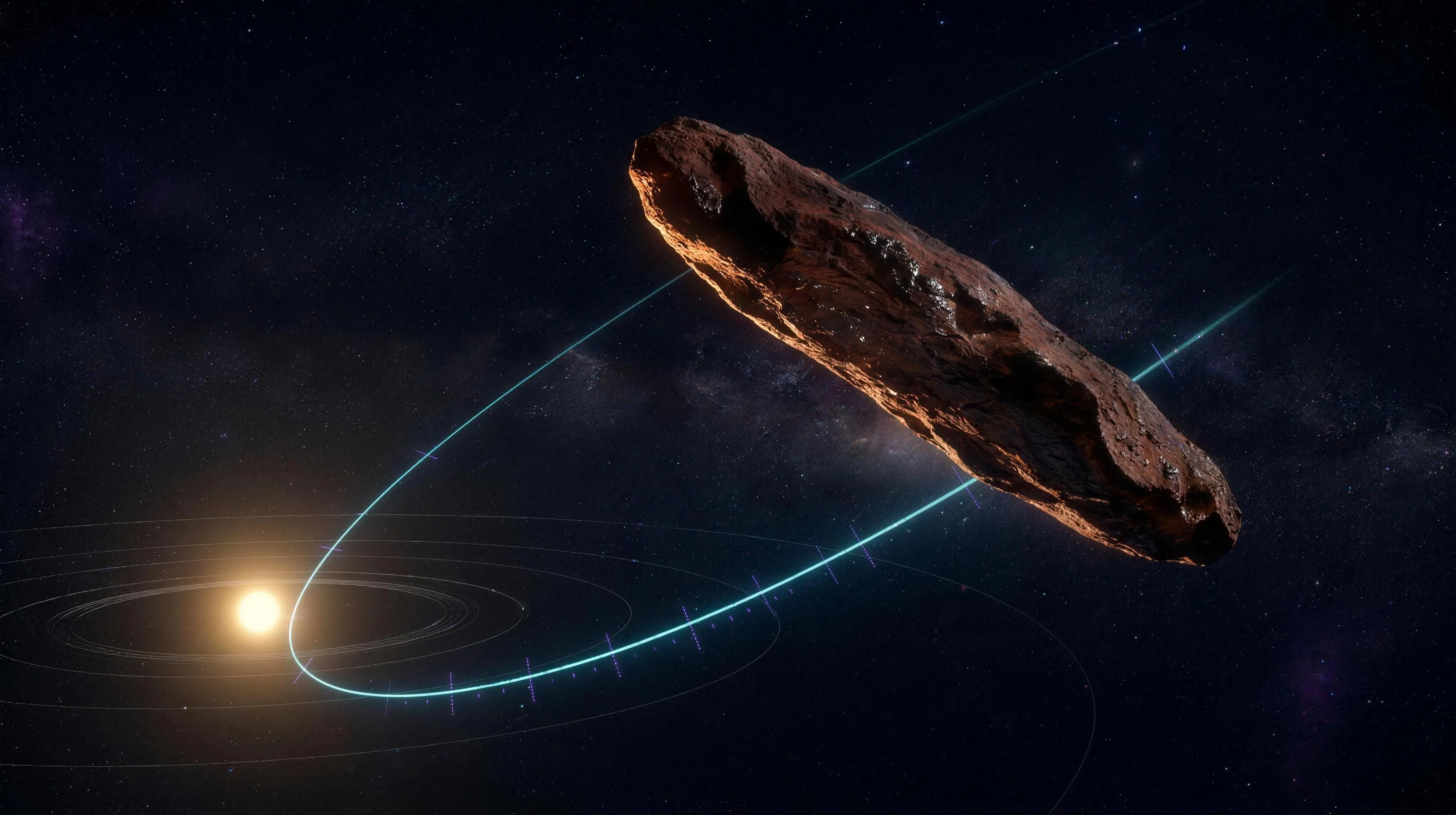 Open the interactive ▸
 What you're looking at
The Orbit view is the visit from outside. The Sun, the planets on their rings, and threading between them a cyan curve that refuses to close: the real fitted trajectory of 1I/2017 U1, eccentricity 1.2011, falling in from the direction of Lyra at 26.4 km/s, whipping inside Mercury's orbit on 9 September 2017, and leaving toward Pegasus for good. Scrub the date, ride alongside, and switch on the gravity-only ghost: a violet twin coasting on gravity alone, which the flown body pulls measurably ahead of. The separation readout is true kilometres; the drawn gap is a labelled exaggeration you control.
The Body view is the visitor itself, which no telescope ever resolved: every image ever taken is a single point of light. What was measured is the light curve, brightness swinging by a factor of ten every 7.3 hours or so, and from it two shapes were modelled: the famous ~8:1 cigar and Mashchenko's 115 × 111 × 19 m pancake. Swap between them and watch the curve under the body redraw, computed live from the exact projected area of the model you chose, tumbling on two axes the way the real body did.
The Evidence table, bottom-left, is the sim's conscience. Seven rows: the orbit, the curve, the shape, the push, the silence, the natural readings, the sail. Each is tagged MEASURED (published data), MODELLED (a fit to that data) or READING (an interpretation of it), and rows light up as you touch the matching control, so you always know which kind of claim you are looking at.
Why it's here
Most instruments on this site demonstrate a law; this one files a case. It is the second "phenomenon file" after the Crop Circles: the pattern is real, and the cause is where the periphery begins. ’Oumuamua is the cleanest file of its kind, because the anomaly was not reported by witnesses; it was measured by mainstream astronomy itself: an orbit that never closes, an extreme light curve, and a non-gravitational push published in Nature. The dispute is not over the data but over the readings, and one of those readings, a cosmic artifact, is argued under the name of a former chair of Harvard's astronomy department. No case is better suited to stress-testing the stance of this site: summarise, attribute, link, and leave the verdict to you.
It also fills a missing rung in the gallery. The Gravity instrument shows the law that closes planets into ellipses; this one shows the same law's other regime: above eccentricity 1 the orbit opens, and the visitor never comes back. And it shares its conscience with The Rendering Engine: where that instrument tags every rung of an analogy ENGINE / PHYSICS / READING, this one's Evidence table tags every fact MEASURED / MODELLED / READING. The push is measured; the shape is modelled; hydrogen ice, nitrogen ice and the lightsail are three readings. The table sits at the sim's bottom-left, lighting up live.
How it works
One equation flies the whole visit:
r̈ = −GM☉ r̂ / r² + A₁ (1 AU / r)² r̂ · A₁ = 4.92×10⁻⁶ m/s²
The orbit is exact. The cyan path integrates the equation above from the fitted perihelion state (JPL elements: e = 1.2011, q = 0.2559 AU, i = 122.7°). Drop the A₁ term and you get the violet ghost, solved from the hyperbolic Kepler equation. The speed readout comes from vis-viva; at perihelion it touches 87.4 km/s, and it never falls below the 26.4 km/s the visitor keeps forever.
The push is the measurement. Micheli et al. fit every astrometric position and found no gravity-only orbit works: something adds about one part in a thousand of solar gravity, radially, fading as roughly 1/r². The sim integrates both trajectories and prints their true separation in kilometres; the exaggeration slider scales only the drawing, never the number.
The light curve is geometry. For an ellipsoid with semi-axes a, b, c seen along a direction u, the projected area is π√(b²c²u₁² + a²c²u₂² + a²b²u₃²): the sim evaluates exactly that, every frame, for the tumbling model you picked, and converts it to magnitudes. A ~8:1 body swings ~2.3 mag; the observed 2.5 needed the most extreme shape ever fit to a natural object.
The readings are recoil. Sublimating ice is a weak rocket: gas leaves the sunlit side, the body recoils away from the Sun, matching the measured direction. The gas preset stages that with jets drawn deliberately, dishonestly visible, and says so, because the honest version of the natural readings is exhaust nothing could see. The sail preset swaps the rock for a sheet under a millimetre thick, which is what sunlight pressure requires: the physics from Bialy & Loeb, the artifact inference tagged as Loeb's reading.
The numbers stay honest. Eccentricity, v∞, distances, speeds, dates and the push offset are computed from the real elements every frame. Planet positions ride mean circular orbits with the correct phase: context, and labelled so in the Accuracy table.
The orbit, the push and the light-curve amplitude are real; the shapes are fits; the jets, the sheet and the exaggerated gap are staged readings and presentation, tagged wherever they appear.
The presets
Six ways to run the visit, from the plain replay to the reading that made headlines.
- The visit. July 2017 to October 2018 on the real orbit. The whole file, at time-lapse speed.
- The open orbit. The hyperbola against an amber bound comet sharing its perihelion. One path closes forever; one never does.
- The push. The gravity-only ghost switched on at discovery, gap exaggerated ×400 and labelled. The anomaly, made visible.
- The tumble. The body view with the live light curve: the ×10 swing that made the shape famous.
- Outgassing. The natural reading: invisible exhaust drawn visible, recoil arrow matching the measured push.
- Lightsail. The loud reading: the rock swapped for the mm-thin sheet the radiation-pressure fit requires.
Try this
- Watch the orbit refuse to close. Run The open orbit and follow both paths outward. The amber comet turns back; the cyan curve just leaves.
- Read the gap honestly. In The push, drag the exaggeration to ×1 and watch the ghost disappear into the flown path while the km readout keeps counting. That invisible-but-real gap is the whole discovery.
- Catch discovery day. Scrub to 19 October 2017 and look where the visitor already is: outbound, past Earth, fading. Every measurement in this file fit into the four months that followed.
- Break the cigar. In the Body view, swap cigar for pancake and watch the light curve stay plausible. Two shapes, one curve: that is what MODELLED means.
- Stage both readings. Run Outgassing, then Lightsail, and notice the recoil arrow barely changes. The push does not care which story you tell about it; that is why the case stays open.
- End on the Evidence. Touch the exaggeration slider and watch the push row flash MEASURED; press the sail preset and watch its row flash READING. The tags are the point.
Accuracy
The honest line between what was measured, what was modelled, and what is read in:
| Feature | Status | What that means |
|---|---|---|
| The hyperbolic orbit: e = 1.2011, q = 0.256 AU, v∞ = 26.4 km/s, perihelion 9 Sep 2017 | Measured | The JPL/MPC fit to every astrometric position ever taken. The trajectory drawn in the sim is computed from these elements, with the fitted radial acceleration included. |
| The light curve: brightness swinging ×10 (~2.5 mag) every ~7.3 h, on no clean period | Measured | Meech et al. 2017; Belton et al. 2018. The most extreme light curve of any natural body then known, and the tumbling that rules out simple rotation. |
| The push: 4.92×10⁻⁶ m/s² at 1 AU, falling as ~1/r², radial | Measured | Micheli et al. 2018, Nature. No gravity-only orbit fits the data. About 0.1% of solar gravity, exactly the residual the violet ghost in the sim makes visible. |
| The silence: no coma, no tail, no dust; Spitzer non-detection | Measured | Deep imaging and infrared limits. Whatever produced the push, nothing was seen producing it. This is what separates 1I from every normal comet. |
| The shapes: the ~8:1 cigar and the 115×111×19 m pancake; the two-axis tumble | Modelled | No telescope resolved the body: every image is a point of light. Both shapes are fits to the light curve (Meech; Mashchenko 2019), and the sim derives its drawn curve from the exact projected area of whichever model you pick. |
| The natural readings: H₂-ice or N₂-ice outgassing, exhaust no instrument could see | Reading | Seligman & Laughlin 2020; Jackson & Desch 2021; Bergner & Seligman 2023. Each reproduces the push; each strains on survival between the stars or on cosmic abundance. Most of the field considers one of these likeliest. |
| The loud reading: sunlight pressure on a mm-thin sheet; Loeb's artifact claim | Reading | Bialy & Loeb 2018 (the physics), Loeb 2021 (the claim). The radiation-pressure fit is a published calculation; the inference to manufacture is an interpretation, and the sim tags it READING wherever it appears. |
| Circularised planet orbits, the visible exhaust jets, the body texture, the gap exaggeration | Illustrative | Presentation. Planets ride mean circular orbits with correct phase; the drawn jets are many orders of magnitude brighter than anything observed; the rock surface is invented; the exaggeration slider only scales the drawn gap and always says so. The km readout stays true throughout. |
In one line: the orbit, the light curve, the push and the silence are measurements; the cigar and the pancake are models; hydrogen ice, nitrogen ice and the lightsail are readings of the same anomaly, argued in the sources below, and the instrument tags all three, takes no side, and leaves the verdict to you.
Sources
- Meech, K. J., et al. (2017). A brief visit from a red and extremely elongated interstellar asteroid. Nature 552, 378. The discovery paper: the orbit, the colour, the ×10 light curve.
- Micheli, M., et al. (2018). Non-gravitational acceleration in the trajectory of 1I/2017 U1 (’Oumuamua). Nature 559, 223. The push: 4.92×10⁻⁶ m/s², ~1/r², no gravity-only fit.
- Belton, M. J. S., et al. (2018). The excited spin state of 1I/2017 U1 ’Oumuamua. ApJL 856, L21. The tumbling.
- Mashchenko, S. (2019). Modelling the light curve of ’Oumuamua. MNRAS 489, 3003. The pancake: 115×111×19 m favoured over the cigar.
- The ’Oumuamua ISSI Team (2019). The natural history of ’Oumuamua. Nature Astronomy 3, 594. The mainstream synthesis: a natural object, origin unknown.
- Bialy, S., & Loeb, A. (2018). Could solar radiation pressure explain ’Oumuamua's peculiar acceleration? ApJL 868, L1. The lightsail physics: the push fits a mm-thin sheet.
- Seligman, D., & Laughlin, G. (2020). Evidence that 1I/2017 U1 (’Oumuamua) was composed of molecular hydrogen ice. ApJL 896, L8. The H₂ reading.
- Jackson, A. P., & Desch, S. J. (2021). 1I/’Oumuamua as an N₂ ice fragment of an exo-Pluto surface. JGR Planets 126. The nitrogen reading.
- Bergner, J. B., & Seligman, D. Z. (2023). Acceleration of 1I/’Oumuamua from radiolytically produced H₂ in H₂O ice. Nature 615, 610. The currently favoured natural mechanism.
- Loeb, A. (2021). Extraterrestrial: The First Sign of Intelligent Life Beyond Earth. Houghton Mifflin Harcourt. The artifact claim, argued at book length.