Project Orion
In 1958, a team at General Atomics sat down and designed a 4,000-ton spaceship that flies by throwing atomic bombs out the back, one per second, and riding the blasts on a 20-metre steel plate. It was not a joke. A metre-scale model flew in 1959. The numbers kept refusing to rule it out. A treaty, not physics, is what killed it.
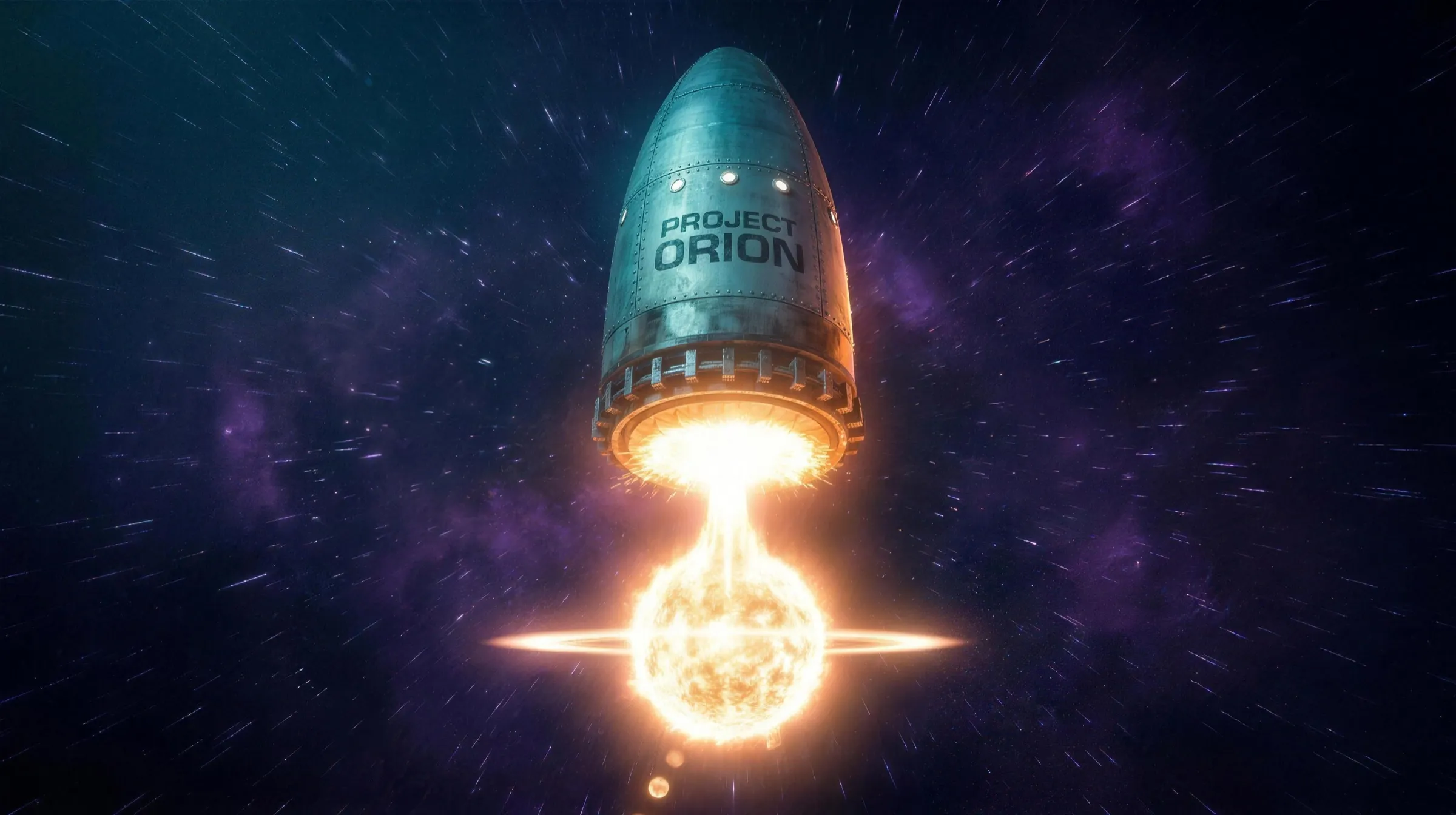 Open the interactive ▸
 What you're looking at
The 4,000-ton class Orion, sliced down the middle, floating in deep space. Drag to orbit, scroll to zoom. From the bottom up: the scorched pusher plate with its oil sprayers, the doughnut gas bags and the ring of telescoping pistons that together turn a bomb into a shove, the delivery gun on the axis, racked decks of pulse units, a shield deck, and the crew section under the nose. Click any part, or its label, for a short explainer.
Then fire it. The gun throws a pulse unit out through the port; 30 metres behind the ship it detonates. A star-flash whites the screen, a turbulent fireball blooms, a directed cigar of plasma slaps the plate, the plate glows white and cools, the pistons compress and rebound, and the starfield streaks a little faster. Yield runs from 0.1 to 5 kilotons, the interval and single-shot controls set the rhythm, and the time controls slow the whole cycle down 10× or 50× so you can watch the plasma actually arrive.
On the right, live telemetry: velocity gained, Δv per pulse, pulses fired and magazine remaining, the average acceleration, the plate's ~10,000 g peak against the 2-4 g the crew rides, an effective specific impulse, and a time-averaged thrust. Bottom-left, the impulse equation runs live. And Compare mode stands the ship next to a Saturn V at true scale, which is the fastest way to feel what 4,000 tons means.
Why it's here
Most of this site lives out at the edge of what is confirmed. Project Orion is the mirror image: a story that sounds like fringe lore, a Cold War government seriously engineering a bomb-propelled interplanetary ship with a crew of dozens, that turns out to be entirely documented. Every part of this machine is in the declassified record. For seven years, serious people were paid to make it real, and the public learned the details decades later.
That cuts both ways, and we let it. Orion calibrates how wild classified engineering can actually get, which matters when weighing claims that unusual sightings trace back to secret programs: "we would have heard about it" is weaker than it sounds. And in the same breath it shows secrecy's limits, because Orion did surface, in memoirs, archives and treaty debates. We lay out the record; what it implies about the periphery is yours to decide.
How it works
One pulse is bookkeeping, an impulse divided by a mass:
Δv = J / M per pulse
The detonation vaporises a tungsten slab into a directed jet of plasma. The plate catches it for a few microseconds and takes an impulse J; the ship of mass M gains velocity Δv. Repeat once a second, thousands of times, and the increments add into tens of kilometres per second.
Efficiency is still specific impulse, the effective exhaust speed in seconds:
Iₛₚ = Δv·M / (mᵤ · g₀) , g₀ = 9.80665 m/s²
Chemical rockets top out near 450 s because the energy lives in the propellant's own bonds. A fission charge carries about a million times more energy per kilogram, but no chamber can hold that fire, so Orion externalises it: let the bomb burst in open space and catch the push on armour. The era's studies projected 1,800 to 2,500 seconds, with thrust measured in meganewtons at the same time. No other propulsion concept, then or since, offers both at once.
The price is the ride. The plate feels roughly 10,000 g for microseconds. Gas bags stretch the blow into milliseconds, a ring of long pistons stretches it into a full second, and the crew feels a steady 2 to 4 g, once per pulse. The absorbers, not the bomb, were the hardest engineering on the ship, and mistuning them so the strokes stack instead of cancel was a real failure mode the designers worried about.
The interactive runs a first-order teaching model: Δv per pulse is 12 m/s·√kt on a constant 4,000-ton ship, effective Iₛₚ follows from an assumed pulse-unit mass, and accelerations follow from the interval. The historical frame is real; every number that moves is modeled, and the accuracy table below draws the line exactly.
The machine, bottom to top
Seven components, each clickable in the interactive. Together they turn a bomb into an engine.
- Pusher plate. A steel disc about 20 m across, thick at the centre, thin at the rim. The only part that ever touches the bomb, and test data said ablation eats far less of it per shot than intuition suggests.
- Oil sprayers. Between pulses they film the plate face with oil; the flash boils it off and the heat leaves with it. This one trick is most of why the plate survives thousands of pulses.
- Gas bags, stage one. Pneumatic doughnuts behind the plate that stretch the microsecond shock into milliseconds. The front bumper.
- Pistons, stage two. A ring of long telescoping absorbers that stretch milliseconds into a full second and hand the crew 2-4 g.
- Delivery gun. A gas gun on the axis firing pulse units through the plate's central port, about one per second. A machine gun that feeds an engine.
- Magazine. Racked decks of shaped charges, each wrapping a fission device in channel filler and a tungsten propellant slab. The bomb is just how you heat the propellant.
- Shield and crew decks. A thick disc kills the line-of-sight radiation path; behind it, living space for a crew measured in dozens, riding to Mars like a train over rail joints.
And below it all, thirty metres of empty space where, once per second, a small sun is born, shaped into a jet, and spent against steel.
Try this
- Set time to 0.02× and fire one pulse. Watch the unit fall, the flash, the plasma crossing the gap, and the plate take the hit.
- Crank the yield to 5 kt and set the drive to Firing. Watch the peak-shock readout climb toward 18,000 g while the crew figure barely moves.
- Shorten the interval and watch average acceleration and time-averaged thrust rise together; this rhythm is what the absorbers were tuned around.
- Click the pusher plate, then the oil sprayers, and read why the plate survives at all.
- Open Compare and stand it next to a Saturn V at true scale. The Saturn is taller; the Orion weighs more than it.
- Run the story, eight chapters, from the tyranny of the rocket equation to the treaty that ended it.
Accuracy
The honest line between the documented record and what is drawn or modeled for clarity:
| Feature | Tier | What that means |
|---|---|---|
| The machine itself | T1 Established | The 4,000-ton class vehicle, the ~20 m steel pusher plate, oil-film ablation protection, two-stage shock absorbers (gas bags then pistons), the pulse-unit delivery gun and shaped-charge pulse units are all from the declassified record of the 1958-1965 General Atomics program. |
| The history | T1 Established | The November 1959 Putt-Putt flight test on chemical charges, the "Mars by 1965, Saturn by 1970" ambition, the 1963 Partial Test Ban Treaty and the 1965 shutdown are documented history. |
| Performance band | T2 Theoretical | The specific impulse band shown (roughly 1,800-2,500 s) is what the era's studies projected. Nothing of this scale was ever flown, so these are study numbers, reported as such. |
| The 3-D shape | T3 Stylised | A schematic, not a blueprint. The hull profile, deck layout, piston count and proportions are drawn to read clearly and stay roughly true to the concept drawings, not to match engineering documents. |
| Live numbers | T3 Stylised | Δv per pulse (12 m/s·√kt), the accelerations, the magazine count and plate temperatures are first-order teaching estimates. Ship mass is held constant. The interactive flags them as modeled. |
| The explosion | T3 Stylised | The fireball, plasma jet, shock ring and sparks are stylised, and the real event takes microseconds; on screen it is stretched by orders of magnitude so you can watch it. |
In one line: the machine and its history are real and documented; every number that moves on screen is a first-order teaching estimate; and nothing stylised changes the story, because no other propulsion concept has ever offered this much thrust and this much specific impulse at once.
Sources
- Project Orion (nuclear propulsion). Wikipedia. en.wikipedia.org/wiki/Project_Orion_(nuclear_propulsion)
- George Dyson. Project Orion: The True Story of the Atomic Spaceship. Henry Holt, 2002.
- Freeman J. Dyson. Death of a Project. Science 149 (3680), 141-144, July 1965. science.org
- General Atomic. Nuclear Pulse Space Vehicle Study (GA-5009, 1964), declassified via NASA NTRS. ntrs.nasa.gov