Quantum Tunnelling
Roll a ball at a hill it doesn't have the energy to climb and it always rolls back. Roll a particle at a barrier it can't climb and a sliver of it comes out the other side, every time. The wall is solid; the wave leaks through anyway.
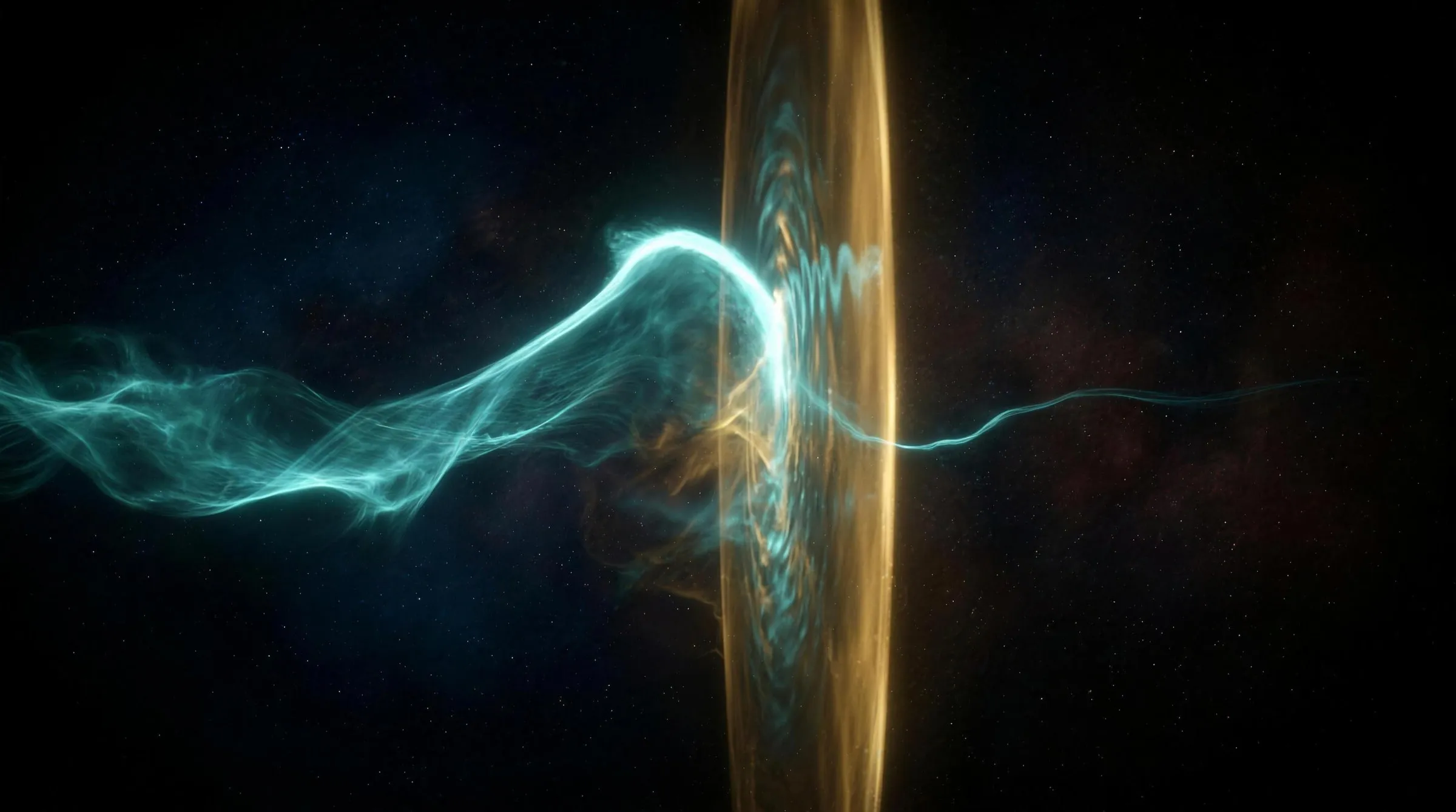 Open the interactive ▸
 What you're looking at
A wave packet, the cyan |ψ|² hump, rolls in from the left at energy E and meets a barrier of height V₀ (the amber block). Classically, if E is below V₀ the particle simply hasn't got the energy; it must turn around. Watch what actually happens: most of the packet reflects, but inside the barrier the wave doesn't stop dead, it decays smoothly, and a small piece re-emerges on the far side and keeps going. That piece is the particle having tunnelled.
This is not a cartoon of the idea; it's a live solution of the time-dependent Schrödinger equation running in your browser (split-step method). The gold dashed line is the energy E. Inside the barrier the wave falls by a factor of e every 1/κ of distance, the decay length, so a barrier twice as thick doesn't halve the transmission, it squares its smallness.
The graph underneath is the exact transmission T(E): the probability of getting through, against energy. Below V₀ it climbs out of almost nothing; above V₀ it approaches 1 but ripples with resonances. Drag E, V₀ and the barrier width L, or switch the particle between electron, proton and alpha, same wall, wildly different odds, because tunnelling depends ferociously on mass.
Why it's here
This is the third quantum piece, after the Double-Slit (one particle, both paths) and the Bell test (entanglement). Those two are about what's real before you look. Tunnelling is about what's possible: in the quantum world a particle is a spread-out wave, and a wave doesn't respect a wall the way a pebble does. The "impossible" happens, at a calculable rate.
And unlike most quantum strangeness, tunnelling is load-bearing for the universe. The Sun shines because protons tunnel through their own electrical repulsion to fuse, they're far too cold to climb it. Radioactive alpha decay is an alpha particle tunnelling out of a nucleus it could never classically leave (Gamow, Gurney & Condon, 1928, the first triumph of the new quantum mechanics applied to the nucleus). The scanning tunnelling microscope images single atoms because the tunnelling current changes about tenfold for every ångström of gap. Your phone's flash memory stores bits by tunnelling electrons through an insulator. Take tunnelling away and the stars go dark and the periodic table stops decaying.
How it works
For a rectangular barrier of height V₀ and width L, a particle of mass m and energy E < V₀ gets through with probability T = [ 1 + V₀²·sinh²(κL) / (4E(V₀−E)) ]⁻¹, with κ = √(2m(V₀−E)) / ℏ.
κ is the decay constant: inside the barrier the wave amplitude falls like e^(−κx). For a thick or tall barrier this collapses to the law that runs the chapter: T ≈ 16·(E/V₀)(1−E/V₀)·e^(−2κL).
Three things fall straight out of that exponent. Width kills transmission fastest, T drops exponentially with L (the ångström-sensitivity that makes the STM work). Mass sits inside κ as √m, so a proton (1836× the electron) faces a κ ~43× larger and a T smaller by hundreds of orders of magnitude through the same wall, which is why electrons tunnel in your electronics but you don't. And the gap V₀−E: the closer the particle's energy creeps to the top, the thinner the effective wall.
Above the barrier (E > V₀) the sinh becomes a sine and T oscillates back up to 1 at resonances (κL → real momentum; the barrier width matches an integer number of half-wavelengths). Even then, a classically-certain pass still partly reflects, another purely quantum effect.
The animation solves the real equation; the numbers come from the exact formula above. The one thing it idealises is the barrier's shape, real ones (the Coulomb wall of a nucleus, the oxide in a memory cell) are curved, which changes the prefactor (the "Gamow factor") but not the exponential heart.
The three particles
The same wall, three masses, the cleanest way to feel the √m in the exponent.
- Electron (light). The featherweight. Tunnels readily through ångström-scale barriers, which is exactly why it's the workhorse of the STM and of flash memory. Verdict: tunnels easily.
- Proton (1836× heavier). Through an everyday electron-scale barrier its transmission is effectively zero. It only tunnels where barriers are thin and energies enormous, the core of the Sun, where it still happens just often enough to light a star. Verdict: tunnels only under extreme conditions.
- Alpha particle (~7300× heavier). The heavyweight, and the historical one. Its chance per encounter with the nuclear wall is astronomically small, but it batters that wall ~10²¹ times a second, and that tiny probability times that vast frequency sets a radioactive half-life (Gamow, 1928). Verdict: tunnels rarely, but relentlessly.
Accuracy
The honest line between what is exact and what is dialled for display:
| Feature | Status | What that means |
|---|---|---|
| Transmission T(E) for a rectangular barrier | Established | The exact quantum-mechanical result. Sets the T(E) curve, the readouts, and the verdict. |
| Decay constant κ = √(2m(V₀−E))/ℏ and the e^(−2κL) law | Established | Direct from the Schrödinger equation. The decay length 1/κ and the exponential collapse with width are exact. |
| Mass dependence (electron vs proton vs alpha) | Established | κ ∝ √m, so heavier particles tunnel exponentially less. The per-particle numbers are real. |
| The live wave evolution | Established | A genuine numerical solution of the time-dependent Schrödinger equation (split-step Fourier). What you see is the equation, not an animation of it. |
| Tunnelling powers alpha decay, fusion, the STM, flash memory | Established | Gamow/Gurney–Condon 1928; stellar fusion; Binnig–Rohrer STM (Nobel 1986); Esaki tunnel diode (Nobel 1973). Confirmed, everyday physics. |
| How long a particle "spends" inside the barrier (tunnelling time) | Theoretical | Genuinely open. The Hartman effect and modern attoclock experiments disagree on whether it's near-instant; there is no settled definition. |
| What the particle "is doing" under the barrier | Theoretical | Interpretation-dependent, the wavefunction is unambiguous, the story you tell about it is not. |
| Real barriers are rectangular | Stylised | Nuclear and oxide barriers are Coulombic/curved. The rectangular barrier is the textbook idealisation; the exponential physics is the same, the prefactor (Gamow factor) differs. |
| Animation units, packet width and speed | Stylised | The solve runs in scaled units, with a Gaussian packet sized and paced for watchability. The displayed T, κ and energies are in real eV/nm. |
| 1-D, single barrier; absorbing edges; Gaussian packet | Illustrative | A teaching reduction of a 3-D scattering problem. Faithful to the transmission physics, not to any specific device geometry. |
In one line: the transmission formula, the exponential decay constant, the mass dependence and the Schrödinger evolution are exact, established physics; only the rectangular-barrier shape, the scaled animation units and the packet's size are dialled for display, and "how long tunnelling takes" is the one genuinely open question.
Sources
- Gamow, G. (1928). Zur Quantentheorie des Atomkernes. Z. Phys. 51, 204. Alpha decay as tunnelling.
- Gurney, R. W., & Condon, E. U. (1928). Wave Mechanics and Radioactive Disintegration. Nature 122, 439. The independent, simultaneous account.
- Atkinson, R. d'E., & Houtermans, F. G. (1929). Zur Frage der Aufbaumöglichkeit der Elemente in Sternen. Z. Phys. 54, 656. Tunnelling as the key to stellar energy.
- Fowler, R. H., & Nordheim, L. (1928). Electron Emission in Intense Electric Fields. Proc. R. Soc. A 119, 173. Field emission by tunnelling.
- Esaki, L. (1958). New Phenomenon in Narrow Ge p–n Junctions. Phys. Rev. 109, 603. The tunnel diode (Nobel 1973).
- Josephson, B. D. (1962). Possible new effects in superconductive tunnelling. Phys. Lett. 1, 251. Cooper-pair tunnelling (Nobel 1973).
- Binnig, G., Rohrer, H., Gerber, Ch., & Weibel, E. (1982). Surface Studies by Scanning Tunneling Microscopy. Phys. Rev. Lett. 49, 57. The STM (Nobel 1986).
- Merzbacher, E. (2002). The Early History of Quantum Tunneling. Physics Today 55(8), 44. Historical review.
- Ramos, R., et al. (2020). Measurement of the time spent by a tunnelling atom within the barrier region. Nature 583, 529. The still-unsettled tunnelling-time question.