Raptor & Merlin
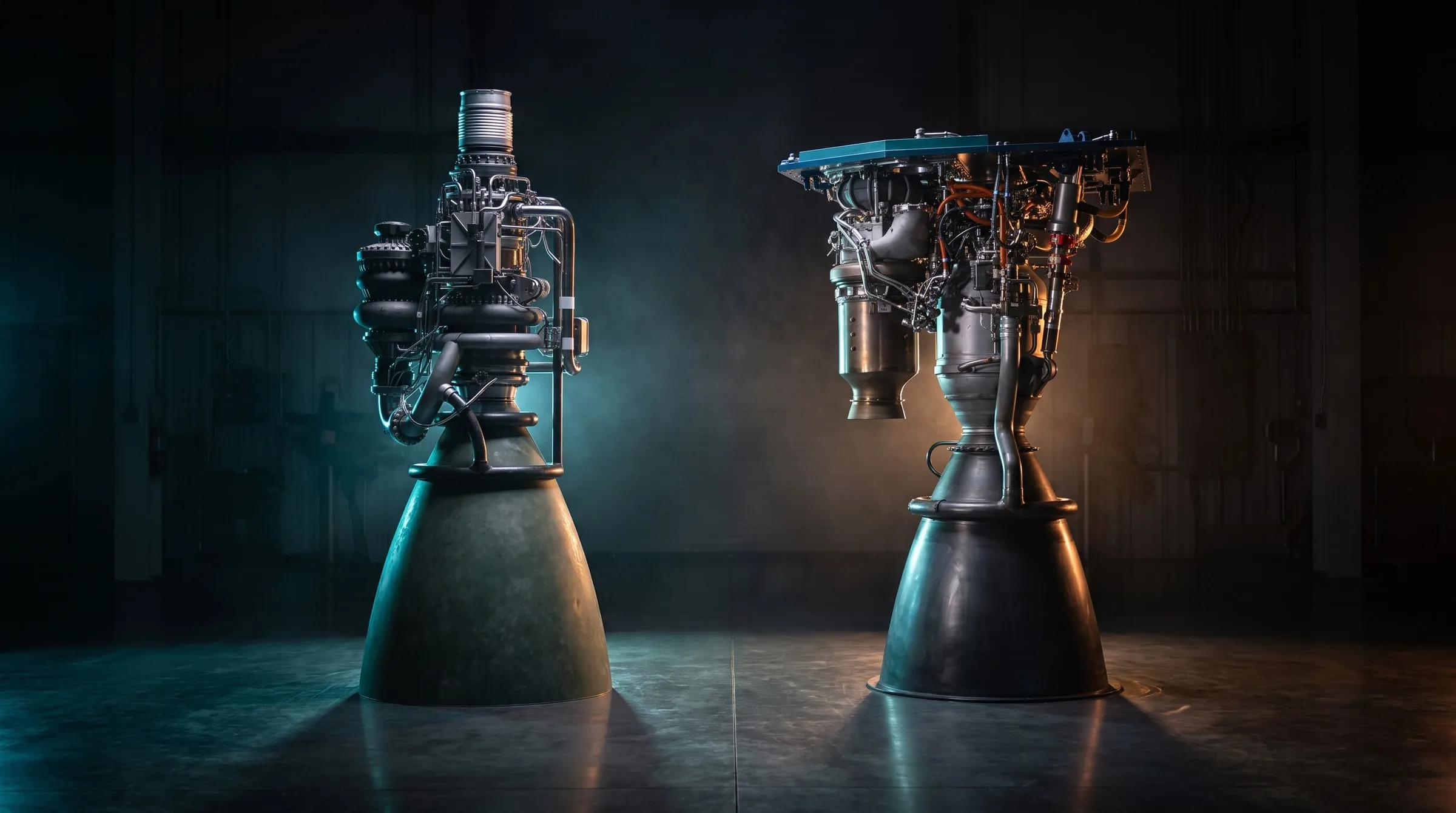
Two SpaceX engines, cut in half and lit from inside. One is the kerosene workhorse that lands Falcon 9. The other is the methane monster that runs its combustion chamber at a pressure no engine had ever sustained. Switch between them and watch the same problem, feeding a fire, get two very different answers.
 Open the interactive ▸
 What you're looking at
A single rocket engine, sliced down the middle so you can see into it, floating in a dark instrument bay. Drag to orbit it, scroll to zoom. Propellant enters at the top through two inlets, gets forced through pumps and preburners, ignites in the combustion chamber at the narrow waist, and accelerates out through the flared bell as the exhaust plume.
The coloured streams are the propellants moving through the plumbing in real time. Blue is liquid oxygen. Teal is liquid methane on Raptor, amber is RP-1 kerosene on Merlin. Down the centre, the hot combustion gas rushes through the throat and out the nozzle. Labels pin each real component: the turbopumps, the preburners or gas generator, the injector, the throat, the regeneratively cooled nozzle. Click any label, or the part itself, and a short explainer card opens for it.
On the right, a live telemetry column reads out the numbers that matter: thrust, chamber pressure, specific impulse, mass flow, mixture ratio, chamber temperature, expansion ratio, thrust-to-weight, and a modeled pump power. Pull the throttle and the whole engine answers at once. Thrust falls, the chamber pressure drops, the plume shrinks, the propellant slows in the lines. Drag the altitude slider from the pad to 80 km and the same hardware moves through air that thins to nothing: the plume opens up, the pressure term in the live thrust equation flips sign, and the nozzle readout calls the flow underexpanded, matched, overexpanded or separated.
Why it's here
Most of this site bends the fundamental fabric of reality: spacetime with mass and speed, matter with quantum weirdness. This piece is different. It is about the applied end of physics, the place where thermodynamics and fluid mechanics get welded into metal and actually lift a skyscraper off the ground.
A rocket engine is the most honest machine there is. It cannot cheat. Every newton of thrust is momentum thrown backwards, nothing more. What separates a good engine from a great one is not magic but bookkeeping: how little of your propellant's energy you waste getting the rest of it out the door. Raptor and Merlin are the two cleanest answers SpaceX has flown, and setting them side by side shows the single most important fork in the whole field of rocketry, the choice between an open cycle and a closed one.
How it works
Thrust has two parts, momentum and pressure:
F = ṁ·vₑ + (pₑ − pₐ)·Aₑ
The first term is propellant mass flow ṁ leaving at exhaust velocity vₑ. The second is the pressure difference between the nozzle exit pₑ and the ambient air pₐ, acting over the exit area Aₑ. That second term is why the same engine makes more thrust in vacuum than at sea level, and why a vacuum engine wears a much bigger bell.
Efficiency is measured by specific impulse, the exhaust speed expressed in seconds:
Iₛₚ = F / (ṁ · g₀) ⟹ F = ṁ · Iₛₚ · g₀ , g₀ = 9.80665 m/s²
Higher Iₛₚ means more thrust per kilogram of propellant burned. To get it you want the highest, hottest, best-expanded exhaust you can build, which means the highest chamber pressure you can survive.
And there is the whole drama. To push propellant into a high-pressure chamber you need pumps, and the pumps need power. How you power the pumps is the engine. Merlin burns a little propellant in a small gas generator, uses that hot gas to spin one turbopump, and then throws the gas away out a side duct. Simple, robust, and it caps the chamber near 97 bar. Raptor gasifies both propellants in two preburners, one oxygen-rich and one fuel-rich, spins two turbopumps, and then routes every gram of that gas into the main chamber. Nothing is discarded, so the chamber reaches roughly 300 bar, the highest of any flying engine, and the efficiency climbs with it.
The interactive scales thrust, chamber pressure and mass flow linearly with the throttle as a first-order teaching model, holds specific impulse and mixture ratio roughly constant, and computes mass flow directly from thrust and Iₛₚ so the three always agree. The headline numbers, thrust, chamber pressure, Iₛₚ, mixture ratio, dry mass and dimensions, are the real published figures. See the accuracy table below for exactly which parts are real and which are drawn for clarity.
The two cycles
The same job, feeding a high-pressure fire, solved two ways. The comparison is the whole point.
- Merlin 1D, gas generator (open cycle). LOX and RP-1 kerosene, the kerolox workhorse. A separate gas generator drives a single-shaft, dual-impeller turbopump and dumps its exhaust overboard, the small dark stream you can see venting down the side of the nozzle. Sea-level thrust about 845 kN, chamber pressure 97 bar, Iₛₚ 282 s at sea level and 311 s in vacuum, mixture ratio near 2.36:1, dry mass about 470 kg. Nine of them fly on every Falcon 9 first stage, and they have landed and reflown more than any engine in history.
- Raptor 2, full-flow staged combustion (closed cycle). LOX and liquid methane, methalox. Two preburners feed two turbopumps and then the whole flow enters the chamber, so almost none of the propellant's energy is wasted. Sea-level thrust about 2.26 MN (230 tonnes force), chamber pressure near 300 bar, Iₛₚ 327 s at sea level and 350 s in vacuum, mixture ratio near 3.6:1, dry mass about 1,630 kg. Thirty-three power the Super Heavy booster. Full-flow staged combustion had never flown before Raptor.
Merlin trades ultimate performance for simplicity and has been rewarded with reliability. Raptor accepts ferocious complexity, two preburners and hot oxygen-rich turbomachinery, in exchange for pressure and efficiency no open cycle can reach.
Try this
- Start on Raptor at full throttle and orbit the cutaway to find the two preburners and two pumps feeding the injector.
- Switch to Merlin and watch the gas generator's exhaust venting overboard, the visible signature of an open cycle.
- Pull the throttle to its floor near 40 percent and watch thrust, pressure and flow collapse together while the nozzle readout slides toward flow separation.
- Drag the altitude slider upward and watch the plume bloom as the air thins, the Mach diamonds fade, and the specific impulse climb.
- Open Compare to stand both engines on one pad at true scale, with a person for height.
- Then run the story, eight chapters, for the whole argument from feeding a fire to the scoreboard.
Accuracy
The honest line between what is measured and what is drawn for clarity:
| Feature | Tier | What that means |
|---|---|---|
| Thrust, chamber pressure, Iₛₚ, mixture ratio, dry mass, dimensions, expansion ratio | T1 Established | Published SpaceX and reference figures for the sea-level engines. The headline numbers are real. |
| Thrust-to-weight and mass flow | T1 Established | Recomputed from those figures and matched to the sources (Raptor 141:1, Merlin 184:1). |
| The 3-D shape | T3 Stylised | A schematic surface of revolution, not a CAD model. The bell contour, the size and placement of pumps, preburners and plumbing, and the internal routing are drawn to read clearly and be roughly true to each cycle, not to match engineering drawings. |
| Throttle response | T3 Stylised | A first-order linear model: thrust, chamber pressure and mass flow scale linearly with the throttle, while Iₛₚ and mixture ratio are held roughly constant. |
| Chamber temperature | T3 Stylised | A typical combustion value, not a per-throttle solve. |
| The exhaust plume | T3 Stylised | The plume, its Mach diamonds and its growth with throttle, is stylised. |
| Altitude | T3 Stylised | An exponential model atmosphere; thrust and Iₛₚ interpolate between the published sea-level and vacuum figures. The geometry stays the sea-level engine, where a real vacuum variant would carry a much larger nozzle. |
| Exit pressure, pump power, overboard flow | T3 Stylised | Order-of-magnitude teaching estimates. They drive the nozzle-match readout (underexpanded / matched / overexpanded / separation), the pump power line and Merlin's ~3% overboard figure, and the interactive flags them as modeled. |
In one line: the performance numbers are real, published figures; the geometry, the throttle response, the chamber temperature and the plume are stylised for clarity, and nothing stylised changes the story the numbers tell, Raptor really does run about three times Merlin's chamber pressure, and that is the whole reason full-flow staged combustion is worth its complexity.
Sources
- SpaceX Raptor. Wikipedia. en.wikipedia.org/wiki/SpaceX_Raptor
- SpaceX Merlin. Wikipedia. en.wikipedia.org/wiki/SpaceX_Merlin
- Everyday Astronaut. Raptor 1 vs Raptor 2: What Did SpaceX Change? everydayastronaut.com
- Merlin 1D propellant flows and mixture ratio (≈214 kg/s LOX, ≈91 kg/s RP-1 → O/F ≈ 2.35), via the Merlin references above and the Wevolver spec sheet. wevolver.com
Two engines, one fire, and the single choice that separates them.
Open the interactiveCompiled July 2026