The Submerged Egg Buoyancy Bench
Set the crown at 35 ft in the October water and the body displaces 51,503 t, a Typhoon-class submarine's mass in an egg. Exit A: a steel wall 0.91 m thick weighs exactly that, and a match of 1.1e-5 (585 kg) keeps it within a metre for five minutes while the column's own gradient holds it, with a period of 8.9 min. Exit B: 5.05 × 10⁸ N carried by a 100 m² jet at 70 m/s and 17.7 GW, which reaches, in under a second, a surface the interview found without apparent disturbance, or by a 1.13 m cable to a 59,200 t anchor on a floor 1,390 m down. The eye: in Jerlov IB water the crown shows at 120 times the threshold; in type II it is gone below 36.6 ft, and only a 13 × 9 m cap of the outline shows at 35 ft; five weeks later CalCOFI's white disk vanished at 18 to 24 m in that water. The printed 7,230 ft and 78° fit 500 yards at 7,072 ft, not the 5,000 ft the same interview gives, which put the line of sight at 5,220 ft and 73.3°. Two verdicts hang at equal size.
Keep the signal
The station is free. No ads, no tracking cookies. If the files are worth your time, following is the support.
 Open the interactive ▸
 What you're looking at
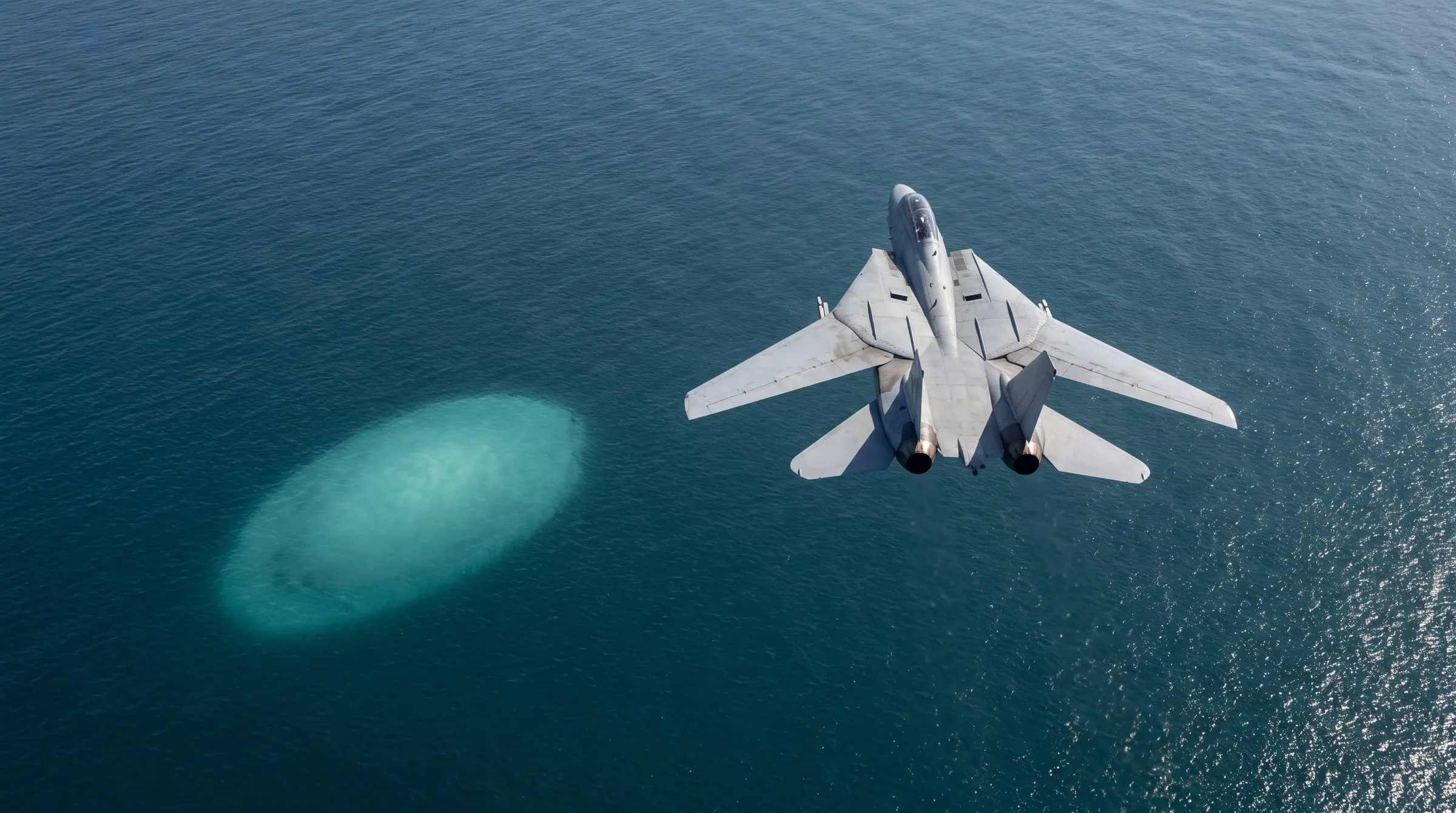
The Sea is the water of the day in 3D: buoy 46025’s hour (a 16.67 s swell of about 0.6 m and a light wind’s chop), the sun where the NOAA equations put it for the hour on the dial at the Tanner Banks buoy’s position, the Tomcat’s line of sight from 5,000 ft and 500 yards, and the body under the surface as a spheroid with its crown at the dial’s depth, coloured at every pixel by the contrast law for the water type on the dial: the crown pale, the flank fading into the water; the interview’s phrase is ‘the edges were not clear’. Stand in the cockpit, in the overview, under the surface beside the body, or two metres over the water; a toggle draws the boil a jet would make, and says so.
The Ledger is the fork on one sheet. Exit A: the volume, the water the body displaces averaged over its own 40 m, the neutral mass, the Typhoon and Ohio beside it, the wall of steel or aluminium that weighs that mass drawn to scale in section, and the density match the five minutes need. Exit B: the whole buoyant force, the jet through the nozzle on the dial with its speed and power, the cable at the strength on the dial, the steel anchor whose weight in water is the force, and the interview’s ‘no apparent disturbance’ against each.
The Drift integrates five minutes of a density-mismatched body in the chosen column with Lamb’s added mass, a quadratic drag and the column’s own restoring: one curve per mismatch, the record’s 20 to 50 ft shaded, the day’s 0.2 °C of warming marked, and the ladder of what each mismatch does in 300 s. The Eye runs Preisendorfer’s law through the crown’s depth for every Jerlov type at the wavelength on the dial, hangs CalCOFI’s three Secchi depths on the same law, and below it re-runs the interview’s geometry. The File runs the cards, the statement and the interview quoted, and the two verdicts at equal size.
Why it is here
The case has a culture note on the site, the Culture 01 source note on Future Visions, which covers Lacatski's book as a whole and does not open chapter 31; the wiki has an entry on unidentified submerged objects. Chapter 31 is three pages: a pilot's statement and a BAASS phone call seven years later. What it gives has a shape, and the shape is one an instrument can take over: a white body 40 × 60 m by eye, 20 to 50 ft down, motionless for about five minutes, with no apparent disturbance on the surface. A body that holds station under the surface has two exits: it weighs what the water it displaces weighs, or something carries its buoyancy. INST-29 Trans-Medium prices water entry; this bench prices station-keeping, and is its sibling.
So the instrument does one thing: it prices both exits and closes neither. It enters the record's numbers as printed (the depth, the size, the altitude, the separation, the minutes), plugs in the day's sea (buoy 46025's hourly record), the month's water column (the World Ocean Atlas October profile at the Tanner Banks cell, with CalCOFI's four casts five weeks later beside it) and the published tables (UNESCO 1983's equation of state, Jerlov's and Solonenko & Mobley's water types, Preisendorfer's contrast law, Quan & Fry's index, Lamb's added mass), and computes Exit A's wall and match, Exit B's jet and mooring, and what an eye at 5,000 ft sees through that water. On the way it decodes a pair of numbers the interview left behind: the printed 7,230 ft and 78° fit 500 yards at an altitude near 7,000 ft, not 5,000. The record is the record's; the reading is the reader's.
How it works
Everything on the bench is arithmetic on the record’s numbers and on published tables: a spheroid’s volume, the water’s density by the equation of state, a force, a wall, a jet, a cable, one drift equation and one contrast law. The script that ships with the site re-derives every displayed number before the build is allowed to pass.
V = 4/3 π a b c · m = ρ̄ V · F = ρ̄ g V · (1 + k₂) z̈ = ε g − N² z − ½ C_d (A/V) ż|ż| · C_z = ζ_o C₀ e^(−(a + b + K_d) z)
The fork. The body is a prolate spheroid with semi-axes 20, 20 and 30 m, 50,265 m³, its crown at the dial’s depth and its centre 20 m below. The water is UNESCO 1983’s EOS-80 on the chosen profile, averaged over the body’s 40 m: 1,024.62 kg/m³ in the October atlas at a 35 ft crown, so the neutral mass is 51,503 t and the buoyant force 5.051 × 10⁸ N. Exit A’s wall is the similar-spheroid shell of the hull density that weighs the neutral mass: 0.91 m in steel, 13 % of the volume. Exit B’s jet is ρ A v² = F and P = ½ ρ A v³; the cable is F/σ; the anchor is the steel whose weight in water is F.
The drift. (1 + k₂) z̈ = ε g − N² z − ½ C_d (A/V) ż|ż|, integrated at 10 ms for 300 s, with k₂ = 0.62 Lamb’s broadside factor for a 2:3 spheroid, A the broadside projection, and N² the column’s buoyancy frequency over the body’s own height (2.2 × 10⁻⁴ s⁻² in the atlas column). At ε = 1e-5 the crown moves 0.88 m and settles 0.44 m below its matched depth with a period of 8.9 min; at 1e-4 it moves 8.7 m; with the restoring off, 2.7 and 26 m. The match that keeps it within a metre is 1.1e-5, 585 kg; the day’s 0.2 °C at the buoy is 4.8e-5 and settles a matched body 2.1 m.
The eye. C₀ = (R − R∞)/R∞ with R the egg’s reflectance and R∞ the deep water’s; ζ_o = (N⁰ t/m²)/(N⁰ t/m² + r N_o) with r Fresnel’s reflectance at the look-down angle for Quan & Fry’s index and N⁰/N_o the water-leaving over the sky radiance; C_z = ζ_o C₀ e^(−(a + b + K_d) z) with a and b from Solonenko & Mobley and K_d from Jerlov at the wavelength on the dial. The visible cap is the part of the spheroid whose flank still clears the threshold. A measured Secchi depth Z gives α + K = Γ/Z with Γ = ln(ζ_o C₀/C_T); CalCOFI’s 18 m gives 0.34/m, between IB and II, and a 46 × 31 m cap at a 35 ft crown.
Nothing is fitted. The only choices are the dials: the crown’s depth within the record’s band, the profile, the water type and wavelength, the reflectances and the threshold, the hull material, the nozzle, the cable’s strength, C_d, the mismatch and the hour; every finding is quoted at the defaults and across them.
The dials that decide the result
The crown, the column, the water type; the hull, the nozzle, the cable; the mismatch, the drag, the warming; the hour. Together they draw every version of the water the record could mean.
- The crown. 20 to 50 ft, the statement’s band, read as the depth of the body’s highest point; default 35 ft. Presets at the shallow end, the middle and the deep end.
- The column. The World Ocean Atlas October profile at the Tanner Banks cell, or one of CalCOFI’s four casts of 11 to 15 November 2002 (90.0 53.0 with its 18 m Secchi, 90.0 60.0 with 24 m, 93.3 55.0 mixed to 30 m, 93.3 45.0 with 19 m). The density, the mass, the force and the column’s stiffness follow it.
- The water type and the wavelength. Jerlov I, IA, IB, II, III and coastal 1, 3, 5 at 450 to 550 nm; default IB at 475 nm. Types I and IA are drawn dashed because their scattering is flagged in the source.
- The reflectances and the threshold. The egg’s 0.3 to 0.95 (default 0.8, ‘white or opaque’); the deep water’s 0.01 to 0.10 (default 0.03); the water-leaving over the sky radiance 0.005 to 0.10 (default Preisendorfer’s 0.02); the threshold 0.5 to 5 % (default Koschmieder’s 2 %).
- The hull, the nozzle, the cable. A hull density from 1,000 to 8,000 kg/m³ with steel and aluminium as presets; a nozzle from 10 to 1,000 m²; a cable strength from 250 to 2,000 MPa.
- The mismatch, the drag, the warming, the hour. ε from 1e-7 to 1e-2; C_d from 0.1 to 1.5; the day’s warming from 0 to 2 °C (the buoy saw 0.2 °C on the day and 2 °C across two days); the column’s restoring on or off; the hour from 07:00 to 17:00 PDT, which moves the sun and picks the buoy’s hour.
The claims, as they stand
The statement and the interview one by one, and where each lands when the record’s numbers are entered and the tables are applied.
| A white or opaque egg about 40 × 60 m, 'approximately 20-50’ in depth', motionless for about five minutes proposed by Graves, the witness statement; confirmed in the BAASS interview of 27 August 2009 | CONTESTED | Entered as printed. The bench reads the depth as the crown's, because a 40 m-tall body cannot lie wholly in the band, and the size as the visible cap's, because a curved body's flank fades below the threshold before its outline: the 40 × 60 m is a floor. |
| 'no apparent disturbance to the surface of the water above or around where the object was located' proposed by the interview | CONTESTED | A still body in still water leaves the surface flat, and a mooring leaves it alone; a jet carrying 5.05 × 10⁸ N through 100 m² throws 7,021 m³/s upward at 70 m/s into a surface 11 m up. The observation prices Exit B's jet and nothing else. |
| 'It was not a life form or vessel (i.e., submarine) that I had ever seen before' proposed by the statement | READING | Exit A's neutral mass is 51,503 t, 1.07 Typhoon-class submarines by displacement, in a body 60 m long where a Typhoon is 175 m; a steel wall 0.91 m thick weighs it. The bench cannot tell a hull from a shape, and does not. |
| 'difficult to determine the exact size, as there appeared to be some disturbance in the water, almost like a distortion from extremely hot water blending around the object's edges'; 'the edges were not clear' proposed by the statement; the interview | READING | In the 18 m Secchi water the flank 20 m below the crown carries 1e-3 of the crown's contrast, and the visible cap at a 35 ft crown is 46 × 31 m of a 60 × 40 m outline. Seawater's index moves 1e-4 per °C (Quan & Fry); how much heat the description implies the record does not say, and the bench does not price it. |
| About 5,000 ft, about 500 yards, 'a visual line of sight of roughly 7230 ft (1.19 nautical miles) and a look-down angle of approximately 78°' proposed by the interview | EXACT | 5,000 ft and 500 yards give 5,220 ft and 73.3°; the printed 7,230 ft and 78° solve back to 501 yards at 7,072 ft. The same interviewer’s B-011 figures (27,170 ft, 83.5°) follow from 18,000 ft, 45,000 ft and half a nautical mile to within a tenth of a degree. Which of the three numbers slipped, the record does not say. |
| The water: 1,025 kg/m³ (the pitch) proposed by the bench’s pitch on the backlog board | MEASURED | The October atlas gives 1,024.14 kg/m³ at a 35 ft crown and 1,024.62 averaged over the body; CalCOFI’s November casts give 1,024.33 to 1,024.50 at the crown. The bench prints its own figures and quotes the pitch’s as the board’s. |
| Exit A: a matched hull proposed by this bench | MODELLED | 51,503 t; a steel wall 0.91 m (0.97 m thin-shell), 13 % of the volume, aluminium 2.9 m; a match of 1.1e-5 (585 kg) to sit within a metre for five minutes in the atlas column, whose gradient brings a matched body back with a period of 8.9 min; the day’s 0.2 °C settles it 2.1 m. An Argo float parks at 1,000 m for nine days on the same principle. |
| Exit B: something holding it down proposed by this bench | MODELLED | 5.05 × 10⁸ N. A jet through 100 m²: 70 m/s and 17.7 GW; through 1,000 m²: 22 m/s and 5.6 GW. A cable at 500 MPa: 1.13 m thick; a dead-weight steel anchor of 59,200 t on a floor 1,390 m down. Anything that carries the force another way is outside the bench’s price list. |
| 'stayed motionless until we left the area' proposed by the statement | CONTESTED | From 5,000 ft a metre of settling is 0.04°. A mismatch of 1e-4 moves the crown 8.7 m in five minutes in the atlas column and 26 m in a mixed one; 1e-5 moves it 0.9 m. Motionless to the eye means a match to parts in a hundred thousand, or a hand on the trim. |
| Visible from 5,000 ft through 20 to 50 ft of water proposed by the statement and the interview | MODELLED | In Jerlov I to IB the crown shows through the whole band (IB at 35 ft: 120 times the threshold); in II it shows at 20 ft, is marginal at 35 and gone below 36.6 ft, and only a 13 × 9 m cap of the outline shows; in III and coastal 3 and 5 nothing shows at 20 ft, and coastal 1 is gone below 28 ft. CalCOFI’s Secchi disk vanished at 18 to 24 m in that water five weeks later: a white egg vanishes where the disk did, below the band. |
| What the bench amounts to proposed by this bench | READING | Two exits, one egg. A hull of a submarine’s mass, matched and held by the column; or half a billion newtons carried without marking the sea. The record cannot choose between them, and the bench does not. |
Try this
- Start in the cockpit. The crown at 35 ft in IB water shows as a pale patch 500 yards off the left wing, a mile down the line of sight. Switch the type to II: the patch shrinks to a cap; slide the crown to 50 ft and it is gone.
- Go below. Under the surface the crown is bright and the keel is the water’s colour; switch to type III and the body is a shadow in fog.
- Open the ledger. Read Exit A’s wall, then switch the hull to aluminium. Read Exit B’s jet, then widen the nozzle to 1,000 m² and watch the speed fall as 1/√A and the power as 1/√A³.
- Run the drift. At 1e-5 the crown moves under a metre. Slide to 1e-4, then switch the restoring off. Pick the 93.3 55.0 cast, which is mixed through the body’s height.
- Look through the water. Find where each type’s line crosses the threshold; then find CalCOFI’s three dots at 18, 19 and 24 m and follow their dashed lines back to 35 ft.
- Read the geometry. 5,000 ft and 500 yards give 5,220 ft and 73.3°; the printed 7,230 ft and 78° give 501 yards at 7,072 ft. B-011 comes back to a tenth of a degree.
- Finish in the file. The sensors not used, the second account, the pitch’s round numbers, then the two verdicts.
Accuracy
The honest line between what is measured, what is quoted, what is arithmetic on them, and what is a reading:
| Feature | Status | What that means |
|---|---|---|
| The buoy, the column, the tables | Measured | Buoy 46025's hourly record for 10 October 2002 (NDBC 46025h2002); the World Ocean Atlas 2023 October profile at 32.5°N 119.5°W; CalCOFI cruise 0211's casts and Secchi readings; UNESCO 1983's equation of state, checked against its printed values; Jerlov 1976's K_d and Solonenko & Mobley 2015's a and b; Quan & Fry 1995's index; Lamb's k-factors; Preisendorfer 1986's contrast law. Nothing on the bench changes them. |
| The statement and the interview | Reported | The depth, the size, the colour, the edges, the altitude, the separation, the passes, the minutes, the undisturbed surface, the unused sensors and the printed geometry, quoted as Future Visions prints them (ch. 31, pp. 203 to 205; ch. 32 for the second account). |
| The arithmetic | Exact | A spheroid’s volume and surface; ρ V and ρ g V; a similar-spheroid shell; ρ A v² and ½ ρ A v³; F/σ; the drift equation; √(h² + d²) and atan(h/d); the contrast law applied to a curved body. No parameter is fitted. |
| The dials | Modelled | The crown's depth within the band (the record gives a band, and the bench reads it as the crown's); the profile; the water type and wavelength; the reflectances and threshold; the hull material; the nozzle; the cable's strength; C_d; the mismatch; the hour. The findings are quoted at the defaults, and the dials show where they part. |
| What it amounts to | Reading | Whether the body was a density-matched hull, something held down, or something the record does not name, is a reading, and the bench declines to make it for you; the pitch's round numbers are quoted as the board's, never as the bench's. |
In one line: Every number of the record is quoted as printed, every table is a published one checked against its own values, every dial is named as a choice, and the two exits are priced at equal size; whether the body was a hull, a held thing, or something the record does not name is left where the record leaves it. The reading is yours.
Sources
- Lacatski, J. T. (2026) Inside the U.S. Government Covert UFO Program: Future Visions, RTMA: Chapter 31, "AAWSAP Special Report B-010, Submerged Egg-shaped Object" (pp. 203 to 205), the witness statement and the BAASS phone interview of 27 August 2009; Chapter 32, "B-011, Airborne Egg-shaped Object" (pp. 206 to 208), the second account and its geometry.
- NOAA National Data Buoy Center, standard meteorological files 46025h2002 (Santa Monica Basin), 46054h2002 (West Santa Barbara) and 46047h2002 (Tanner Banks; no rows from 25 September to 17 October 2002), and the station pages as of 26 September 2026 for the positions (33.765°N 119.077°W; 32.418°N 119.535°W), the hulls, the 2 m sea-temperature depth and the 1,390 m water depth, which describe today’s moorings, not those of 2002; retrieved 26 September 2026.
- NOAA NCEI, World Ocean Atlas 2023, decadal average, October, 1° grid: temperature (woa23_decav_t10_01) and salinity (woa23_decav_s10_01) at 0 to 60 m in the cell centred 32.5°N 119.5°W; retrieved 26 September 2026 by OPeNDAP.
- CalCOFI, CalCOFI Database 194903-202105 (csv, 16 October 2023), Cast and Bottle tables: cruise 0211, casts 30088 (90.0 53.0, 15 November 2002, Secchi 18 m), 30087 (90.0 60.0, 15 November, Secchi 24 m), 30073 (93.3 55.0, 12 November) and 30071 (93.3 45.0, 11 November, Secchi 19 m), bottle data to 60 m.
- Fofonoff, N. P. & Millard, R. C. Jr (1983) Algorithms for Computation of Fundamental Properties of Seawater, UNESCO Technical Papers in Marine Science 44 (EOS-80: eqs. 7, 13, 15 to 19), as transcribed in the python-seawater package (seawater/eos80.py, seawater/library.py) with the check values of its p. 22.
- Preisendorfer, R. W. (1986) Eyeball Optics of Natural Waters: Secchi Disk Science, NOAA Technical Memorandum ERL PMEL-67: the contrast reduction formula (eqs. 1, 6), the inherent contrast (eq. 7), the still-surface factor (eq. 4) and the direct ocle.
- Jerlov, N. G. (1976) Marine Optics, Table XXVII (K_d by water type), and Solonenko, M. G. & Mobley, C. D. (2015) "Inherent optical properties of Jerlov water types" Applied Optics 54(17), Tables 3 to 8 (a and b), both as shipped with provenance in Ishibashi, T., jerlov v0.2.2 (Zenodo record 22690259; the package’s own citation gives doi 10.5281/zenodo.22321312), whose DATA.md flags the suspect scattering of types I and IA.
- Quan, X. & Fry, E. S. (1995) "Empirical equation for the index of refraction of seawater" Applied Optics 34(18), the ten-coefficient equation as printed in the Ocean Optics Web Book ("Water").
- Lamb, H. (1932) Hydrodynamics §114, the added-mass factors of a prolate spheroid, as given by Imlay, F. H. (1961) The Complete Expressions for "Added Mass" of a Rigid Body Moving in an Ideal Fluid, DTMB Report 1528, and implemented in Grande, D. et al. (2021) "Open-source Simulation of Underwater Gliders", Oceans 2021 (added_mass_prolate_spheroid.m); the sphere limit 1/2 from Wikipedia, "Added mass".
- Wikipedia, "Typhoon-class submarine" (23,200 t surfaced, 48,000 t submerged, 175 × 23 × 12 m; citing Apalkov 2002), "Ohio-class submarine" (16,764 t surfaced, 18,750 t submerged, 170 m × 13 m), "Steel" (7,750 to 8,050 kg/m³), "Aluminium" (2.70 g/cm³) and "Visibility" (the 2 % contrast convention); retrieved 26 September 2026, general references entered on dials or beside the ledger.
- Argo Program, "How do floats work" (argo.ucsd.edu): a float sinks to a drift depth of 1,000 m for about 9 days and changes buoyancy by pumping oil into an external bladder; retrieved 26 September 2026.
- NOAA Global Monitoring Laboratory, "Solar Calculator" and its published equations (the solar position for 32.418°N 119.535°W on 10 October 2002).
- Signals from the Periphery, Culture 01, the source note on Future Visions; the INST-29 Trans-Medium bench for the water-entry side of the same question.