Trans-Medium
The UAP story keeps ending at the same address: the surface of the sea. In 2004, Fravor saw a patch of whitewater the size of an airliner before he ever saw the Tic Tac above it. In 2013, a border-patrol thermal camera over Aguadilla watched a warm dot cross the shoreline and slip into the water four times without slowing, then seem to become two. In 2019, sailors in USS Omaha's combat information center tracked a sphere down to the waves until someone shouted "whoa, it splashed!": and the search that followed reportedly found nothing. Congress now defines "transmedium objects" in statute. This instrument builds the missing character in all three accounts: the water itself, as a live wave spectrum: and then drops the claims into it, so you can watch what physics charges for each crossing.
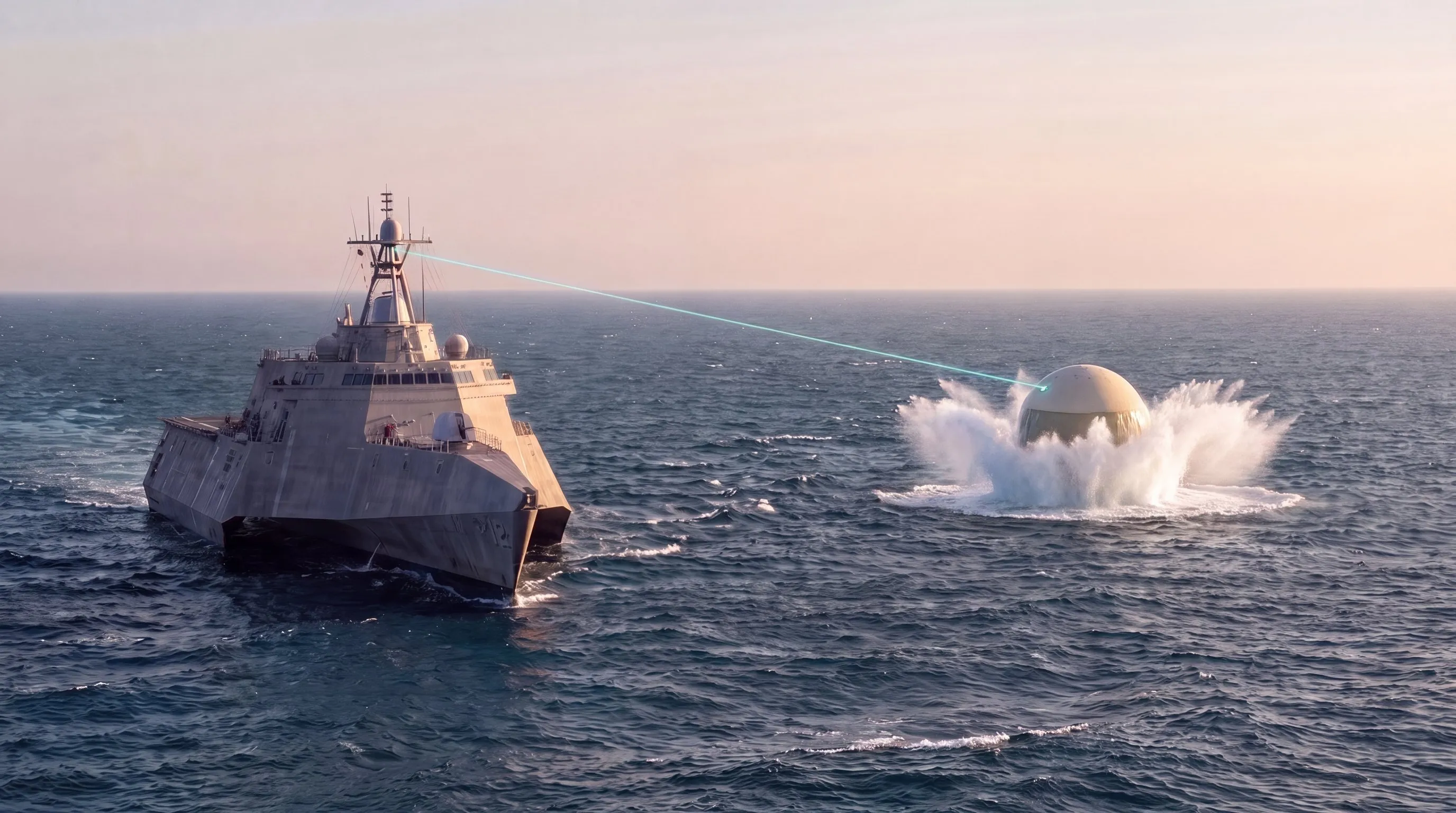 Open the interactive ▸
 What you're looking at
The Ocean view is the sea made instrument: a JONSWAP wave spectrum solved live by two FFT cascades, crests sharpened by choppy displacement, whitecaps injected where the surface folds, the sky mirrored by Fresnel reflection and the sun scattered into a glitter lane. Above it, the replay: three seconds of air, the drop, the slam, the ring of foam, the boil. Drag to orbit; the sea state dial re-derives the whole ocean from a new wind.
The Entry view is the crossing in cross-section: the trajectory coloured by phase (air, slam, cavity, wetted), the cavity envelope swelling and sealing around the path, the depth rulers, and THE BILL: entry speed, peak g, stopping depth in body-lengths, energy in TNT-equivalent. The dashed blue ghost is what the account describes: it never decelerates, because testimony feels no drag. The gap between the dashes and the solid line is the entire file.
The Ledger view prices every world with the same integrator: the Omaha descent (physically cheap, and that is the honest surprise), the Aguadilla runner (megawatts or lanterns, nothing in between), the 700-mph stress test (a depth charge in milliseconds), the supercavitating torpedo, the gannet, the cricket ball. Below them, the dated public record, 2004 to the AARO rename, one click each.
Why it's here
The Navy trilogy (Tic Tac, GoFast, Gimbal) audited things in the sky: a remembered number, a parallax-manufactured speed, a rotation that may belong to the camera. This instrument opens a new folder: the water. Because in the public record the story keeps walking to the sea: Fravor saw whitewater before he saw the Tic Tac; Aguadilla's warm dot went in and out four times; the Omaha sphere ends on a sailor's "it splashed." Congress even coined a word for it. And water, unlike sky, hands anything that crosses it an immediate physics bill.
It is also this site's first machine where the ocean itself is part of the instrument. That sea is not a backdrop: it is a JONSWAP wave spectrum solved live, two FFT cascades, choppy displacement, whitecaps injected where the surface Jacobian folds. There is an argumentative reason for the effort: a trans-medium claim is entirely about the word interface, so the interface has to be a real place: one that can grow wind, carry swell, and splash when the sphere arrives. But the Evidence table will keep reminding you: the sea being beautiful asserts nothing. The physics readouts come from the integrator, never the renderer.
How it works
One drag integrator and one wave spectrum run the whole instrument; nothing else is asserted.
F = ½ρC_d·A·v² · σ = (p−p_v)/½ρv² · λ_stop = 2m/ρC_dA · h(x,t) = Σ h̃(k,t)e^{ik·x}
The entry is integrated, not animated. Every replay is a numerical solution of ½ρCdAv² drag plus buoyancy at 5,000 steps per second, with a stated coefficient book: Cd ≈ 1.0 while the sphere wets (the slam), 0.12 while a cavity runs, 0.5 fully wetted, and a ricochet branch below ~8° entry. Change any dial and the whole world: peak g, stopping depth, energy: is recomputed before the next frame.
The sea is a spectrum, not an asset. The JONSWAP spectrum (the North Sea measurement campaign's standard form) is sampled into two h₀(k) fields, evolved by the dispersion relation ω = √(gk(1+k²/k_m²)), and inverse-FFT'd on the GPU every frame: 54 butterfly passes producing displacement, choppy offsets and a Jacobian whitecap mask. The sea state dial changes the wind speed and re-derives everything. No two visits show the same waves; none of the physics depends on any of them.
The cavity has one dial behind it. The cavitation number σ = (p − pv)/½ρv² is printed for every entry: fast and shallow drives σ below ~0.025 and a vapour tunnel opens (drag collapses, the path goes teal); slow or deep and the water closes back. The same arithmetic prices the VA-111 torpedo's 200-knot cruise at megawatts of continuous thrust: known physics' invoice for living past the wall.
The ghosts keep the argument honest. Each scenario draws its REPORTED behaviour as a dashed overlay: Aguadilla's undecelerated 80-mph water run, Omaha's continue-and-vanish: beside the solid modelled path. The instrument never averages the two: one is testimony, the other is arithmetic, and the visible gap between them is precisely what any reading of these cases must explain.
The evidence is tagged as you go. The bottom-left table is the conscience of the sim: the accounts and the empty search are REPORTED, the density wall and the Navy provenance are MEASURED, the slams, cavities and megawatts are MODELLED, and whether anything ever truly crossed is a READING. Rows flash as you touch the controls that depend on them.
The wall is measured. The splash, the four entries, the whitewater: reported. The slam, the tunnel, the stopping depths, the megawatts: modelled, exactly, from stated inputs. And whether anything has ever swum out of the sky: that is the reading this site never supplies. The instrument computes; you conclude.
The four scenarios on the dial
Four positions of the same instrument, so every corner of the argument has somewhere to land.
- Omaha 2019. The account as described: a sphere on a slow final descent into a moderate sea. The honest surprise is how cheap it is: a survivable slam, a modest boil, a scar of foam. The expensive parts of Omaha were never the splash: they are the reported hour aloft, the empty search, and pixels that cannot tell "into the sea" from "behind the swell."
- Aguadilla 2013. The expensive account: ~80 mph nearly parallel to the water. Run it and the sphere does what blunt bodies do: skips like a stone, slams, stops within metres. The dashed ghost keeps its speed through the water, as reported. To make the ghost real you must pay megawatts continuously, or accept the lantern reading and let the water have touched nothing at all.
- The stress test. 700 mph into the interface: the entry speed the fast-mover lore implies. Thousands of g at the slam; the object's whole kinetic energy: tens of kilograms of TNT: delivered to the water in tens of milliseconds; a crater of spray and a datum for every hydrophone in the range. Fast, splashless entry is not a small claim, and this dial is where you feel why.
- Known physics. The VA-111 supercavitating torpedo at ~200 knots: the one machine that lives past the wall, by blowing rocket gas into an artificial cavity and paying megawatts for the privilege, loudly. The gannet and the cricket ball sit beside it in the Ledger as the biological and blunt controls. The sea forgives shape, never speed.
The readings, as they stand
Every serious reading of the water cases, with who argued it and where it lands today. One row is retired by the Pentagon's confirmation; the file itself is open.
| Genuine trans-medium objects: things that fly, then swim argued by the crews' readings; SCU 2015 (Aguadilla); Corbell & Knapp (Omaha) | OPEN | Open. The accounts are mutually reinforcing and sit on instrumented ranges. The unpaid bill is this page's whole subject: silent, splashless, megawatt-free crossings have no public precedent in physics, and the strongest supporting data (radar, sonar, the full tapes) stays unreleased. |
| Mundane objects plus geometry: horizon occlusion, lanterns, washout argued by West / Metabunk analyses, 2021-22 | OPEN | Open, and mechanically cheap: Omaha's "splash" as a receding object dropping behind swell on a compressed long lens; Aguadilla as two drifting lanterns whose thermal trace sinks below the warm-sea background, the "split" as mere separation. Its unpaid bill: trained crews, correlated FAA radar, and the fact that none of it has been formally adjudicated either. |
| Somebody's hardware: the 2019 drone-swarm context argued by documented via FOIA (the SoCal 2019 UAS events); argued by drone-hypothesis researchers | OPEN | Open for Omaha specifically: the sphere flew inside a weeks-long cluster of unexplained UAS activity around the same strike group. Its unpaid bill: a ~6 ft sphere loitering an hour, surviving a water landing, and staying unclaimed and unrecovered for years. |
| Hoax or CGI argued by early internet commentary | RETIRED | Retired for Omaha: the Pentagon confirmed Navy provenance in 2021. Effectively retired for Aguadilla: the video left DHS custody informally, but the SCU verified its origin with the agency's own personnel. Whatever these pixels show, the recordings are real. |
Try this
- Read the wall first. Open the Evidence table and click the MEASURED row: ×837. Everything else on this page: every slam, cavity and megawatt: is that one ratio wearing different costumes. It is also the only row with no counter-reading.
- Feel v². In the Entry view, run Omaha's descent and read the bill: tens of g. Now drag entry speed up by a factor of ten and watch peak load multiply by a hundred. The slam scales with the square: this is why "how fast did it enter" is the only question that matters, and why no account answers it.
- Open the tunnel. Set speed above ~250 kt and watch the path turn teal as σ drops below the supercavitation threshold: physics' own loophole, open for business. Then read what the Ledger charges the one real machine that uses it: megawatts, continuously, plus a wake every sonar hears. The loophole is real; free is not on the menu.
- Skip a stone the size of a car. Take the angle below 8° at Aguadilla speeds and the sphere ricochets: once, twice, six times: before the sea keeps it. The stone-skipping regime is real physics and it is the closest honest thing to "entering the water without slowing." It still ends within metres of the first bite.
- Watch the two lines disagree. In the Aguadilla scenario, keep the REPORTED ghost on: dashed, serene, undecelerated: beside the modelled path that skips, slams and dies. That visible gap is the entire case, drawn as two lines. Deciding which line the 2013 pixels actually show is not this page's job; it is yours.
- End at the record. In the Ledger, click the six dated cards left to right: whitewater, four entries, "it splashed," the Pentagon's provenance line, the statute, the all-domain rename. Notice which shelves they sit on: testimony, video, testimony, measurement, law, bureaucracy: and that not one of them is an adjudication. The file is open. That is the finding.
Accuracy
The honest line between what is reported, what is measured, what is modelled here, and what is a reading:
| Feature | Tier | What that means |
|---|---|---|
| The wall: sea water is ~837× denser than air | T1 Measured | Standard values: 1025 vs 1.225 kg/m³. Drag scales with density, so crossing the interface multiplies the fluid's push a thousandfold, discontinuously. Every claim in this file is a claim about surviving that step function. Nobody disputes this row. |
| Omaha provenance: a Navy-taken video | T1 Measured | Pentagon spokesperson Susan Gough confirmed the clip released in May 2021 was taken by Navy personnel aboard USS Omaha (15 July 2019) and examined by the UAP Task Force. That settles the recording's reality and nothing else: authenticity is not identity. |
| The Omaha account: a sphere, an hour, a splash, an empty search | T3 Reported | The ~6 ft size, the transit, the final descent, the "whoa, it splashed!" audio and the wreckage-free search are descriptions from the crew and the journalists who released the clip. The video shows a dark shape low over water; a long lens near the horizon cannot distinguish entering the sea from passing behind swell. |
| The Aguadilla track: four entries and a split | T3 Reported | A CBP aircraft's thermal camera (25 Apr 2013) recorded the object crossing the airfield and the shoreline; the SCU's 2015 report prices it as a genuine transmedium object using FAA radar correlation, ~40-120 mph speeds and four brief submergences. The lantern counter-reading prices the same pixels as two drifting light sources lost against a warm sea. |
| The Nimitz whitewater: testimony, no sensor | T3 Reported | Fravor describes an airliner-sized patch of roiling water under the hovering Tic Tac in 2004, fading when the object left. No instrument recorded the sea that day. It is the oldest and least checkable layer of the file, and the reason the file exists. |
| The entry integrator: slam, stop, ricochet | T2 Modelled | One integrator prices every world: ½ρCdAv² drag with a stated coefficient book (slam ≈ 1.0 while wetting, 0.12 cavity-running, 0.5 wetted), buoyancy, and the shallow-angle skip regime. Peak g, stopping depth and energy are exact consequences of your dials, recomputed live. |
| The cavity: σ decides, the torpedo proves | T2 Modelled | The cavitation number σ = (p − p_v)/½ρv² decides whether a vapour tunnel opens; natural supercavities need σ below roughly 0.025 (Truscott et al. 2014). The VA-111 torpedo shows what sustained cavity-running costs: rocket gas and megawatts. The instrument prints σ for every entry and prices the torpedo with the same arithmetic. |
| The sea: a JONSWAP spectrum, not a recording | T2 Modelled | The water is an oceanographic wave spectrum (JONSWAP) sampled into two FFT cascades with Jacobian-driven foam, Tessendorf's method. The sea state dial re-derives it from a new wind speed. It makes the interface a place; it asserts nothing about any particular night. |
| Whether anything ever truly crossed | T3 Reading | No public adjudication of Omaha or Aguadilla exists; AARO's posture is agnostic. The genuine-crossing reading buys physics with no public precedent; the mundane readings buy stacked coincidences on instrumented ranges. This page prices both and endorses neither. |
In one line: the density wall and the Navy provenance are measured; the sphere, the splash, the four entries, the whitewater and the empty search are reported; the slams, cavities, stopping depths, megawatts and the sea itself are modelled, exact arithmetic and an oceanographic spectrum on stated inputs; and whether anything real has ever crossed the interface is a reading, the one this site leaves to you. The sea pushes back a thousandfold the moment you touch it. The accounts say something touched it and kept going. The instrument prices both sentences.
Sources
- Corbell, J., & Knapp, G. (May 2021). The USS Omaha "Spherical" UAP video. extraordinarybeliefs.com. The released CIC footage of 15 Jul 2019, the "it splashed" audio, and the reported wreckage-free search.
- Gough, S., Pentagon spokesperson (May 2021). Statements to press confirming the Omaha video was taken by Navy personnel and included in the UAP Task Force's examinations. Provenance settled; identity untouched.
- Powell, R., et al. / Scientific Coalition for Ufology (2015). 2013 Aguadilla Puerto Rico UAP: A Detailed Analysis. ~160 pp: the CBP thermal video, FAA radar correlation, speed and submergence estimates, the split.
- West, M. (2021-22). Metabunk analyses. The Omaha horizon-occlusion reading; the Aguadilla lantern reading with thermal-washout water "entries." The strongest public counter-cases.
- Fravor, D. (2019-2023). Interviews and House Oversight subcommittee testimony (26 Jul 2023): the airliner-sized whitewater beneath the 2004 Tic Tac.
- US Congress (Dec 2021). NDAA FY2022 § 1683; 50 U.S.C. § 3373. The statutory definition of "transmedium objects or devices."
- US DoD (20 Jul 2022). Establishment of the All-domain Anomaly Resolution Office. Air, sea, space and transmedium in one office's name.
- Truscott, T. T., Epps, B. P., & Belden, J. (2014). Water Entry of Projectiles. Annual Review of Fluid Mechanics 46: 355-378. Slam, cavity formation, ricochet: the physics book this instrument's drag coefficients cite.
- Public references on the VA-111 Shkval supercavitating torpedo: ~200 kt via ventilated cavity + rocket propulsion. The known-physics cost of living past the wall.
- Chang, B., et al. (2016). How seabirds plunge-dive without injuries. PNAS 113(43). The gannet's ~24 m/s entries: shape, not power.
- Hasselmann, K., et al. (1973). Measurements of wind-wave growth and swell decay (JONSWAP). Dt. Hydrogr. Z. Suppl. A8. The sea's spectrum.
- Tessendorf, J. (2001). Simulating Ocean Water. SIGGRAPH course notes. The FFT method this page's ocean runs on.