The Ubatuba Magnesium
The fragments came with a story nobody could check: a disc over a beach, a noon explosion, metal falling light as paper, a signature nobody could read. Then they did something no other piece of claimed UFO debris has ever done. They stayed on the table for sixty-one years. An arc spectrograph in Rio read them in 1957 and saw nothing but magnesium, and that sentence, misread as a purity of 100%, became the founding claim: purer than Earth could make. Oak Ridge quietly read 99.8% a year later. Dow's own laboratory read 99.98%. The Condon study's neutron activation found zinc, barium and five hundred parts per million of strontium, a metal nobody puts in magnesium by accident, and closed the purity claim with one flat sentence; Dow's archive answered the strontium with a seven-hundred-gram experimental batch poured in March 1940. The same 1968 laboratory botched an isotope measurement so badly it implied a thirty percent excess of mass 26, and that number was left out of the published report, to be found in a box of papers forty years later. Meanwhile the best mass-spectrometry laboratories of four decades, including the one that discovered what real extraterrestrial magnesium looks like in Allende meteorite inclusions, put the fragments exactly where sublimed terrestrial metal sits: on the mass-dependent fractionation line, never off it. That line judges laboratories too: the one modern analysis that left it carried no error bars and was overturned by the same gram of metal a year later. What no instrument can recover is the link between the grams that survived and the three lumps in the letter: two pieces vanished into military laboratories, one burned in an arc, one walked out of MIT with a visitor. This bench builds the machine, draws the line, prices every claim, and leaves the letter unsigned.
 Open the interactive ▸
 What you're looking at
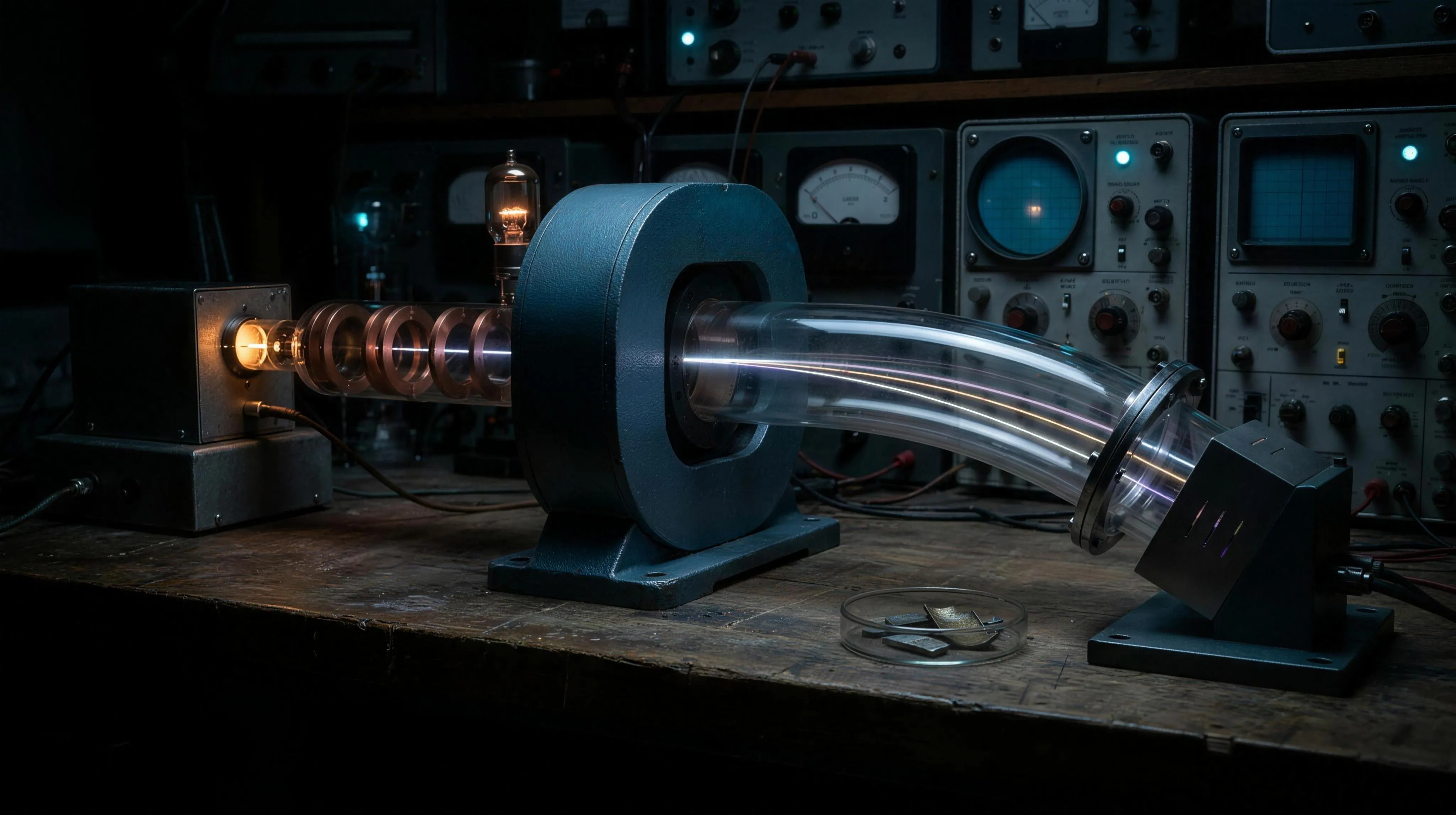
The Spectrometer is the 3D anchor, at true scale: one scene unit is ten centimetres. Magnesium ions leave a hot filament, take ten kilovolts, and turn through a magnetic sector that converts mass into radius: 30.50, 31.13 and 31.74 cm for the three isotopes, arriving 6.3 millimetres apart at the collector slits. Scan the field and the beams sweep the slits, which is literally what a mass spectrum is. Load the terrestrial standard, the Cleveland 2018 Ubatuba numbers, an Allende CAI, or the broken 1968 claim, and watch what each does to the beams: the real anomaly is unmissable, the Ubatuba residuals are micrometres.
The Ruler is the three-isotope diagram that decides the case. Every mass-dependent process on Earth moves δ²⁵Mg and δ²⁶Mg along one line whose slope comes from the atomic masses and nothing else; real extraterrestrial magnesium, carrying the decay ash of extinct ²⁶Al, sits off the line, by +13 permil in Allende CAIs and +100 in anorthite. Every error-barred Ubatuba measurement sits on the line. The Al/Mg dial moves a ghost marker showing where a genuine relic would sit at any composition you choose.
The Ledger prices the purity claim. The 1957 'absence of any other metallic element' is drawn as what it is, a detection-limit bound of at least 99.9%, against every quantitative assay that followed: 99.8, 99.98, 99.88, all below the 99.998% metal on Dow's 1957 shelf. Side panels carry the strontium thread to its 1940 Dow batch and the density detour to its arithmetic end. The custody mode lists all eighteen recorded handlings, with the four losses drawn in red.
The File runs 1957 to 2018 in ten cards: the column, the purity report, the leap, the quiet deaths, the Condon test, the hidden number, the density detour, the ratio era, the last duel, and the chain. Below them hang two verdicts at equal size: a letter, a bound and a line on one side; a provably broken chain of custody on the other.
Why it's here
This station's materials line began with INST-48, the Osmium Fingerprint: when a claim rests on the substance itself, the court that can try it is not rhetoric but instrumentation. Ubatuba is that line's purest case in the UFO file: over sixty-one years the same fragments passed through arc spectrographs, neutron activation, thermal-ionisation mass spectrometry, ion probes and ICP-MS, making them the field's only artefact with a continuous laboratory record. The material evidence Vallée returns to throughout Forbidden Science, and the crash-retrieval chapters of Coulthart's In Plain Sight, both funnel to the same question: given a lump of metal, how would you ever prove it is not of this Earth? This bench builds the answering machinery in front of you: a mass spectrometer, a fractionation line, and a ledger that prices claims at their detection limits.
Nor is this an execution. Both sides of the case hold real, portable facts. On one side: every error-barred isotope measurement lands on the terrestrial fractionation line, the purity claim died privately by 1961 and formally in 1968, and the lone anomalous reading was a failed measurement with a wrong sample weight that nobody ever reproduced. On the other: the link to the original three samples is, in the words of Sturrock himself, the physicist who did the most to prove the fragments terrestrial, completely lost; two pieces vanished into military laboratories, one was burned by the USAF, and one walked out of an MIT office in 1984. The bench hangs both sides at full size. It prices; it does not vote.
How it works
Three pieces of arithmetic run this instrument, and every number in all three is either published or a computed consequence of published constants, checked by a script that ships with the site.
r = √(2mV/q) / B · δ²⁵ = β·δ²⁶ (β = 0.511-0.521) · δ²⁶Mg* = (²⁶Al/²⁷Al)₀ · (Al/Mg) / R₂₆
The sector machine is one equation. Give every singly-charged ion the same energy and a magnetic field turns each on a circle whose radius grows with the square root of its mass. At 10 kV and 0.2312 tesla, ²⁴Mg turns on 30.50 cm and the three beams land 6.3 mm apart per mass unit. The geometry is a representative mid-century sector, labelled as such; the arithmetic is exact. It exists on this bench because the whole case is about numbers this machine makes, and because seeing the collector explains the case's failures better than any argument: the residuals in dispute move beams by micrometres, which is why a wrong sample weight or an uncorrected drift can manufacture an anomaly from clean metal.
The line is computed from the masses alone. δ²⁵ = β·δ²⁶ with β between 0.511 (kinetic law) and 0.521 (equilibrium law), both falling out of the exact CIAAW masses; Sturrock's published track slope of 2.12 in absolute-ratio space is the same arithmetic. Everything Earth does to magnesium, evaporation, distillation, sublimation, slides samples along this line. Radiogenic ²⁶Mg* from extinct ²⁶Al displaces samples off it. The entire case reduces to which of those two signatures the fragments carry, and every error-barred measurement answers: the first.
The ghost marker prices the alternative. At the canonical early-solar-system ²⁶Al/²⁷Al of 5.23×10⁻⁵, a relic's off-line excess is (5.23×10⁻⁵ × Al/Mg / 0.1394) × 1000 permil: +13‰ at Al/Mg 35, +100‰ at 266, exactly the measured Allende values. This is what makes the terrestrial verdict meaningful rather than dismissive: the alternative signature is loud, specific, and routinely measured by the same laboratories, and the fragments simply do not have it.
The purity arithmetic is subtraction. The 1968 neutron activation totals ~1,230 ppm of impurities; Dow's triply-sublimed shelf metal totals ~19. The instrument computes the ratio at 66 and prints the claim's honest 1957 conversion: 'nothing detected' at a 1,000 ppm detection limit means 'at least 99.9%', a bound Dow's catalogue beat by an order of magnitude before the letter was posted. The density detour gets the same treatment: pure ²⁶Mg would weigh 1.858 g/cc, the Jolly balance said 1.866, the AEC said 1.7513, and the conjecture lasted exactly as long as the worse measurement.
And the custody arithmetic is counting. Eighteen recorded handlings, 1957 to 2018. Of the pieces split from the original samples: two never returned, one burned, one lost to a visitor. The bench carries Sturrock's own sentence, 'completely lost', at full size, because it is the one fact that keeps the file open after every measurement has closed.
The published record is used exactly as given: every analysis with its stated precision, every absence tagged as an absence, the failed 1968 number drawn rather than buried, and the chain's losses listed in red. The sector geometry, the fractionation line, the ghost marker and the pure-isotope density are modelled from named equations with anchors in a script that fails the build if they drift. What the bench declines to do is convert a broken chain of custody into either a saucer or a hoax. A measurement can only speak for the gram in the machine; the difference between that gram and the letter's grams is the entire remaining case, and it is not a physics question.
The dials that decide what happens
Two run the machine, two run the ruler, one runs the ledger. None of them can sign the letter.
- The source selector. The terrestrial standard; the Ubatuba fragment at its Cleveland 2018 values; an Allende CAI carrying the real +13‰ excess; and the 1968 NOLAT claim, renormalised and labelled. The whole isotope case is the contrast between the last two: one is what an anomaly looks like, the other is what a broken measurement looks like.
- The sector field, 0.222 to 0.242 tesla. Scanning it walks the three masses across the fixed collector slits: the on-peak lamp lights as each beam centres. This is the physical act behind every ratio in the file, and the dial's fineness is the point: the difference between 'terrestrial' and 'headline' is smaller than the width of your finger's motion.
- The spread aid, ×20, labelled. At true scale the three beams nearly overlap from across the room, which is honest and inconvenient. The aid multiplies only the differences between radii, never the machine, and announces itself on an amber chip while it is on.
- The ruler zoom, ±120 to ±12 permil. At full scale the CAI excesses and the ghost marker dominate and the terrestrial band is a sliver; at ±12 the band fills the view and the error bars finally speak. The case lives at both scales: the first shows what the fragments are not, the second shows how precisely they are not it.
- The relic's Al/Mg dial. Slides the ghost marker along the pure-radiogenic axis by straight arithmetic from the canonical ²⁶Al/²⁷Al. It is the bench's fairest control: it lets the extraterrestrial hypothesis show exactly what it would have looked like, at any composition, and thereby prices what was never found.
- The ledger mode. Purity prices the founding claim against every assay; custody lists the eighteen handlings and four losses. The two modes are the two verdicts, drawn as data.
The claims, as they stand
Six claims, with who made each and where it lands today. One is measured five times over. Two are refuted on the record. Two are live, one on each side of the case. And the event itself is the one claim no instrument ever touched.
| A disc exploded over a Ubatuba beach at noon in 1957 proposed by the unsigned letter, via Ibrahim Sued's column | UNVERIFIABLE | Unverifiable, and carried as such. The writer was never identified despite a republished appeal in 1985; no independent witness of a noon fireball over a populated coast was ever found; and Kaufmann & Sturrock 2004 catalogued three candidate events, none matching cleanly. The event is the one part of this case no instrument ever touched. |
| The magnesium was purer than 1957 technology could produce proposed by Fontes 1957-62, on the Barbosa and Texeira reports | REFUTED | Refuted, on the record. The 1957 statement was a detection-limit bound read as a total, made against a chempur reference salt, by a run that missed even its own carbon electrodes' contaminants. Oak Ridge read 99.8% in 1958, Dow 99.98% in 1961, and Condon's neutron activation 99.88% in 1968, all below Dow's off-the-shelf 99.998% triply-sublimed metal. The instrument computes the gap at 66×. |
| The fragments carry anomalous magnesium isotopes proposed by NOLAT 1968 (14.3% ²⁶Mg); Jueneman's pure-²⁶Mg conjecture | REFUTED | Refuted twice over. The density that fed the conjecture (1.866 g/cc, within 0.5% of computed pure-²⁶Mg) was answered by the AEC's 1.7513; the 14.3% was a failed measurement on a wrong sample weight, omitted from the Condon Report, found in Craig's papers in 2008, and reproduced by no laboratory in five subsequent decades of better instruments. |
| The isotope ratios are terrestrial proposed by Caltech 1976; Paris 1986; Evans 1997; Elemental 1998; Cleveland 2018 | MEASURED | Measured, five times independently. Every analysis with stated precision sits on the mass-dependent fractionation line, at displacements consistent with multiply-sublimed commercial metal; the single off-line point (Austin 2017, no uncertainties) was contradicted by the same specimen a year later. A genuine ²⁶Al relic would sit tens of permil off the line, a signature the same laboratories measure routinely in meteorites. |
| The strontium points to deliberate manufacture proposed by Condon Report, on Busk's testimony and the Dow archive | CONTESTED | Live, in a narrow and telling sense. 500 ppm of uniformly-distributed strontium is not a production contaminant and was, in Dow's judgment, intentionally added; Dow itself had poured a 700-gram Mg-Sr batch at nominally this concentration in March 1940. The exotic row thus has a terrestrial pedigree, but no specific batch was ever matched to the fragments, and nobody has explained why experimental foundry metal was on a Brazilian beach. |
| The tested specimens are the original fragments proposed by assumed by every analysis since 1958 | CONTESTED | Contested by the record itself. Sturrock 2001: the association of the surviving specimens with the original three samples "had been completely lost". Two pieces were never returned by military laboratories, one was burned, one was lost at MIT in 1984. Every terrestrial verdict above attaches to the surviving grams; whether those are the letter's grams is beyond any instrument. |
Try this
- Start on the bench and orbit down to eye level. A mass spectrometer is a small machine for so large an argument: source, column, magnet, slits. The three beams leaving the magnet carry the entire case.
- Take the collector camera preset. Six millimetres between mass 24 and 25, at true scale. Then remember the disputed residuals are a thousandth of that gap. This is why error bars decide everything in this file.
- Load the 1968 claim from the source selector. The violet beam jumps thirty percent over-bright, the collector lamp saturates. No later laboratory ever saw this. Load the Ubatuba (Cleveland) numbers back and watch the beams settle to within micrometres of the standard.
- Scan the field dial slowly. Each beam centres its slit in turn and the on-peak lamp lights: you are performing a mass scan, the actual gesture behind every number in this case since 1968.
- Open the ruler at ±120‰. The red CAI points and the off-scale NOLAT arrow show what anomalies look like. The grey terrestrial band is a sliver near the origin. Everything measured about Ubatuba lives in the sliver.
- Turn the Al/Mg dial to 266. The ghost marker climbs to +100 permil, the Bradley 1978 anorthite value, computed from the canonical ²⁶Al by arithmetic you can check. That is the signature a genuine relic owes and the fragments never showed.
- Zoom to ±12‰ and read the two 2017-18 points. Austin, hollow, no error bars, 54 permil off the line; Cleveland, error-barred, residual 0.4. Same gram of metal. The line referees its own referees.
- Switch to the ledger. The claim bar is an arrow pointing left from its detection limit, not a value: that is what 'absence of any other metallic element' honestly is. Below it, every measured assay lands dirtier than Dow's shelf.
- Click the strontium panel. The one genuinely odd row: 500 ppm, uniform, intentional in Dow's judgment, and matching a 700-gram experimental batch Dow poured in 1940. Odd, terrestrial, and never matched to a named batch: hold all three at once.
- End in the file and read both verdicts. If you leave certain it was a saucer, the line and the ledger disagree with you. If you leave certain it was a hoax, remember no instrument has standing on that question either: the chain is broken in both directions. The letter stays unsigned.
Accuracy
The honest line between what is measured, what the record reports, what is modelled here, and what is a reading:
| Feature | Tier | What that means |
|---|---|---|
| Masses, abundances and the CAI excesses | T1 Measured | The CIAAW atomic masses (23.98504170 / 24.9858370 / 25.9825930 Da) and representative abundances (78.99 / 10.00 / 11.01%) anchor everything. The genuine extraterrestrial signature the ruler shows for contrast is measured too: excess ²⁶Mg from extinct ²⁶Al, +13‰ in Allende CAIs (Lee 1976) and about +100‰ in Al-rich anorthite (Bradley 1978), routinely detectable since 1976. |
| The Condon neutron-activation table, in full | T1 Measured | National Office Laboratory, February 1968, Brazil fragment vs Dow triply-sublimed magnesium: Mn 35 vs 4.8 ppm, Zn 500 vs 5, Cr 32 vs 5.9, Cu 3.3 vs 0.4, Ba 160 vs none detected, Sr 500 vs none detected. Impurity totals ~1,230 ppm vs ~19 ppm. The report's own sentence: "The claim of unusual purity of the magnesium fragments has been disproved." |
| Every published isotope analysis, with its precision | T1 Measured | Caltech 1976: terrestrial to ±0.04%, raw abundances never released, drawn at the origin with its stated bound. Paris 1986: ±0.2%. Charles Evans SIMS 1997: on the fractionation track, qualitative. Elemental Research 1997-98: digitised abundances without uncertainties, drawn hollow. Cerium Labs 2017: 79.31/10.10/10.58, no uncertainties, 54‰ off-line. ICP-MS Services 2018: 79.28/9.94/10.85 with published CIs, residual 0.4‰, on the line. |
| The purity assays 1958-1998 | T1 Measured | Oak Ridge 1958: 99.8%, Sr and Ba below a 1,200 ppm measurability floor. Dow (Busk) 1961: Ca 100, Sr 30, Ba 30 ppm. Elemental Research 1998: Ca 3,230-4,600 ppm, Sr 568-916, Ba 248-301 in the surviving specimens. Dow's 1951 eight-times-sublimed reference: every impurity at or below single-digit ppm. |
| The sector geometry | T2 Modelled | r = √(2mV/q)/B at 10 kV and 0.2312 T puts ²⁴Mg on 30.50 cm and separates the beams by ~6.3 mm per mass unit: a REPRESENTATIVE mid-century magnetic sector, labelled as such on the instrument, because the historic laboratories used several different machines whose exact geometries are unpublished. The arithmetic itself is exact and anchored in scripts/ubatuba-tune.mjs. |
| The fractionation line and the ghost marker | T2 Modelled | The line's slope band spans the kinetic (0.511) and equilibrium (0.521) mass-dependent laws, both computed from the exact masses; Sturrock's published track slope of 2.12 in absolute-ratio space falls out of the same arithmetic. The ghost marker solves δ²⁶Mg* = (²⁶Al/²⁷Al)₀ × (Al/Mg) / R₂₆ at the canonical 5.23×10⁻⁵: what a real early-solar-system relic would show at any aluminium content you dial. |
| The NOLAT 1968 renormalisation | T3 Reading | The 1968 laboratory reported only "²⁶Mg = 14.3 ± 0.7%"; no 24/25 split was published. To load it into the spectrometer the instrument renormalises assuming a normal 24/25 ratio, and says so. Either way the number is a failed measurement: Sparks's weight correction moves it to 23.1%, further from nature, and no laboratory ever reproduced anything like it. |
| Whose gram survived | T3 Reading | Two pieces never returned (Brazilian Army and Navy, 1957), one burned (USAF, 1958), one lost to a visitor (MIT, 1984); Sturrock 2001: association of the surviving specimens with the original three samples "had been completely lost". Whether the tested metal is the fallen metal is therefore permanently unanswerable, and the bench carries that as a reading, not a verdict. |
In one line: the CIAAW masses and abundances, the Condon neutron-activation table, the 1958-98 purity assays, every published isotope analysis with its stated precision, and the Allende CAI excesses are the record, used as published; the sector geometry (representative, labelled), the fractionation line and its slope band, the ghost-marker arithmetic and the pure-²⁶Mg density are MODELLED from named equations with anchors checked by scripts/ubatuba-tune.mjs; the 1957 purity statements are carried as detection-limit bounds, the NOLAT 14.3% as a failed measurement drawn rather than buried; and whose gram survived is a reading the bench declines to make, hanging a letter, a bound and a line opposite a provably broken chain at exactly equal size. Load the source, scan the field, and watch where the beams land.
Sources
- Condon, E. U. (dir.), Scientific Study of Unidentified Flying Objects (1968), Section III Chapter 3 ("Direct Physical Evidence", R. Craig) and Case 4, full text at files.ncas.org: the February 1968 neutron-activation analysis by Maynard J. Pro at the National Office Laboratory, Alcohol and Tobacco Tax Division (Brazil vs Dow triply-sublimed impurity table, carried in full); the strontium finding, Busk's testimony, the microprobe uniformity result, Dow's 25 March 1940 700-gram Mg-Sr batch and 0.1-40% experimental alloy range; the Dow 1951 eight-times-sublimed reference analysis; the two density figures (1.866 Jolly balance via Lorenzen 1962; 1.7513 AEC flotation); and the conclusions "not nearly as pure as magnesium produced by known earthly technology prior to 1957" and "the claim of unusual purity of the magnesium fragments has been disproved."
- Sturrock, P. A., "Composition Analysis of the Brasil Magnesium," Journal of Scientific Exploration 15(1):69-95 (2001): the full case history used here, including Ibrahim Sued's O Globo column of 14 September 1957 (Appendix 1, with translation), the letter text, the Barbosa (24 September 1957) and Texeira analyses with the chempur-reference caveat, Fontes's roles and claims, the chain of custody from Sued to SU-A..SU-J with the "completely lost" association, the Caltech 1976 result (terrestrial to 0.04%, fractionation track slope 2.12, his Appendix 2), Paris 1986 (Lorin & Havette, within 0.2%, Ca 8,500 / Sr 700 ppm), Charles Evans & Associates SIMS 1997, and Elemental Research ICP-MS 1997-98 ("the isotopic composition of the Brazil magnesium is clearly compatible with terrestrial origin").
- Powell, R., M. Swords, M. Rodeghier & T. Budinger, "New Insights Concerning Physical Analyses on the Most Famous UAP Physical Artifact," Journal of Scientific Exploration 36(1):37-48 (2022): the Oak Ridge September 1958 analysis (99.8%, Sr/Ba below 1,200 ppm measurability); the Dow/Busk December 1961 letter (Ca 100, Sr 30, Ba 30 ppm); the NOLAT 1968 isotope estimate (²⁶Mg 14.3 ± 0.7%) found by Swords in Craig's papers at Texas A&M in 2008, with Sparks's 2018 weight correction to 23.1%; the Cerium Labs Austin 2017 and ICP-MS Services Cleveland 2018 abundances, confidence intervals and Sr isotope tables; and the closing assessment "99.88% pure magnesium ... The strontium impurity is not a normal by-product ... and would have been intentionally added."
- Kaufmann, F. & P. A. Sturrock, "On Events Possibly Related to the 'Brazil Magnesium'," Journal of Scientific Exploration 18(2):283-291 (2004): the three candidate events behind the letter (an undisputed April 1957 aircraft crash, a 1930s meteorite-like fall, a one-witness silent disintegration), and the finding that neither the Ubatuba location nor the 1957 date can be established.
- CIAAW (ciaaw.org/magnesium.htm): magnesium atomic masses ²⁴Mg 23.98504170(9), ²⁵Mg 24.9858370(3), ²⁶Mg 25.9825930(2) Da, abundance intervals with the representative values 78.99 / 10.00 / 11.01% used as this instrument's standard.
- Lee, T., D. A. Papanastassiou & G. J. Wasserburg, "Demonstration of ²⁶Mg excess in Allende and evidence for ²⁶Al," Geophysical Research Letters 3:41-44 (1976): the ~1.3% (13‰) ²⁶Mg excess correlated with Al/Mg. Bradley, J. G., J. C. Huneke & G. J. Wasserburg, JGR 83:244 (1978): ~10% (100‰) excess in Allende anorthite. Jacobsen, B. et al., EPSL 272:353 (2008): the canonical ²⁶Al/²⁷Al = 5.23×10⁻⁵ carried by the ghost marker.
- Galy, A. et al., "Magnesium isotope heterogeneity of the isotopic standard SRM980 and new reference materials for magnesium-isotope-ratio measurements," J. Anal. At. Spectrom. 18:1352 (2003) (the DSM-3 scale); Young, E. D. & A. Galy, "The isotope geochemistry and cosmochemistry of magnesium," Rev. Mineral. Geochem. 55:197-230 (2004) (the kinetic and equilibrium mass-dependent laws this instrument computes from the exact masses); Teng, F.-Z. et al., EPSL 300:63-71 (2010) (seawater δ²⁶Mg −0.83 ± 0.10‰ and the few-permil terrestrial range).
- Lorenzen, C., The Great Flying Saucer Hoax (1962), pp. 89-132: Fontes's 1957-62 account as published by APRO, including the Jolly-balance density and the 1 ppm sensitivity assertion, used here as the claims side of the ledger. Krenzke et al., J. Metals (Jan 1958) 28-30, via Sturrock 2001, for 1950s commercial electrolytic magnesium at ~99.9%.
- The mass-spectrometer physics: r = √(2mV/q)/B with CODATA constants; the representative 10 kV / 0.2312 T / 30.5 cm sector geometry is solved and checked in scripts/ubatuba-tune.mjs (the historic instruments' exact parameters are unpublished, and the instrument labels the geometry as representative). Instrumental mass fractionation and standard-bracketing practice per Young & Galy 2004.
- Randle, K., "The Ubatuba UFO Sample" (kevinrandle.blogspot.com, May 2010), for the provenance critique from the skeptical side; Condon Case 4's own line, "The fisherman has never been located or identified, and it has not been established that the columnist actually received the letter from a third party," carries the same point inside the 1968 record.
Run the machine. Read the line. Then go find out who signed the letter.
Open the interactiveCompiled August 2026