The Osmium Fingerprint
INST-46 ended with one line intact: something real is in the Greenland ice at 12,822 years before present, a platinum spike that rose a hundredfold over fourteen years, and nobody knows what put it there. The impact reading owes a crater no survey has found. This instrument runs the other suspect. It is not exotic. It is a crack in the ground in Iceland, the kind that opened 27 kilometres of curtain fire in 1783 and hazed Europe for a summer, the kind whose sulfur reaches Greenland in three weeks, the kind that in 1991, under instruments, wrote a platinum peak into a snow pit at the exact site where GISP2 was drilled. Meanwhile the sediments kept talking: a Texas cave recorded five osmium excursions where one impact should be, each with the fingerprint of fractionating volcanic gas rather than the even-handed delivery of a chondrite, and a Florida river site found the same step at the same horizon. Then the clocks were synchronised, and the platinum spike landed 48 years after the cooling began: too late to be the trigger, whoever fired it. What the volcanic reading still cannot produce is a volcano. No vent is named, no tephra shard sits in the platinum layer, and the key tables disagree with themselves at depths their authors do not discuss. This bench hands you the fissure, the mixing curves and both complete tables, and lets the rows decide what they can. The last question they cannot.
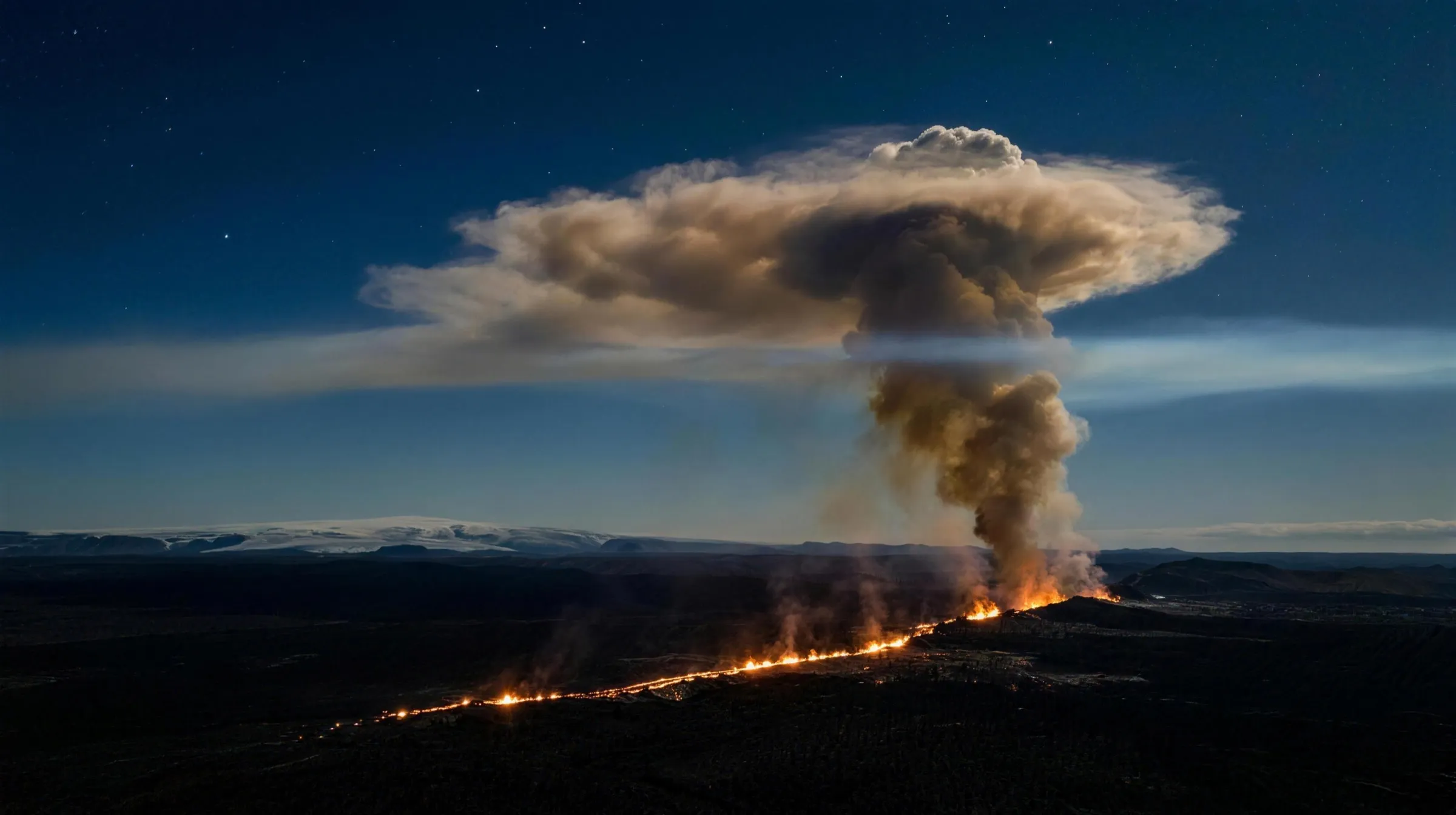 Open the interactive ▸
 What you're looking at
The Fissure view is the 3D anchor, at true scale: one scene unit is one kilometre. A curtain of fire a few hundred metres tall runs along the opened ground, feeding a convective column that climbs an order of magnitude higher, against a dashed ceiling at 9 km, the subpolar tropopause. The dial sets the discharge feeding the column, and the Mastin relation answers with a height; the transport line to Summit, 1,247 km away, lights only when the column tops the ceiling, because that is what it takes. Four presets: Laki 1783, Eldgjá 939, Holuhraun 2014 as the control case that stayed under it, and the unnamed 12.9 ka candidate.
The Mixing Bench is Sun 2020's argument as a machine. Osmium abundance against isotope ratio, the chondritic mixing line drawn honestly through the data, the published volcanic band behind it, and a marker that walks whichever curve you select as you turn the fraction dial. Three rows judge every mixture live: can the endmember reach the ratio, what fraction lands the osmium, and what iridium that fraction must deliver. One endmember fails the third row by two orders of magnitude.
The Record view draws both published tables complete. Hall's Cave on age or depth: five orange horizons across four thousand years, the same-depth pairs that disagree joined in red, the gap between 151 and 155 cm shaded rather than smoothed over. Beneath the age axis runs the ice ledger: eight bipolar sulfate events with V8 at twice Okmok, the three onset clocks, Laacher See's alibi, and the platinum spike sitting after all of it. Page-Ladson gets its own panel, replicate disagreements included.
The File view runs 2013 to 2026 in nine cards: the spike, the first doubt, the continental case, the osmium, the alibi, the cluster, the Iceland reading, the reply, and the two ledgers of 2026 that now publish past each other. Below them hang two verdicts at equal size. Neither is empty, and neither closes.
Why it's here
INST-46, the Younger Dryas Impact Ledger, ran a chain of inference to the place where it breaks, and closed with exactly one line unbroken: the real, hundredfold platinum spike in Greenland ice, cause unknown. That bench's discipline was to keep an unexplained measurement separate from support for one particular explanation. This bench is the sequel that discipline owes: if not an impact, then who put the metal in the ice? The house rules are unchanged and the suspect is new. This time the party in the dock is a crack in the ground in Iceland, and the interrogation uses the same instruments the impact got: arithmetic.
This is not a straw man. The volcanic reading is alive in the literature, carries data, and is growing: Sun et al. 2020 counted five osmium horizons in a Texas cave where one impact should be; Nana Yobo et al. 2026 found the same step at an underwater site in Florida; Green et al. 2025 measured the nominated tephra directly, acquitted it, and pointed at Iceland instead; and Gabrielli et al. 2008 had already caught the mechanism working, when the 1991 Hekla eruption left a platinum peak in a snow pit at the exact GISP2 site. But this bench also displays the volcanic reading's own wounds, plainly: no volcano has been named, the key tables disagree with themselves at the centimetre scale, and the impact camp has pointed, in its own journal, at a real gap in the opposing table. Two verdict cards hang at equal size, as on INST-46, because this is still the same open file.
How it works
Three machines run this instrument, and every number on all three is either published or an arithmetic consequence of published numbers, with the anchors checked by a script that ships with the site.
R_mix = (f·C·R + (1−f)·C_c·R_c) / (f·C + (1−f)·C_c) · H = 2.0 V^0.241 · P(≥5) = 1 − Σ e^{−λ}λ^k/k!
The mixing machine is two lines of conservation. Mix a fraction f of an exotic endmember into local crust and both the osmium abundance and the isotope ratio follow. Solve it forward and the marker walks the curve; solve it backward from a sample and it returns the fraction required. The chondritic endmember is CI at 486,000 ppt and 0.127; the volcanic band is the envelope of the four curves Sun et al. published, endmembers 1,000 to 37,500 ppt at 0.115-0.20. Nothing here is fitted by us.
The iridium row is the discriminant, and it is bought with the same fraction. A chondrite that supplies the deepest excursion's osmium also supplies iridium at CI proportions: 250 times the measured value. Confirmed impact horizons, the K-Pg above all, are proven by exactly that evenness. Volcanic gas condensate runs osmium-selective, Kudryavy at Pt/Ir near 12, Tolbachik high platinum and low iridium, Kīlauea's aerosol enriched seventeen-thousandfold; the layers look like that instead. And the deepest sample, at 0.12, sits below the chondritic endmember itself: no mixture of crust and chondrite reaches it at any fraction.
The column machine is one power law with three checks. Mastin's H = 2.0 V^0.241, applied to the discharge feeding the column, not the lava rate: Holuhraun poured 100 m³/s of lava, fed its column almost nothing, and stalled under 4 km, while Laki's explosive phases fed thousands and stood 9 to 13 km over Iceland. The formula lands all three calibration eruptions inside their observed ranges, and it prices the ceiling: about 500 m³/s of column feed tops the 9 km subpolar tropopause. Green et al.'s phrase is 'a relatively small Icelandic fissure eruption', and the dial shows you exactly how small.
The recurrence machine is one Poisson line. At the generous end of published impact rates, one continent-scale event per hundred thousand years, the probability of five inside Hall's Cave's four-thousand-year window is about 10⁻⁹. The ice ledger, meanwhile, holds eight volcanic sulfate events of matching magnitude in a four-hundred-year stretch of the same window, measured, not estimated. The instrument prints both numbers side by side and lets the prior speak for itself.
And the timing cut costs nothing to compute at all. Subtraction: the spike at 12,822, the speleothem onset at 12,870, the layer-counted onset at 12,846. The platinum arrives 48 years after one clock's cooling and decades after the other's. Whatever made it, comet or fissure, fired after the event it was hired to explain. The one measurement that survived INST-46 turns out to be an alibi for the Younger Dryas itself.
The published tables, the sulfate events, the eruption parameters and the snow-pit fallout are used exactly as the record gives them, with every replicate disagreement drawn and every secondary-source number tagged. The mixing, the column heights, the threshold and the recurrence probability are modelled from equations named on the instrument, with anchors in a script that fails the build if they drift. What the bench refuses to do is name the volcano. A fingerprint identifies a kind of hand, not a person; the difference between those two things is the entire subject of this file, and it is the same difference INST-46 was built to draw.
The dials that decide what happens
Two of them run the eruption, two run the mixture, two run the record. None of them can close the case, and that is the finding.
- The eruption preset. Laki 1783 with its 27 km of fissure and 122 Mt of SO₂; Eldgjá 939, three times longer and nearly twice the sulfur; Holuhraun 2014, the measured control case that stayed under the ceiling; and the 12.9 ka candidate, which is a hypothesis wearing the others' clothes. Its every parameter is a dial precisely because nobody has found it.
- The discharge feeding the column, 1 to 10,000 m³/s. The single number that decides whether Iceland can reach Greenland. Below about 500, everything rains out in weather; above it, the sulfur and its metals ride the polar vortex. Note how modest the threshold is: the candidate does not need to be a Laki.
- The endmember switch: volcanic gas or CI chondrite. The instrument's fairest control. Both are drawn through the same data; the chondrite is given its full, honest mixing line. It survives the ratio row and the osmium row, and dies on the iridium row, which no dial can save.
- The exotic fraction, 0.0001% to 30%. Watch how little is needed: a tenth of a percent of either endmember moves a crustal sediment most of the way to 0.13. Parts-per-trillion chemistry is what lets a one-centimetre layer archive a hemisphere-scale event, and also what makes replicate scatter so dangerous to everyone's tables.
- The site and axis switches. Hall's Cave on age shows the five horizons against the ice ledger; on depth it shows what the age axis hides, the gap and the disagreeing pairs. Page-Ladson shows the independent Florida step with its own replicate problem. The instrument does not pick a favourite witness.
- The eruption ledger toggle. Abbott 2021's eight bipolar events under the record, with Okmok and Tambora as reference lines. It is the strip that makes the recurrence argument visual: five orange horizons above, eight measured eruptions below, one window.
The claims, as they stand
Six claims, with who made each and where it lands today. One is measured and undisputed. Four are contested, which is what an open file looks like. One has been refuted twice, by the volcanic camp's own instruments.
| Something spiked the Greenland ice at 12,822 BP proposed by Petaev et al. 2013 | MEASURED | Measured and undisputed, still. This is the line that survived INST-46, unchanged: platinum up a hundredfold over fourteen years, cause unknown. What is new here is its position on the synchronised clocks: about 48 years after the cooling began. That single placement retires it as a trigger for either hypothesis, which is not the same as explaining it. |
| The spike was delivered by an Ir-poor iron impactor proposed by Petaev et al. 2013, the original reading | CONTESTED | Contested, and carrying INST-46's unpaid debt. The platinum budget prices an iron body near 0.8 km, which owes a crater no survey has found. Boslough's reply offered a cheaper iron: Cape York, already lying in Greenland. The continental platinum sheet of Moore et al. 2017, eleven sites wide, remains this reading's best surviving evidence, and the new Hall's Cave counter-dataset claims fresh impact proxies. |
| The osmium excursions record volcanic gas, not meteorite proposed by Sun et al. 2020; Nana Yobo et al. 2026 | CONTESTED | Contested, with the arithmetic favouring it and the tables wounding it. Five horizons in four thousand years where one impact should be; osmium enriched alone while iridium, ruthenium, platinum and palladium sit at crustal levels, which is what a fractionating gas does and an even-handed chondrite cannot; and the same step at an independent Florida site. Against it: replicate pairs at the headline depths that disagree with their twins, in both papers, undiscussed in either. |
| Laacher See caused the boundary horizon, or the cooling proposed by Sun et al. 2020, following older proposals | REFUTED | Refuted twice over, by the volcanic camp's own instruments. Reinig et al. 2021 tree-ring date the eruption to 13,006 ± 9 cal BP, one to two centuries early, and Green et al. 2025 measured its tephra: platinum-poor, below crustal abundance, never found in Greenland ice. A 2023 radiocarbon challenge keeps the date contested; the geochemical acquittal stands on its own. |
| An Icelandic fissure eruption wrote the platinum spike proposed by Green et al. 2025 | CONTESTED | Live and unproven, which this instrument prices exactly. For it: the chemistry (high Pt, low Ir, chloride-complexing gas), a 14-year rise that fits an eruption sequence better than an instant, a 9 km ceiling a modest fissure clears, and a channel demonstrated in 1783 and again, with platinum, in 1991. Against it: no vent, no tephra shard in the platinum layer, and the strongest deglacial eruption-rate surge in Iceland dates after the Younger Dryas, not at its onset. |
| The eruption cluster triggered the Younger Dryas proposed by Abbott et al. 2021; Nana Yobo et al. 2026 | CONTESTED | Live, and not this instrument's to settle. V8 sits 25 years before the layer-counted onset, dead on the speleothem one, with the largest deglacial mercury peak beside it; its cumulative forcing exceeds anything in the Common Era. But bipolar deposition usually means low-latitude, and the same authors disagree in print about whether these events were northern at all. Volcanism also cannot power 1,193 years of cold by itself; the ocean has to do that, and meltwater remains the standing rival. |
Try this
- Start at the fissure with Laki, and drag the camera to ground level. The famous curtain of fire is the small part. The column above it is the machine, and the dashed ring at 9 km is the whole game.
- Switch to Holuhraun. Eleven megatons of SO₂, and the verdict strip goes red: the column never beat 4 km, and nothing reached Greenland. Now drag the discharge dial up and watch the exact moment the transport line lights.
- Load the 12.9 ka candidate and read its threshold. About 500 m³/s. That is what 'relatively small' means in numbers: the suspect does not need to be a monster, which is precisely why its absence from the tephra record is not yet an acquittal.
- Click the Hekla note in the fissure view. 1991, a snow pit at Summit, a platinum peak from a mid-sized eruption. Read it, then remember the spike this whole file is about was found in ice from the same site.
- Go to the mixing bench, select the chondrite, and give it its best case. The dashed line passes through the data. On the ratio axis the impact reading works. This is worth seeing before the next step.
- Now read the third row. The fraction that supplies the osmium of UR2 must deliver iridium at 250 times the measurement. Then select UR2 itself and note its 0.12 sits below chondrite entirely. Two independent kills, one dial.
- Switch the endmember to volcanic gas. All three rows go green at sub-percent fractions. Then read the last evidence row: what the band cannot supply is a name.
- Open the record on the age axis. Five orange horizons, eight sulfate bars, three clocks, one late platinum spike. Click V8: twice Okmok, twenty-five years before the onset, volcano unknown.
- Switch to the depth axis. The gap between 151 and 155 cm is shaded, not smoothed. Click it, and read what can and cannot be verified about the 153 cm sample. Then switch to Page-Ladson and find the same replicate problem in the other camp's table.
- End at the file and read both verdicts. If you leave thinking the volcano did it, you have overshot the evidence by exactly one tephra shard. If you leave thinking the comet did it, you have overshot by one crater. The measurement is real, and it is still nobody's.
Accuracy
The honest line between what is measured, what the record reports, what is modelled here, and what is a reading:
| Feature | Tier | What that means |
|---|---|---|
| Both sediment tables, in full | T1 Measured | Sun 2020's Table S1 (37 rows, Hall's Cave) and Nana Yobo 2026's Table S2 (30 analyses, Page-Ladson) are carried complete: every ratio, every osmium abundance, every same-depth replicate that disagrees with its twin, and the absence of rows between 151 and 155 cm. Nothing is averaged, smoothed or excluded. Where a row's iridium column is ambiguous in the published PDF, it is carried as null rather than guessed. |
| The platinum spike and its clock position | T1 Measured | Petaev et al. 2013 as published: a rise of at least a hundredfold over about 14 years to 82.2 ppt at 12,822 yr BP. Green et al. 2025 place that age about 48 years after the speleothem-synchronised onset of the Younger Dryas, and decades after the GICC05 onset. Note that Petaev publishes no numeric Pt/Ir ratio; his claim is qualitative, and this instrument carries it as such. |
| The eruption cluster in the ice | T1 Measured | Abbott et al. 2021, from synchronised Greenland and Antarctic cores: eight bipolar sulfate events between 13,023 and 12,871 yr BP. V8, at 12,871, deposited 279 kg of sulfate per square kilometre on Greenland, more than twice Okmok 43 BCE and six times Tambora, 25 years before the GICC05 onset. No source volcano has been identified for any of the eight. |
| The Iceland-to-Summit channel | T1 Measured | Laki 1783: haze at Nuuk within three weeks, sulfate in eleven Greenland cores. Hekla 1991: a platinum peak and an iridium spike in a Summit snow pit, 1,218 km from the vent, at the exact site GISP2 was drilled. The delivery mechanism this instrument animates is not a model; it has been observed twice, once with the same metal. |
| The mixing bench | T2 Modelled | Two-component conservation of osmium, with ¹⁸⁸Os proportional to total Os. The chondrite test solves the CI fraction against each sample's osmium, then prices the iridium that fraction must deliver: for the deepest excursion the answer is 250 times the measurement. The volcanic band is the envelope of Sun's four published curves, not a fit of ours. Anchors in scripts/osmium-tune.mjs. |
| The column and the ceiling | T2 Modelled | Mastin 2009's H = 2.0 V^0.241, applied to the discharge feeding the convective column rather than total lava output. The same formula lands Laki inside its observed 9-13 km, Eldgjá inside 11-18, and Holuhraun under 4, which is the model's check. The 9 km subpolar tropopause and the ~500 m³/s threshold that clears it follow from the same arithmetic. |
| The recurrence argument | T2 Modelled | Poisson arithmetic at the generous end of published impact rates: the probability of five continent-scale impacts inside a four-thousand-year window is about 10⁻⁹. Volcanic sulfate events of matching magnitude: eight, in the same window, measured in the ice. The prior is printed, not asserted. |
| The UR1-UR5 horizon grouping | T3 Reading | Sun et al. never publish an explicit sample-to-horizon mapping, and never name the 155 cm horizon at all. The grouping drawn on the instrument is reconstructed from their main text and tagged as such. Young's 153 cm sample, with the highest platinum in the sequence, exists only in his account; neither side has published the data. |
| Who made the spike | T3 Reading | Open, and the instrument declines to close it. The volcanic reading has the chemistry, the recurrence and the channel, and lacks a vent. The impact reading has a continental platinum sheet at eleven sites, and owes the crater INST-46 priced. The timing cut retires the spike as a trigger for either: whatever made it arrived after the cold began. |
In one line: both sediment tables in full with their disagreements drawn, the GISP2 platinum series, the eight bipolar sulfate events, the Hekla 1991 Summit fallout and every eruption parameter are the record, used as published and tagged where a number survives only in secondary sources; the mixing curves, the iridium over-prediction, the column heights against the 9 km ceiling and the 10⁻⁹ recurrence probability are MODELLED from named equations with anchors checked by scripts/osmium-tune.mjs; the horizon grouping and the 153 cm sample are tagged as readings and reports; and the question of who spiked the ice is a reading this bench declines to make, hanging a fingerprint without a culprit opposite a sheet without a crater at exactly equal size. Feed the column, mix the endmembers, and find the row that breaks.
Sources
- Petaev, M. I., Huang, S., Jacobsen, S. B. & Zindler, A., "Large Pt anomaly in the Greenland ice core points to a cataclysm at the onset of Younger Dryas," PNAS 110(32):12917-12920 (2013). Platinum rising at least a hundredfold over ~14 years to 82.2 ppt at 12,822 yr BP, layer average 30 ppt over 62.5 cm; the inference of an Ir-poor iron near 0.8 km; the concession that no such crater has been found. The Pt/Ir claim is qualitative throughout: no numeric ratio appears in the paper. The exchange: Boslough, M., "Greenland Pt anomaly may point to noncataclysmic Cape York meteorite entry," PNAS 110:E5035, and Petaev et al.'s reply, "Is Greenland Pt anomaly global or local?"
- Moore, C. R. et al., "Widespread platinum anomaly documented at the Younger Dryas onset in North American sedimentary sequences," Scientific Reports 7:44031 (2017): eleven sites, YDB mean 6.0 ppb against 0.3 background. The continental case, carried here at full strength as the volcanic reading's standing problem.
- Sun, N., Brandon, A. D., Forman, S. L., Waters, M. R. & Befus, K. S., "Volcanic origin for Younger Dryas geochemical anomalies ca. 12,900 cal B.P.," Science Advances 6:eaax8587 (2020). Table S1 carried in full: 37 samples, ¹⁸⁷Os/¹⁸⁸Os 0.12-2.35, Os 22.6-4,477.8 ppt, five unradiogenic horizons across ~4,000 years, HSE abundances at crustal levels throughout; the four mixing curves of Table S4; the Kudryavy, Tolbachik and Erta Ale condensate comparisons of Table S2. Wu, Y. et al. (2013) for the Melrose spherule films at 0.112-0.121. Sun, N. et al., Geochimica et Cosmochimica Acta 312:57-74 (2021) for Debra L. Friedkin (0.21 vs 1.5 background; paywalled, carried as quoted by Nana Yobo et al.).
- Young, M. D., "Geochemical re-evaluation supports cosmic impact rather than volcanism at Younger Dryas onset, Hall's Cave, Texas: Reply to Sun et al. 2020," Airbursts and Cratering Impacts 3(1), DOI 10.14293/ACI.2025.0007 (2025). The journal is published by the Comet Research Group. His checkable claims check out against Table S1: no rows between 151 and 155 cm, five same-depth samples at 151 cm spanning 0.41-2.22, the 171 cm pair differing 140-fold in osmium. His 153 cm sample at 1,807 ppt platinum is not in any published table, his allegations of author removal are uncorroborated, and this instrument carries both facts.
- Nana Yobo, L., Brandon, A. D., O'Brien, S., Halligan, J. J. & Waters, M. R., "Volcanic forcing of global climate cooling at the Younger Dryas onset preserved in North American sediments," Science Advances 12(18):eaec9030 (2026). Table S2 carried in full: 30 analyses at Page-Ladson, ¹⁸⁷Os/¹⁸⁸Os 0.40-0.75, YD base at 8.51 m = 12,820 ± 50 B.P. at 0.51 vs 0.72 background; the four-site comparison; the attribution to the 12.98-12.87 ka bipolar cluster, source unidentified. The replicate pairs at 8.51 and 8.60 m, one excursion and one background each, are drawn on the instrument and undiscussed in the paper.
- Moore, C. R., West, A., Kennett, J. P. et al., "Impact-Related Proxies, Environmental Change, and Faunal Extinctions across the Younger Dryas Boundary in Hall's Cave, Texas," Airbursts and Cratering Impacts 4(1), DOI 10.14293/ACI.2026.0006 (2026): a 61-date Bayesian re-dating, reported spherules, nanodiamonds and shocked quartz, and no Hg/TOC enrichment at the boundary, presented as evidence against volcanic input. Abstract-verified; full text behind the publisher.
- Green, C. E., Baldini, J. U. L., Brown, R. J., Schmincke, H.-U., Edmonds, M. & Meisel, T. C., "A possible volcanic origin for the Greenland ice core Pt anomaly near the Bølling-Allerød/Younger Dryas boundary," PLOS ONE 20(9):e0331811 (2025). Laacher See tephra measured directly: platinum-poor, below crustal abundance. The spike's chemistry read as a Cl- and Pt-rich Icelandic fissure eruption, likely subglacial or submarine; the 14-year duration read as more consistent with an eruption than an instant; and the spike placed ~45-50 years after the Younger Dryas onset on the synchronised chronologies.
- Gabrielli, P. et al., "Siderophile metal fallout to Greenland from the 1991 winter eruption of Hekla (Iceland) and during the global atmospheric perturbation of Pinatubo," Chemical Geology 255:78-86 (2008): a well-defined platinum peak and an iridium spike in a 2.7 m Summit snow pit, attributed to Hekla, 1,218 km away. Soyol-Erdene, T.-O. et al., Environmental Science & Technology 45:5929 (2011) for the Antarctic mirror: Pt, Ir and Rh peaks in the Cerro Hudson 1991 layer, Pt/Ir at maxima near 220.
- The gas-fractionation measurements behind the mixing bench: Zoller, W. H., Parrington, J. R. & Phelan Kotra, J. M., Science 222:1118 (1983), iridium enriched 17,000-fold in Kīlauea aerosol; Olmez, I. et al., JGR 91:653 (1986); Zelenski, M., Malik, N. & Taran, Y., JVGR (2014), Tolbachik gas at high Pt and low Ir; Kudryavy condensate at Pt/Ir ≈ 12 via Green et al. 2025.
- Abbott, P. M. et al., "Volcanic climate forcing preceding the inception of the Younger Dryas: Implications for tracing stadial transitions," Quaternary Science Reviews 274:107260 (2021): thirty eruptions with VSSI > 1 Tg S in the 13,200-12,800 window, the V5-V8 cluster, V8 at 279 kg/km² Greenland deposition 25 years before the GICC05 onset, the Hekla-like tephra at V5, and the finding that no source volcano is identified. The internal dispute is honoured: Svensson, A. et al., Climate of the Past 16:1565 (2020) read the cluster as likely low-latitude; Abbott et al.'s asymmetry analysis argues northern extratropical.
- Reinig, F. et al., "Precise date for the Laacher See eruption synchronizes the Younger Dryas," Nature 595:66-69 (2021): 13,006 ± 9 cal BP by dendrochronology, 126 years older than the varve age, precluding a direct link to the stadial onset. The live challenge: Smith, V. C. et al., Nature (2023) on magmatic CO₂, and Reinig et al.'s published rejection. Warken, E. et al. (2025) independently: 13,008 ± 8.
- The clocks: Rasmussen, S. O. et al., JGR 111:D06102 (2006) and QSR 106:14 (2014) for GS-1 onset at 12,896 b2k = 12,846 cal BP, ±138 maximum counting error; Cheng, H. et al., PNAS 117:23408 (2020) for the speleothem-synchronised onset at 12,870 ± 30; Steffensen, J. P. et al., Science 321:680 (2008) for the 1-3 year moisture switch. The EGRIP mercury maximum at ~12,870 is carried from the deglacial record.
- The eruptions: Thordarson, T. & Self, S., JGR 108(D1):4011 (2003) and Thordarson et al., Jökull 53:11-48 (2003) for Laki (27 km fissure, ten segments, 14.7 ± 1 km³, 122 Mt SO₂ with ~80% lofted by vent columns to 9-13 km, ~25 Mt H₂SO₄ aloft over a year, haze at Nuuk in three weeks); the 800-1,400 m fountain heights trace only to secondary sources and are tagged REPORTED on the instrument. Thordarson, T. et al. 2001 and Moreland, W. M. et al. 2019 for Eldgjá (75 km system, ~21 km³, 219-220 Mt SO₂, columns 11-18 km); Oppenheimer, C. et al. 2018 for the 939-940 CE date; Hutchison, W. et al., JGR-Atmospheres 129:e2023JD040142 (2024) for the ice-core sulfur series. Pedersen, G. B. M. et al., JVGR 340:155 (2017), Bonny, E. et al., JGR-Solid Earth 123:5412 (2018), Carboni, E. et al., ACP 19:4851 (2019) and Witt, T. et al., Frontiers in Earth Science 6:235 (2018) for Holuhraun: 1.44 ± 0.07 km³, ~11 Mt SO₂, fountains measured at 50-135 m, plume centre of mass under 4 km, 57 fountains localising to 10.
- Mastin, L. G. et al., "A multidisciplinary effort to assign realistic source parameters to models of volcanic ash-cloud transport and dispersion during eruptions," JVGR 186:10-21 (2009), for H = 2.0 V^0.241. Maclennan, J. et al., G³ 3(11):1062 (2002) for the post-glacial Icelandic eruption-rate surge, up to a hundredfold, centred after ~12 ka; the instrument notes that this postdates the Younger Dryas onset rather than explaining it. Zielinski, G. A. et al. (1994/1995), the GISP2 volcanic sulfate series, for Laki (115 ppb volcanic SO₄) and Eldgjá (84 ppb) at Summit.
Clear the ceiling. Fail the iridium row. Then go look for the volcano nobody has named.
Open the interactiveCompiled July 2026