The Younger Dryas Impact Ledger
In 2007, twenty-six authors proposed in PNAS that a comet or asteroid struck or exploded over North America 12,900 years ago, ending the Clovis culture, killing thirty-five genera of megafauna, and tipping the planet back into ice-age conditions for twelve hundred years. The evidence was a layer averaging three centimetres thick, carrying seven physical markers anyone could go and look for. That last part matters, because it is what made the claim science rather than a story, and it is why nineteen years later there is something to show you. One line of it survived: a real, hundredfold platinum spike in Greenland ice, measured at eighty-two parts per trillion, which nobody on either side disputes. Everything else came apart, and it came apart in ways worth watching. An independent team found zero microspherules where eight hundred per kilogram had been reported. A study run by the hypothesis's own supporters confirmed the nanodiamond spike and then found an identical one in modern soil. The only candidate crater turned out to be fifty-eight million years old. Two papers were retracted in February. And the man who measured the platinum spike is now a co-author of the comprehensive refutation, because his own paper had already said the platinum needs a body that would have left a crater nobody has found. This bench does not summarise that. It hands you the dials and lets you try to build the impactor that satisfies all five of the things it would have to do.
 Open the interactive ▸
 What you're looking at
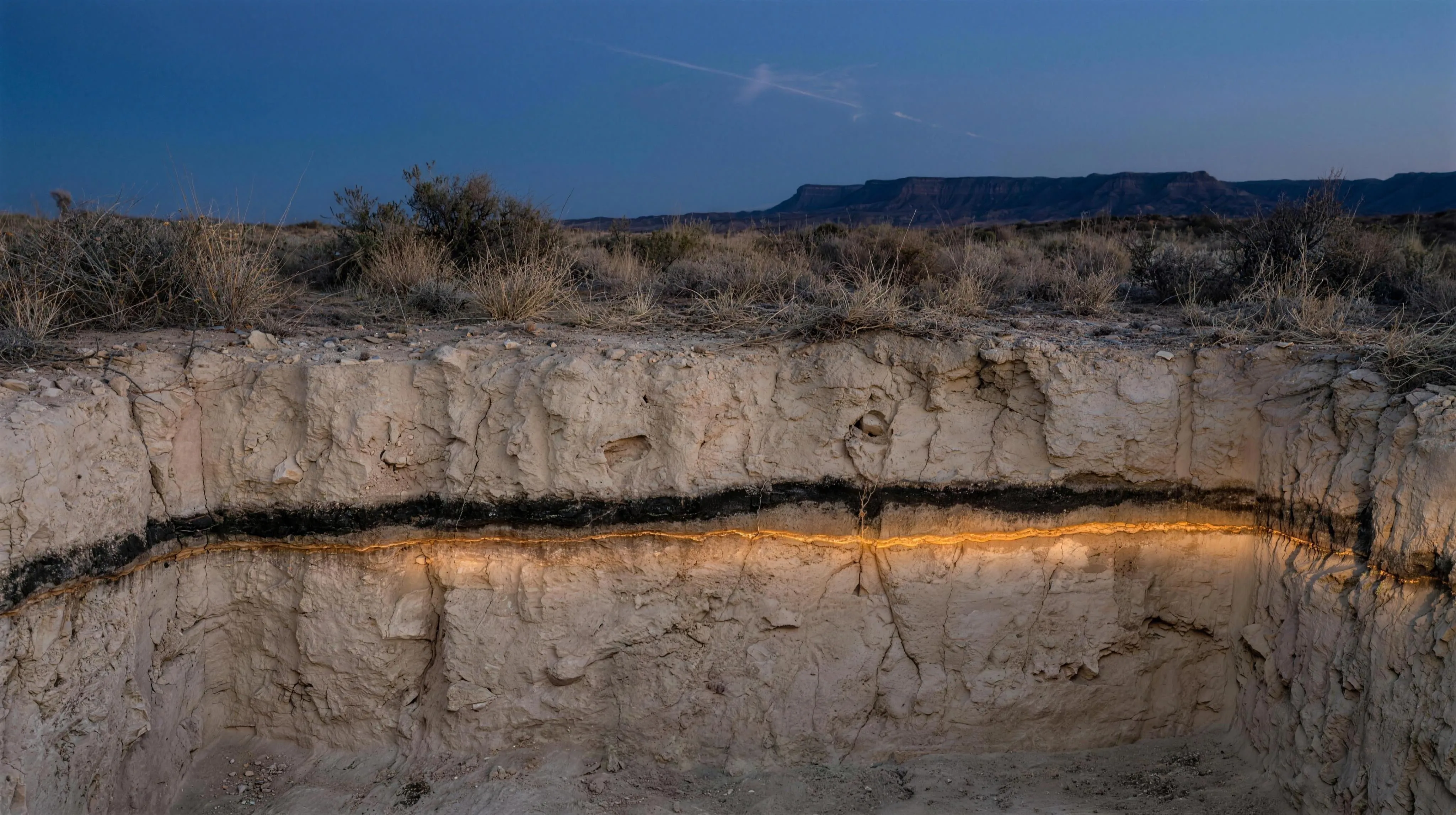
The Layer view is the chronology, and it is the fairest test on the bench because it uses nobody's rules but the proponents' own. On the left is a stratigraphic column of whichever site you select, with its black mat where it has one, the claimed boundary layer beneath, and its measured proxies. On the right is every site at once, each drawn as its published age interval against the hundred-year window the hypothesis claims. Then the switch: modelled ages, from the proponents' Bayesian analysis, or ages measured directly on the layer itself. The count at the corner recomputes every frame, and it changes a great deal.
The Impactor view is where the physics happens. Choose a body, or build your own from diameter, speed, entry angle and composition, and watch it enter: the altitude at which it breaks up, whether it bursts in the air or reaches the ground, and the crater it leaves if it does. Beside it stand five requirements the object would have to satisfy simultaneously, each computed rather than asserted, each showing exactly why it passed or failed. They pull against each other, and no setting lights more than two.
The Ledger view is the record itself: fifteen lines of claimed evidence, each tagged with where it stands after independent testing, with a running tally by category. Select any line to see the claim on one side and the test on the other, and where numbers exist they are drawn on a logarithmic chart, because the disagreements span orders of magnitude. Eight hundred microspherules per kilogram against zero. Iridium on the Clovis surface against more iridium in the modern streambed twenty metres away.
The File view runs 2007 to 2026 on a broken-scale timeline: the claim, the first failed replication two years later, the requiem four years after that, the platinum spike that survived, the chronology audit, the crater that turned out to be Paleocene, the 293-page refutation with the platinum's own discoverer among its authors, and the two retractions of February 2026. Two cards hang below at equal size. One of them is short, and it is not empty.
Why it's here
This station has built several instruments about misidentification. INST-42, Bolide Reentry is a train of meteor fragments read as a craft. INST-43, Project Mogul is a train of balloons read as a flying saucer. INST-35, the Orion Correlation is three pyramids read as a star map. What those share is that the thing being explained is ordinary and the explanation is extraordinary. This one is different, and that difference is why it was worth building.
The Younger Dryas Impact Hypothesis is not a fringe claim. It was published in PNAS in 2007 with twenty-six named authors, it proposed something specific, dated and falsifiable, and it came with a list of physical markers anyone could go and look for. It was taken seriously and tested seriously, and what followed was an unusually public coming-apart: the man who measured its strongest evidence is now a co-author of the comprehensive refutation, two 2025 papers were retracted in February 2026, and the only candidate crater ever offered turned out to be fifty-eight million years older than the ice sheet above it. Building this as an instrument is not about mocking a hypothesis. The real subject of this file is not a comet. It is where a chain of inference breaks, and the difference between an unexplained measurement and evidence for one particular explanation, because the platinum spike is still real and still has no accepted cause, and those two facts do not support each other.
How it works
Three machines run this instrument, and every number on all three is either published or an arithmetic consequence of published numbers.
E = (π/12)ρL³v² · z_b = z* − 2H·ln(1 + (l/2H)√(f²−1)) · D = 1.161(ρᵢ/ρₜ)⅓L^0.78 v^0.44 g^−0.22 sin(θ)⅓ · C_Pt = (M·f/A⊕)/(a·ρ_ice·N)
The chronology machine is the simplest and the most revealing. For each site it asks one question: does its published age interval overlap the window the hypothesis claims? Under the proponents' Bayesian ages, fifteen of fifteen do, and the layer looks like a single moment on four continents. Switch to ages measured directly on the layer and five of eleven do. Lommel's own charcoal is five hundred years too old. Cuitzeo, recomputed, sits thousands of years off. And Gainey, which supplied the highest microspherule count ever published, has its carbon spherules dated to 207 radiocarbon years before present. The synchroneity is being produced by the model, not found in the ground, and you can watch that happen with one switch.
Then there is the precision dial, which is the fairest thing here. Kennett and colleagues published their own dating standard: radiocarbon precision better than a hundred years. Apply it. Sites drop out of the chart as their uncertainties exceed the threshold, and the corpus empties. This matters because several modelled intervals are enormous: Melrose's spans 9,475 years. An interval that wide will overlap almost any window you point it at, so counting it as a hit is not evidence of anything.
The impact bench is Collins, Melosh and Marcus 2005, used as published. Ram pressure against material strength gives a breakup altitude; the pancake model spreads the fragments and decides whether the object bursts or lands; pi-group scaling gives the crater. One correction was needed: their equation 20 is typeset with a lost parenthesis, and only the corrected form reproduces their own Table 6, which it then does exactly. The bench also lands Chelyabinsk at 0.52 megatons bursting at 31 km against a published 500 ± 100 kilotons at about 29.7.
The platinum chain is four lines of arithmetic and it closes on its own source. Take the impactor's mass, multiply by the platinum fraction for its composition, spread it over the Earth, and divide by the ice that accumulated at Summit during the twenty-one years the spike lasted. Run it backwards from the measured 82.2 parts per trillion and it returns an iron body about 830 metres across, against the roughly 0.8 kilometres Petaev and colleagues state in the very paper that reports the measurement. Nothing was fitted to make those agree. It is the same calculation they did, which is why their own paper concludes that a crater of a few kilometres ought to exist, and notes that none has been found.
And the five requirements are the point. Deliver the platinum: needs a kilometre of iron. Leave no crater: needs something a hundred times smaller. Burn a continent: needs something far larger still, and Boslough's objection is worse, since spreading blast that far would require detonating near five hundred kilometres altitude where nothing can explode. Be probable in twenty thousand years: caps the size. And keep the planet cold for 1,193 years, which cannot be bought at any size, because every published stratospheric residence time is in years. Scan the diameter dial and no value satisfies the first two together, and they are four orders of magnitude apart.
The published site ages, the platinum measurement, the ice-core chronology, Hiawatha's date and the replication counts on both sides are used exactly as the record gives them. The claims and the tests, including the two 2026 retractions and the authors who dissented from them, are quoted rather than interpreted. Everything the impactor bench computes is modelled from equations and constants named on the instrument, and you can move any of them and watch the answers move. What the bench refuses to do is turn an unexplained measurement into support for a particular explanation. The platinum spike is real and its cause is genuinely unknown. Those are two separate facts, and keeping them separate is the whole exercise.
The dials that decide what happens
Two of these change how the sites are dated. Four change the object. One of them changes nothing, and that is the finding.
- Modelled ages against direct dates. The single most consequential switch on the instrument. The modelled column is the proponents' own Bayesian output, 354 dates from 23 sections in 12 countries collapsed into a hundred-year window. The direct column is what was measured on the layers themselves. Both are published, both ship, and the instrument draws them side by side rather than choosing between them.
- The precision required, from ±2,500 years down to ±30. Drop any site whose age is less precise than the threshold. The proponents' own published standard is better than 100 years. Applying it is not hostile; it is taking them at their word, and it is the reason Melrose's 9,475-year interval should not count as a hit on a hundred-year window.
- Eight real bodies, from Chelyabinsk to Chicxulub. Firestone's comet at over four kilometres, Petaev's 0.8 km iron, a single Taurid fragment for the swarm scenario, the Hiawatha impactor, and four objects whose effects are actually known so you can check the bench against reality. None of the eight satisfies more than two of the five requirements.
- Diameter, from ten metres to twenty kilometres. The dial that matters, and the one that shows the vice most clearly. Energy and platinum delivered both scale as its cube; the crater you owe scales as its 0.78 power; the recurrence interval climbs steeply. Drag it slowly through the range between 100 m and 2 km and watch the first two requirements trade places without ever both being satisfied.
- Speed and entry angle. Speed runs from 11 km/s, the escape-velocity floor, to 72, a head-on long-period comet. Energy goes as its square, but platinum delivery does not care how fast the mass arrives. Entry angle is measured from the horizontal; shallow entries cross more air and break up higher, and 45° is the most probable angle for a random impact.
- Composition, which sets both density and platinum content. A comet carries about 0.47 ppm platinum, a chondrite 0.93, a magmatic iron like Sikhote-Alin about 30. That last figure is why the hypothesis is pushed toward an iron body by the ice-core measurement, and why an iron body is exactly the object that cannot airburst.
The claims, as they stand
Seven claims, with who made each and where it lands today. One is measured and undisputed. Two are contested, though only one of those is about a comet. Four have been refuted, and in two cases the decisive result came from the hypothesis's own supporters.
| Something unusual is recorded in Greenland ice at 12,822 years ago proposed by Petaev, Huang, Jacobsen & Zindler 2013 | MEASURED | Measured, and undisputed by anyone. Platinum rises at least a hundredfold over about fourteen years to 82.2 parts per trillion, with a platinum-to-iridium ratio of 1265 that exceeds chondrites, crust, and even low-iridium iron meteorites. This is the one line in the whole ledger that survived contact with testing, and it is a real open anomaly. What it is not is evidence for a particular cause, and the paper reporting it says so at length. |
| The impactor that delivered that platinum left no crater proposed by the hypothesis requires it; its own source paper denies it | REFUTED | Refuted by arithmetic, and by the discoverers themselves. Petaev et al. computed the same chain this bench computes and concluded the platinum budget needs an iron body about 0.8 km across, that "the event is expected to form a crater of a few kilometers in diameter", and that "no such crater at YDB has been found so far". Scan the diameter dial: there is no value at which the platinum requirement and the missing-crater requirement are satisfied together, and the two are separated by four orders of magnitude. |
| The boundary layer is synchronous across four continents proposed by Kennett et al. 2015, from 354 dates at 23 sections | CONTESTED | Contested, and this is the strongest argument the hypothesis has left. Under the proponents' Bayesian model every site touches a hundred-year window, which is a remarkable claim of precision. Meltzer et al. 2014 audited the 29-site corpus and found three sites that actually date to it, with two of those contradicted by the layers enclosing them. Several of the modelled intervals are thousands of years wide, and one is 9,475. Measured against the proponents' own published dating standard of better than 100 years, Holliday et al. found no site meets it. |
| The impact markers are real and confined to the boundary proposed by Firestone et al. 2007, and the nanodiamond and spherule papers | REFUTED | Did not survive, and the most damaging results came from the proponents' own side. Surovell 2009 found zero microspherules where 800 per kilogram were reported. Bement et al. 2014, a proponent-led study, confirmed the nanodiamond spike at the boundary and then found an equal one in modern soil, concluding they are "not unique to the YDB". Pigati et al. 2012 found iridium, spherules and titanomagnetite at black-mat sites from 6,000 to over 40,000 years old. A marker that appears everywhere marks nothing. |
| The event ended Clovis and killed the megafauna proposed by Firestone et al. 2007 | REFUTED | Refuted on the archaeology. Waters et al. 2020 date Clovis to 13,050-12,750 cal BP: it begins about two centuries before the onset and continues straight across it, and Folsom appears roughly two hundred years before Clovis disappears. Buchanan et al. 2008 found no demographic bottleneck in the summed radiocarbon record. The extinctions varied by taxon and by continent and were not one event. |
| An impact could hold the planet in a stadial for 1,193 years proposed by the hypothesis requires it | REFUTED | Refuted by residence times, and this one is independent of every dial. Volcanic sulfate clears the stratosphere in one to two years, fine silicate dust in one to two with a tail to about fifteen, soot in about six even at extinction-scale loading. Petaev et al. conceded the point against their own claim: their twenty-year platinum ingrowth already exceeds the five-year lifetime of fine dust. An impact can only produce a millennium of cold by triggering an ocean-circulation shift, and if that can be triggered, meltwater can trigger it without help from space. |
| The Younger Dryas needs an extraordinary trigger at all proposed by the open question, and the one the field is actually working on | CONTESTED | Live, and not about comets. GS-1 is one of many stadials of the last glacial cycle. The mechanism, a slowdown of the Atlantic overturning circulation, is broadly agreed; the trigger is not. Condron & Winsor 2012 show Arctic meltwater routing weakens the overturning by more than 30% and is likelier than the St Lawrence route. Reinig et al. 2021 dated Laacher See to 13,006 ± 9 cal BP, about two centuries too early. And Nana Yobo et al. 2026 report unradiogenic osmium with a volcanic-aerosol signature at three North American sites, correlating with a cluster of bipolar eruptions at 12.98 to 12.87 ka whose cumulative forcing exceeds anything in the Common Era. |
Try this
- Start with the strongest version of the claim. Layer view, modelled ages, precision wide open. Fifteen of fifteen sites touch the window. This really is a striking result and it deserves to be seen at full strength before anything is done to it.
- Now switch to the direct dates. One click. Watch Lommel, Ommen and Cuitzeo jump out of the window and Gainey shoot off the axis entirely. Nothing was reinterpreted; these are simply the ages measured on the layers rather than modelled around them.
- Put the precision dial at ±100 years, the proponents' own standard. The chart empties. Ask yourself whether an interval 9,475 years wide overlapping a hundred-year window is a data point or an artefact.
- Load Petaev's iron and read all five requirements. It nearly delivers the platinum, which is exactly why it was proposed. Then read the second requirement: a seventeen-kilometre crater, which does not exist anywhere of that age.
- Now drag the diameter down until the crater could plausibly hide. Watch the platinum reading collapse as you go. There is no diameter where both are green. Do this yourself rather than taking it from me; it takes about five seconds and it is the entire argument.
- Load Firestone's comet at full size and read the recurrence. Once every thirteen million years, so a fraction of a percent chance in the last twenty thousand. And it still does not ignite a continent.
- Open the fifth requirement and note that no dial affects it. Fifteen years of aerosols against 1,193 years of stadial. Any impact explanation has to route through the ocean, and once you have granted that, meltwater does the same job without an impact.
- Go to the ledger and select the microspherules. Eight hundred per kilogram against zero, on the same sediment, by two labs. Then select the iridium, and notice that the modern streambed beside the site has more of it than the Clovis surface does.
- Select the platinum spike and read the test panel. This is the one line that survived, and the text is drawn from the paper that reports it. Read what its own authors concluded about craters and wildfires.
- End at the file, and read the two cards side by side. If you leave this bench thinking the whole thing was nonsense, you have overshot. Something is in the ice, and nobody knows what put it there.
Accuracy
The honest line between what is measured, what the record reports, what is modelled here, and what is a reading:
| Feature | Tier | What that means |
|---|---|---|
| Every site age on the chart | T1 Measured | The modelled ages are the Bayesian output published by Kennett et al. 2015, with the 68% mean and the 95% range as printed; the direct ages are the radiocarbon, OSL and thermoluminescence dates measured on the layers themselves, or the recomputations published by Meltzer et al. 2014. Both columns ship. The overlap count is not an opinion about these sites: it is recomputed every frame by asking whether each published interval touches the claimed window. |
| The platinum spike | T1 Measured | Petaev et al. 2013 sampled GISP2 ice from 1,719.875 to 1,709.000 m at 2.5 to 4.6 years per sample. Platinum rises by at least a hundredfold over about fourteen years and falls back over seven, peaking at 82.2 parts per trillion against an interval mean near 3.6, with a platinum-to-iridium ratio of 1265. Nobody on either side of this argument disputes that measurement. |
| The stadial itself | T1 Measured | Greenland ice-core layer counting (GICC05) puts the onset of Greenland Stadial-1 at 12,896 years before 2000, that is 12,846 before 1950, with a relative precision of ±4 years and a maximum counting error of ±138, and its termination at 11,703 b2k. Duration 1,193 years. The moisture-source switch at the transition takes one to three years and the temperature response about fifty. |
| Hiawatha | T1 Measured | The crater is 31.1 ± 0.3 km across under up to 930 m of ice, and shocked zircon from its outwash dates the impact to 57.99 ± 0.54 million years. The discovery paper stated plainly that the age was unknown and made no Younger Dryas claim; that claim was made around it, and it is now closed. |
| The entry, the burst and the crater | T2 Modelled | Collins, Melosh & Marcus 2005, used as published, with one correction: their equation 20 is typeset with a lost parenthesis, and with the corrected form the bench reproduces their own Table 6 exactly, including the 40 m iron losing 50% of its velocity and leaving a 1.2 km crater. It also lands Chelyabinsk at 0.52 Mt bursting at 31 km against a published 500 ± 100 kt at about 29.7 km. The pancake breakup model is calibrated by only two events and should be treated cautiously far outside that range, which is said here rather than buried. |
| The platinum arithmetic | T2 Modelled | Impactor mass times its platinum fraction, spread over the Earth, divided by the ice that accumulated at Summit during the twenty-one years the spike lasted, at Greenland's published accumulation rate of 0.086 m of ice equivalent per year at 12.9 ka. Run backwards from the measured 82.2 ppt it returns an iron body about 830 m across, against the ~0.8 km Petaev et al. state. Nothing was fitted to make those agree. |
| How often a body this size arrives | T2 Modelled | Log-log interpolation over current survey estimates (Harris & Chodas 2021; Brown et al. 2013 at the small end). The gap between about 10 and 50 metres, where bolide counts give roughly ten times the telescopic rate, is unresolved as of 2025 and is disclosed on the instrument. It does not affect the argument, because everything the hypothesis needs is far larger, where the two methods agree. |
| Where the five thresholds sit | T3 Reading | A crater under 300 m might have escaped notice; a thousand kilometres of ignition counts as continental. Those are choices, and you are welcome to move them. The conclusion does not move, because the gaps between what each requirement demands are orders of magnitude wide, not factors of two. |
| What made the platinum spike | T3 Reading | Still open. Petaev now favours a small local event; Green et al. 2025 read the fourteen-year build-up as fitting an Icelandic fissure eruption better than an instantaneous impact; neither is demonstrated. The bench states the anomaly and refuses to convert it into support for any particular cause, which is the distinction the whole instrument exists to draw. |
In one line: every site age, the 82.2 ppt platinum peak, the 1,193-year duration from ice-core layer counting, Hiawatha's 57.99 ± 0.54 Ma and the replication counts on both sides are the record and simple arithmetic, auditable on the bench; the claims, the tests, the two 2026 retractions and the dissenting authors are quoted and tagged REPORTED; the entry, burst, crater, thermal, flux and platinum calculations are MODELLED from Collins/Melosh/Marcus 2005 and the published impact flux, with one typographical correction disclosed on the instrument, and the platinum chain closing unaided on its own source paper's inference; and what actually made the platinum spike is a reading, for which this bench hangs two cards at equal size and adds no third. Run the clock, build the impactor, and find the requirement that breaks.
Sources
- Firestone, R. B. et al. (26 authors), "Evidence for an extraterrestrial impact 12,900 years ago that contributed to the megafaunal extinctions and the Younger Dryas cooling," PNAS 104(41):16016-16021 (2007). Seven markers in a layer averaging 3 cm thick; ten Clovis-age sites plus fifteen Carolina Bays; microspherules averaging 390/kg and reaching 2,144/kg at Gainey; iridium in magnetic grains at 7 of 12 sites from 2 to 117 ppb, and in bulk sediment at 5 of 12 from 0.5 to 3.75 ppb, with the paper's own stated uncertainties of ±50-90%.
- Surovell, T. A., Holliday, V. T., Gingerich, J. A. M., Ketron, C., Haynes, C. V. Jr., Hilman, I., Wagner, D. P., Johnson, E. & Claeys, P., "An independent evaluation of the Younger Dryas extraterrestrial impact hypothesis," PNAS 106(43):18155-18158 (2009). Seven sites resampled by the same protocol, two of them Firestone's own: zero microspherules at Blackwater Draw where about 800/kg were reported, and none at all at Topper. "We were unable to reproduce any results of the Firestone et al. study and find no support for Younger Dryas extraterrestrial impact." The counter-replication is LeCompte, M. A. et al., PNAS 109:E2960 (2012), which recovered spherules at 624 and 260 per kg while conceding the peaks "are not reliably correlated with... the onset of the Younger Dryas" and that the spherules "are not cosmic".
- Haynes, C. V. Jr. et al., PNAS 107:4010 (2010): iridium at Murray Springs measured at 64 ± 22 ppb on the Clovis surface against 72 ± 30 ppb in the modern Curry Draw streambed. "We do not observe a LYDB Ir anomaly relative to the local geological background."
- Kennett, D. J. et al., "Nanodiamonds in the Younger Dryas boundary sediment layer," Science 323:94 (2009): cubic nanodiamonds and n-diamonds at 10 to 3,700 ppb by weight, present "in this boundary layer but not above or below". Daulton, T. L., Pinter, N. & Scott, A. C., PNAS 107:16043 (2010) found none, only graphene and graphene/graphane-oxide aggregates. Daulton, T. L. et al., Journal of Quaternary Science 32:7-34 (2017): "We find no evidence for lonsdaleite in YDB sediments and find no evidence of a spike in nanodiamond concentration at the YDB layer."
- Bement, L. C. et al., PNAS 111:1726 (2014), the proponent-led Bull Creek study that confirmed a boundary nanodiamond spike and then found an equal spike in late-Holocene-to-modern deposits: "The second spike of n-diamonds indicates that high levels of nds are not unique to the YDB." Thirty-one of forty-nine samples contained none at all, so no background level exists to compare against.
- Kennett, J. P. et al., "Shock-synthesized hexagonal diamonds in Younger Dryas boundary sediments," PNAS 106:12623 (2009), the lonsdaleite claim at Arlington Canyon. Refuted crystallographically by Daulton et al. 2017: the published lattice image shows two differently oriented sets of 2.06 Å {002} planes, and "no crystallographic zone axis of lonsdaleite exists that can display two differently oriented sets of 2.06 Å {002} planes because there is only one such set of planes in the structure." van Hoesel, A. et al., PNAS 109:7483 (2012) found cubic nanodiamond at Aalsterhut and no lonsdaleite.
- Petaev, M. I., Huang, S., Jacobsen, S. B. & Zindler, A., "Large Pt anomaly in the Greenland ice core points to a cataclysm at the onset of Younger Dryas," PNAS 110(32):12917-12920 (2013). GISP2 ice from 1,719.875 to 1,709.000 m at 2.5-4.6 years per sample; platinum rising "by at least 100-fold over ~14 y" and falling back over ~7 y; peak 82.2 ppt against an interval mean near 3.6; Pt/Ir at the peak of 1265. The paper's own arithmetic and conclusions: the platinum budget "would require an iron meteorite like Sikhote-Alin of ~0.8 km in diameter"; "the event is expected to form a crater of a few kilometers in diameter. No such crater at YDB has been found so far"; and such a body "is unlikely to result in an airburst or trigger wide wildfires proposed by the YDB impact hypothesis". The platinum precedes the ammonium/nitrate burning spike by about 30 years.
- Moore, C. R. et al., "Widespread platinum anomaly documented at the Younger Dryas onset in North American sedimentary sequences," Scientific Reports 7:44031 (2017): 11 sites, 199 samples, YDB mean 6.0 ppb against a 0.3 ppb background, range 0.3 to 65.6 ppb. Two replicates of the same Flamingo Bay sample returned 6.4 and 65.6 ppb. Sun, N. et al., Science Advances 6:eaax8587 (2020) at Hall's Cave found five osmium enrichments spanning about 4,000 years with a volcanic rather than meteoritic isotopic signature.
- Bunch, T. E. et al., PNAS 109:E1903 (2012) and Moore, A. M. T. et al., Scientific Reports 10:4185 (2020), the Abu Hureyra meltglass at 1.6 wt% of bulk sediment with mineral assemblages implying a minimum 1,720 °C ranging above 2,200 °C. Thy, P., Willcox, G., Barfod, G. H. & Fuller, D. Q., Journal of Archaeological Science 54:193-209 (2015) found the same 1-10 mm siliceous scoria droplets at four early Holocene sites in northern Syria, always associated with buildings destroyed by fire, with building earth melting partially well below 1,200 °C.
- van Hoesel, A. et al., "A search for shocked quartz grains in the Allerød-Younger Dryas boundary layer," Meteoritics & Planetary Science 50(3):483-498 (2015): eleven sites searched, exactly one grain with diagnostic planar deformation features, healed and rounded by transport, and therefore probably eroded from a much older structure.
- The 2026 retractions: Kennett, J. P. et al., "Shocked quartz at the Younger Dryas onset (12.8 ka)," PLOS ONE (2025), retracted 11 February 2026 (PLOS ONE 21(2):e0342620) over an age model whose dates "range from centuries before and after the Younger Dryas onset" and over sampling that left most of the core untested; and Moore, C. R. et al., the Baffin Bay paper, PLOS ONE 20(8):e0328347 (2025), retracted the same day (e0342613) over citations that did not support their statements and over chronology and calibration problems. Several authors did not agree with the retractions.
- Kjær, K. H. et al., "A large impact crater beneath Hiawatha Glacier in northwest Greenland," Science Advances 4:eaar8173 (2018): 31.1 ± 0.3 km in diameter beneath up to 930 m of ice. The paper states "The age of this impact crater is presently unknown" and makes no Younger Dryas claim. Kenny, G. G. et al., "A Late Paleocene age for Greenland's Hiawatha impact structure," Science Advances 8:eabm2434 (2022): shocked zircon U-Pb at 57.99 ± 0.54 Ma.
- Kennett, D. J. et al., "Bayesian chronological analyses consistent with synchronous age of 12,835-12,735 Cal B.P. for Younger Dryas boundary on four continents," PNAS 112:E4344 (2015): 354 dates from 23 stratigraphic sections in 12 countries. Meltzer, D. J., Holliday, V. T., Cannon, M. D. & Miller, D. S., "Chronological evidence fails to support claim of an isochronous widespread layer of cosmic impact indicators dated to 12,800 years ago," PNAS 111:E2162 (2014): "only three of those sites are dated to this window of time... Either there were many more impacts than supposed, including one as recently as 5 centuries ago, or, far more likely, these are not extraterrestrial impact markers." The Gainey carbon spherules date to -135 ± 15 and 207 ± 87 14C BP.
- Holliday, V. T., Daulton, T. L., Bartlein, P. J., Boslough, M. B., Breslawski, R. P., Fisher, A. E., Jorgeson, I. A., Scott, A. C., Koeberl, C., Marlon, J. R., Severinghaus, J., Petaev, M. I. & Claeys, P., "Comprehensive refutation of the Younger Dryas Impact Hypothesis (YDIH)," Earth-Science Reviews 247:104502 (2023). Thirteen authors, 293 pages in pre-proof, seventeen sections: "We demonstrate that research in numerous fields has shown the YDIH should be rejected," and, measured against the proponents' own published dating standards, "No sites used to support the YDIH meet these standards." Note that Michail Petaev, who measured the platinum spike, is among the authors. The exchange continues: Sweatman, M. B., Powell, J. & West, A., Earth-Science Reviews 258:104960 (2024); Holliday et al., Earth-Science Reviews 258:104961 (2024), "We stand by our original review." Most proponent replies now appear in Airbursts and Cratering Impacts, a journal launched by the Comet Research Group itself.
- Pinter, N., Scott, A. C., Daulton, T. L., Podoll, A., Koeberl, C., Anderson, R. S. & Ishman, S. E., "The Younger Dryas impact hypothesis: A requiem," Earth-Science Reviews 106(3-4):247-264 (2011). Pigati, J. S. et al., "Accumulation of impact markers in desert wetlands and implications for the Younger Dryas impact hypothesis," PNAS (2012): elevated iridium, magnetic spherules and titanomagnetite at 10 of 13 black-mat sites aged from about 6 ka to over 40 ka, in the American Southwest and the Atacama.
- Haynes, C. V. Jr., "Younger Dryas 'black mats' and the Rancholabrean termination in North America," PNAS 105:6520 (2008): 97 geoarchaeological sites examined, black mats at about two thirds of them, formed as wet-meadow soils, algal mats and pond sediments with 0.05 to 8% organic carbon by rising water tables. Haynes' own position: "I remain skeptical of the ET impact hypothesis."
- Waters, M. R., Stafford, T. W. Jr. & Carlson, D. L., "The age of Clovis, 13,050 to 12,750 cal yr B.P.," Science Advances 6(43):eaaz0455 (2020), from 32 radiocarbon ages at 10 sites. Buchanan, B., Collard, M. & Edinborough, K., "Paleoindian demography and the extraterrestrial impact hypothesis," PNAS 105:11651-11654 (2008): a nearly featureless summed radiocarbon curve from about 15,000 to 9,000 cal BP with no bottleneck at 12.9 ka. Broughton, J. M. & Weitzel, E. M., Nature Communications 9 (2018) for the mixed and taxon-specific causes of the extinctions.
- Collins, G. S., Melosh, H. J. & Marcus, R. A., "Earth Impact Effects Program: A Web-based computer program for calculating the regional environmental consequences of a meteoroid impact on Earth," Meteoritics & Planetary Science 40:817-840 (2005), the entry, breakup, burst, crater, thermal and blast model used throughout the Impactor view. Note that equation 20 as typeset in the published PDF reads "34 + (l/H)²" where the derivation gives "3(4 + (l/H)²)"; with the corrected form this bench reproduces the paper's own Table 6 exactly. Collins, G. S. et al., MAPS 52:1542 (2017) for the airblast reassessment and the caution that the pancake model is calibrated by only two events.
- Boslough, M. (AMQUA 2010, Sandia SAND 2010-1280C) and Boslough, M. et al., "Arguments and Evidence Against a Younger Dryas Impact Event," AGU Geophysical Monograph 198:13-26 (2012): the largest impact expected in the past 20,000 years is about 250 m, and anything above 2 km carries a probability under 1%; a 4-km comet, even fragmenting on entry, "would generate a crater about 50 km in diameter"; fragments of a broken comet drift apart at tens of centimetres per second and so separate by much less than the object's own diameter before arrival; and a 10⁷-megaton explosion would have to detonate near 500 km to produce continental-scale blast, where the atmosphere is far too thin for anything to explode.
- Rasmussen, S. O. et al., JGR 111:D06102 (2006) and Quaternary Science Reviews 106:14 (2014) for the GICC05 chronology: GS-1 onset at 12,896 b2k (12,846 cal BP), ±4 yr relative and ±138 yr maximum counting error, termination at 11,703 b2k, duration 1,193 years. Steffensen, J. P. et al., Science 321:680 (2008): the deuterium-excess switch takes 1 to 3 years, the temperature response about 50. Cuffey, K. M. & Clow, G. D., JGR 102:26383 (1997), as smoothed in Alley, R. B., QSR 19:213 (2000), for the GISP2 accumulation rate of 0.086 m ice equivalent per year at 12.9 ka.
- Stratospheric residence times, the basis of the fifth requirement: Senel, C. B. et al., Nature Geoscience 16:1033 (2023) for fine silicate dust at one to two years with a tail to about fifteen; Bardeen, C. G. et al., PNAS 114:E7415 (2017) for soot at about six years under K-Pg loading; Robock, A., Reviews of Geophysics 38:191 (2000) and Toohey, M. et al., ACP 25:3821 (2025) for volcanic sulfate at roughly one to two years. Petaev et al. themselves noted their ~20-year platinum ingrowth "significantly exceeds the expected lifetime of about 5 years of fine dust".
- The non-impact alternatives: Condron, A. & Winsor, P., PNAS 109 (2012), Arctic meltwater routing weakening the Atlantic overturning circulation by more than 30% and being likelier than the St Lawrence route; Reinig, F. et al., "Precise date for the Laacher See eruption synchronizes the Younger Dryas," Nature 595:66-69 (2021), dating the eruption to 13,006 ± 9 cal BP and concluding the revised date precludes a direct link to Greenland Stadial-1 cooling; and Nana Yobo, L., Brandon, A. D., O'Brien, S., Halligan, J. J. & Waters, M. R., "Volcanic forcing of global climate cooling at the Younger Dryas onset preserved in North American sediments," Science Advances 12(18):eaec9030 (2026), reporting unradiogenic osmium with a volcanic-aerosol signature at Page-Ladson, Hall's Cave and Debra L. Friedkin, correlating with a cluster of bipolar eruptions at ~12.98 to 12.87 ka "whose cumulative radiative forcing exceeds the most volcanically active intervals of the Common Era".
- Impact flux: Brown, P. et al., Nature 420:294 (2002) and Brown, P. G. et al., Nature 503:238 (2013) for the bolide-derived rates at the small end; Harris, A. W. & Chodas, P. W., Icarus 365:114452 (2021) for the current survey-based recurrence estimates used by the bench. The unresolved factor-of-ten discrepancy between bolide counts and telescopic surveys in the 10 to 50 m range is disclosed on the instrument.
Build the object that does all five things. Then look at what is actually in the ice.
Open the interactiveCompiled July 2026