Bolide Reentry
On the night of March 3rd, 1968, a slow procession of lights crossed the sky from Kentucky to Pennsylvania, and letters began arriving: a cigar-shaped craft at treetop height, with a row of lighted square windows, utterly silent. It was the Zond IV launch vehicle breaking up on reentry, a hundred-plus kilometres up, and the letters became the type case of the airship effect: excited perception assembling a train of fragments into a hull with windows. This instrument builds that night, and the whole family it belongs to, as computable physics: the equations of meteor entry with no thrust term anywhere in them, the two speed bands every luminous entry must hold, the breakup altitude that reads out what the object was made of, and the six discriminators that separate a falling rock from anything controlled. Play the witness's sky, dial the assumed distance, break the physics on purpose, then read the file. The equations are textbook, the cases are sourced, and the reading is yours.
 Open the interactive ▸
 What you're looking at
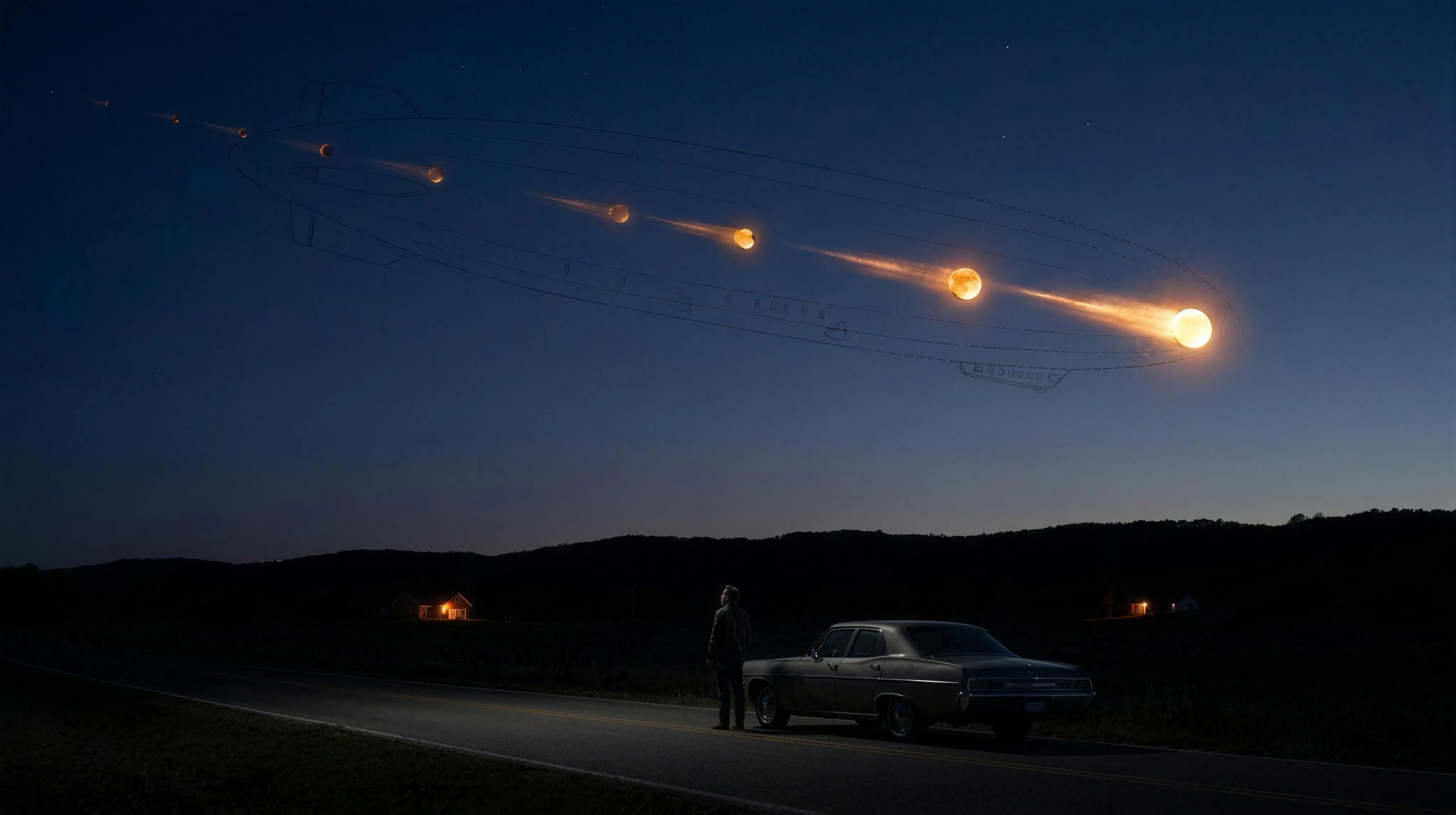
The Sky view is the witness’s side of the story: a night panorama, a fireball event playing out in real angles, and a scrub bar to replay it. Four presets span the family: the 1968-style decaying stage with its slow fragment train, the Chelyabinsk-class stone at 19.16 km/s, the 1972 grazer that leaves, and the 1913 procession. The sketch overlay draws the airship the reports described; the assumed-distance dial converts the same angular track into an implied speed and size, from airliner-at-2-km to rocket-stage-at-200-km.
The Bench is the integrator laid open: altitude against downrange on the left, coloured by computed luminosity, with breakup, dark flight and skip-out marked; speed, light curve and dynamic pressure stacked on the right. The two entry bands are shaded on the speed plot, and the strength line on the q plot is the admission price for staying whole: where q crosses it, the FRAGMENTATION chip fires.
The Two Worlds view puts the ballistic integrator beside a piloted sketch with three cheats: level off, pull up, hover. Each cheat lights up the discriminators it breaks on a six-line ledger: one-way deceleration, dead-straight track, mass-sorted train, the speed bands, bounded duration, the sound delay. The right panel is labelled MODELLED because it must be: the equations contain no thrust term to integrate.
The File view lays the record on a 1913-2021 timeline: the procession, Zond IV, the grazer, Chelyabinsk, the Falcon 9 train, and the bounds card that summarises what reentry physics requires. Below hang the two verdict cards at equal size: what the physics delivers, and where the explanation stops. Click any card to read it in full.
Why it's here
The commonest class of nocturnal light in this station's files is the light that crosses the sky and is gone. INST-38, Green Fireballs, handled the most famous family of them: LaPaz pinning them to the sky by triangulation. This instrument steps one rung upstream, to the physics question under every such sighting: what can an object falling from space into the atmosphere do, and what can it not do? The answer is startlingly specific. It must hold one of two speed bands; it only decelerates; its track is straight enough to use as a ruler; its fragment train sorts by mass and never changes formation; it is over in seconds to minutes. Every one of those five bounds can be tested against sighting data, and this instrument computes all of them for you.
There is a harder reason to pick it: of all the misidentification sources, reentry is the only one with a complete type specimen. On March 3rd, 1968, the Zond IV launch vehicle reentered over the eastern United States, and from the same train of fragments, most witnesses accurately reported glowing debris while a minority reported a cigar-shaped craft at treetop height with a row of lighted square windows. Hartmann's analysis of those letters in the Condon Report gave the airship effect its name and its file number. The 1913 Great Meteor Procession wrote the same reports before airships were common; the 2021 Falcon 9 reentry replayed them in the smartphone era, except that time the orbital catalogue named the stage within hours. Perception has not changed in a century; identification infrastructure has. This instrument sets those three nights beside the two fully instrumented cases, the 1972 grazer and Chelyabinsk 2013, on one bench. The verdict, case by case, belongs to the reader.
How it works
One integrator runs every view, and the panel tags each number as measured, reported, modelled or read.
m dv/dt = -½C_d ρAv² - mg sinγ · dm/dt = -ΛρAv³/2Q · I = -τ(v²/2)dm/dt · q = ρv² · bands: 11.2-72.8 km/s | ~7.8 km/s
The integrator is the renderer. Every trajectory, light curve, flare and dark-flight tail on the bench falls out of the single-body equations plus an exponential atmosphere. Dialled to Chelyabinsk’s published entry, it reproduces breakup near 44 km and peak brightness near 32 km against the measured 29.7, with no fitting: that agreement is why the rest of the instrument can be trusted.
The bands are bookkeeping, not opinion. Anything falling from solar orbit arrives between Earth’s escape speed and the parabolic limit; anything decaying from Earth orbit arrives near 7.8 km/s. The gap between the bands is empty, and everything slower than 7.4 km/s that glows is not reentry physics at all. The bench paints both bands on the speed plot and refuses to let a dial escape them quietly.
Breakup altitude is a strength meter. Dynamic pressure q = ρv² climbs as the air thickens; the altitude where it crosses the material’s strength is set by three orders of magnitude of difference: ~1 MPa stone breaks in the forties of kilometres, a ~kPa rocket stage near 77. The sky reports the material, and the bench computes the crossing live.
The fragment train has a grammar. Smaller pieces decelerate harder and fall behind: the train stretches, sorts by mass, never overtakes, never regroups. That grammar is what the 1968 witnesses read as a row of lighted windows, and what the sketch overlay draws a hull around.
And the witness’s problem is computed too. A ground observer measures angles only; distance, size and speed are assumptions. The assumed-distance dial runs that assumption both ways: at 2 km the Zond IV train moves like an airliner and spans an airliner’s length, which is why the treetop reports were geometrically correct under their assumption. At 200 km the same angles demand eight kilometres per second. One number separates the two stories, and no eye can measure it.
The equations are textbook and integrated as written; the bands, breakup altitudes and durations are computed live; the 1913, 1968 and 2021 testimony and the 1948 dispute are quoted from the record; the witness scene, the train masses and the entire piloted panel are disclosed as modelling choices. What the bench refuses to do is turn a mechanism into a verdict. That reentries have manufactured craft-shaped reports is documented three times across a century; whether any particular sighting in any particular file was a reentry is a case-by-case reading against bounds this bench computes for you. Both verdict cards hang at equal size, and the file stays open.
The dials that decide the night
Four events and seven dials, each a physical quantity with a real-world anchor, not a mood.
- Decaying stage / Chelyabinsk-class / Earth-grazer / The procession. The slow train, the benchmark, the one that left, and the fleet: the whole misidentification family, one click apart. Every preset is just a set of dial positions pinned to the record, and the panel shows you exactly which.
- Entry speed, 7.4 to 72.8 km/s. The dial the bands live on. 7.9 is a decaying stage; 19.16 is Chelyabinsk; the gap between 8.4 and 11.2 is deliberately dead air, because physics keeps it empty.
- Entry angle. Steep is seconds and violence; shallow is minutes; shallow enough at speed and the curvature term wins and the body leaves. The 1972 grazer is this dial at 5 degrees.
- Diameter and material. Together they set mass, strength and density: a 20 m stone survives to airburst at 30 km, a 2.5 m rocket stage shreds at 77. Material is the strength dial in disguise, and breakup altitude is how the sky reads it back.
- Assumed distance, 0.3 to 300 km. The witness dial. It changes nothing in the sky and everything in the report: the same angular track prices out as an airliner, a formation, or a reentering stage depending on this one unmeasurable number.
The cases, as they stand
Five claims from the record, with who established each and where it lands. Three are solved, one is contested in exactly the way that teaches, and the last is the reading that runs the whole file.
| The 1968 “craft with lighted windows”: the Zond IV reentry established by Hartmann’s analysis, Condon Report, 1969 | SOLVED | Solved, and promoted to type specimen. The source was identified while the letters were still arriving; the split between accurate reports and airship reports from the same sky became the textbook demonstration of the airship effect. Revisited by Hartmann in 2015 alongside Chelyabinsk. |
| The 1913 Great Meteor Procession: grazing bodies in formation established by Chant, JRASC, 1913; later trajectory analyses | SOLVED | Solved as phenomenology: grazing, near-orbital bodies level for thousands of kilometres, in groups. Witnesses wrote “a fleet of airships”. The precise origin (a temporary natural satellite is the standing proposal) remains debated; the fleet does not. |
| The 1972 Great Daylight Fireball: an Earth-grazer that left established by satellite tracking; Ceplecha’s analyses, 1979 and 1994 | SOLVED | Fully instrumented: entered over Utah at ~15 km/s, bottomed at 57-58 km, exited over Alberta ~100 s later, orbit solved twice. The file’s control case: the most craft-like flight profile in the record is pure ballistics. |
| Chiles-Whitted 1948: the cigar with windows that “pulled up” established by Project Sign 1948; Blue Book; Hartmann 2015 | CONTESTED | Contested, instructively. Two airline pilots reported a windowed cigar at close range; the passenger saw a streak of light. Later analyses read it as a bolide plus the airship effect; the reported pull-up manoeuvre is the one detail outside the physics, and it rests on testimony alone. The file’s per-case reading, in miniature. |
| Reentry as a general UAP explanation established by the bounds this bench computes | READING | Bounded, which is what makes it usable: two speed bands, one-way deceleration, straight tracks, mass-sorted trains, seconds to minutes. Sightings inside those bounds have a strong candidate; sightings genuinely outside them need something else. Per-case, always. |
Try this
- Watch the airship assemble. Decaying stage preset, sketch overlay on. The train stretches, the hull draws itself around the fragments, the windows are the fragments. Then turn the sketch off and watch the same lights become debris again. That toggle is the entire 1968 case.
- Move the witness. Drag the assumed distance from 2 km to 200 km with the train mid-sky. Implied speed runs from airliner pace to eight kilometres per second; implied size from fuselage to kilometres. Nothing in the sky changed. This is GoFast’s lesson from INST-27, replayed at night.
- Read a material off the sky. Bench view: run the Chelyabinsk-class stone and note breakup in the forties of kilometres; switch material to Craft and watch breakup jump to 77 km while q at failure drops three orders of magnitude. Breakup altitude is a strength meter: this is how analysts tell a rock from a rocket stage in one number.
- Let one leave. Earth-grazer preset, bench view: the trajectory bottoms near 60 km and rises out with the mass readout barely touched. Two minutes of fireball, no landing, no impact: 1972’s flight plan, and the answer to every report that ends “and then it just left”.
- Break the physics on purpose. Two Worlds, cheats on: level off, pull up, hover. Each one lights a ✕ on a named, checkable observable. That six-line ledger is the instrument’s deliverable: not a verdict about any sighting, but the exact list of tests a good track can be put to.
- End at the file. Read 1913, 1968 and 2021 in a row: same phenomenology, three information environments. Then the bounds card, then both verdict cards. The distance between those two cards is where every per-case reading in this station’s files actually happens.
Accuracy
The honest line between what is measured, what the record reports, what is modelled here, and what is a reading:
| Feature | Tier | What that means |
|---|---|---|
| The entry equations | T1 Measured | Classical single-body meteor physics: drag, ablation, luminosity I = -τ(v²/2)dm/dt, dynamic pressure q = ρv², an exponential atmosphere and the curvature term that lets shallow entries skip out. Integrated as written; every curve on the bench is one such integration. |
| The speed bands | T1 Measured | Meteoroids bound to the Sun arrive between 11.2 km/s (Earth escape) and ~72.8 km/s (head-on parabolic limit); decaying satellites arrive near 7.8 km/s. A luminous entry must hold one of the two bands: the cleanest single discriminator in the file. |
| Breakup as a strength meter | T1 Measured | Fragmentation begins where q crosses the material’s strength: stone near 1 MPa breaks in the forties of kilometres, a rocket stage at kilopascals breaks near 77 km. Breakup altitude reads out what the object was made of, and the bench computes it live. |
| The two instrumented cases | T1 Measured | The 1972 Great Daylight Fireball: satellite-tracked, perigee 57-58 km, ~100 s, orbit solved before and after. Chelyabinsk 2013: 19.16 km/s at 18.3°, peak radiance 29.7 km, ~500 kt, a recovered ~570 kg stone. The dials for both are pinned to the published numbers. |
| The three airship nights | T2 Reported | The 1913 procession (Chant’s hundred reports), the 1968 Zond IV letters (Hartmann’s Condon analysis), and the 2021 Falcon 9 evening. Testimony, quoted as the record states it, tagged REPORTED. |
| The witness scene and the train | T2 Modelled | The night panorama, ridge and house lights are this bench’s drawings; the fragment train uses log-spaced masses rather than a true fragmentation spectrum; fireball colours are display choices. Each is tagged MODELLED in the panel. |
| The piloted panel | T2 Modelled | The right half of Two Worlds is deliberately not integrated physics: it is a labelled sketch of what thrust, lift and intent could do, drawn so the discriminator ledger has something to break against. The bench takes no position on whether anything real has done these things. |
| What any given sighting was | T3 Reading | That reentries generate craft-shaped reports is documented three times over a century; whether any particular sighting was a reentry is a per-case reading against the bounds this bench computes. Two verdict cards hang at equal size, and the bench adds no third. |
In one line: the entry equations, the speed bands, the breakup rule and the two instrumented cases are physics you can audit live on the bench; the 1913 procession, the 1968 letters, the 2021 evening and the 1948 dispute are quoted from the record, tagged as reported; the witness scene, the train masses and the piloted panel are disclosed modelling choices; and whether any particular light in any particular file was a reentry is a per-case reading against computed bounds, on which this bench hangs two cards at equal size and adds no third. Play the night, price the assumption, and decide for yourself.
Sources
- Z. Ceplecha et al., "Meteor phenomena and bodies", Space Science Reviews 84 (1998): the single-body entry equations (drag, ablation, luminosity, dynamic pressure) this bench integrates.
- C. F. Chyba, P. J. Thomas & K. J. Zahnle, "The 1908 Tunguska explosion: atmospheric disruption of a stony asteroid", Nature 361 (1993): the pancake fragmentation model used after breakup.
- C. A. Chant, "An extraordinary meteoric display", Journal of the Royal Astronomical Society of Canada 7 (1913): the Great Meteor Procession reports, including the "fleet of airships" comparisons; later trajectory analyses extending the path over 11,000 km.
- W. K. Hartmann’s analysis of the 3 March 1968 Zond IV reentry observations in the Condon Report (Scientific Study of Unidentified Flying Objects, 1969): the cigar-with-windows letters, the excitedness effect, and the airship effect as type case.
- W. K. Hartmann, "Chelyabinsk, Zond IV, and a possible first-century fireball of historical importance", Meteoritics & Planetary Science 50 (2015): the modern revisit pairing the two events.
- The 1972 Great Daylight Fireball record: satellite-sensor tracking, entry over Utah at ~15 km/s, minimum altitude 57-58 km, exit over Alberta after ~100 s; Z. Ceplecha’s 1979 and 1994 analyses (size 3-14 m, reduced by the passage).
- O. Popova et al., "Chelyabinsk airburst, damage assessment, meteorite recovery, and characterization", Science 342 (2013); J. Borovička et al., Nature 503 (2013); P. Brown et al., Nature 503 (2013): entry 19.16 km/s at 18.3°, peak radiance 29.7 km, ~500 kt, ~1,500 injured, the ~570 kg Chebarkul stone.
- Contemporary records of the 25 March 2021 Falcon 9 second-stage reentry over the Pacific Northwest: the fragment train, the evening’s UFO-fleet reports, and the identification within hours.
- Project Sign / Blue Book records and later analyses of the 24 July 1948 Chiles-Whitted encounter, including Hartmann’s 2015 discussion: the file’s contested per-case reading.
Assemble the airship from falling debris. Then read where the explanation stops.
Open the interactiveCompiled July 2026