The Arecibo Message
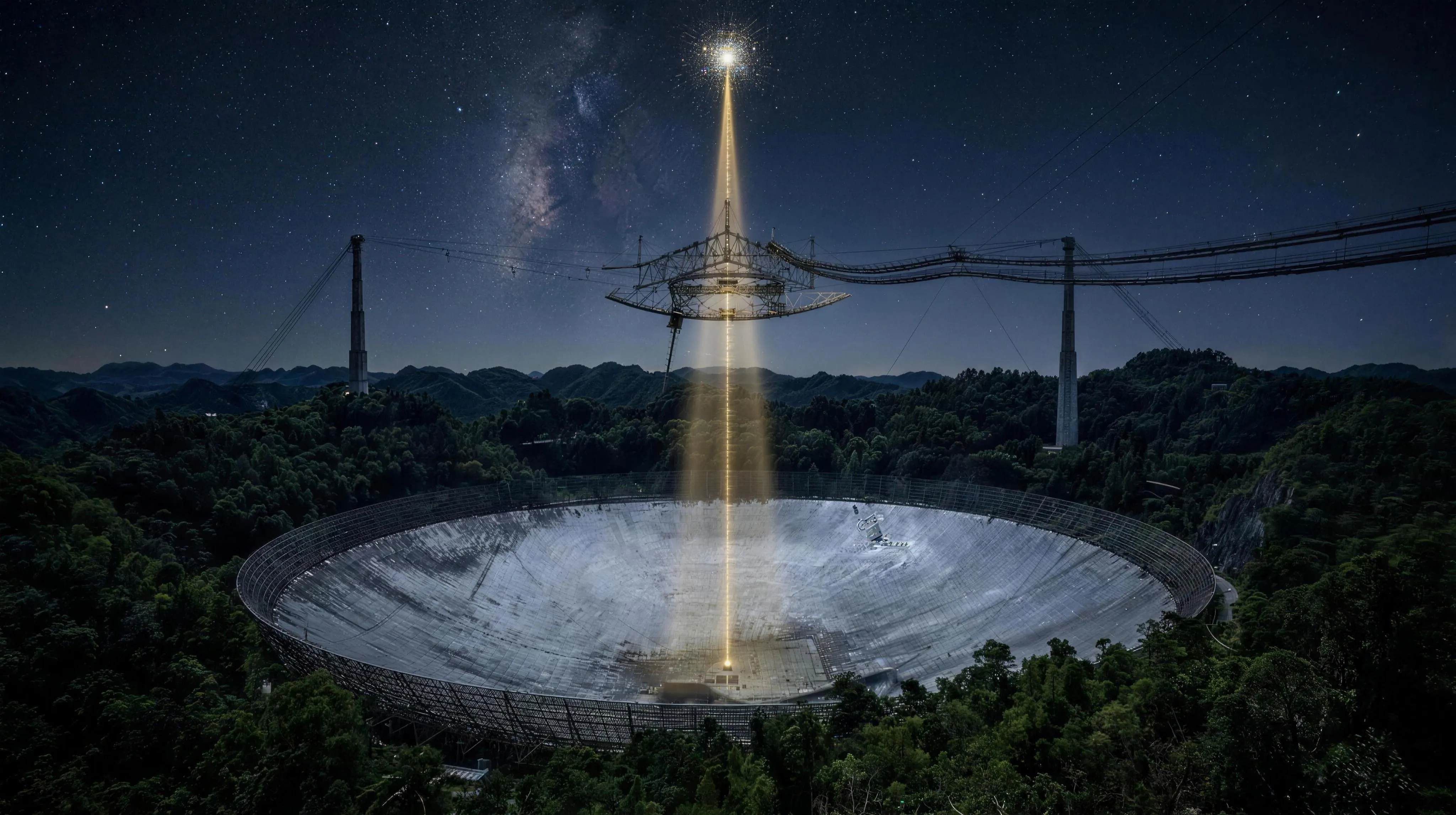
On the afternoon of 16 November 1974, at a ceremony dedicating a resurfaced dish, the Arecibo planetary radar was pointed at a cluster of a few hundred thousand stars in Hercules and run for one hundred and sixty-seven point nine seconds. It sent 1679 bits at ten a second, 450 kilowatts at 2380 megahertz, with no header, no error correction and no repeat. The length was the key: 1679 factors only as 23 by 73, so a receiver that can count gets exactly two ways to fold it and one of them draws numbers, atoms, a double helix, a human, a solar system and the telescope itself. That is the elegant half. The other half is arithmetic nobody quotes: the same transmitter and a receiver as good could read that picture to about ninety-three light years and merely notice the carrier to about three thousand, against a target twenty-five thousand light years away, from an instrument that fell into its own dish in 2020. This bench builds both halves. Send it, break the fold, compose your own, and read where the delivery stops.
 Open the interactive ▸
 What you're looking at
The Send view is the transmission in real time, or eight or thirty-two times faster if you would rather not sit through all 167.9 seconds. The beam leaves the platform toward a drawn M13, the last ninety transmitted bits ride it as visible ones and zeros in two frequency lanes, and a waterfall in the corner shows exactly what a receiver tuned to 2380 MHz would have drawn: two narrow columns taking turns. Turn on the audio to hear the same bits at a pitch ears can follow. Along the bottom, a logarithmic journey strip marks Proxima, the read range, the detect range and M13, with the wavefront sitting where it actually is today.
The Decode view is the machine that makes the message a message. Drag the width dial and the 1679 bits re-fold live, cell by cell, into whatever rectangle you ask for. At 17 the last row is ragged; at 41 the figures shear into diagonal noise; at 73, the other factor, the rows close and the picture still refuses. Snap to 23 and the whole raster lands at once, with a colour sweep running down the seven sections and each one labelled where it sits. A side column keeps the arithmetic honest: the remainder bar, the divisor ladder, and the reason the number 1679 was chosen before a single figure was drawn.
The Compose view gives you the same 23 by 73 envelope, loaded either with the 1974 message or blank, and lets you paint. Beside the grid, a log-log chart of signal-to-noise per bit against distance carries three real receiving dishes and a dashed curve for what coherent integration over the whole message buys you. Pick a target, pick a receiver, and read where your version crosses the line marked readable. Then press transmit and watch your own bits go out on the 1974 machine, because the physics does not care what the picture says.
The File view lays sixty years on a broken-scale timeline: the 1961 cryptogram that one person on Earth solved, the ceremony, the objection filed within days, the later transmissions aimed at stars close enough to answer, the Chilbolton formation, and the collapse. Below hang two verdict cards at equal size: what the message delivers, and where the delivery stops.
Why it's here
This station's SETI line has been telling two sides of one story: INST-22, the Wow! Signal and INST-23, Pulsar LGM-1 are about how we listen, and INST-19, the Drake Equation is about why we think listening is worth the trouble. This instrument adds the third side: the one time we transmitted. On 16 November 1974, at the ceremony dedicating Arecibo's resurfaced reflector, the planetary radar built for bouncing pulses off Venus and Mercury was pointed at the globular cluster M13 in Hercules and sent 1679 bits, ten a second, for 167.9 seconds, once. No repeat, no error correction, no follow-up. The most famous interstellar message humanity has ever sent runs under three minutes.
There is a reason to pick it beyond fame: it is one of the rare files in this archive where both ends are computable. One end is the encoding. 1679 is a semiprime, divisible only by 23 and 73, and that fact is itself the decoding manual, riding along inside the length of the message. You can set the fold wrong with your own hand, watch perfectly intact data shred into diagonal noise, then snap back to 23 and watch seven sections fall into place. The other end is the link budget. Transmit gain comes from the aperture, received power falls as the inverse square, and the most repeated sentence about this message, that it was detectable across the galaxy, becomes two much more honest numbers the moment it is written down: a receiver as good as Arecibo could read it to roughly 93 light years and merely detect the carrier to roughly 3,100, against an M13 sitting 25,000 light years away. This instrument does not adjudicate whether those 167.9 seconds were a message or a monument. It puts both numbers on the bench and prints its assumptions on the face of the machine.
How it works
Two pieces of arithmetic run the whole instrument, and the panel tags every number measured, reported, modelled or read.
1679 = 23 × 73 · G = η(πD/λ)² = 73.1 dBi · EIRP = 9.1 TW · S = EIRP / 4πd² · SNR = S·A / kT_sys·B
The fold is the first half. A raster needs a width, and nothing in the message states one. What the message does instead is choose a length with exactly two prime factors, so a receiver that can factor has two candidates and one of them is a picture. Every other width leaves a remainder, and the remainder is fatal in a specific way worth seeing: each row is offset from the one above by the same amount, so straight lines become diagonals and figures smear. This view exists because that failure mode is the one every real signal detection has to survive.
The link budget is the second half. A 305-metre aperture at 12.6 centimetres has a gain of about 73 dBi, which turns 450 kilowatts into roughly 9 terawatts of effective radiated power inside a beam 1.7 arcminutes wide. Received flux falls as one over distance squared. A receiver of effective area A collects S·A watts against a noise power of k·T_sys·B. Take reading the raster as an SNR of ten per bit, take detecting the carrier as coherent integration over the full 167.9 seconds against a threshold of fifteen, and the two ranges fall out: about 93 light years and about 3,100.
The message calibrates itself in the carrier. The human figure gives its height as 14, meaning fourteen wavelengths of the transmission it arrived on, which is 1.764 metres; the dish gives its diameter as 2430 wavelengths, or 306.18 metres. The receiver is already holding the ruler, because the ruler is the signal. It is the single best idea in the artifact and it costs almost no bits.
Two lines in the message have since moved. The base-pair count reads about 4.29 billion against a modern figure nearer 3.1 billion, and the solar system still has nine planets. This bench points at both instead of quietly fixing them. A message that dates its sender is doing something a corrected one could not, and any receiver clever enough to read the raster is clever enough to notice that the numbers are a snapshot.
And the journey is pure arithmetic on a date. One light year per year since November 1974 puts the wavefront about 52 light years out today, roughly 0.2% of the way to M13, with arrival around the year 26,975 and the earliest conceivable reply around 51,975. Nothing here is modelled. It is a subtraction, and it is the number that makes the rest of the argument concrete.
The bits, the transmitter numbers, the airtime and the wavefront's distance are used exactly as the record gives them. The design team, the stated intent, Drake's 1961 cryptogram, Ryle's objection and the Chilbolton formation are quoted rather than interpreted. Every reach number is textbook radio with four assumptions printed on the face of the instrument, so you can move them and watch the ranges move as the square root, which is the honest way to learn why no receiver anyone can build reaches M13. What the bench refuses to do is convert a link budget into a verdict about what the transmission meant. Two cards hang at equal size, and the file stays open.
The dials that decide what happens
One dial changes the encoding, the rest change the physics. None of them change the bits.
- Row width, 4 to 80. The whole decoding problem in one slider, with quick stops at 17, 23, 41 and 73. Every position is arithmetically valid; only one is a picture. Watch the remainder bar as you drag: when it reads zero the rows close, and when it reads anything else the figures shear.
- Target: Proxima, TRAPPIST-1, Kepler-452, M13. Four addresses spanning four orders of magnitude, from a star whose answer could arrive within a human lifetime of the sending to the cluster that was actually chosen. The readout answers with arrival year, earliest reply year and signal-to-noise per bit.
- Receiver: Green Bank 100 m, Arecibo 305 m, FAST 500 m. Three real dishes. Swapping the best receiver on Earth for the second best moves the readable range by tens of light years, which is the point: distance squared beats engineering, every time, by a lot.
- Playback rate: real time, 8×, 32×. One-times real is worth doing once. The message is genuinely under three minutes, and the length is the argument.
- Audio. Off by default. It plays the two FSK states at 660 and 880 hertz, a tenth of a second each, which is the real rhythm at an unreal pitch. It is the closest you can get to standing in the control room.
The claims, as they stand
Five claims about this message, with who established each and where it lands. Two are as settled as this file gets, one is contested by arithmetic rather than opinion, one is an open argument as old as the message, and one is a hoax that taught us something anyway.
| The message is self-decoding: the length is the key established by Frank Drake, 1974, following his own 1961 cryptogram | SOLVED | Solved, and demonstrable on this bench. 1679 has exactly two prime factors, so a receiver that can count and factor gets exactly two candidate rectangles and one of them draws figures. The instrument lets you try every other width and watch the data shred, which is the strongest argument for the design that exists. |
| It was a demonstration, not an attempt at contact established by the published record on the 1974 ceremony | SOLVED | As close to settled as intent ever gets: the record states the message was meant more as a demonstration of human technological achievement than a serious attempt to enter into a conversation. The bench prices exactly how far the demonstration reaches, and the answer, roughly 93 light years to read, makes the framing look honest rather than modest. |
| It is detectable across the galaxy established by the popular retelling, repeated for fifty years | CONTESTED | Contested by arithmetic rather than by opinion. With a twin-Arecibo receiver, 25 K system temperature and the 10 Hz bit bandwidth, the carrier is detectable to roughly 3,100 light years by integrating the whole 167.9 seconds, and the raster is readable to roughly 93. Both numbers are enormous and both fall far short of 25,000. Detectable is not readable, and neither reaches the target. |
| Transmitting at all was reckless established by Sir Martin Ryle, within days, to Drake and the IAU | READING | Open, and the same argument runs today. Ryle, a Nobel laureate and past IAU president, pressed for a resolution against transmitting without international consultation. Fifty years and several deliberate METI campaigns later there is still no agreed procedure. The bench takes no side and gives the objection the same size type as the message. |
| Someone answered at Chilbolton in 2001 established by the crop-formation reading of an edited Arecibo raster | HOAX | Hoax, on the record's own terms: the SETI Institute stated there is no evidence to suggest an other-than-earthly origin for the graphics, which appeared in a field beside a radio telescope. What the formation does demonstrate is real and more interesting: the 1974 grid has become an alphabet people write in, and it is legible enough that an edited version reads as a reply. |
Try this
- Sit through it once at 1×. The whole artifact is 167.9 seconds. Watch the bit counter climb toward 1679 and the section indicator move through numbers, atoms, nucleotides, the helix, the human, the solar system and the dish. Then notice that this is the entire transmission and that nothing was ever sent again.
- Break the fold on purpose. Decode view, drag the width slowly from 20 to 26. Watch the picture assemble, snap, and disintegrate. Perfect data, ruined by one wrong integer in the receiver. That is what a real detection looks like before someone guesses right.
- Try 73. The other prime factor closes the rows and still refuses to draw. Both folds are arithmetically legal, only one was written, and a receiver would burn about a second finding out which.
- Read the helix count. Click the double helix section. The number down its spine is about 4.29 billion base pairs, which was the 1974 estimate. That single stale figure is the most human thing in the message.
- Run the link budget against the legend. Compose view, target M13, receiver Arecibo. The per-bit SNR is around one ten-thousandth of what reading needs. Now switch to Proxima and watch the curve clear the line by orders of magnitude. Distance is doing everything.
- Compose something and send it. Blank grid, paint whatever you like, press transmit, and watch your bits go out on the 1974 machine. The airtime is identical, the reach is identical, and the picture is yours. That is the whole lesson about METI in one button.
- End at the file. The 1961 cryptogram that stumped a room of experts, then the objection filed within days, then the two verdict cards. If you leave certain about what those 167.9 seconds were, you are more certain than the record.
Accuracy
The honest line between what is measured, what the record reports, what is modelled here, and what is a reading:
| Feature | Tier | What that means |
|---|---|---|
| The 1679 bits | T1 Measured | The transmitted artifact, unedited, shipped as data and rendered bit for bit. The decode view folds this exact string; the compose view edits a copy and never touches the original. Fold it at 23 and the published raster appears because it is the published raster. |
| The transmitter | T1 Measured | 2380 MHz, 450 kW, binary frequency-shift keying about 10 Hz apart, 10 bits per second, 167.9 seconds of airtime, sent once on 16 November 1974 from the 305-metre dish. Every one of those numbers is from the record and used as written. |
| The journey | T1 Measured | One light year per year since November 1974 puts the wavefront about 52 light years out in mid-2026, arrival at M13 around the year 26,975, and the earliest conceivable reply around 51,975. This is arithmetic on a date, not a model. |
| The design and the intent | T2 Reported | Written by Frank Drake with Carl Sagan and colleagues; the published record is explicit that it was meant more as a demonstration of the instrument than a serious attempt at conversation. Drake's 1961 cryptogram, Martin Ryle's objection and the Chilbolton formation are quoted the same way, tagged REPORTED. |
| The reach numbers | T2 Modelled | Textbook radio arithmetic with four stated assumptions: transmit aperture efficiency 0.35, receiver system temperature 25 K, the 10 Hz bit bandwidth, and thresholds of SNR 10 per bit to read and 15 after coherent integration to detect. Change any of them and the ranges move as the square root, which is why no plausible receiver reaches M13. |
| The drawing | T2 Modelled | The beam cone is exaggerated by orders of magnitude to be visible at all; the real beam is 1.7 arcminutes. The star field and the cluster stars are procedural rather than catalogued. The audio plays the two FSK states at 660 and 880 Hz because a 10 Hz separation at 2380 MHz is not something ears can do. |
| What the sections mean today | T3 Reading | The base-pair count is the 1974 estimate of about 4.29 billion against a modern figure nearer 3.1 billion, and the solar system still has nine planets. The bench points at both rather than silently correcting them, because a message that dates its sender is doing something the correct version would not. |
| Message or monument | T3 Reading | One pass, 167.9 seconds, at a target two orders of magnitude beyond read range, from a transmitter that collapsed in 2020. The bench computes the budget and hangs two verdict cards at equal size. It adds no third. |
In one line: the 1679 bits, the transmitter's power and frequency, the 167.9 seconds and the wavefront's distance today are the record and simple arithmetic, auditable on the bench; the design team, the stated intent, the 1961 cryptogram, Ryle's objection and the Chilbolton formation are quoted and tagged REPORTED; every reach number is textbook radio from four assumptions printed on the instrument, tagged MODELLED; and whether a single 167.9-second pass aimed at the year 26,975 was a message or a monument is a reading, for which this bench hangs two cards at equal size and adds no third. Send it, break the fold, compose your own, and decide for yourself.
Sources
- The Arecibo message transmission record: 1679 bits sent 16 November 1974 from the 305 m Arecibo reflector at 2380 MHz and 450 kW, modulated by frequency shifting about 10 Hz at 10 bits per second, total broadcast under three minutes, aimed at the globular cluster M13 at roughly 25,000 light years, at the ceremony marking the telescope's remodelling.
- The message design: written by Frank Drake with Carl Sagan and colleagues (the credited team includes James C. G. Walker, Linda M. French and Richard Isaacman), and described in the record as meant more as a demonstration of human technological achievement than a serious attempt to enter into a conversation with possible extraterrestrials.
- The raster: 73 rows of 23 columns; the alternative 23 rows by 73 columns "produces an unintelligible set of characters". Contents in order: the numbers 1 to 10 in binary with marker bits; the atomic numbers of hydrogen, carbon, nitrogen, oxygen and phosphorus (1, 6, 7, 8, 15); the chemical formulas of the nucleotides of DNA; the double helix over a base-pair count of approximately 4,294,441,822; a human figure with height encoded as 14 wavelengths (1.764 m) and a population of approximately 4.3 billion; the Sun and nine planets with Earth displaced toward the figure; and the telescope with its diameter as 2430 wavelengths (306.18 m).
- The bit string itself is taken from OEIS A248747, the published binary sequence of the Arecibo message, and verified against the standard 23 x 73 rendering before shipping. It is carried in the instrument as a fixed data file and is never modified by the engine.
- Frank Drake's 1961 Green Bank cryptogram: 551 bits (551 = 19 x 29) mailed to the attendees of the first SETI meeting; Bernard "Barney" Oliver decoded it and replied in binary with an image of a martini glass and olive.
- Sir Martin Ryle's objection: within days of the transmission the Astronomer Royal, Nobel laureate and past president of the International Astronomical Union wrote in protest and pressed the Union to condemn transmitting, arguing that it should not be undertaken without international consultation.
- The Chilbolton formation, August 2001: a crop formation beside the Chilbolton radio telescope in Hampshire resembling a modified Arecibo message. The SETI Institute's response: "There is no evidence to suggest an other-than-earthly origin for these graphics."
- Later transmissions from the RT-70 planetary radar at Yevpatoria under Alexander Zaitsev: Cosmic Call 1999 (four stars), the Teen Age Message 2001 (six solar-type stars, August to September) and Cosmic Call 2003 (five stars). The Cosmic Call messages carried a copy of the Arecibo message among their sections.
- The collapse of the Arecibo Telescope: the 900-tonne instrument platform fell into the dish on 1 December 2020 after successive cable failures.
- The link-budget figures on this bench are computed from standard radio relations (G = eta (pi D / lambda)^2, inverse-square propagation, noise power k T B) with the assumptions printed on the instrument: transmit aperture efficiency 0.35, receiver system temperature 25 K, 10 Hz bit bandwidth, SNR 10 per bit to read and threshold 15 after 167.9 s coherent integration to detect. They are tagged MODELLED throughout.
Send the message the whole argument is about. Then read where the delivery stops.
Open the interactiveCompiled July 2026