The Drake Equation
In 1961, the night before the first SETI meeting in history, Frank Drake wrote its agenda as an equation: seven numbers which, multiplied, count the civilizations broadcasting in our galaxy right now. Three have since been measured. Four are still readings. This instrument hands you the sliders, and tags every factor by how we know it.
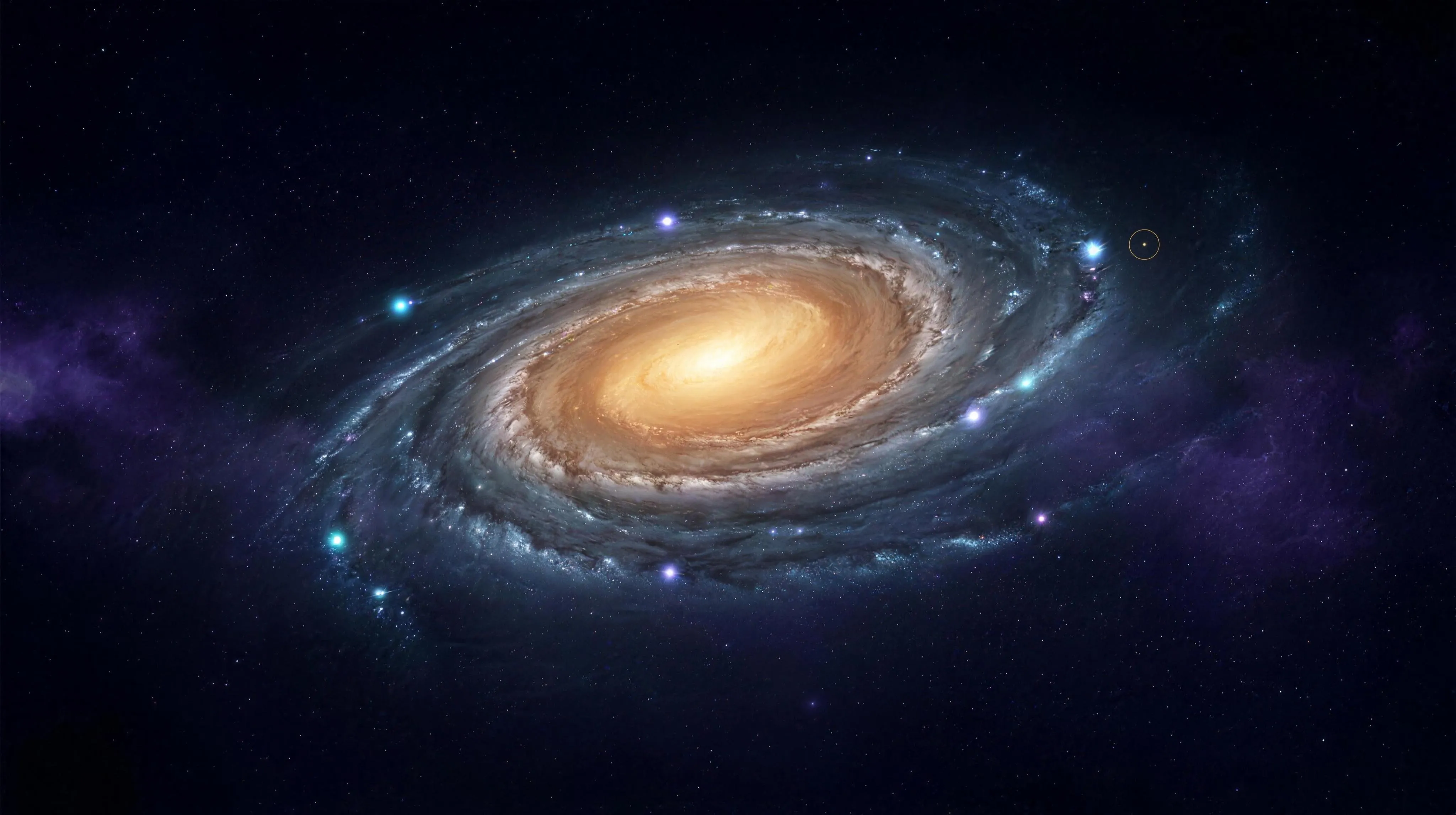 Open the interactive ▸
 What you're looking at
The Galaxy view is the answer as a place. A spiral disk 100,000 light-years across, the Sun's position marked just past halfway out one arm, and scattered through the habitable mid-disk annulus, one violet beacon for every civilization your current factor values expect to be on air right now. Drag the sliders and watch the disk fill or go dark; the status bar keeps the honest arithmetic alongside: N itself, the expected distance to the nearest neighbour, the signal round-trip time, and the probability that we are alone.
The amber ring around the Sun is us. About 110 years of radio leakage makes a bubble about 110 light-years deep, and at this map's true scale that is about two pixels across: all but invisible, which is the honest fact. The exaggeration slider that rescues it is labelled at every setting, the same contract as the sibling instruments: the drawing may be scaled, the numbers never are.
The Ledger view is the equation as an argument. Eight bars on a log scale, each the running product after one more factor, crossing or failing to cross the glowing amber line at N = 1: just us. The first bars stand green and cyan, measured and modelled; from fl onward every bar turns violet, readings, and the giant final leap is L. Below on the left, The Seven Numbers table tags each factor MEASURED, MODELLED or READING and flashes as you touch the matching slider.
Why it's here
This instrument is the gallery's master question. Every sighting, hearing and file archived on this site is, at bottom, asking the same thing: is anyone else out there. In 1961 Frank Drake split that unanswerable question into seven that could, in principle, each be answered, and wrote them as an equation to serve as the agenda of the first SETI meeting ever held. It is not a law; it is a checklist, multiplying from the stars born each year all the way down to how long a radio stays on. In the sixty-odd years since, the telescopes have genuinely answered the first three items; the last four remain readings. No equation suits this site's stance better: summarise, attribute, link, and hand the verdict, sliders included, to you.
It also gives The Periphery its statistical wing. Crop Circles and ’Oumuamua each file a case; this instrument files the prior: how many civilizations the galaxy should even contain before any case comes to trial. And it is the dark twin of The c-Wall: however large N is, put the interstellar distances and round-trip times on the readout and you see that "why don't they visit" and "why are they silent" are two halves of one question. Fermi asked it over lunch in 1950; this instrument lets you release his front yourself and watch it sweep the whole disk in under 1% of the galaxy's age. That question now has an entire instrument of its own: The Fermi Paradox.
How it works
One line of multiplication runs the whole instrument:
N = R★ · fp · ne · fl · fi · fc · L
The product is exact and yours. Seven sliders set the seven factors; N, the civilization birth rate, the nearest-neighbour distance and P(alone) are recomputed from them on every input. The logarithmic sliders (fl, fi, L and friends) are not a style choice: they are the honest shape of factors argued over orders of magnitude.
The markers are statistics, not addresses. N expected civilizations are seated at random, biased toward the arms, inside a 13,000–33,000 light-year habitable annulus: a band wide enough to contain the 7 to 9 kpc galactic habitable zone published in Lineweaver 2004. Above 2,400 the display caps and says so; below N = 1 the disk goes dark while the readout keeps the fraction.
The distances are the point. The nearest-neighbour estimate treats the seated civilizations as a Poisson field in the annulus: d ≈ 0.5/√σ. With Drake's own 1961 values that comes out about eight hundred light-years, which makes the round-trip readout near seventeen hundred years, and quietly explains why contact and visiting are such different questions.
P(alone) is the same number read backwards. If civilizations arise as a Poisson process with mean N, the chance the galaxy holds none but us is e⁻ᴺ. Watch it snap from under a percent to near-certainty as you walk the presets from Sagan's optimism to Rare Earth: that swing, not any single answer, is the honest output of the equation.
The Fermi front is a model, and tagged as one. One civilization expanding at 2% of light speed with generous stopovers crosses the disk in tens of millions of years, under 1% of the galaxy's age (Hart 1975). The front you release is time-compressed and its Myr counter runs live against the 13,000-Myr disk. What it collides with, 65 years of measured silence, gets its own MEASURED row.
R★ and fp are measurements; ne is a modelled extrapolation; fl, fi, fc and L are readings spanning orders of magnitude; the galaxy art, the annulus and the front are staging and models, tagged wherever they appear. The arithmetic between them is exact.
The presets
Six ways to set the seven numbers, from the original blackboard to the paradox's quiet dissolution.
- Green Bank 1961. Drake's blackboard values, as argued by the Order of the Dolphin. N lands near a thousand.
- The telescopes. The first three factors replaced by their modern measured and modelled values, the last four left as Drake guessed them. The equation, half-hardened.
- The optimist. Sagan-flavoured: life and minds nearly inevitable, L a million years. The disk fills with beacons; P(alone) collapses.
- Rare Earth. Ward & Brownlee: microbes common, complex life a lottery. N falls below one, us included only by luck.
- Dissolved. Sandberg, Drexler & Ord 2018: propagate honest uncertainty instead of point guesses and the silence stops being a paradox. At these settings P(alone) reads 98%; their full distributions give a 53% to 99.6% chance that we are alone in the galaxy.
- Fermi's question. A moderate galaxy plus one expanding front at 2% of c. Watch the Myr counter, then look at the silence row.
Try this
- Find our bubble. In Galaxy view drag the exaggeration slider to ×1 and watch the amber ring vanish into the Sun's dot while the readout still says 110 ly. That two-pixel ring is everything anyone could yet know about us.
- Walk the wall. In Ledger view, run Green Bank, then drag fl down one decade at a time and watch every bar right of the wall sink with it. One slider, six orders of magnitude, and the whole galaxy empties.
- Prove N ≈ L. Set the per-year factors near one, then swing L from a century to ten million years. The final bar tracks it almost exactly: Drake's summary of his own equation, drawn live.
- Race the front. Run Fermi's question and read the Myr counter as the violet ring crosses the disk: tens of millions of years against the galaxy's 13,000-Myr age. Then ask the question the preset is named after.
- Watch the tags, not the dots. Move R★ and see a green MEASURED row flash; move fl and see a violet READING flash. The two flashes are the entire epistemology of this subject.
- End on the long odds. Run Dissolved and look at P(alone) sitting near 98%, inside the 53% to 99.6% range the paper gives for our galaxy. Not "no aliens": just honesty about seven numbers, four of which nobody knows.
Accuracy
The honest line between what was measured, what was modelled, and what is read in:
| Feature | Status | What that means |
|---|---|---|
| R★ · the star formation rate: ~1.65 M☉ of new stars per year, roughly three stars | Measured | Licquia & Newman 2015, from Bayesian synthesis of radio and infrared surveys. The one factor Drake could nearly look up in 1961, and the best-pinned number in the equation today. |
| fp · the fraction of stars with planets: ≈ 1; bound planets outnumber stars | Measured | Cassan et al. 2012, Nature, from six years of microlensing, confirmed by Kepler. The single largest hardening of the equation since it was written: a 1961 guess of ~0.35 became a measurement of ~1. |
| ne · temperate rocky worlds per system: η⊕ ≈ 0.4 for Sun-like stars | Modelled | Bryson et al. 2021, from Kepler occurrence rates. Real counts underneath, but extrapolated beyond what was directly observed, and "habitable" is doing quiet work in the definition. Honestly cyan. |
| fl · the probability that life appears on a habitable world | Reading | One known sample, and it had to be positive for anyone to be asking (Spiegel & Turner 2012). Earth's early start encourages; the anthropic trap forbids computing anything from it. Published serious values span at least six orders of magnitude, which is why this slider is logarithmic. |
| fi, fc · minds, and minds that broadcast | Reading | Three billion years of single cells before one technological species; dinosaurs never built a radio. Whether intelligence is convergent or a fluke divides serious biologists, and a civilization that never leaks a signal scores fc = 0 however brilliant it is. |
| L · how long a civilization stays detectable | Reading | Drake's own summary: with the per-year factors near one, N ≈ L. Our single data point reads ~110 years and holding. A century-scale L gives a galaxy of sparks that never overlap; a ten-million-year L gives someone old and near. |
| The silence: no confirmed extraterrestrial signal in 65 years of searching | Measured | Project Ozma 1960 through Breakthrough Listen's wideband surveys (Enriquez 2017 and successors). A null result over a tiny sampled volume, but a real measurement, and the one every reading of N must survive. |
| The galaxy art, the civilization markers, the habitable annulus, the Fermi front | Illustrative | Presentation and modelling choices. The spiral is procedural, not an ephemeris; the violet dots are a statistical seating (capped at 2,400 and labelled when capped); the 13–33 kly annulus is one published reading of the galactic habitable zone; the front's 2% c with settling stops is a Hart-style model. The N, distance and probability readouts are computed from your sliders throughout. |
In one line: the star formation rate, the planet fraction and the 65-year silence are measurements; the habitable-world count is a modelled extrapolation; life, minds, radios and their lifetimes are readings argued across orders of magnitude in the sources below, and the instrument multiplies exactly, tags every factor, takes no side, and leaves the verdict to you.
Sources
- Drake, F. (1961). The Green Bank equation, written as the agenda of the first SETI meeting, National Radio Astronomy Observatory, Green Bank, West Virginia; first formal publication in Drake, F. (1965), The Radio Search for Intelligent Extraterrestrial Life.
- Cocconi, G., & Morrison, P. (1959). Searching for Interstellar Communications. Nature 184, 844. The two-page paper that made SETI a science, one year before Ozma.
- Cassan, A., et al. (2012). One or more bound planets per Milky Way star from microlensing observations. Nature 481, 167. fp ≈ 1: planets outnumber stars.
- Licquia, T. C., & Newman, J. A. (2015). Improved estimates of the Milky Way's stellar mass and star formation rate. ApJ 806, 96. R★: ~1.65 M☉/yr.
- Bryson, S., et al. (2021). The occurrence of rocky habitable-zone planets around solar-like stars from Kepler data. AJ 161, 36. η⊕ ≈ 0.37–0.60: the ne row.
- Spiegel, D. S., & Turner, E. L. (2012). Bayesian analysis of the astrobiological implications of life's early emergence on Earth. PNAS 109, 395. Why one forced-positive sample fixes almost nothing about fl.
- Ward, P., & Brownlee, D. (2000). Rare Earth: Why Complex Life Is Uncommon in the Universe. Copernicus. The pessimist preset, argued at book length.
- Hart, M. H. (1975). An Explanation for the Absence of Extraterrestrials on Earth. QJRAS 16, 128. The colonization-timescale argument behind the Fermi front.
- Sandberg, A., Drexler, E., & Ord, T. (2018). Dissolving the Fermi Paradox. arXiv:1806.02404. Propagate honest uncertainty and an empty galaxy stops being surprising.
- Enriquez, J. E., et al. (2017). The Breakthrough Listen search for intelligent life: 1.1–1.9 GHz observations of 692 nearby stars. ApJ 849, 104. The modern face of the measured silence.