Kenneth Arnold 1947
He did the one thing almost nobody in this literature does: he measured something. Kenneth Arnold started the sweep second hand of the eight-day clock on his instrument panel as the first of nine objects cleared the southern edge of Mount Rainier's snowfield, and stopped it as the last of them passed the crest of Mount Adams. One minute, forty-two seconds. The summits are 46.73 statute miles apart on a bearing of 163.9 degrees true, and he reported the objects' course as about 170: agreement to six degrees, on a number he had no way to check. That division gives 1,649 mph, Mach 2.24 at his altitude, four months before the sound barrier was officially broken and five days after a world air speed record of 623.62 mph. And the whole of it rests on a quantity nobody ever measured. Speed is exactly linear in the assumed distance, so the identical sighting yields 1,765 mph at Arnold's own twenty-three miles, 460 at Hynek's six, and 230 at the pelican reading's three. Work the two dials on this bench: bring the distance in, take the span down in the same proportion, and the image returns to exactly what it was while the speed keeps a fraction of its value. An eye receives only angular size and angular rate, and those are identical for a large far object and a small near one. That invariance is why the distance had to be assumed, and why assuming it decided everything. Two other things came out of that week and neither was his: a phrase he is never recorded saying, and a size, forty-five to fifty feet, that was a filing error about somebody else's aeroplane and was then used for decades to prove his sighting impossible.
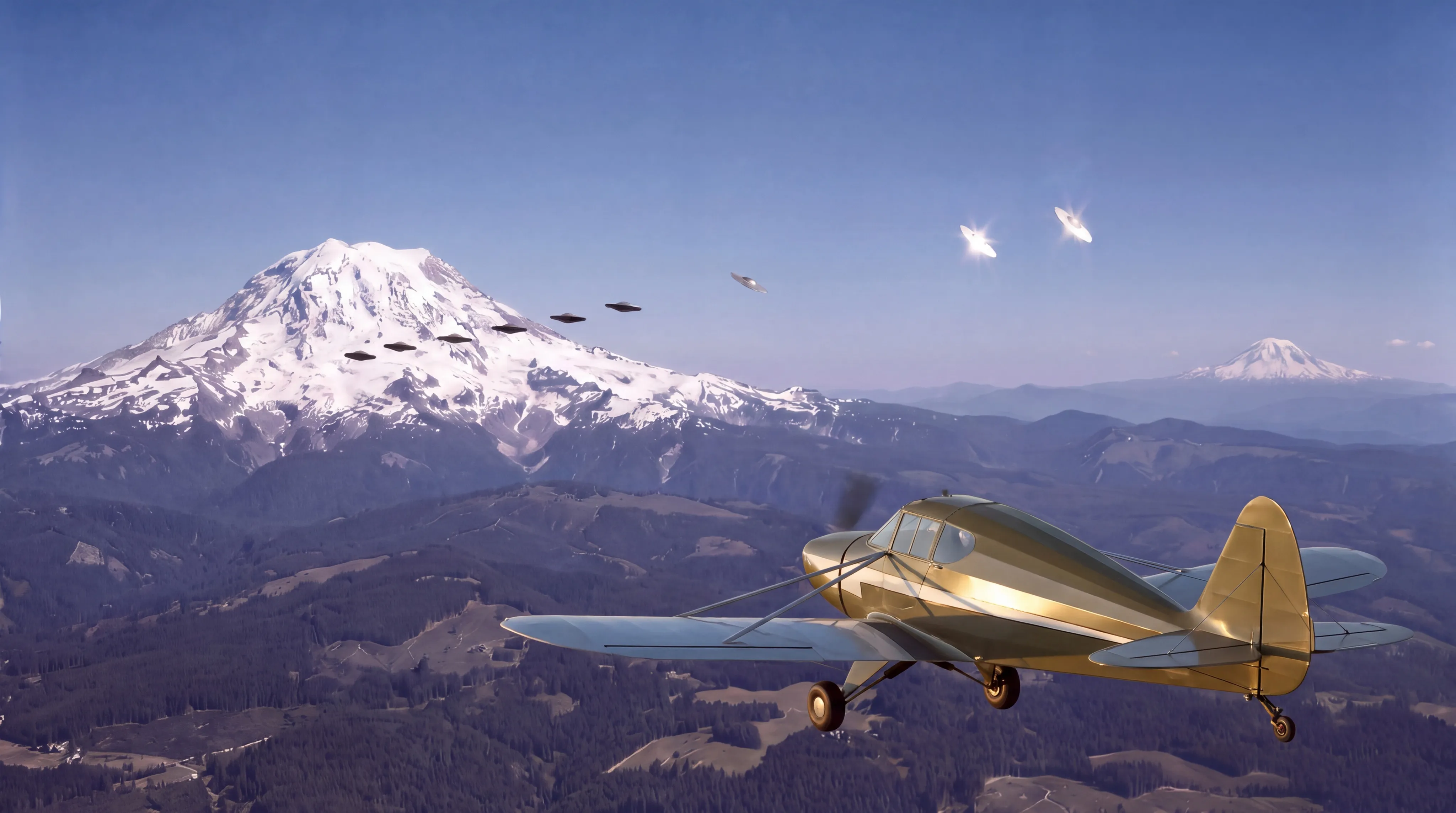 Open the interactive ▸
 What you're looking at
The Ridge view is 3D and first person because the argument is spatial: an eye at 9,200 feet, two volcanoes 46.7 miles apart on their real coordinates and 1947 heights, a 7,690-foot spur three miles west-southwest of Rainier's summit that briefly hid the objects, an 11,138-foot peak due east that could not have, and a visible horizon sitting 1.57 degrees below true level. One scene unit is one metre. Run the transit against the real 102-second clock, then drag the distance dial and watch the objects come toward you; pull the span dial down in proportion and the image returns to exactly what it was, at a fraction of the speed.
The Ledger view is the case in one line. v = d / 102 s is a straight line through the origin: every mile of assumed distance buys about 77 mph. The sound barrier and the five-day-old world record are laid across it, and every published reading is pinned where its distance puts it, from Arnold's twenty-three miles to the pelican hypothesis's three. Below the chart, the error ledger sets the term he measured, about five percent, against the term he assumed, more than sixty.
The Eye view separates three quantities the historical arguments used interchangeably: detecting a bright line at half an arcsecond, resolving two features at one arcminute, and discerning a distinctive outline at about three. Drag the span dial and watch it cross them. The DC-4 that Arnold resolved at fifteen miles is pinned as the control, and Hynek's 1956 memo is quoted verbatim with its three checkable errors set beneath it.
The Word view is thirteen dated entries from June 1947 to June 1977. Every source in the first fortnight uses saucer, pie plate and disc as shape words and gives the motion its own separate simile; the skipping-across-water image everyone can quote appears in none of them. The same timeline carries the shape drift: nine identical flat discoids in June and July, a crescent from August 1947 after an Air Force captain showed Arnold the Rhodes photograph, and by 1977 a wraith-like tadpole.
The File view is the case on ten cards, from the lost Marine transport to the sonic boom nobody reported, and two verdicts at equal size: the speed was never measured, only assumed; and the era began with a shape word and a wrong number.
Why it's here
There is no earlier brick in the casework line. Before 24 June 1947 strange things in the sky were scattered local curiosities; after it they had a name, an era, and a plaintiff who would be retried every few years. This station's Project Sign entry begins with this case, and yet Kenneth Arnold himself had no wiki entry here until this bench was built. What earns him an instrument is something else: this is one of the very few cases whose central claim reduces completely to one line of arithmetic. One timed interval, one assumed distance, one division. Seventy years of argument have all happened inside that divisor.
It picks up old threads too. INST-36, Mantell 1948, is the very next year and dies on the same unmeasured distance. INST-50, Special Report No. 14, is the Air Force's later attempt to bring statistics to all of this, and the first summer it counted is the summer Arnold detonated. INST-41, Fata Morgana, handles the stamp the Air Force put on this case: OTHER (MIRAGE). The error-propagation craft is the same as INST-58, the Nazca bench: that one asks whether ancient people could have done something, this one asks what one man alone can establish.
How it works
Five exact shelves and zero fitted constants run everything. The panel tags every number exact, modelled, reported or reading.
d, θ = haversine(summits) · v = d·f / 102 s · M = v / a(9,200 ft) · α = span / range · dip = √(2h / (7/6)R⊕)
The geodesy, exactly. Distance and bearing from published coordinates in closed form: 46.73 statute miles at 163.9 degrees true, against a reported course of about 170. The observer's stated turn point over Mineral sits 21.8 miles from Rainier and 48.3 from Adams, sweeping an arc of about 73 degrees, which opens toward Shough's 80 as Arnold flew east during the run.
The speed, exactly, and its one weakness. The travelled span over 102 seconds. The span is the summit line scaled by a distance factor, plus one chain length when the correction for his last-object stop mark is on, which is the conservatism his own arithmetic gave away. Because the relation is linear and the divisor was never measured, the bench treats distance as a dial rather than a number, and prints what every published reading implies.
The atmosphere, exactly. The International Standard Atmosphere gives 736.7 mph at 9,200 feet, so the answers carry Mach numbers rather than adjectives. The bench draws the two lines that mattered in 1947: the sound barrier, unbroken for another four months, and Colonel Boyd's world record of 623.62 mph, five days old on the afternoon of the sighting.
The horizon, exactly. The refracted dip is √(2h/kR) with k = 7/6, giving 1.57 degrees from 9,200 feet. This is the piece of schoolbook geometry that reconciles three things that had never agreed: Arnold's 'level with the horizon', the 5,000-to-7,000-foot ridges he said the objects were hugging, and the height of the cleft that occulted them.
The eye, exactly and symmetrically. Angular size is span over range in arcminutes, plotted against three separately labelled thresholds. The arithmetic rules out no one: whichever distance you choose, it hands you the size and the speed that go with it. What it does expose is that the threshold used to declare the objects impossible would also have hidden the airliner Arnold resolved in the same minutes, and no analyst on either side ever suggested he had not seen it.
What is deliberately not computed. No verdict on what the nine objects were. No probability for the case. No psychological reading of the shape drift beyond the dates themselves. Where the record is silent or human, the bench carries a label instead of a guess.
The geodesy, the speed arithmetic, the Mach numbers, the horizon dip, the angular sizes and the sun's position are exact and auditable; the Cascade foothills, the objects' drawn outline and their staged altitude are labelled models; the 102 seconds, every figure Arnold gave, the quotations, Hynek's memo, the Air Force filing and the 1947 wave counts are reported as documented; and what the nine objects were is a reading, for which the bench hangs two verdicts at equal size and adds no third.
The dials that decide what happens
One dial does almost all the work, and that is the point of the instrument: it is the dial nobody in 1947 could set.
- The distance dial. From half a mile to thirty. Everything downstream moves with it: the implied speed, the Mach number, the angular size, the physical chain length, the height the objects sit at on the apparent horizon. Nothing in the record constrains it except one occulting peak.
- The five reading presets. Arnold's own twenty-three miles, Shough's eighteen, Hynek's six, the jet-formation four, the pelican three. Each is a published position by a named analyst, and each snaps the whole bench to what that position requires.
- The chain correction. Arnold started the clock on the FIRST object at Rainier and stopped it on the LAST object at Adams, deliberately, to be sure. So in those 102 seconds the leader actually flew the summit span PLUS a chain length, and his own arithmetic left that out. The bench opens on his figure; switch the correction on and see the number he could honestly have claimed, about eleven percent higher.
- The transit, with Run. The real 102 seconds, time-lapsed six to one, along the true 164-degree line between the summits.
- The horizon reference. Draws true level and the visible horizon 1.57 degrees below it. The gap between those two lines is the entire altitude argument, so the bench draws it rather than asserting it.
- The span dial. From ten feet to three hundred, across the file's 45 to 50, Arnold's 100, Shough's 70-to-90 floor and Ruppelt's 210, so a reader can watch each one cross or fail to cross the three thresholds.
The claims, as they stand
Six positions on the founding case of the modern era, from Arnold's own supersonic figure to the pelicans, with who made each and where it lands once the arithmetic is done.
| Nine craft flew in formation at roughly 1,700 mph, more than twice the speed of sound made by Arnold, from his own map computation at Pendleton, 26 June 1947 | CONTESTED | Rests entirely on the assumed distance. The 102 seconds is well measured and his stop-mark convention was conservative; the geodesy checks out and his reported course agrees with the true bearing to six degrees. But nothing measured the range, and speed is exactly linear in it. The unanswered problem is not the arithmetic, it is that nothing at Mach 2.2 crossed forty-seven miles of Washington in daylight and left a sonic boom in a single report. |
| The objects were ordinary aircraft, much closer than Arnold thought, at about 400 mph made by J. Allen Hynek, technical analysis, memorandum of 5 June 1956 | DID NOT SURVIVE | Right instinct, unsound route. The memo takes the ATIC summary's 45 to 50 feet as Arnold's own size estimate when it was actually the file's mistaken figure for a DC-4's outer-engine span; it reads 'thickness one twentieth of the width' as 'length twenty times the width' and derives a three-foot object; and it applies a letter-reading acuity threshold as a detection limit. Ruppelt records that ATIC never adopted the conclusion anyway: no suitable aircraft could be found in the area. |
| The sighting was a mirage produced by an atmospheric inversion made by the Air Force record card for Incident 17; Donald Menzel, in six successive versions | DID NOT SURVIVE | Did not survive the geometry. A mirage is a grazing-incidence effect and needs a light source near the horizon; the sun that afternoon stood about 58 degrees up and 150 degrees round the compass, behind the observer. Mirages appear above a horizon and do not translate through seventy degrees of azimuth, and Arnold's objects were dark silhouettes against a mountainside. Menzel changed his mechanism six times across three books, which is itself a datum. |
| Arnold watched a formation of American white pelicans made by James Easton (2000), building on Martin Kottmeyer's swan suggestion (1997) | DID NOT SURVIVE | Did not survive the angles. Nine pelicans at their measured three-metre spacing make a formation about thirty-three metres long, which subtends roughly twenty-four arcminutes at three miles against the ten to fifteen degrees of chain Arnold measured off a ridge: short by a factor of about thirty. Radar-tracked pelicans top out near 37 knots. And Arnold considered and rejected birds within seconds, in print, twice, on speed and on season. |
| The objects were a daylight fireball or meteor train made by Philip J. Klass, Skeptics UFO Newsletter no. 46, July 1997 | DID NOT SURVIVE | Did not survive the clock. Nothing entering the atmosphere is slower than about 7.4 miles per second, at which the Rainier-to-Adams leg takes six seconds, not 102. Klass's own assumed speed of 10,000 mph is below every possible entry velocity. Meteors decelerate monotonically and cannot re-brighten, nothing glows at 6,000 feet, and Arnold reported the objects gaining altitude past Adams. Klass never printed the measured duration. |
| Arnold described the objects as flying like a saucer skipped across water, and was misquoted made by Arnold, from April 1950 onward, repeated for the rest of his life | READING | Contested, and important. No 1947 source contains the skipping simile: saucer, pie plate, pie pan and disc are used as SHAPE words from the first sentence ever printed, and the motion always gets its own separate image. The complaint's first documented appearance is the Murrow interview of 7 April 1950, in the same year his own drawings first show a crescent. That he felt misrepresented is real; that the press invented the shape word is not what the record shows. |
Try this
- Set the distance to 23 miles and press Run. This is Arnold's own account, exactly as he told it: nine objects, the real line, the real clock. Read the speed. Then remember that the sound barrier was still four months away.
- Now drag the distance from 23 down to 3, then take the span down with it. The speed collapses almost eightfold and the image comes back to where it started. No observer in the world could have told those two cases apart alone.
- Tap the five reading presets in order. Arnold, Shough, Hynek, jets, pelicans. Every one of them is the same 102 seconds. What separates them is not evidence about the objects; it is a judgement about what a pilot would have recognised.
- Turn the chain correction on. The number rises by about eleven percent, because Arnold gave that away on purpose. A man inflating his story does not choose the convention that shrinks it.
- On the Ridge, switch the horizon reference on and look at the two rings. The red one is what he could see; the blue one is where he thought it was. At sixteen miles that gap is over two thousand feet, and it puts the objects at exactly the height of the cleft that hid them.
- On the Eye, set the span to 50 feet at 23 miles, then to 100. Watch the marker cross the shape threshold. Then set it to the DC-4's 60 feet at 15 miles and notice where the control lands relative to the line that was used to rule the objects out.
- On the Word, drag from the first entry to the last. Read the June 1947 quotations, then the 1950 misquote claim, then the 1977 tadpole. Nothing in that sequence requires anyone to be lying.
Accuracy
The honest line between what is exact, what is modelled here, what the record reports, and what is a reading:
| Feature | Tier | What that means |
|---|---|---|
| The geodesy | T1 Exact | Published summit coordinates in closed form: Rainier to Adams is 46.73 statute miles on a bearing of 163.9 degrees true, against the objects' reported course of about 170. The press rounded the span to fifty miles, which is seven percent long, and that rounding sits inside every speed figure ever printed about this case. |
| The speed arithmetic | T1 Exact | The travelled span over the timed 102 seconds, with the span scaled by the assumed distance, and one chain length added when the correction for his last-object stop mark is switched on. The relation is linear: every mile of assumed distance buys about 77 mph. The identical sighting runs from 230 to 1,800 mph across the published readings. |
| The atmosphere | T1 Exact | The ISA speed of sound at 9,200 feet is 736.7 mph, so the summit-to-summit answer is Mach 2.24, four months before the sound barrier was officially broken and five days after a world air speed record of 623.62 mph. The event goes subsonic below 9.6 miles and below the world record below 8.1. |
| The horizon dip | T1 Exact | From 9,200 feet the visible horizon lies 1.57 degrees below true level under standard refraction, about three moon-diameters. An object on that horizon at sixteen miles sits near 7,000 feet, not 9,200, which reconciles Arnold's 'level with the horizon' with the ridge heights he described and with the cleft that occulted the objects. |
| The angular arithmetic | T1 Exact | Span over range in arcminutes, against three thresholds kept deliberately apart: detection at half an arcsecond, resolution at one arcminute, and a discernible outline at about three. A shape at 23 miles needs roughly 106 feet; the ATIC file's 45 to 50 feet subtends 1.4 arcminutes, a dot. The DC-4 Arnold resolved at fifteen miles is drawn as the control. |
| The Cascade staging | T2 Modelled | The peaks that carry arguments stand on their published coordinates and 1947 heights, but the foothills between them are shaped noise rather than a digital elevation model, and exist so the eye reads distance. The objects' drawn outline follows Arnold's June 1947 sketch, and their staged altitude places them on the apparent horizon, which is this bench's argument rather than the record's fact. |
| The record, whole | T3 Reported | The 102 seconds, every size and distance Arnold gave and how they moved, the five-mile chain, the occulting peak, all quotations with their dates and publications, Hynek's 1956 memo, Ruppelt's two ATIC factions, the Air Force's mirage filing, Fred Johnson's letter, and Bloecher's 1947 wave counts. Carried as documented, with the disagreements left visible. |
In one line: the geodesy, the speed arithmetic and its linear coupling to distance, the Mach numbers, the 1.57-degree horizon dip, every angular size and the sun's position that afternoon are EXACT and machine-checked, with no fitted constant anywhere; the Cascade foothills, the objects' drawn outline and their staged altitude are MODELLED and labelled; the 102 seconds, every size and distance Arnold gave, the quotations with their dates, Hynek's memo, Ruppelt's factions, the mirage filing and the wave counts are REPORTED as documented; and what the nine objects were is a READING, for which this bench hangs two verdicts at equal size and adds no third. Time the transit, drag the distance, and decide.
Sources
- Kenneth Arnold, report to the Commanding General, Army Air Forces, Wright Field, c. 8 July 1947, with his own hand-drawn sketches: the primary document, and the source of the 102 seconds, the twenty-to-twenty-five miles, the five-mile chain, and the thickness of one twentieth of the width. Filed as Project Sign / Blue Book Incident 17, 'Mount Rainier'.
- Nolan Skiff, East Oregonian, 25 June 1947 (the first story ever printed); Bill Bequette's Associated Press wire of the same day; and Bequette's long interview, East Oregonian, 26 June 1947, which carries the 'flat like a pie pan and somewhat bat-shaped' description, the fish-flipping motion simile, and the intervening-peak distance argument in Arnold's own words.
- Arnold's live interview with Ted Smith, KWRC radio, Pendleton, 26 June 1947: the only source in which his words survive in context and unedited, including the 1,200 mph figure he gave the press and his own error-tolerance argument that even at three or four minutes the objects exceed 800 mph.
- J. Allen Hynek, technical analysis of the Arnold case, memorandum for the Office of the Scientific Advisor, 5 June 1956 (Richard F. Haines papers, American Heritage Center, University of Wyoming): quoted verbatim on this bench, with its three checkable errors set beside it. An equivalent argument is attributed by Shough and Maccabee to the appendix of the Project Grudge final report of 27 April 1949, which this bench has not seen and cites as reported.
- Edward J. Ruppelt, The Report on Unidentified Flying Objects, 1956, chapter 2: the two ATIC factions, the 'about 210 feet long' figure, and the 0.2-arcsecond acuity claim that differs from Hynek's own threshold by a factor of nine hundred while reaching the same conclusion.
- Martin Shough, The Singular Adventure of Mr Kenneth Arnold, 147 pp., June 2010 (NARCAP/NICAP): the most detailed reconstruction available, source of the 16-to-20-mile range, the Glacier Island identification of the occulting peak, the horizon-dip argument, the refutation of Little Tahoma, and the pelican formation geometry. Its conclusions are carried here as reported, and its own uncertainties are carried with them.
- Bruce Maccabee, 'Ultimate Arnold' (1997 MUFON Symposium): the independent size reconstruction at 80 feet or larger, the DC-4 control argument, and the rebuttal of Klass's meteor hypothesis on entry-velocity grounds.
- Donald Menzel, Flying Saucers (1953), The World of Flying Saucers (1963, with Boyd) and The UFO Enigma (1977, with Taves): six successive and mutually incompatible explanations for the same sighting, from blown snow to water drops on the aircraft window, the fourth of which the Air Force adopted for its record card.
- Philip J. Klass, Skeptics UFO Newsletter no. 46, July 1997 (the meteor hypothesis); Martin Kottmeyer, REALL Newsletter, July 1997 (swans); James Easton, Voyager Newsletter nos. 10 and 13, 2000 (pelicans); with the ornithological data from O'Malley and Evans, Canadian Journal of Zoology 60 (1982) on pelican formation spacing and Alerstam et al., PLoS Biology 5(8) 2007 on radar-tracked airspeeds.
- Fred Johnson's letter to Lt Col Donald Springer, 20 August 1947, and the FBI memorandum on his follow-up interview: five or six objects seen through a telescope from about 5,000 feet in the Cascades the same afternoon, roughly thirty feet across, with his compass needle swinging while they passed. Filed separately and generally cited as the first sighting the Air Force could not explain.
- Ted Bloecher, Report on the UFO Wave of 1947 (privately produced, 1967, with an introduction by James E. McDonald): 853 sightings and 3,283 witnesses compiled from 140 newspapers in 90 cities, peaking on 6 and 7 July.
- Geodesy and physics: USGS/GNIS coordinates and 1947-correct summit heights, including Mount St Helens at its pre-1980 elevation; the International Standard Atmosphere for the speed of sound at altitude; standard terrestrial refraction at 7/6 Earth radii for the horizon dip; a Meeus low-precision solar solution for 24 June 1947, computed for both Pacific standard and daylight time, which reproduces Shough's published sun position to a third of a degree. All constants are solved and checked in scripts/arnold-tune.mjs, which is re-runnable and prints every number the instrument is allowed to carry. This bench fits no constant anywhere.
Run the 102 seconds. Drag the distance. Watch the speed collapse while the sighting stays the same. Then decide what one man alone could establish.
Open the interactiveCompiled August 2026