The Avrocar
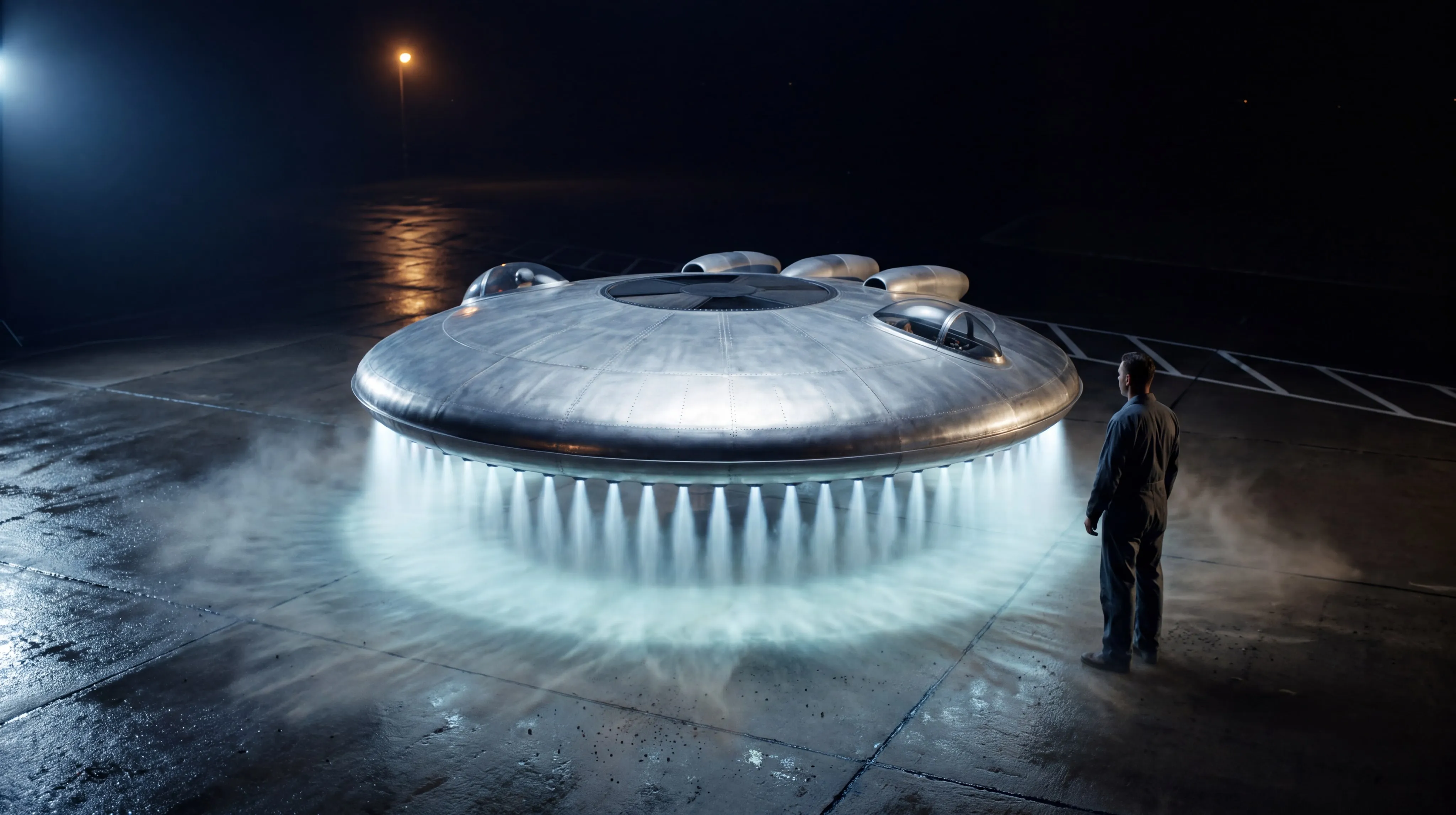
Every other saucer on this site is a claim about physics nobody has demonstrated. This one is an object you can go and stand next to. Two VZ-9 Avrocars were built, both flew, and both survive on museum floors: an eighteen-foot aluminium disc, three turbojets feeding a five-foot turborotor with 124 blades, and a cushion of trapped air holding it up. What it could not do is arithmetic on two published weights. With no ground under it the machine made 3,150 lb of lift, against an empty airframe of 3,000 lb: one hundred and fifty pounds for the pilot, the fuel and the payload together. Everything it ever did happened inside about one metre of ground, and above about two feet the cushion stopped being stable and the disc broke into the pitch and roll the programme called hubcapping. The same file that holds the Air Force's cool technical review of this aircraft also holds a 1954 memorandum arguing that circular aircraft could be mistaken for flying saucers. This instrument builds both halves: the machine, and the claim.
 Open the interactive ▸
 What you're looking at
The Rig view is the machine in 3D, at true scale, with a person standing beside it. It is 3D because the question about this aircraft is a distance: the gap between the rim of an eighteen-foot disc and the ground. Raise it and watch the cushion dim, the augmentation fall and the disc break into hubcapping past about two feet. Push it past the ceiling and there is no drama, just a machine settling because the lift is not there. A staff on the left is ticked at eighteen inches, two feet and three feet, which is the entire operating world of this aeroplane.
The Ledger view is lift against height, and it is where the aircraft is explained. The amber curve is the machine: L(h) = 3,150 + 1,038 / h pounds, anchored on two published weights and nothing else. The dashed curve above it is standard thin-jet theory, the cushion the configuration was chosen for, which it never got. The red dashed line across the bottom is 3,150 lb, the lift with no ground under it. The weights are drawn across all three, including the 150 lb bracket between the empty airframe and that red line, and a side panel prices the two losses: 1.14× through the turborotor, 0.24 of the theoretical cushion.
The Mistake view tests the file's 1954 memorandum. On the left, angular size: an 18 ft disc against the full moon and a thumb at arm's length, with a range slider, because the memo's claim is about appearance. On the right, an altitude ladder from this machine's three-foot ceiling up through the design goal, Frost's projection, and four reported altitudes this site already carries on its own instruments. Between them, two cards at equal size: what the memorandum said, and what the machine that class produced actually did.
The File view is the paper trail: a 1952 Canadian research contract, the 1953 leak, the Scientific Advisory Board's briefing at Omaha and its November 1954 report, the confusion memorandum, Doolittle's forwarding letter, the January 1955 paragraph that was cut, the KC-97 case the committee could not explain, CIRVIS, rollout, first flight, two trips to the Ames tunnel, cancellation, and two museum floors. It closes on two verdicts at equal size: it was real and it flew, and it never left the cushion.
Why it's here
The station has priced a lot of saucers. INST-32, Electrogravitics, put LaViolette's two competing thrust models on one pressure dial; the warp and Casimir benches costed negative energy. What all of them share is a claim about physics and no machine. This file contains the opposite: an actual machine. The briefing "The saucers they were building themselves" covers DOW-UAP-D095, which holds the Scientific Advisory Board's review of Avro's Project Y2, a memorandum arguing that circular aircraft could be mistaken for UFOs, a KC-97 case the Air Force recorded itself unable to explain, and the CIRVIS reporting programme. That line produced the VZ-9 Avrocar: two airframes, test pilots, a NASA wind tunnel, and both survivors on museum floors today.
It earns its place because it separates two things that usually arrive fused. The first is the engineering: a real saucer really flew, and everything it could do lived inside about a metre of ground, for reasons you can compute exactly from two published weights. The second is that 1954 memorandum, which is the most reasonable-sounding sentence in the whole saucer literature: observers unfamiliar with the technology may mistake circular-planform VTOL aircraft for UFOs. This instrument puts both on the bench and declines to merge them for you. An 18 ft disc really does match the full moon at 600 m; and the machine that class produced flew from two airfields, never above three feet, for 93.5 hours in total, twelve years after the scare it gets invoked to explain began.
How it works
One cushion law, two published weights and one fitted constant run the entire instrument, and the panel tags every number measured, reported, modelled or read.
p_c = J(1+cos θ)/h · L(h) = T + η·A·J(1+cos θ)/h = 3,150 + 1,038/h lb · h_max(W) = 1,038/(W − 3,150) m
The Avrocar is a hovercraft that wanted to be an aeroplane. The turborotor's efflux leaves as a curtain around the rim, and the curtain's momentum traps a pad of raised pressure under the disc. Thin-jet theory makes cushion pressure the curtain's momentum flux per unit length times (1 + cos θ), divided by the gap. Lift is therefore a flat thrust term plus a term in 1/h, and the standard augmentation for a circular planform is 1 + D/4h. This is textbook ground-effect machine theory, applied to an aircraft that was sold as a fighter.
Two published weights fix the whole curve. Maximum lift out of ground effect is 3,150 lb, which is the flat term with no ambiguity: no ground, no cushion. The machine held its 4,285 lb zero fuel weight at a ceiling of about three feet, which fixes the 1/h term. The result is one line, L(h) = 3,150 + 1,038/h pounds, and its rearrangement gives the ceiling for any all-up weight directly: h = 1,038/(W − 3,150) metres.
The one fitted number is the finding. Textbook augmentation at three feet is 2.5×, about 7,900 lb. The machine made 4,285. So it realised 0.24 of the cushion the theory owed it, and that constant is the only free parameter on the bench. Read it beside the other multiplier, 1.14× from a lift fan that should have returned twice its input thrust, and the engineering story is complete without a word of opinion. The technical record names the cause in one clause: excessive losses in the ducting system, which became apparent and were never resolved.
The ceiling has a pole, and the pole is the obituary. As the all-up weight falls toward 3,150 lb the ceiling runs away to infinity, and above it the ceiling collapses fast. The empty airframe is 3,000 lb. That leaves 150 lb for the pilot, the fuel and the payload combined, which is less than a pilot. Out of ground effect there is no cushion to improve, so no amount of development inside that budget moves a number of that shape.
Instability is reported, not solved. The critical height near two feet, the loss of control above it, and the leading-edge separation and reattachment cycle in forward flight are all from the record. The amplitude ramp and the waveform you watch on the bench are drawn, and the instrument says so on its own face. Fifty-two holes drilled three feet from the centre in 1961 improved hover and moved nothing else.
The weights, dimensions, speeds, dates, flight hours and the angular-size arithmetic are the record used exactly as it gives them, and where sources disagree, on maximum takeoff weight and on engine thrust, the disagreement is printed rather than resolved. The cushion law is textbook and is labelled as modelled; the single constant fitted to it is labelled as the finding. What the 1954 memorandum is entitled to explain is a reading, so the bench hangs the memorandum and the machine as two cards at equal size, and adds no third.
The dials that decide what happens
A gap, a weight, a speed and a range: four sliders, and between them the whole career of the only flying saucer that ever existed.
- The gap at the rim, 0 to 1.6 m. The distance the programme lived in. Cushion pressure goes as 1/h, so this slider is not a camera control, it is the aircraft. Eighteen inches is where it was flown; two feet is where it started to come apart; three feet is where the lift ran out at zero fuel weight.
- All-up weight, 3,000 to 7,000 lb. Empty at 3,000, zero fuel at 4,285, the two design transition weights at 5,650 and 6,970. Drag it and watch the ceiling move on the ledger. Below 3,150 lb the ceiling goes to infinity, which is the cleanest way to see that the whole problem is 150 pounds wide.
- Forward speed, 0 to 40 knots. Best free flight was 30 knots in 1960 and 20 at the final evaluation in June 1961, against a design goal of 300 mph. Add speed and the pitch cycle takes over, which is the second way the same cushion failed.
- Slant range, 50 m to 30 km. For the Mistake view. This is the memo's claim reduced to geometry: how big does an 18 ft disc look, against the moon and against a thumb, and at what range does it stop being a disc at all.
- Three flight cards. Hover as flown, forward at the best speed ever achieved, and the attempt to climb out. The third one is not a manoeuvre, it is a wall.
- Layers. The cushion, whose brightness is the share of the weight the ground is carrying; the curtain; the downwash; the scale figure and the ticked staff; and the six-foot ditch it crossed at eighteen inches, which is the part of the story usually left out.
The claims, as they stand
Six claims about the only flying saucer that was ever actually built, with who established each and where it lands today. Two are settled, two are still argued, one does not survive contact with the flight log, and one is the kind of claim no bench can close.
| The United States and Canada built a real flying saucer established by Avro Canada under John Frost, 1952-61; USAF and US Army funding | SETTLED | Settled, and often forgotten. Two VZ-9 Avrocars were built, both flew, and both survive: 58-7055 at the National Museum of the United States Air Force since 2007, 59-4975 at the U.S. Army Transportation Museum. About ten million dollars over nine years. Nothing on this bench is a reconstruction of a rumour. |
| It could not hover out of ground effect established by the programme flight test record; Lindenbaum & Blake | SETTLED | Settled, and decisive. Maximum lift with no ground under it was 3,150 lb against a zero fuel weight of 4,285 lb, and against an empty airframe of 3,000 lb. The margin for pilot, fuel and payload combined is 150 lb. The record names the cause: excessive losses in the ducting system, which became apparent and were never resolved. |
| Hubcapping was what stopped it established by the Avro and NASA Ames test programme, 1959-61 | CONTESTED | Settled as a description, still argued as a cause. Above a critical height reported near two feet the cushion ceased to be stable and the aircraft broke into pitch and roll. Fifty-two holes drilled three feet out from the centre in 1961 improved hover and moved nothing else. Whether a longer programme could have solved it is a counterfactual; the lift arithmetic above is not. |
| Circular VTOL aircraft could be mistaken for UFOs established by a 1954 memorandum in DOW-UAP-D095 | CONTESTED | Reported, and prospective. The memorandum argues the confusion is possible for observers unfamiliar with the technology and recommends re-examining reports near Soviet activity for unknown foreign types. It is a collection requirement. It names no sighting, and the file records no case it closed. |
| The Avrocar explains the flying saucer reports established by a popular inference, not a claim in the file | DID NOT SURVIVE | Did not survive contact with the flight log. The saucer scare began in 1947. This aircraft first left the ground in November 1959, flew from Malton and Moffett Field and nowhere else, logged about 93.5 hours across two airframes, never exceeded about 35 mph, and never climbed above about three feet. It is not a candidate for reports at thirteen, twenty-five or eighty thousand feet. |
| A secret version flew higher established by the recurring claim around any cancelled disc programme | READING | Open in the sense that no absence can be proven, and unsupported in every sense that matters here. Both airframes are accounted for and on public display, the wind tunnel data and the lift figures were published, and the physics of the failure is a shortfall in installed thrust rather than a control problem waiting on a better computer. The bench computes what the published numbers allow; it cannot compute what is not in the record. |
Try this
- Start at zero and lift it to eighteen inches. Watch the cushion come up and the augmentation chip climb past 1.7×. That is the aircraft working, and it is working entirely because the ground is there.
- Now go to two feet. The disc starts to wander in pitch and roll. This is hubcapping, and its onset height is from the record. Nothing on the machine changed; only the distance to the ground did.
- Push to three feet at zero fuel weight. The state chip flips to SINKING and the lift number drops under the weight. There is no failure event and no bang. The aeroplane simply runs out of ground.
- On the ledger, drag the weight down to 3,000 lb. The ceiling marker runs off the right-hand edge, and the 150 lb bracket is the only thing between the empty airframe and the flat line. That bracket is the programme.
- Compare the two curves. The dashed line is what standard theory owed this configuration; the amber line is what it got. At three feet that is 7,876 lb against 4,285. Then read the side panel: 1.14× through the fan, 0.24 of the cushion.
- In the Mistake view, set the range to 600 m. The disc is exactly moon-sized: the memo's premise is real. Now drag out to 19 km and watch it stop being a disc at all. Somewhere between those two numbers is the entire honest version of the confusion argument.
- Read the ladder from the bottom. Three feet, then eighteen inches below it, then nothing until the design goal at ten thousand. Every rung above is a figure this site carries on another instrument. Click one and it will tell you which.
- End at the file, on the January 1955 card. The office's best efforts were constantly directed to discouraging, minimising and playing down UFOs, and the article's final paragraph, which carried a UFO tie-in, was to be eliminated. Their saucer could be printed. Everyone else's could not be mentioned beside it.
Accuracy
The honest line between what is measured, what the record reports, what is modelled here, and what is a reading:
| Feature | Tier | What that means |
|---|---|---|
| The two weights | T1 Measured | Maximum lift out of ground effect, 3,150 lb, against a zero fuel weight of 4,285 lb: the pair the technical literature on the programme reports, and the pair this entire bench is anchored on. Everything else about the aircraft's performance follows from them by arithmetic. |
| The airframe | T1 Measured | An 18 ft disc, 3 ft 6 in tall, 254 sq ft of published planform, a 5 ft turborotor with 124 blades, three Continental J69-T-9 turbojets, 3,000 lb empty. The published area agrees with πD²/4 to 0.2%, which is a free check that the diameter is right. |
| The flight record | T1 Measured | Tethered 29 September 1959, free 12 November, testing halted 5 December with 18.5 hours. Best free flight 30 knots in spring 1960 and 20 at the June 1961 final evaluation. A 90 degree turn: 5 seconds left, 11 right. About 93.5 hours across both airframes, all of it at Malton and Moffett Field. |
| The angular size | T1 Measured | 2·arctan(D/2R) on a published diameter, nothing else. An 18 ft disc matches the full moon at about 600 m, fills a thumb at arm's length at about 160 m, and drops below the eye's disc resolution of roughly one arcminute beyond about 19 km. |
| Hubcapping | T2 Reported | Rapid, unpredictable swings in pitch and roll from a ground cushion that stops being stable above a critical height reported at about two feet, with a forward-flight mechanism of leading-edge separation and reattachment. The onset height and the mechanism are from the record; the amplitude ramp and the waveform on the bench are drawn, and the panel says so. |
| The design weights and goals | T2 Reported | Design transition weights of 6,970 lb in ground effect and 5,650 lb out of it; a design goal of 300 mph, 10,000 ft and 995 miles; Frost's own projection of Mach 3.5 at 100,000 ft. Some reference summaries give a maximum takeoff weight of 5,560 lb instead of 5,650, and 660 lbf per engine instead of 920; both disagreements are carried openly rather than silently resolved. |
| The cushion law | T2 Modelled | Thin-jet momentum-curtain theory (Chaplin; Stanton-Jones) gives augmentation 1 + D/4h for a peripheral jet turned to the vertical. The bench fits exactly one constant to it, the fraction of that textbook cushion the machine realised, solved from the single published pair of weights: 0.24. That number is the instrument's finding, and it is printed on the face. |
| What the memo explains | T3 Reading | The 1954 memorandum is prospective and is about intelligence collection. It names no sighting and the file records no case it closed. Whether it explains anything in the sighting record is a reading, and the bench hangs the memo and the machine as two cards at equal size and adds no third. |
In one line: the weights, dimensions, speeds, dates, flight hours and angular sizes are the record plus arithmetic, auditable on the bench, with the two source disagreements printed rather than smoothed; hubcapping's onset and mechanism, the design weights and the design goals are quoted and tagged REPORTED; the thin-jet cushion law is MODELLED, and the single constant fitted to it, 0.24 of the textbook cushion, is the instrument's finding rather than its input; and what a 1954 memorandum about a class of aircraft is entitled to explain is a reading, for which this bench hangs two cards at equal size and adds no third. Raise the gap, load it up, and decide for yourself.
Sources
- DOW-UAP-D095, "Joint U.S.-Canadian Aviation Projects and UFO Sighting Reports, 1954-1955", PURSUE Release 04, U.S. Department of War, hosted at war.gov/ufo. The file carries the Scientific Advisory Board cover on Avro Project Y2 (November 1954), the Doolittle forwarding letter of 10 December 1954, the 14 December memorandum drawing attention to its generally negative findings on technical feasibility, the 13 January 1955 memorandum for record on the Air Intelligence Digest article, the 1954 memorandum on mistaking circular-planform VTOL aircraft for UFOs, the 11 July 1955 evaluation of the KC-97 Newfoundland incident, and the 3 November 1955 memorandum on CIRVIS under AFR 200-3 and the JANAP 146 series.
- Signals from the Periphery, Release 04 Briefing 5, "The saucers they were building themselves", the site's own summary of that file, which this instrument is built from.
- Lindenbaum, B. & Blake, W., "The VZ-9 Avrocar", the American Helicopter Society technical account of the programme. Source of the two figures this bench is anchored on: maximum lift attained out of ground effect 3,150 lb, zero fuel weight 4,285 lb, therefore incapable of hover out of ground effect; and of the finding that excessive losses in the ducting system became apparent and were never resolved. Also the source for three Continental J-69 turbojets at 920 lb thrust each and the 5 ft, 124-blade turborotor.
- The technical review "Avrocar: a real flying saucer" (Advances in Aircraft and Spacecraft Science 4:4, 2017; arXiv:1507.06916): programme span 1954-1961 at about US$10 million, design transition weights of 6,970 lb in ground effect and 5,650 lb out of it, 18.5 hours on the first airframe and about 75 on the second, 30 knots reached in April 1960 and 20 at the final evaluation in June 1961, 100 knots by the modified model in the Ames tunnel, a 90 degree turn in 5 seconds left and 11 right, and the fifty-two stabilisation holes drilled radially three feet from the centre.
- Avro Canada VZ-9 Avrocar reference summaries for the dimensions and dates: 18 ft diameter, 3 ft 6 in height, 254 sq ft planform, 3,000 lb empty, first tethered flight 29 September 1959, first free flight 12 November 1959, testing halted 5 December 1959, NASA Ames 40 ft by 80 ft wind tunnel tests April 1960 and April 1961, funding ended March 1961, cancellation December 1961, serials 58-7055 and 59-4975, and the estimated-versus-actual performance table (300 mph against 35, 10,000 ft against 3, 995 miles against 79). These summaries list a maximum takeoff weight of 5,560 lb and 660 lbf per engine, both of which disagree with the technical sources above; the disagreement is printed on the instrument rather than resolved silently.
- Contract and programme history: Canadian Defence Research Board contract 1952 at CAN$400,000; the press leak of 11 February 1953; USAF contract 1955 at US$750,000; Avro private venture funding of $2.5 million in 1956; additional Air Force funding from March 1957 under Project Y-2 / Weapons System 606A; a joint-services contract of $2 million and about $700,000 more; the second airframe contracted March 1959 at $1.77 million; rollout from the Malton plant in May 1959, three months after the CF-105 Arrow cancellation. John Frost joined Avro Canada in June 1947 from de Havilland, where he had worked on the Vampire, the Hornet and the Swallow.
- The hubcapping description as the programme and its historians give it: rapid, unpredictable oscillation in pitch and roll from an unstable ground cushion above a critical height of about two feet, with flight above about three feet impossible; and in forward flight, separation over the leading edge dropping the pressure under the front of the disc, a nose-down pitch, reattachment, a pressure spike and a nose-up pitch, repeating as a limit cycle. Ames wind tunnel work also indicated the configuration would be unstable and uncontrollable at speed.
- Ground-effect theory: the thin annular-jet momentum curtain of Chaplin (1957) and Stanton-Jones (1961), in which cushion pressure is the jet momentum flux per unit length times (1 + cos θ) divided by the height, giving the standard augmentation 1 + (1 + cos θ)·D/4h for a circular planform. The bench uses it as the reference curve and fits one constant, the realised fraction, to the two published weights.
- Museum disposition: 58-7055 acquired by the National Museum of the United States Air Force in November 2007 and displayed from June 2008; 59-4975 at the U.S. Army Transportation Museum, Fort Eustis, Virginia, after a showing at Man and His World in Montreal in 1968; a replica at the Royal Aviation Museum of Western Canada.
- Cross-referenced altitudes on the ladder are the figures this site already carries on its own instruments: the GoFast trigonometric solution near 13,300 ft (INST-27), the Gimbal jet altitude of 25,000 ft (INST-28), the consensus reconstruction of Mantell's climb to about 30,000 ft (INST-36), and the reported 80,000 ft start of the 2004 Nimitz descent (INST-24).
Lift it eighteen inches. Take the ground away. Then decide what a memorandum about a class of aircraft is allowed to explain.
Open the interactiveCompiled July 2026