Electrogravitics
In 1950 a private researcher had two saucer-shaped discs circling a twenty-foot course on fifty watts, and by 1956 a London intelligence publisher was printing the names of Martin, Bell, Convair, Lockheed and Sperry as firms working on gravity control. Three years later the entire subject left the open literature and never came back. Paul LaViolette's 2008 book reads that silence as classification and builds a working antigravity programme on top of it. This instrument does not argue with the conclusion. It builds the one experiment that could settle the foundation: take the air away. Ion wind needs gas and dies without it. A real charge-to-gravity coupling does not. Pull the pressure to the floor and watch the two readings separate, then read the counter-bill the book's own author printed in chapter 12.
 Open the interactive ▸
 What you're looking at
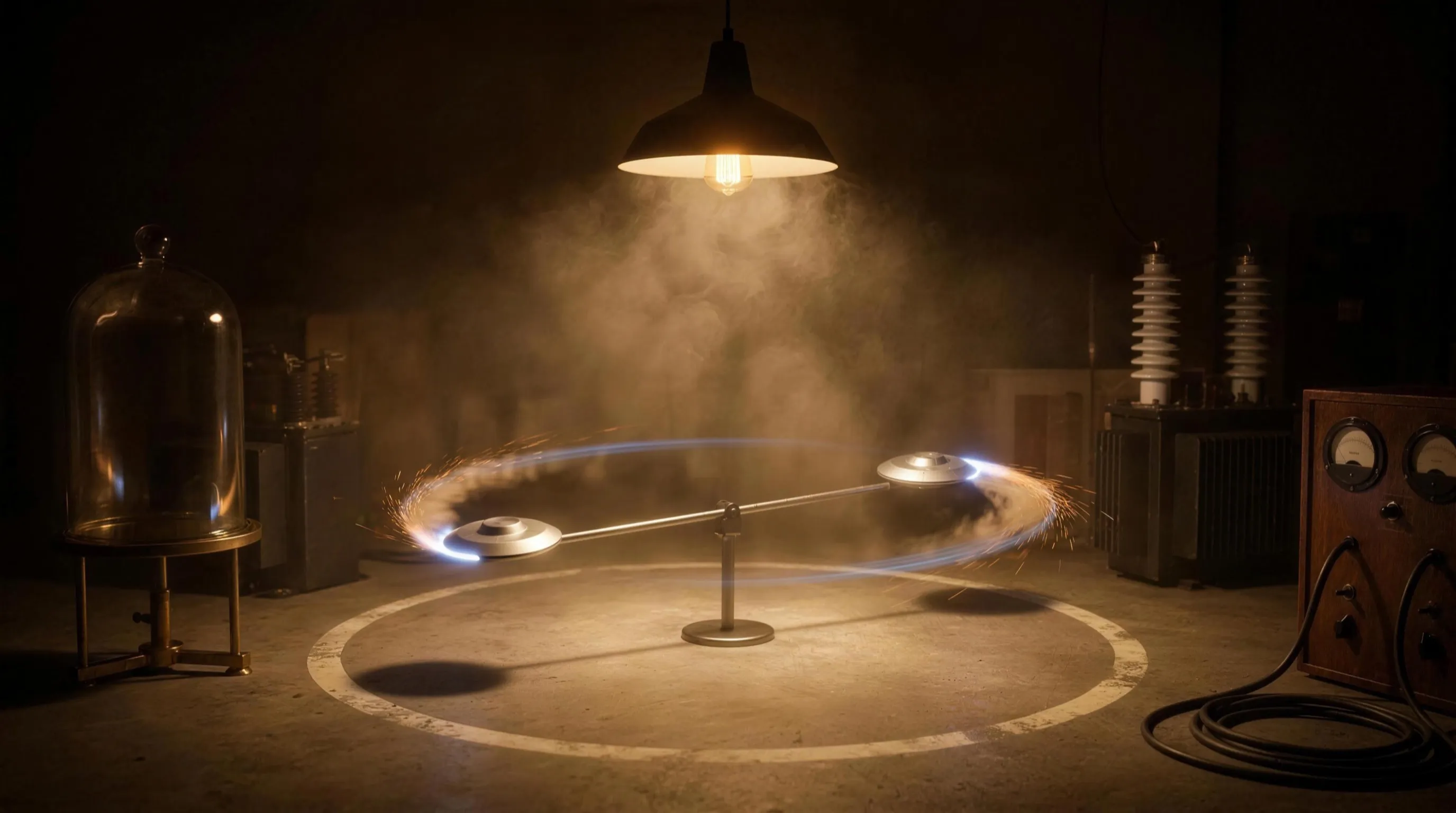
The Bench view is Brown's 1950 apparatus at real dimensions: a six foot pivoting beam, a twenty foot circular course, and two discs with a hair-thin wire charged positive along the leading edge and an aluminium body charged negative. Raise the voltage past corona onset and the wire lights; the space charge builds ahead of the wire and trails behind the body; the discs accelerate to the twelve miles an hour Brown reported at fifty kilovolts on about fifty watts. Switch on HEAT THE WIRE and the ionisation beads Turman described appear along it, evenly spaced, exactly where he found thrust rising.
The Jar view is the decisive experiment. It rebuilds the SNCASO chamber of 1955 to 1956: the bell jar, the rotor on its central bearing, the electrode pairs, and the optional Plexiglas enclosures Brown sealed them in so that no ion could escape. Drag the pressure dial down and the blue drains out of the chamber as the gas goes. Past about 150 kilovolts the gap breaks down and the rotor takes a forward kick from each discharge, which is the moment Brown said they had to cut the voltage for fear the rotor would shatter the jar.
The Craft view is the proposal, staged and labelled as one: Electrokinetics Corporation's 1960 aero-marine vehicle, seventy feet across and twenty-four feet high, with the triarcuate canopy Brown found gave the best vertical thrust. It lights its flame-jet generator, burning deliberately orange-red because incomplete combustion is what makes the charged particles, energises the ionizer, closes the toroidal vortex Brown smoke-tested on an eighteen-inch model, and lifts to twenty-five feet as the pontoons retract. Nothing at this scale was ever built, and the caption says so throughout.
The Curve view plots the corona model against LaViolette's replot of the Navy data, with the book's own caveat printed underneath, and then draws the two lines the whole case rests on: current collapsing as the chamber is pumped down while the reported thrust holds near seventeen grams. The Ledger view prices nine claims against both readings and hands four of them to the counter-bill.
Why it's here
This site has already priced several propulsion claims: Warp Energy computes what a warp ship would cost in negative energy, Laser Sail computes what an interstellar drive that actually works has to pay, and Washington 1952 puts the OFFICIAL explanation on the bench rather than the anomalous claim. This instrument brings the same discipline to electrogravitics, which is the source text for the whole suppression genre: Thomas Townsend Brown's discs, the 1956 report naming the major aerospace firms, the silence of 1959, and every book since that says they have had it all along.
It is here because this file has a property most do not: it contains a clean decisive experiment. Ion wind needs gas. Electrogravitics does not. Take the air away and the two readings must separate. This instrument takes no side; it draws both curves off the same dials and lets you pull the pressure to the floor yourself. And the counter-bill is not something this site added: LaViolette wrote it himself, in chapter 12. He replicated the most popular devices on his own side, measured nothing, printed the nulls, and concluded that ordinary ion repulsion dominates in lightweight devices. An author who will do that to his allies has earned a serious argument rather than a dismissal. The book itself is covered separately, in a source note that walks its chapters, lists the documents it recovers and marks where the chain of inference runs ahead of them. This instrument is the part of that book you can drive.
How it works
Two thrust models run off one set of dials. One is textbook corona physics. The other is built exclusively from numbers the book states about itself.
ion: F = I·d/μ, I ∝ δ·V(V − V₀), μ ∝ 1/p · electrogravitic: F ∝ n·V^2.5·g(K), independent of p · g(K): damped and floored, air→BaTiO₃ ≈ 15×
The ion branch is ordinary and unkind. Corona onset comes from a Peek-form law for the wire radius you dial, current follows V(V − V_onset) scaled by gas density, and thrust is the standard electrohydrodynamic result F = I·d/μ with ion mobility inverse in pressure. A mean-free-path cutoff kills it where the electrode gap turns collisionless, near a millionth of an atmosphere. The result scales as roughly the square of pressure, so it does not fade politely: it goes to nothing.
The electrogravitic branch uses the book's constants and only the book's. Thrust follows field nonlinearity, because chapter 4 derives it from the third derivative of the electric potential. It rises as V^2.5, splitting the difference on Brown's own stated second-to-third power. It grows with the dielectric constant, but not raw: Turman measured K² to K^2.3, and applying that over the six-thousandfold span from air to barium titanate would zero the no-dielectric bench, while Brown reported the Paris rotor thrusting with no dielectric at all. So the K term here is damped and floored, air to barium titanate a factor of about fifteen, and that damping is this site's choice, disclosed here like the rest. It is pressure-independent, because that is precisely the claim. And it is anchored to seventeen grams at 250 kilovolts with a barium titanate dielectric, which is the single figure the 1960 report gives for hard vacuum.
The Talley preset is the honest test of that model. Set it and the modelled residue at nineteen kilovolts without a high-K dielectric comes out near four ten-thousandths of a gram, well below the milligram or two that Brown's bench, Turman's balance or Talley's vacuum rig could have resolved. Be precise about what that is worth: the ONR preset returning exactly eight grams is a calibration anchor, not a test, and the 1958 disc reading 111 percent depends on a device mass this site chose. Only two figures here are genuinely out of sample, and Talley is one of them. The book's own scaling law, pinned only to the book's own favourable numbers, predicts the funded null result the book itself reports. That is not this site putting a thumb on the scale; it is what the numbers do somewhere the author did not take them.
Nothing on screen is a data point that cannot be quoted. The Curve view plots exactly two measured points, because those are the two the text gives: Cady's 47 kilovolts at three miles an hour, and Brown's reported carousel at fifty kilovolts and twelve miles an hour, on a different rig and labelled so. The book reproduces a fuller logarithmic plot. That plot is not reproduced here rather than invented from its shape.
One arithmetic error is corrected in place. The book states that 150 kilovolts accelerates electrons to about 82 percent of the speed of light. Solving γ = 1 + V/511 keV gives 0.634 c at 150 kilovolts; 0.82 c needs roughly 380. The Jar view prints the book's figure and the computed one side by side, and the evidence table flags it. Faithful does not mean credulous.
That these things move is measured. Cady's numbers and Talley's null are measured. The Paris chamber, the seventeen grams and the discs lifting past their own weight are reported, each by one source with no independent chain. The two thrust models are modelled, exactly, from stated inputs. And whether 1959 was a classification or a collapse is the reading this instrument leaves open, because the evidence genuinely does not close it. The bench computes; you conclude.
The six experiments on the dial
Every preset is a dated experiment in the book, including the two that cut against it.
- Carousel, 1950. Brown's tethered discs at fifty kilovolts on roughly fifty watts, running the twenty foot course at twelve miles an hour. Open air, no dielectric. Both models predict thrust here and the bench cannot separate them, which is the honest starting position.
- ONR test, 1952. Cady's measurement: eighteen inch discs, eight grams at 47 kilovolts, 1.5 percent efficiency. The instrument's ion branch is calibrated to this point, so the reading you get is the reading the Navy got.
- Paris vacuum, 1956. Four to five inch discs below one billionth of an atmosphere on 70 to 220 kilovolts from a 200 watt source. Watch the ion term go to zero on the readout. What is left is the book's claim, and the panel says so.
- Domed disc, 1958. The Winston-Salem geometry at 250 kilovolts with a barium titanate dielectric, lifting past 110 percent of its own weight. This is the regime the electrogravitic model is anchored in, and the only one where it predicts anything large.
- Talley, high vacuum. Nineteen kilovolts, steady, no high-K dielectric, hard vacuum. The readout falls below the detection floor and the verdict line says so. A funded, instrumented test found nothing here, and the book prints that.
- Winterhaven, 5 MV. The proposal's own extrapolation to five million volts, which it claimed would give 1,150 miles an hour in air and over 1,800 up high. It jumps you to the Craft view, and the readout answers ARCING: air breaks down near 30 kV/cm, so a gap that size flashes over around 2.7 megavolts, and past that there is no steady corona to push against, only an arc. This is the second genuinely out-of-sample result, it is ordinary high-voltage engineering rather than anything from the book, and the proposal never addresses it. An estimate in a funding document; nothing at this scale was ever flown.
The readings, as they stand
Four readings of the same bench, with who argued each and where it lands today. One leads on evidence, one is unpaid but falsifiable, one is under-explored, and one cannot be tested here at all.
| Ion wind and unbalanced electrostatic repulsion argued by Cady for the ONR 1952; Tajmar 2004; the NASA-commissioned 2004 study; and LaViolette himself, for lightweight devices | LEADING | Leading, and endorsed in part by the book it opposes. It explains the thrust, the voltage exponent, the polarity independence Turman found, and above all why seventy years of amateur replication produce thrust in air and nothing repeatable in vacuum. Its unpaid bill: it has to treat the Paris and 1960 vacuum reports as mistaken or misreported rather than engaging them, because the raw data no longer exist to check. |
| A real charge-to-gravity coupling argued by Brown from the 1920s; LaViolette via subquantum kinetics | OPEN | Open but unpaid. It is specific, quantitative and genuinely falsifiable: thrust should follow the third derivative of potential and survive in vacuum. That is a testable claim, and it is the best thing in the book. Its unpaid bill: every vacuum result supporting it is unreplicated and traceable to one man or one company, while the instrumented vacuum tests that were funded and published found nothing. |
| Real effect, wrong theory: an unmodelled electrostatic or dielectric mechanism argued by implicit in Talley's spark-plus-high-K result and in the residual-thrust reports | OPEN | Open and under-explored. Talley measured nothing under steady voltage but large thrust from spark discharges with a high-K dielectric, which is neither classic ion wind nor gravity control. If anything real is hiding in this file, this is the likeliest shape of it, and almost nobody has looked. |
| A classified programme flying the technology now argued by LaViolette chapters 5 to 9; Nick Cook; the wider suppression literature | READING | Unpaid in full. It rests entirely on reading the 1959 silence as classification, and then on anonymous testimony at two and three removes. No physical artefact, no document, no instrumented measurement. This instrument deliberately stops before this claim, because nothing on the bench can test it. |
Try this
- Run the decisive experiment. Start on Carousel 1950 and watch both thrust lines sit on top of each other. Now drag CHAMBER PRESSURE slowly to the floor. The corona current dies, the ion thrust dies with it, and whatever is left is the whole of the book's case. Note how small it is with no dielectric in the gap.
- Then add the dielectric. Still in vacuum, drag DIELECTRIC CONSTANT from air up toward barium titanate. The modelled residue climbs by more than an order of magnitude. This is why Brown told Schaffranke the thrust grew when barium titanate sat between the plates, and why Talley only saw thrust with a high-K material.
- Reproduce the funded null. Load the Talley preset and read the verdict line. The model says nothing above measurement error, at nineteen kilovolts, in vacuum, with no high-K dielectric. That is exactly what Veritay measured for Phillips Laboratory, and exactly what LaViolette reports in chapter 12.
- Find the nonlinearity. Back in air at fifty kilovolts, drag FIELD NONLINEARITY from a blunt electrode toward the one mil wire. Corona onset falls, current climbs, thrust climbs. This is the detail Brown stressed in a private letter and underplayed in his patents, and it is the most testable idea in the book.
- Fire the discharge. In the Jar view at 150 kilovolts in hard vacuum, press FIRE A DISCHARGE repeatedly. The rotor takes a kick each time and spins up, which is the runaway Brown described before they cut the voltage. Watch the readout beside it: the book's 0.82 c and the computed 0.63 c, printed together.
- Watch the craft, then read the caption. Load Winterhaven and let the sequence run: flame jet, ionizer, vortex, lift, pontoons up. It is the most beautiful thing in the instrument and it is a drawing from a 1960 corporate proposal. The caption never lets you forget which.
Accuracy
The honest line between what is measured, what is reported, what is modelled here, and what is a reading:
| Feature | Tier | What that means |
|---|---|---|
| That these devices move at all | T1 Measured | Charge an asymmetric capacitor to tens of kilovolts in air and it develops thrust toward its positive electrode. This is not disputed by anyone, sceptics included, and has been reproduced by amateurs for seventy years. The entire argument is about the mechanism, never the motion. |
| Cady's ONR figures, June 1952 | T1 Measured | The Office of Naval Research measured eighteen-inch discs at three miles an hour, eight grams of thrust at 47 kilovolts and 1.5 percent efficiency, and read the result as ion wind. Real numbers from a real instrumented test, and this instrument is calibrated to them. |
| Talley's vacuum null, and the book prints it | T1 Measured | Robert Talley at Veritay Technology, funded through Phillips Laboratory at Edwards Air Force Base, found no thrust at steady nineteen kilovolts in high vacuum. Thrust appeared only with spark discharges and only with a high-K dielectric. LaViolette reports this in chapter 12 rather than burying it. |
| The Paris vacuum tests, 1955 to 1956 | T3 Reported | Brown is said to have flown four to five inch discs and a rotor below one billionth of an atmosphere at SNCASO under French government sponsorship. This is the hinge of the entire book, and its documentation is one summary by Brown, one letter of 1973 to Rolf Schaffranke, and one 1960 corporate report. No independent measurement chain, no error analysis, no replication. |
| The 1960 curves: thrust holding while current collapses | T3 Reported | Electrokinetics Corporation's March 1960 report "Electrohydrodynamics" shows thrust near seventeen grams persisting in hard vacuum as current falls away, which is the single number the whole electrogravitic case rests on. It is a company document, never peer-reviewed and never independently reproduced. |
| The Winston-Salem discs lifting past their own weight | T3 Reported | Fifteen and eighteen inch domed saucers at Agnew Bahnson's facility are described as lifting 110 to 125 percent of their own weight at 50 to 250 kilovolts, witnessed and described in private letters. In the same correspondence Brown told Turman that no device had ever fully left the ground. |
| The ion branch: ordinary corona physics | T2 Modelled | Onset from a Peek-form law, current as V(V − V_onset) scaled by gas density, thrust as F = I·d/μ with mobility inverse in pressure, and a mean-free-path cutoff where the gap turns collisionless. It therefore dies as roughly the square of pressure, which is what ions must do. Nothing bespoke. |
| The electrogravitic branch: the book's own scalings | T2 Modelled | Thrust following field nonlinearity (the third derivative of potential, chapter 4), rising as roughly V^2.5 (Brown's stated second-to-third power), growing with the dielectric constant on a damped, floored curve (Turman measured K² to K^2.3; applied raw over air→barium titanate it would zero the no-dielectric bench, so this instrument uses a factor of about fifteen instead, and that damping is this site's choice), pressure-independent by construction, and anchored to the book's own reported seventeen grams. Every constant is the book's. The formula that combines them is not: the book states these three scalings in three separate chapters and never writes down a single law you could evaluate, so assembling one is this site's act, disclosed here rather than buried in the code. |
| One correction printed on screen | T2 Modelled | The book states that electrons accelerated through 150 kilovolts reach about 82 percent of the speed of light. The exact relativistic value is 0.634 c; 0.82 c corresponds to roughly 380 kilovolts. The Jar view prints both. Being faithful to a book does not mean repeating its arithmetic in silence. |
| What the silence of 1959 means | T3 Reading | The subject leaves the open literature almost overnight around 1959. Classification, or an enthusiasm that collapsed once careful measurement found ion wind? Everything modern in the book, the B-2 chapter included, rests on the first answer, and the book asserts it rather than arguing it against the second. This instrument does not settle it. |
In one line: that these devices move, Cady's 1952 numbers and Talley's vacuum null are measured; the Paris chamber, the seventeen grams and the discs lifting past their own weight are reported, each resting on a single source with no independent chain; the corona physics and the book's own scaling law are modelled live from stated dials, with one of the book's arithmetic errors corrected on screen; and whether 1959 was classification or collapse is a reading this instrument leaves exactly where the evidence leaves it. Pump the chamber down and decide for yourself.
Sources
- LaViolette, P. A. (2008). Secrets of Antigravity Propulsion: Tesla, UFOs, and Classified Aerospace Technology. Bear & Company. The book this instrument is built from. Chapters 1 to 3 supply the experiments, chapter 4 the theory, chapter 12 the counter-evidence, appendices A and D the primary letters.
- Brown, T. T. (1928). A method of and an apparatus or machine for producing force or motion. British patent 300,311. And US patent 1,974,483 (1934): the gravitator and gravitator motor.
- Brown, T. T. (1960, 1962, 1965). US patents 2,949,550, 3,022,430 and 3,187,206. Electrokinetic apparatus. The nose electrode, the arcuate canopy, the high-K dielectrics and the nonlinear field gradients.
- Gravity Research Group (Feb 1956). Electrogravitics Systems: An Examination of Electrostatic Motion, Dynamic Counterbary and Barycentric Control. Report GRG-013/56, Aviation Studies (International) Ltd. Reproduced in full as the book's appendix C.
- Electrokinetics Corporation (Mar 1960). Electrohydrodynamics. Bala Cynwyd, Pennsylvania. The source of the seventeen-gram vacuum figure and the thrust-versus-current curves this instrument is anchored to.
- Brown, T. T. (1968, 1971). Letters to Thomas Turman. Reproduced as the book's appendix A. The one mil wire, the blunt edge, the diurnal and sidereal cycles, and the admission that no device ever fully lifted from the ground.
- Brown, T. T. A Brief Description of Experiments Made in Paris. Reproduced as the book's appendix D. Brown's own account of the 1955 to 1956 vacuum chamber work at SNCASO.
- Talley, R. L. (1991). Twenty First Century Propulsion Concept. Phillips Laboratory report PL-TR-91-3009, Veritay Technology Inc. The funded, instrumented vacuum test: no thrust under steady voltage, thrust only from spark discharges with a high-K dielectric.
- Tajmar, M. (2004). Biefeld-Brown Effect: Misinterpretation of Corona Wind Phenomena. AIAA Journal 42(2), 315-318. An independent vacuum test of asymmetric capacitors, reporting no thrust once the corona wind is removed.
- Canning, F. X., Melcher, C., & Winet, E. (2004). Asymmetrical Capacitors for Propulsion. NASA/CR-2004-213312. The NASA-commissioned review, attributing lifter thrust to ion wind and quantifying it.
- Christenson, E. A., & Moller, P. S. (1967). Ion-neutral propulsion in atmospheric media. AIAA Journal 5(10), 1768-1773. The F = I·d/μ thrust relation this instrument's ion branch computes.
- Peek, F. W. (1929). Dielectric Phenomena in High Voltage Engineering (3rd ed.). McGraw-Hill. The corona onset law used for the wire electrodes.
- Schatzkin, P. (2005). Defying Gravity: The Parallel Universe of T. Townsend Brown. The fullest independent biography, and a useful check on the book's chronology.
- Cook, N. (2001). The Hunt for Zero Point. The genre sibling, covering the same 1950s documents from a different angle.