The Big Sur Tracking-Film Bench
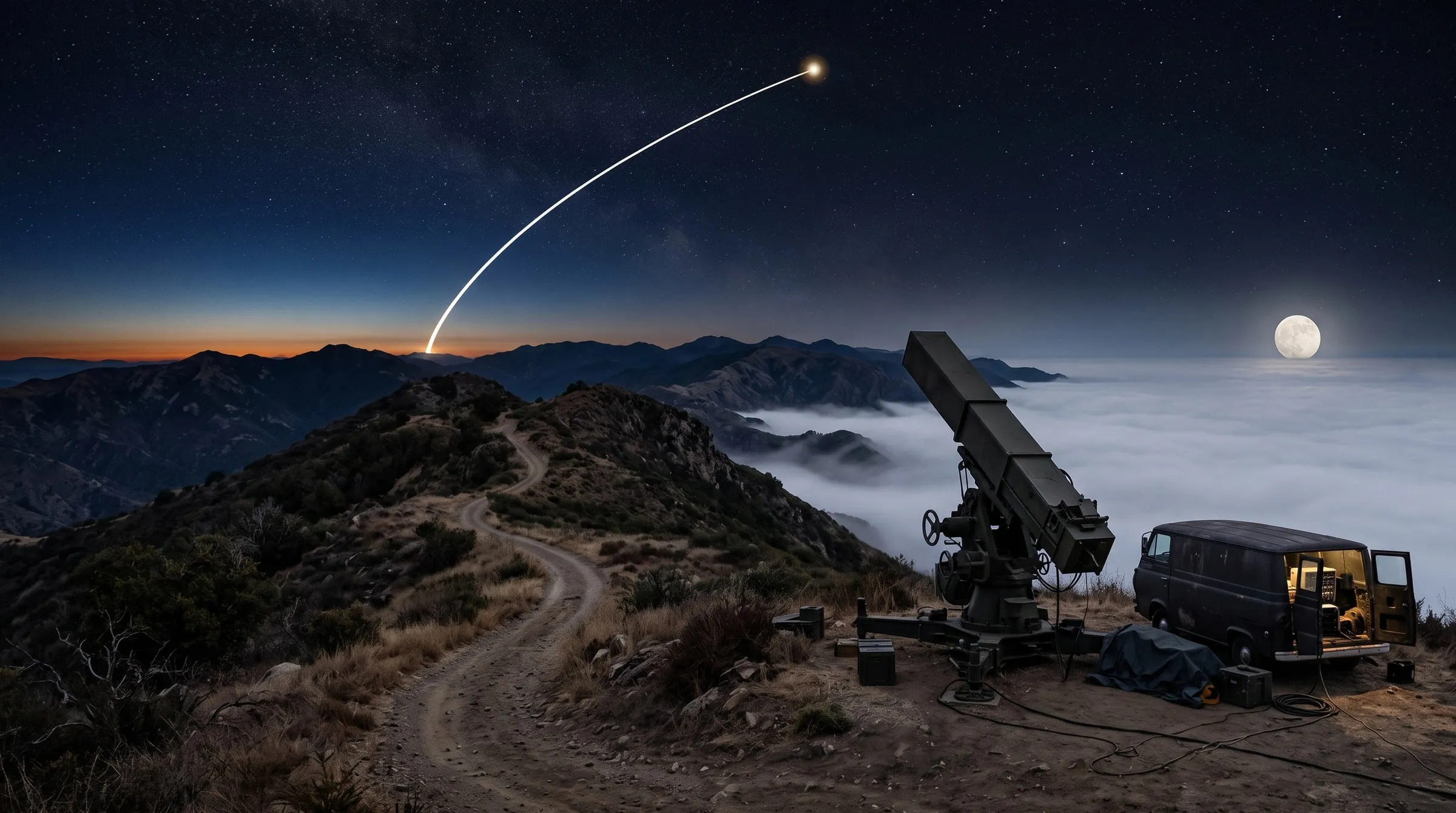
Set the clock to T+330 s on 22 September 1964 and look out west-south-west from the peak. The Atlas is 461 mi off and 22.6° up, in sunlight while the site is still dark, the Sun 8.7° below the horizon in the east and a full Moon low in the west. On the tube's 875-line raster at 720 in, one line is 0.314 arcseconds, 1.1 thousandths of an inch; at the 500 slant miles George 2009 gives for shutdown the Mark 4 reentry vehicle, 10 ft 8 in long in the museum, spans 0.83 arcseconds, 2.9 thousandths and 2.65 lines, his 1993 'between two and three scan lines', and a hundred feet of Atlas tank spans 7.8 arcseconds and 24.9 lines, his 2009 'twenty-four'. Johnson's criteria ask eight lines to recognise a shape and 12.8 to identify one: 9.8 m and 15.7 m at that range, twice that at a thousand miles. A 3.25 m sphere there in full sun is magnitude +4.7, far inside the tube's 'twelve or thirteen'. Jacobs's 'relative polar orbit' drawn at ten lines and flown in two seconds is 12.3 g; a thousand feet of film is 16,000 frames. Mansmann, as Jacobs quotes him: 'sizes undeterminable'. George 1993: 'Nothing "circled" any of the images.' The bench rules on nothing.
Keep the signal
The station is free. No ads, no tracking cookies. If the files are worth your time, following is the support.
 Open the interactive ▸
What you're looking at
The Shot is the globe in 3D, lit from where the clock puts the Sun, with the two Vandenberg pads, the peak above Big Sur and the Kwajalein atoll at their coordinates. The Atlas climbs on a modelled curve to the dialled burnout and coasts on the exact minimum-energy ellipse toward Kwajalein, bright where it stands in sunlight and dim in the Earth’s shadow; the telescope’s line runs from the peak to the vehicle at every second, with the slant range and the elevation on its label. Two launches as presets, the 15th in daylight and the 22nd before dawn; three cameras: from the peak, the side and the plan.
The Tube is the raster: the dialled lines over the dialled field, with the object drawn at the lines it spans at this range and focal length, and beside it a ladder of lines with Johnson’s four rungs (detect, orient, recognise, identify) and the sizes each needs here, the Mark 4 and the tank marked on it, and the three limits named: the pitch, the mirror’s diffraction, the seeing. Its rows price the light too: a Lambert sphere’s magnitude at this range against the eye’s 6.5 and George’s twelve or thirteen for the tube.
The Circle is Jacobs’s circuit drawn in lines around the warhead’s mark, round in the dialled frames at 30 per second, a flash at each cardinal point, with the radius in metres, the relative speed and the g it costs, and the film’s budget of 16,000 frames. The File holds the book, Jacobs’s article and rejoinder, Mansmann’s letters, Crain’s article, George’s two articles and the launch log on cards, and two cards at equal size: what Jacobs and Mansmann wrote of the film they saw, and what George wrote of the one he analysed, with the arithmetic beside each.
Why it is here
The case already has its pieces on this site: the source note on In Plain Sight in Culture, and the wiki's Big Sur Incident 1964. The note records what Ross Coulthart wrote; this bench does not retell the case. It does something else. Three men wrote about what the telescope filmed that September, and none of them measured a range. Robert Jacobs writes that an object flew into the frame, circled the warhead package in 'a relative polar orbit' and flashed four times; Florenz Mansmann wrote in 1983, as Jacobs quotes him, that 'Telescopic photography of that magnitude makes sizes undeterminable' and in 1987 'saucer-shaped. (Dome? Don't remember.)'; Kingston George writes in 1993 that the warhead's image 'would be less than six-thousandths of an inch long on the image orthicon face, or between two and three scan lines'. The casework line already holds benches of that shape: The Tremonton Film Rangefinder multiplies a film's angles by an assumed distance, and The Lubbock Thirty Degrees a Second Bench divides a rate by an unmeasured height. Big Sur joins them: the raster is fixed, the range is free.
So the instrument does two things. First it draws the arc: the minimum-energy ellipse from the Vandenberg pad to Kwajalein, the telescope's line from Anderson Peak, and the Sun at each of the two Atlas D launches the log lists for September 1964, +18.8° over the site for the 15th at 15:27 UTC and −9.8° for the 22nd at 13:10 UTC, 45 minutes before sunrise. Jacobs gives 'September 2nd, 3rd, or 15th' and 'broad daylight'; George 1993 gives the 22nd and 'before sunup'; both are presets, and the bench names neither. Then it prices the raster: an object's image is its angle times the focal length, and over the pitch that is a number of lines, so the Mark 4 reentry vehicle at the 500 mi George 2009 gives for shutdown spans 2.7 lines, his 1993 'between two and three', and a hundred feet of tank 24.9, his 2009 'twenty-four', while Johnson's criteria put recognition of a shape at eight lines, 9.8 m there. A Lambert sphere at the same place is magnitude +4.7, bright enough to register. Jacobs's circuit is priced in lines and frames: ten lines round in two seconds is 12.3 g. The sentences stay on the cards as printed, with page and issue; the bench does not say what the object was.
How it works
Everything on the bench is arithmetic on the sources’ figures, the tabulated places, vehicle, tube and criteria, and the shared sky module; the burnout, the raster’s height, the seeing, the albedo, the free range and the circuit are dials. The script that ships with the site re-derives every displayed number before the build is allowed to pass.
θ = L/R · image = f θ · pitch = H/N · lines = f θ N/H · v² = (μ/r₀)·2 sin(ψ/2)/(1 + sin(ψ/2)) · γ = (90° − ψ/2)/2 · m = −26.74 − 2.5 log₁₀((2/3) p (D/2)² φ(α)/d²) · a = 4π²r/T²
The arc. On a sphere of 6,371 km the pad is 182.5 km from the peak on a bearing of 329°, and 7,785 km from Kwajalein on 266.8°. The powered climb is a modelled curve to a burnout at T+290 s, 200 km up and 500 km downrange (the Atlas D’s 135 s booster and five-minute sustainer as tabulated; George’s "about two minutes" and "two and half minutes after that"), and from there the coast is the minimum-energy ellipse covering the remaining central angle: 6.53 km/s at 28.6°, apogee 1,455 km, 32.4 minutes in all. The line from the peak is exact on the sphere, without refraction: 494 km (307 mi) and 21.7° up at burnout, 1,170 km (727 mi) at T+400 s, 1,937 km when a thousand feet of film runs out. The Sun is Meeus’s, the Moon a truncated series, the sidereal time IAU 1982; a point is sunlit outside the Earth’s shadow cylinder, and on the 22nd the climb enters sunlight about T+226 s, 121 km up.
The tube. An object of length L at slant range R subtends θ = L/R; on a focal length f its image is f θ; a raster of N lines over a field H inches high has a pitch H/N, so the image spans f θ N/H lines. The instrument is the sources’: a 240 in basic focal length with Barlows to 2,400 (Jacobs), set to 720 in on George’s 1964 report, 875 lines at 30 frames per second (George 2009); the field is a 3-inch orthicon’s 1.6 in diagonal at 4 by 3, 0.96 in high, a dial because no source names the tube. The sizes are tabulated: the Mark 4, 10 ft 8 in by 4 ft in the museum, the Atlas F’s reentry vehicle as Wikipedia tabulates it, while George writes in 2009 that the package duplicated the Atlas F’s; the Atlas, 10.0 by 82.51 ft, and George’s "one hundred feet". Johnson’s criteria are the rungs: 1.0, 1.4, 4 and 6.4 line pairs across the smaller dimension to detect, orient, recognise and identify. The mirror’s Rayleigh limit at 550 nm is 0.227 arcseconds; the seeing is a dial; the coarsest of the three governs.
The light and the circle. A Lambert sphere of diameter D and albedo p in full sun at range d and phase angle α has m = −26.74 − 2.5 log₁₀((2/3) p (D/2)² φ(α)/d²), with φ(α) = (sin α + (π − α) cos α)/π; the phase angle comes from the geometry at the dialled second. A circuit of r metres in T seconds, relative to the warhead, is flown at 2πr/T with a centripetal acceleration 4π²r/T²; the radius is dialled in lines at the dialled range, the period in frames at 30 per second, and four flashes at the cardinal points are one per quarter period. A thousand feet of 35 mm at 16 frames per foot is 16,000 frames, 533 seconds.
No constant is fitted to the sources: they give the bench an instrument, a handful of dates, a few sentences and three line counts, and the bench computes from the tabulated places, vehicle and tube. The choices are the dials, and every finding is quoted at George’s setting and across them.
The dials that decide the result
Five presets and the free dials. Together they draw every number the three accounts attach to the film, and the dials reach any other.
- Buzzing Bee. The default: 22 September 1964, 13:10 UTC (06:10 PDT), pad 576A-3, the Sun −9.8° at the site, the full Moon 17.7° up in the west; the clock at T+330 s, 461 mi slant, 22.6° up, sunlit.
- Butterfly Net. 15 September 1964, 15:27 UTC (08:27 PDT), pad 576A-1, the Sun +18.8°, 98 minutes after sunrise; the same arc in daylight.
- George’s warhead. The Mark 4 at a free 500 mi on 720 in and 875 lines: 0.83 arcseconds, 2.9 thousandths, 2.65 lines.
- The tank at 500 mi. George’s hundred feet: 7.8 arcseconds, 27.3 thousandths, 24.9 lines. The tank at 2,000 mi: 6.2 lines.
- The dials. The clock 0 to 600 s and the burnout (240 to 300 s, 150 to 250 km, 300 to 700 km); the focal length through Jacobs’s Barlow set, 240 to 2,400 in; 525, 875 or 1,029 lines; the raster’s height 0.5 to 1.5 in; the object 0.3 to 40 m, with the Mark 4, the Atlas and George’s hundred feet marked; the seeing 1 to 10 arcseconds; the range from the arc or free, 100 to 3,000 mi; the albedo; the circuit’s radius 2 to 40 lines, its period 15 to 1,800 frames, its flashes 1 to 10 frames.
The claims, as they stand
The sources’ sentences and the tables, one by one, and where each lands when the range is a dial.
| 'The images were shot through a huge motorised telescope and captured on a 35-millimetre camera'; 'about 160 kilometres from Vandenberg' stated by Coulthart, In Plain Sight p. 51 | REPORTED | The instrument is Jacobs’s and George’s: a 24-inch mirror, 240 in basic focal length with Barlows to 2,400, 720 in on George’s report, an image orthicon at 875 lines recorded from a kinescope on 35 mm film. The pad is 182.5 km (113 mi) from the peak on the sphere; the book’s 160 km, Jacobs’s 124 mi and George’s 110 mi are printed as theirs. |
| 'the date of the event was most probably either September 2nd, 3rd, or 15th, 1964'; 'the launch we photographed was NOT predawn. It was broad daylight.' stated by Jacobs 1989, p. 5; the rejoinder | REPORTED | The log lists two Atlas D flights that month, the 15th at 15:27 UTC and the 22nd at 13:10 UTC, none on the 2nd or 3rd. The bench’s Sun at the site: +18.8° on the 15th, 98 minutes after sunrise; −9.8° on the 22nd, 45 minutes before it. Both are presets; the bench names no date. |
| 'about 60 miles straight up from planet Earth and some 300 to 500 nautical miles down range'; 'some 18 thousand miles an hour' stated by Jacobs 1989, p. 6 | REPORTED | The arc at burnout is 200 km (124 mi) up and 500 km (270 nmi) downrange at 6.53 km/s (14,600 mph); at T+400 s, 519 km up and 1,082 km (584 nmi) downrange. His figures are printed beside the arc’s; the bench names no error. |
| 'this ... "thing"...flew a relative polar orbit around our warhead package'; 'four distinct bright flashes of light at approximately the 4 cardinal compass points of its orbit' stated by Jacobs 1989, p. 6 | REPORTED | Priced as a circuit: ten lines at 500 mi is 12.3 m of radius; round in two seconds it is 39 m/s and 12.3 g relative to the warhead, a flash every 15 frames; in ten seconds, half a g. The radius, the period and the flashes are dials; no source times the circuit. |
| 'The object was saucer-shaped. (Dome? Don't remember.)'; 'What was on the film was seen only twice by Bob Jacobs ... I saw it four times.' stated by Mansmann, 6 May 1987 | REPORTED | Quoted as his, as NICAP reproduces the letter; his 1983 ‘classic disc, the center seemed to be a raised bubble’ and ‘sizes undeterminable’ as Jacobs prints them. The Tube sits beside the sentences: a shape needs eight lines to recognise and 12.8 to identify, 9.8 m and 15.7 m at 500 mi, and the lines need a range nobody measured. |
| 'The image of the warhead, even if viewed exactly side-on, would be less than six-thousandths of an inch long on the image orthicon face, or between two and three scan lines.' stated by George 1993, p. 185 | REPORTED | Reproduced: the Mark 4’s 10 ft 8 in at 500 mi on 720 in and 875 lines over 0.96 in is 0.83 arcseconds, 2.9 thousandths, 2.65 lines. The size, the range, the raster and the focal length are dials, and the lines follow. |
| 'The tank image length on the face of the IO tube (seven or eight arc-seconds) would be roughly twenty-seven thousandths of an inch at first, or perhaps twenty-four scan lines, diminishing to around two thousandths, or a single scan line, by the end of the viewing.' stated by George 2009, p. 44 | REPORTED | His hundred feet at 500 mi is 7.8 arcseconds, 27.3 thousandths, 24.9 lines; at 2,000 mi 6.2 lines and at 3,000 mi 4.1. The arc’s own range at the film’s run-out is 1,937 km (1,203 mi), where the tank spans 10.3 lines; his "roughly 3,000 miles" is printed as his. |
| 'Nothing "circled" any of the images.'; 'The small charges that released the decoys were seen as short flashes about as bright as a dim star.' stated by George 1993, p. 185 | REPORTED | Quoted as his, beside Jacobs’s circuit at equal size. The flashes’ brightness is not modelled; a Lambert sphere the Mark 4’s size at 500 mi is magnitude +4.7, inside the eye’s 6.5 and the tube’s ‘twelve or thirteen’. |
| 'our records indicate that no Atlas F missiles were launched from Vandenberg AFB, CA on 15 September 1964' stated by Vandenberg’s FOIA answer of 27 March 1987, as Crain reports it | REPORTED | The log lists an Atlas D that day at 15:27 UTC from pad 576A-1; Jacobs wrote ‘an Atlas-F as I recall strongly, but it may possibly have been an Atlas-D’. The bench prints the log and the answer side by side. |
| The Mark 4 reentry vehicle is 10 ft 8 in by 4 ft; the Atlas D 10.0 by 82.51 ft; a 3-inch image orthicon’s field 1.6 in on the diagonal; Johnson’s criteria 1.0, 1.4, 4 and 6.4 line pairs; 35 mm film 16 frames per foot stated by the National Air and Space Museum; Wikipedia; a Toshiba 5820 datasheet; read 2 October 2026 | TABULATED | Carried as tabulated and used as read; the tune checks that George’s two line counts come back from them at his 720 in and 875 lines over the datasheet’s field. |
| What the bench amounts to stated by this bench | READING | One instrument, three accounts, no measured range. The raster’s lines and focal length are the sources’, its height a datasheet’s; every line count, size and g attached to the film since is that pitch times a range someone chose. The bench prints the readings beside the sentences and rules on none of them. |
Try this
- Watch the shot. Let the clock run: the Atlas climbs out of the Earth’s shadow about T+226 s, the line from the peak lengthens past 1,000 mi before the film would have run out, and the arc dims again where it drops back into the shadow far downrange.
- Switch to Butterfly Net. The same arc a week earlier, the Sun +18.8°: the whole flight in daylight, the sky bright behind it, which George 2009 writes for the 15th and Jacobs writes for his launch.
- Open the Tube at George’s warhead. Read 2.65 lines, then set the free range to 70 mi, Mansmann’s "nuts and bolts" distance, as Jacobs quotes him, and watch the Mark 4 climb past the recognition rung.
- Change the focal length. At 2,400 in the pitch is 0.094 arcseconds, finer than the mirror’s 0.227 and than any seeing the dial allows, so the air governs; at 240 in it is 0.94 arcseconds and the tank at 500 mi is eight lines.
- Set the object to the tank. 24.9 lines at 500 mi, 6.2 at 2,000, 4.1 at 3,000: George’s "twenty-four scan lines, diminishing to around two thousandths, or a single scan line".
- Price the circle. Ten lines round in 60 frames is 12.3 g; stretch the period to 300 frames and it is half a g; widen the radius to 24 lines in 120 frames and read 7.4 g.
- Finish in the file. The two Atlas D flights of the log and the skies above each, the FOIA answers Crain reports, Mansmann’s 1987 letter, and the two cards at equal size.
Accuracy
The honest line between what is reported, what is tabulated, what is arithmetic on them, what is a choice, and what is a reading:
| Feature | Status | What that means |
|---|---|---|
| The book, the articles, the letters, the log | Reported | Coulthart, In Plain Sight pp. 51 to 53; Jacobs, MUFON UFO Journal 249 (1989), pp. 3 to 8, and his rejoinder to Klass; Mansmann's letter of 6 May 1987 as NICAP reproduces it, and his letters of 1983 as Jacobs prints them; Crain, MUFON UFO Journal 245 (1988); George, Skeptical Inquirer 17(2) (1993) and 33(1) (2009); the Vandenberg launch log. Each quoted as printed, with page, date or issue. |
| The places, the vehicle, the tube, the criteria | Tabulated | Pads 576A-1 and 576A-3 and Kwajalein from Wikipedia; Anderson Peak from OpenStreetMap, its summit's elevation from the USGS; the Atlas D's 10.0 by 82.51 ft and its burn times; the Mark 4's 10 ft 8 in by 4 ft from the National Air and Space Museum; the 3-inch orthicon's 1.6 in field from a Toshiba 5820 datasheet; Johnson's criteria; 16 frames per foot. |
| The arithmetic | Exact | The distances and bearings on a sphere; the Sun and the Moon through the site's shared sky module; the minimum-energy ellipse from the burnout state and the position at every second; the slant range, the elevation and the sunlit test; θ = L/R, the image on the tube, the lines over the pitch, the rungs' sizes; the Rayleigh limit; the Lambert sphere's magnitude; the circuit's speed and g; the film's frames. Checked in the tune against the closed forms and George's own line counts. |
| The dials, and what is staged | Modelled | The burnout's time, height and range and the climb's shape; the raster's height; the seeing; the albedo; the free range; the circuit's radius, period and flashes: the sources give none of them. The globe's texture, the markers and the vehicle's sprite are staging. The film itself, the flashes' brightness, the decoys' dynamics, the tube's transfer below the raster, the Earth's rotation during the flight and Venus's place are not modelled. |
| What it amounts to | Reading | What the film showed, which launch it was and which of the two readings the lines and the skies fit is a reading, and the bench declines to make it for you; the two reading cards sit at equal size. |
In one line: Every sentence of the book, the articles and the letters is quoted as printed and attributed; the instrument’s figures are the sources’ own; the places, the vehicle, the field and the criteria are the published tables; the burnout, the raster’s height, the seeing, the albedo, the range and the circuit are named as choices; and what the film showed is left with the reader, where the bench leaves everything about the case.
Sources
- Coulthart, R. (2021) In Plain Sight: An Investigation into UFOs and Impossible Science (HarperCollins Australia), pp. 51 to 53: the telescope and the 35 mm camera, the 160 kilometres, Jacobs’s account of the screening and the 16 mm copy, Mansmann’s "domed disc" as Jacobs relays it, the letters. The site’s source note on the book.
- Jacobs, B. (1989) "Deliberate Deception: The Big Sur UFO Filming" MUFON UFO Journal 249, pp. 3 to 8: the 24-inch mirror and the 240 in focal length, the Barlows to 2,400 in, the kinescope and the 35 mm film, the "300 to 800 nautical miles", the site at 3,400 ft near Anderson Peak, the 124 miles, the dates, the "T + 400 seconds", the "60 miles straight up", the "relative polar orbit", the four flashes, the dome, the "laser tracking". Jacobs, B. (undated, after January 1993) "Low Klass: A Rejoinder" (NICAP): "broad daylight", the chaff, Venus and the Moon, and Mansmann’s letters of 30 January 1983, 8 March 1983 and 28 November 1991 as it prints them.
- Mansmann, F. J. (1987) letter to T. Scott Crain Jr., 6 May 1987, two pages, as NICAP reproduces it: the four screenings, "saucer-shaped. (Dome? Don’t remember.)", the signature. Crain, T. S. Jr. (1988) "UFO Filmed Circling Atlas Rocket" MUFON UFO Journal 245: the FOIA answers of 10 and 27 March 1987, "some 60 miles above the Pacific Ocean", "Two days later".
- George, K. A. (1993) "The Big Sur ‘UFO’: An Identified Flying Object" Skeptical Inquirer 17(2), pp. 180 to 187: the deployment, the B.U. Scope on its gun mount, the image orthicon, Buzzing Bee before sunup on 22 September, the sequence on the monitor, the thousand feet of film, the warhead at two to three scan lines, the flashes as decoy charges, "Nothing "circled"", the decoys and the packing, the film destroyed. George, K. A. (2009) "‘Buzzing Bee’ Missile Mythology Flies Again" Skeptical Inquirer 33(1), pp. 42 to 46: the 240 in basic focal length, 875 lines at 30 frames per second, 720 in on the 1964 report, the tube’s twelve or thirteen magnitudes, the tank at seven or eight arcseconds and 24 lines to one, the two Atlas D launches and their skies, "roughly 3,000 miles".
- Encyclopedia Astronautica, "Vandenberg" launch log (read 2 October 2026): Atlas D from 576A1 on 15 September 1964 at 15:27 GMT; Atlas D from 576A3 on 22 September 1964 at 13:10 GMT; the month’s other launches.
- Reference tables, read 2 October 2026: Wikipedia "Vandenberg Launch Complex 576A" (the pads’ coordinates), "SM-65D Atlas" (10.0 ft by 82.51 ft; the 135 s booster and the five-minute sustainer; the Mark 4 on the Atlas E and F), "Kwajalein Atoll", "Nike Zeus" (4,800 miles from California), "Johnson’s criteria" (1.0, 1.4, 4 and 6.4 line pairs), "35 mm movie film" (16 frames per foot), "Daylight saving time in the United States" (California’s Proposition 12 of 1949); the National Air and Space Museum’s Reentry Vehicle, Mark 4 (A19660029000: 10 ft 8 in by 4 ft); a Toshiba 5820 image orthicon datasheet (a 1.6 in diagonal field at 4 by 3); OpenStreetMap node 358800763 "Anderson Peak" (36.1808° N, 121.6427° W) and the USGS 3DEP elevation at it (4,079 ft).
- The site’s shared sky module public/lib/astro.js (Meeus’s Sun, a truncated-series Moon, IAU 1982 sidereal time), first shared by the Lubbock bench and audited against JPL Horizons in INST-64’s tune; the Blue Marble globe texture served for the Landing Corridor (INST-77).
- On this site: The Tremonton Film Rangefinder (INST-90) and The Lubbock Thirty Degrees a Second Bench (INST-95), the casework benches of the same shape; The Reflection Bench (INST-51), which priced the specular glint of a sunlit aircraft; the wiki node Big Sur Incident 1964; the source note on In Plain Sight.