Green Fireballs
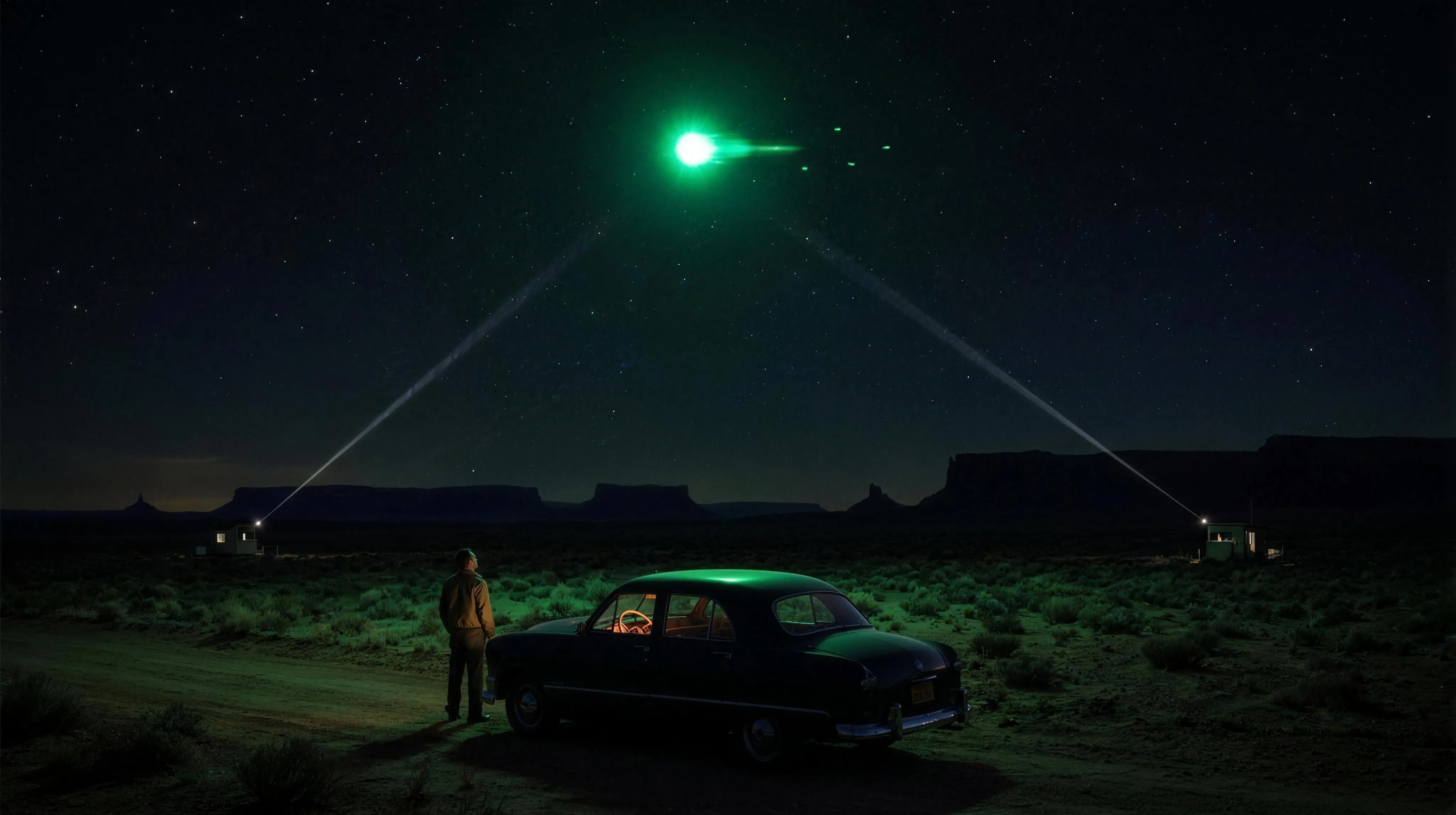
In the last weeks of 1948, green fireballs began crossing the most sensitive airspace in America: Los Alamos, Sandia, Kirtland. They appeared at full intensity instantly, flew level at eight to ten miles at constant speed, burned a green nobody could place, lasted about two seconds, and were never once heard. The witness who mattered was the region's own meteor specialist: Lincoln LaPaz saw one himself, triangulated three real paths from a network of security patrolmen, and told a room at Los Alamos containing Edward Teller that he defied anyone to find conventional meteorites that behave that way. The laboratory's director closed the minutes unconvinced in both directions: the meteor explanation was not out, and the horizontal path and the silence were puzzling. This instrument builds the machine the argument ran on: replay both falls, solve a path from bearings with your own network, weigh the colour on a real spectrum strip, then read both verdicts. The geometry is arithmetic, and the case has been open for seventy-five years.
 Open the interactive ▸
 What you're looking at
The Two Falls view is one desert night with two events in it. The meteor enters steep and bright, decelerates visibly, breaks up low, and a sound front crawls out across the ground and reaches the observer minutes behind the light: LaPaz's baseline, exactly as he built it for the conference. The fireball switches on at full intensity, runs dead level at nine miles at constant speed, fragments still green, and the dashed ring of the sound that was never heard fades on the desert floor. Every labelled station is clickable: the observer is LaPaz himself on the road near Las Vegas, New Mexico, 9:02 PM, 12 December 1948.
The Triangulation view is the heart of the bench and of the case. Five AESS posts stand on a stylised New Mexico map; an event fires; each reporting station measures azimuth and elevation for its first and last point, with a bearing error you dial. One station draws a ribbon of ambiguity, small-and-close to huge-and-far, the same trap that ran the Mantell case. Two stations decide a path. The solver runs live least squares, and the readout prints solved altitude, slope, implied speed, and the honest distance between its answer and the truth. The slope number is the whole argument: steep is a rock, level is the anomaly.
The Colour view spreads the case's most famous number, LaPaz's 5,200 ångströms, across a real spectrum strip. Light the candidates: copper burns at 510-522 nm and is rare in meteorites; magnesium burns at 517-518 and is abundant in them; they sit a few nanometres apart, and the shaded eye band shows why no naked-eye estimate can split them. Oxygen's auroral 557.7 and sodium's 589 stand off to the yellow as controls. The dashed line is drawn dashed because it is an estimate: no spectrogram of a green fireball was ever taken.
The File view lays the case out card by card on a 1948-51 timeline: the pilot reports, the three solved paths, the conference, the Sandia log with its 209 sightings and copper-powder investigations, and Project Twinkle's empty instrumented watch. Below hang the two verdict cards at equal size, LaPaz's "not a conventional meteor fall" beside Bradbury's "the meteor explanation is not out", which is this site's editorial stance rendered as layout. Click any card to read more.
Why it's here
On this station's file shelf the case owns two primary documents. The Sandia file from Release 02 is the observations: 116 pages, 209 sightings logged around the base from 1948 to 1950, with the copper-powder residue investigations inside. The Los Alamos conference minutes from Release 04 are the attempt to explain them: on 16 February 1949 Teller, Bradbury, Reines and LaPaz sat in room P-162 and worked through sound, energy and light, and the meeting ended without an answer. What this instrument opens is the computable machine the two documents share: LaPaz's triangulation.
There is a deeper reason to pick it: this is the root document of the whole nukes-and-UFOs question, and its central evidence happens to be entirely computable. Triangulation is pure geometry; the sound delay is simple acoustics; emission lines are laboratory constants. INST-36 opened the 1948 archive line, and the angular-size trap that ran the Mantell case reappears here wearing the same face, except that LaPaz supplies the correct escape: a network. So this bench does not adjudicate the fireballs. It puts the meteor baseline and the fireball's clauses into one sky, builds the network as a solver you can crank, spreads the 5,200 Å colour fight across a strip, and hangs LaPaz's and Bradbury's closing sentences side by side, quoted.
How it works
One piece of geometry runs the whole bench, and the panel tags every number as measured, reported, modelled or read.
sight line: (az, el) per station · solve: min Σ ‖(I − ddᵀ)(x − s)‖² · slope = atan(Δy / run) · sound: t = d / 0.32 km s⁻¹ · Cu 510-522 · Mg 517-518 · 5,200 Å ± eye
The solve is exact. Each station's bearings define a sight line; the bench assembles the 3×3 normal equations for the point minimising the summed squared distance to all lines, and solves them in closed form, once for the event's first point and once for its last. No fitting library, no iteration: this is the same arithmetic LaPaz ran with logarithm tables.
The error is the teacher. Bearings carry Gaussian noise on the dial you set, so the solved path wanders between observations of the same truth. Re-observe and watch it jump; add stations and watch it settle. The instrument's quiet lesson is that the difference between testimony and measurement is not sincerity, it is redundancy.
One station is refused on principle. With a single post the bench draws the ray family instead of a solution, because every range along the sight line fits the same bearings. That refusal is the case's deepest link to the rest of this station: it is the Mantell trap, the GoFast trap, the trap the 1940s files keep springing, and the network is its only escape.
The sky replays are honest about their sources. Every clause of the fireball's behaviour is REPORTED from the conference minutes and replayed as described. The meteor baseline's specific numbers are MODELLED illustrations of the qualitative baseline LaPaz himself drew. The sound front runs twelve times faster than real sound, and the panel says so; the printed delays are true.
And the colour is an estimate, drawn as one. The strip renders laboratory wavelengths at their true positions, but LaPaz's 5,200 Å is a naked-eye figure with no spectrogram behind it, so it is drawn dashed inside a MODELLED resolution band. The bench's one firm colour conclusion is negative: the eye alone cannot pick copper from magnesium, which is why the Sandia investigators went looking for powder on the ground.
The geometry is exact, the delays are computed, the wavelengths are laboratory constants; the fireball's behaviour is quoted from the minutes, the file's contents from the releases; the bench's own event paths, error sizes and eye band are disclosed as modelling choices. What this bench refuses to do is finish the conference's argument. Room P-162 produced a specialist who said not conventional, a director who said the meteor is not out, and a physicist whose blackboard proved the reports could not all be true of one simple rock. Seventy-five years later the residue analysis is still unread inside 116 public pages. Both readings are here, running.
The dials that decide the case
Two events, two dials and a strip of candidates, each a position from the record, not a mood.
- Meteor / Fireball. The baseline and the anomaly, in the same sky and on the same map. Every clause that separates them, onset, slope, deceleration, sound, is one of LaPaz's conference points, and the bench replays both without deciding which world 1948 was.
- Stations, 1 to 5. The whole epistemology of the case in one slider. One post is a direction and a story; two are a solution; five are a measurement. LaPaz's wave yielded exactly three real solutions, and the bench lets you feel how expensive each one was.
- Bearing error, 0 to 2 degrees. Patrol inspectors with compasses and stopwatches, not theodolites. At zero the solve is surgical; at two degrees it wanders kilometres between re-observations. The dial prices the difference between enthusiasm and instrumentation, which is the difference Project Twinkle was built, too late, to buy.
- The candidate elements. Copper, magnesium, oxygen, sodium, iron: each chip lights laboratory lines at true positions. Copper against magnesium is the entire colour argument; oxygen is the cheap way out that needs LaPaz's estimate to be wrong; sodium is the control that shows his eye meant something by "green".
- Show true path. The line nobody had in 1948. Leave it on to check the solver; switch it off to work the way the network actually worked, from bearings alone, and feel how much authority three solved paths actually carried.
The readings, as they stand
Five claims about the fireballs, with who argues each and where it lands. One leads and was never proven; three are live and share the geometry; one is a caution that outranks them all.
| Shallow-angle, high-altitude meteors, in an unusual run argued by the leading hypothesis on the conference table; Bradbury's closing position | LEADING | The conventional reading, never proven and never excluded. It has to carry the horizontal constant-velocity paths, the instant onset and the silence, which is exactly the load Bradbury conceded was puzzling. It survives because nothing was ever recovered to test it against, and because meteor greens (magnesium, oxygen) are real. |
| Not conventional meteors: something else in the atmosphere argued by Lincoln LaPaz, in the minutes and for years after | OPEN | The specialist's reading, built on his own triangulations: no conventional meteorite flies level at constant speed, turns on instantly, and drops nothing. He never named craft; his claim ends at "not conventional". The triangulation view is his argument, runnable. |
| A material body, or an electron phenomenon argued by Teller, after twenty minutes at the blackboard | OPEN | Less a hypothesis than a demonstration that the numbers refused to close: if the reports were all true, the silence bounded the body near a cubic centimetre, and a cubic centimetre cannot blind. Teller's arithmetic survives as the case's cleanest statement of internal contradiction. |
| Copper in the fireballs: testable on the ground argued by the Sandia investigations, DOW-UAP-D017 | OPEN | The one thread that turned the colour argument into chemistry: residual copper powder found in some sighting areas, investigated by the weapons programme. Whether the residue analysis concluded is inside the 116 pages, unread in public; the briefing flags it as the file's most decidable open question. |
| Concentrated observers, not a concentrated phenomenon argued by the honest confound, held up by the Release 02 briefing | READING | New Mexico in 1948 was full of trained personnel watching the sky under orders. Some of the wave's geography is the geography of attention, and any reading of intent has to pass through this filter first. The bench keeps it in the file view, where it belongs. |
Try this
- Watch both falls without touching anything. The meteor first: steep, slowing, loud. Then the fireball: instant-on, level, silent. Every difference you just saw with your own eyes is one sentence of LaPaz's case to the conference. The bench's job is to let you check each sentence; the record's job was to survive them.
- Fire an event with one station and try to say where it was. The ribbon shows three paths, all consistent with the bearings: near and small, true, far and huge. This is what every single-witness UFO report is, rendered as geometry. Then add a second station and watch the ambiguity die.
- Solve a fireball with five stations at low error. Altitude nine miles, slope under two degrees, speed constant. Now switch the event to meteor and solve again: slope forty-five degrees. One number separates the worlds, and the network measures it. This is the entire reason LaPaz's testimony carried weight that ordinary witnesses' could not.
- Crank the bearing error to 2° and re-observe five times. The solved path jumps kilometres each time; the fit readout confesses it. Notice the altitude stays roughly right while the slope swings: now you know which of LaPaz's two claims, 8-10 miles or dead level, was the harder one to establish, and why Bradbury's doubt had room to live.
- Light copper and magnesium together. Two sets of lines, six nanometres apart, both deep inside the eye band. Then light oxygen and read the verdict line. You have just run the entire 1949 colour argument to its honest end: the eye cannot decide, and only powder on the ground, or a spectrogram nobody ever took, could.
- End in the File and read the two cards aloud. A specialist who solved three paths and said not conventional; a director who stayed with the meteor and admitted what puzzled him. Then find Twinkle's card: the instruments that could have settled it arrived after the wave had passed. Every anomaly file on this station eventually reaches this fork; this is the one where the fork convened Teller.
Accuracy
The honest line between what is measured, what the record reports, what is modelled here, and what is a reading:
| Feature | Tier | What that means |
|---|---|---|
| The triangulation geometry | T1 Measured | Each station's azimuth and elevation define a sight line; the solved endpoint is the least-squares point closest to all the lines, computed exactly from the 3×3 normal equations. Two stations decide a path, more stations harden it, and one station is provably not enough. Nothing about the object needs to be believed to accept any of this. |
| The sound arithmetic | T1 Measured | Sound from 8-10 miles takes about 45 seconds to reach the ground; the bench computes the true delay from its own geometry and prints it. The replay compresses the front twelve-fold so you do not wait, and says so. |
| The emission wavelengths | T1 Measured | Cu I at 510.5, 515.3 and 521.8 nm; the Mg I triplet at 516.7-518.4 nm; the [O I] auroral line at 557.7; Na D at 589. Laboratory constants, drawn at their true positions on the strip. |
| The fireball's clauses | T2 Reported | Instant full intensity, level at 8-10 miles, nearly constant velocity, about two seconds, green near 5,200 Å, silent, fragments still green: every clause is LaPaz to the conference, DOE-UAP-D004, and the bench replays them as reported rather than certifying them as true. |
| The three solved paths | T2 Reported | 12 December, 20 December, 30 January: the only events of the wave that yielded real triangulated solutions, per the minutes. The bench's solver fires as many events as you like; the record got three. |
| The file and the watch | T2 Reported | The Sandia log's 209 sightings and copper-powder investigations (DOW-UAP-D017); the Grudge connection; Project Twinkle's instrumented watch closing with no photographic solution and no spectrogram. All quoted from the releases and the standard record. |
| The bench's own machinery | T2 Modelled | The station layout is stylised New Mexico at round coordinates; the event paths, bearing-error sizes and stopwatch timing are this bench's choices; the meteor baseline's specific numbers (entry angle, speeds, break-up altitude) are illustrative. Each is tagged MODELLED in the panel. |
| The eye band | T2 Modelled | LaPaz reported an estimate, not a spectrogram. The ± 12 nm band around 5,200 Å is this bench's honest guess at what a trained naked eye can resolve from memory, tagged MODELLED; its one load-bearing property, that copper and magnesium both fit inside it, survives any reasonable width. |
| What the solved paths mean | T3 Reading | Unusual shallow meteors, or something else: the two readings that split conference room P-162 in February 1949 still split the literature. The bench demonstrates what the geometry can and cannot exclude, quotes both signatures, and adds no third. |
In one line: the triangulation, the sound delays and the emission wavelengths are arithmetic and laboratory constants you can audit; the fireball's behaviour, the three solved paths, the Sandia log and Twinkle's non-result are quoted from the two PURSUE files and the standard record, tagged as reported; the bench's station layout, event paths, error sizes and eye band are disclosed modelling choices; and whether the solved paths describe unusual meteors or something else is a reading, on which the specialist and the director signed opposite sentences in the same minutes, which is precisely why this case belongs on this station. Solve a path and decide for yourself.
Sources
- DOE-UAP-D004, "Los Alamos Conference on Aerial Phenomena, 1949", PURSUE Release 04, U.S. Department of War. The 16 Feb 1949 minutes: LaPaz's Starvation Peak account and class properties, the sound canvassing, Teller's blackboard bound, Bradbury's closing line. Every conference quotation on this bench is from this file.
- DOW-UAP-D017, "UAP Reported at Sandia Base, 1948-1950", PURSUE Release 02, U.S. Department of War. The 116-page log: 209 sightings, the copper-powder residue investigations, the Project Grudge connection.
- Signals from the Periphery, Release 02 Briefing 3: the Sandia file read as the root of the nukes-and-UFOs question, with the concentrated-observers confound held up front.
- Signals from the Periphery, Release 04 Briefing 3: the conference transcript read line by line; the scan-damage caveats on the two best-known quotations are inherited here.
- Laboratory emission wavelengths from standard spectroscopy references: Cu I 510.55 / 515.32 / 521.82 nm, Mg I 516.73 / 517.27 / 518.36 nm, [O I] 557.7 nm, Na D 589.0 / 589.6 nm; the copper flame-test green of the chemistry classroom.
- Project Twinkle and the wider green-fireball record (the instrumented watch of 1949-51, its underfunding and non-result), from the standard historical accounts; flagged as context beyond the two PURSUE files, exactly as the Release 04 briefing flags it.
- The site wiki cluster: Green Fireballs, Lincoln LaPaz, Edward Teller, the Los Alamos Conference on Aerial Phenomena, PURSUE, the Department of War.
Solve the path. Steep is a rock; level at nine miles is the case.
Open the interactiveCompiled July 2026