The c-Wall
Pour in all the energy you like: a ship made of ordinary matter can crowd up against the speed of light forever and never touch it. The last step to c always costs infinity, for a dust grain as surely as for a starship.
 Open the interactive ▸
 What you're looking at
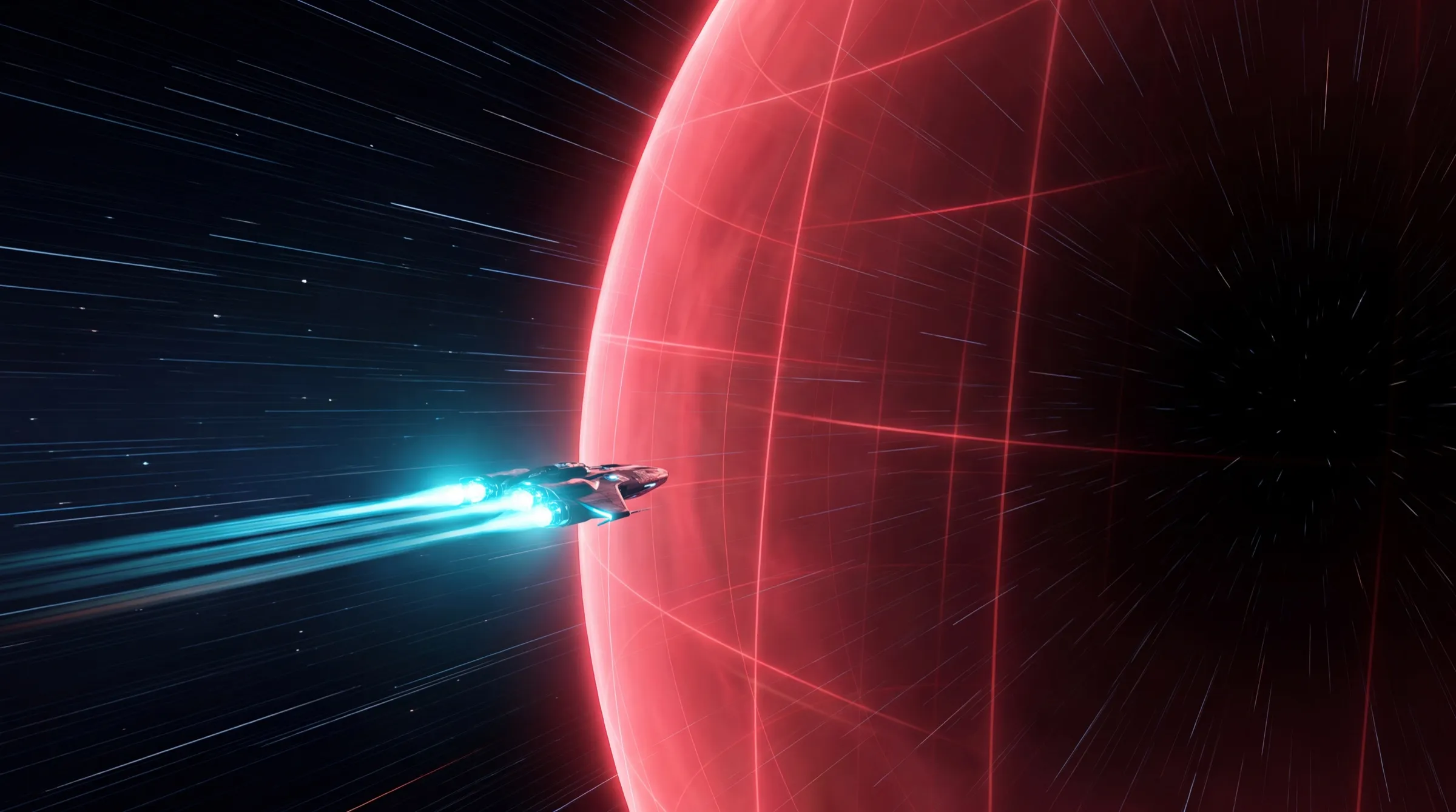
The Chase view is the argument made physical. A starship at full thrust tears through streaming stars, and ahead of it stands the wall: a vast red membrane at the speed of light. Pour in energy and the wall crowds closer, but its distance shrinks as a power of 1−β, so it never, ever arrives. Hold a steady 1 g and the ship clock runs for years of ship-time while the wall refuses to yield a metre. Switch to the warp bubble and the payoff lands: the wall sweeps straight past a craft that never moves through space at all.
The Curve view is the classic chart, built in three dimensions. The amber tube is the bill: the ship's kinetic energy, (γ−1)mc², plotted against the speed it buys. Down low the curve is gentle and early speed is cheap. As the speed nears c the curve turns vertical and runs clean off the top of the frame toward the red wall plane. A glowing marker rides the curve at your chosen speed; the status bar reads that speed, the Lorentz factor γ, the energy in rest-masses, and what the next 0.001 c would cost.
You can drop a marker for each equal tank of energy you add (they crowd against the wall like moths on glass), switch the energy axis to logarithmic to see the whole climb at once, choose whether the bill is priced for 1 kg, a tonne or a 1,000-tonne starship, and run an eight-chapter story from the 1905 rule to the warp loophole. Every printed number is exact special relativity; the speed readout never shows a bare 1.000, because it never happens.
Why it's here
The rest of the site keeps circling two ways to bend spacetime, named in The Bubble: extreme mass and extreme speed. This is the speed route's invoice. The companion pieces show the other prices the velocity route charges a crew: the optical violence of the Near-Light view, the aging toll of Time Dilation, the crushing g-force of turning fast. The c-Wall is the fourth and heaviest: the sheer energy of getting up to speed at all.
It also explains why the interesting question stopped being "build a faster engine." No engine that pushes against space can reach c, because the last step always costs infinity, and even the modest speeds below it are absurdly expensive. That dead end is exactly what a warp drive is meant to sidestep: move the space, not the ship, and the kinetic-energy wall never appears. Whether that can be built is the open question (priced in the Warp Energy Problem); that a thrust ship can never reach c is settled, daily-measured physics.
How it works
One formula draws the wall:
KE = (γ − 1) mc² · γ = 1 ∕ √(1 − β²) → ∞ as β → 1
The energy runs away (the wall). At low speed the kinetic energy hides as the familiar ½mv². But as β → 1, γ → ∞, so the energy grows without limit. Reaching c exactly would take infinite energy for any rest mass at all. The curve and its vertical wall are this formula, drawn; the chase and its unreachable red membrane are the same formula, felt.
Diminishing returns. Rest to 0.5 c costs about 0.15 mc². 0.5 c to 0.9 c costs roughly seven times that. 0.9 c to 0.99 c, several times more again. Each new nine after the decimal point costs more than everything before it, which is what the equal-energy steps show as dots: identical tanks of energy, each buying less and less speed, bunching against the wall.
Speeds don't simply add. Fire a 0.9 c probe from a 0.9 c ship and a bystander measures not 1.8 c but 0.994 c: velocities combine as (u + v)/(1 + uv/c²), which can never cross c. What does add cleanly is rapidity, φ = artanh β; you can always add more, but β = tanh φ keeps the speed below c no matter how high φ climbs. The wall, seen from a second angle.
A steady 1 g, forever. Hold a comfortable, Earth-normal thrust and the exact relativistic-rocket result is β = tanh(aτ/c): a year of ship-time puts you at 0.775 c, 0.9 c takes 1.4 years, 0.99 c takes 2.6, and you keep accelerating without bound and never reach c. The clock runs; the wall stays put. The kinematics are exact; the catch is that no fuel tank can actually supply this energy, which is the wall itself.
How close have we come? Our fastest spacecraft, the Parker Solar Probe, touched 191 km/s in December 2024: about 0.0006 c, a single pixel from the origin here. Only lone particles get close. An LHC proton at 6.8 TeV runs at 0.99999999 c (γ ≈ 7,250), and even it would need infinitely more to finish the trip to c.
Every number on screen is computed live from exact special relativity at the speed you set. Only the wall's on-screen distance, the axis scaling and the sped-up ship clock are presentation choices.
The presets
Eight speeds, from our fastest real craft to the one loophole.
- Parker probe · 191 km/s. The humbling baseline: our fastest craft ever, still only 0.0006 c.
- 0.1 c. The bill is just 0.5% of a rest-mass; the curve has barely lifted.
- 0.5 c. Halfway to c costs only 0.15 mc².
- 0.9 c. The kinetic energy passes one whole rest-mass (1.29 mc²).
- 0.99 c. 6 mc², and the curve has turned steep.
- 0.999 c. 21 mc², with c still infinitely far ahead.
- LHC proton · 6.8 TeV. A real particle at 0.99999999 c (γ ≈ 7,250): the fastest matter we accelerate, and still not c.
- Warp bubble. The contrast: a flat-space interior, so the (γ − 1)mc² wall never applies.
Try this
- Walk the nines. Step 0.9 → 0.99 → 0.999 and watch the wall in the chase crowd closer while the bill multiplies. It never arrives.
- Hold a steady 1 g. The ship clock runs for years, the speed climbs forever, and the wall never yields. This is the exact relativistic rocket.
- Turn on the equal-energy steps in the Curve view: identical tanks of energy bunching against the wall is the whole argument in dots.
- Check the next 0.001 c. At 0.9 c it already costs tens of thousands of times more than your first 0.001 c did. Watch that number run away.
- Price it in joules. Switch the mass to a 1,000-tonne starship and compare the bill to the world's yearly energy output.
- End on the warp bubble. The wall sweeps straight past it: no motion through space, no kinetic energy, no wall. Its price lives in the Warp Energy Problem.
Accuracy
The honest line between what is exact and what is stylised:
| Feature | Status | What that means |
|---|---|---|
| Kinetic energy (γ−1)mc², total energy γmc², infinite at c | Established | Special relativity. Confirmed every day in particle accelerators, which pour in exponentially more energy for ever less speed. Sets the curve and the wall. |
| γ = 1/√(1−β²); rapidity φ = artanh β; velocity addition (u+v)/(1+uv/c²) | Established | Exact closed-form special relativity. Rapidities add linearly while β = tanh φ stays below c: the same wall, seen another way. |
| Constant 1 g run: β = tanh(aτ/c), γ = cosh(aτ/c) | Established | The exact relativistic-rocket result for steady proper acceleration. The kinematics are exact; the impossibility is that no tank can supply the energy, which is the wall. |
| Real anchors: Parker Solar Probe 191 km/s; LHC proton at 6.8 TeV; world energy ≈ 6×10²⁰ J/yr | Established | Measured figures, rounded for display. Parker (Dec 2024) is the fastest craft; the LHC proton (γ ≈ 7,250) the fastest matter we accelerate. |
| Warp bubble: the kinetic-energy wall does not apply | Theoretical | The Alcubierre idea: a flat interior that never moves through space at speed, so there is no (γ−1)mc² to pay. A valid metric needing negative energy, never built. The one speculative element. |
| The wall's on-screen distance, axis scaling, marker glow, compressed ship clock | Illustrative | Presentation only. The wall's distance shrinks as a power of 1−β so it visibly crowds and never arrives; the linear axis caps at 8 mc²; the ship clock is sped up. Every printed value uses the exact speed and energy. |
In one line: the energy wall is exact, daily-confirmed physics: a thrust ship can get arbitrarily close to c but never reach it; only the warp bubble claims a way around, and that is the open question.
Sources
- Einstein, A. (1905). On the Electrodynamics of Moving Bodies. Annalen der Physik 17, 891. The relativistic kinematics behind γ and the velocity-addition law.
- Einstein, A. (1905). Does the Inertia of a Body Depend upon its Energy-Content? Annalen der Physik 18, 639. The mass and energy relation E = mc² underlying (γ−1)mc².
- Taylor, E. F., & Wheeler, J. A. (1992). Spacetime Physics (2nd ed.). W. H. Freeman. Energy, momentum, rapidity, and why c is unreachable.
- Rindler, W. (2006). Relativity: Special, General, and Cosmological (2nd ed.). Oxford University Press. Relativistic energy and the velocity-composition law.
- Baez, J. (1998). The Relativistic Rocket. UC Riverside Physics FAQ. The β = tanh(aτ/c) constant-proper-acceleration result.
- CERN. The Large Hadron Collider: beam energy and proton kinematics (6.8 TeV per beam).
- NASA / Johns Hopkins APL (2024). Parker Solar Probe closest approach: 191 km/s, the fastest human-made object.
- Energy Institute (2024). Statistical Review of World Energy: world primary energy ≈ 620 EJ (6.2×10²⁰ J) in 2023.
- Alcubierre, M. (1994). The warp drive: hyper-fast travel within general relativity. Class. Quantum Grav. 11, L73.
- Puthoff, H. E. (2010). Advanced Space Propulsion Based on Vacuum (Spacetime Metric) Engineering. DIA Defense Intelligence Reference Document.