The Warp Energy Problem
The warp bubble slips past the c-wall by moving space instead of the ship. It pays for it with a wall of negative energy that no one knows how to build, and Alcubierre's first estimate of that bill was larger than the whole observable universe.
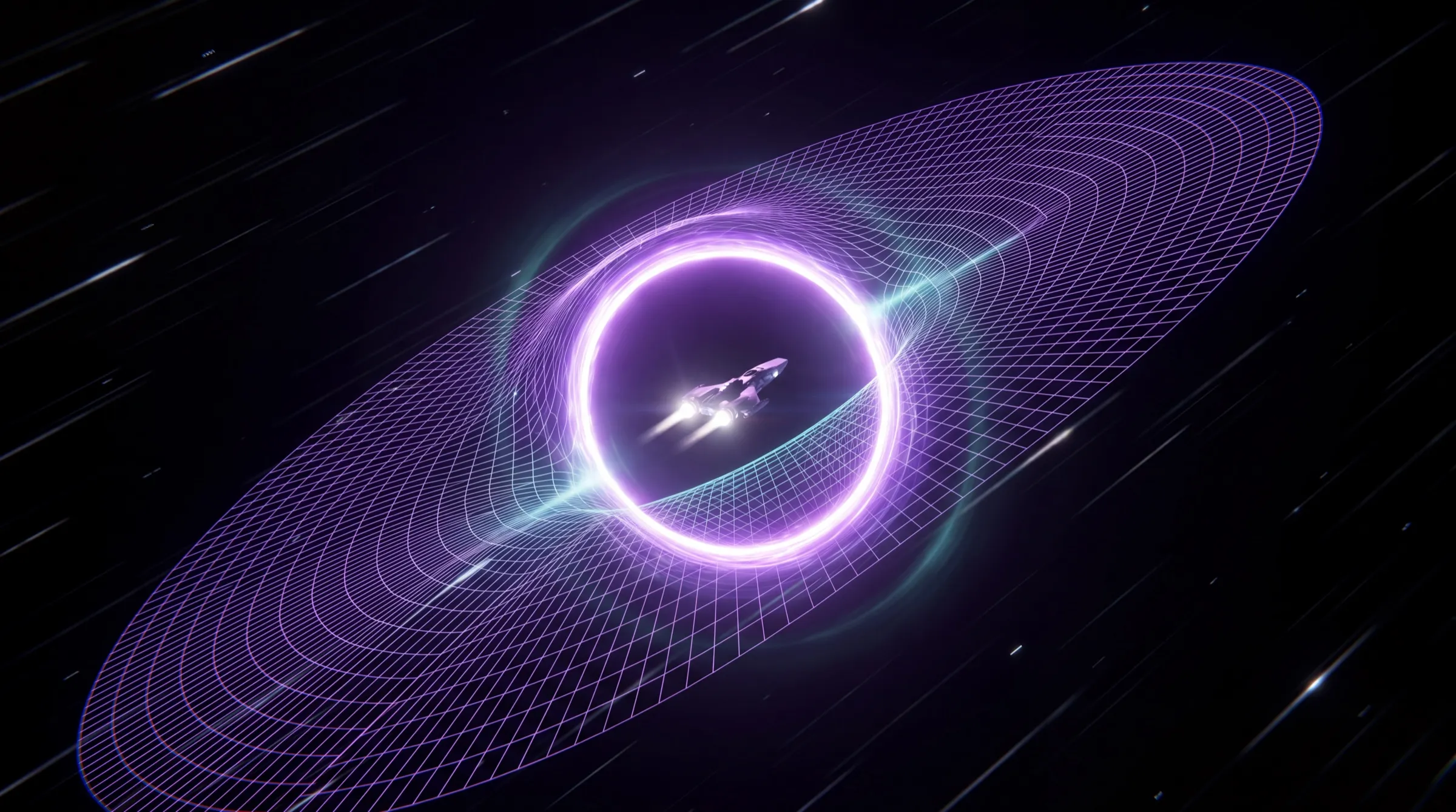 Open the interactive ▸
 What you're looking at
The Bubble view is the Alcubierre warp bubble in three dimensions. A ship rides a pocket of perfectly flat space while the spacetime sheet around it is pulled together ahead and stretched apart behind: the ship never accelerates, space itself does the travelling. In the wall of the bubble, a glowing violet ring marks the energy density the geometry demands, and wherever it glows, that density is negative. That ring is exotic matter, stuff that weighs less than nothing, which has never been made in the quantities a warp drive needs.
The Ledger view is the bill. A logarithmic tower of mass climbs from the Casimir lab floor up past the Sun, the Milky Way and the whole observable universe, with a glowing marker at the negative energy the current bubble requires. On the Alcubierre preset the marker sits above the universe line, off the top of everything that exists. The four headline presets then walk that marker down through the real thirty-year history of the problem, from an estimate larger than the universe to a 2024 solution that finally needs no exotic matter at all, at the price of never exceeding light speed.
You can build your own bubble with the radius, speed and wall-thickness sliders and watch the required energy run away as roughly v²·R²/Δ; flip on the energy-condition map to see where the density turns negative; show space pinching ahead and stretching behind; or drop to the Casimir preset to see the largest negative energy we can actually make, real, measured, and almost unimaginably too small. A live energy bill, click-anywhere explainer cards, and an eight-chapter story run the whole argument.
Why it's here
The c-Wall showed why a thrust ship can never reach light speed: the kinetic energy runs to infinity at c. The warp bubble named in The Bubble is the celebrated way around that wall. Carry a pocket of flat space and never move fast through space at all, so the infinite energy bill never comes due.
This piece is the catch. The escape from the first wall runs straight into a second one. To curve spacetime into a travelling bubble, the bubble's wall must be threaded with negative-energy exotic matter, and the deepest results we have say that kind of matter must stay scarce. The c-Wall priced the velocity route; this prices the warp route. Both walls are real; only one of them has ever been crossed, and it is not this one.
How it works
General relativity runs both ways: pick a spacetime, and one equation hands you the matter needed to hold it.
G_μν = (8πG ∕ c⁴) T_μν · geometry fixes the matter
The geometry fixes the matter. Usually you start with the matter and solve for the spacetime it curves. But you can also write down any spacetime you like and read off the matter needed to hold it together. Feed in the Alcubierre warp metric and the answer is forced: in the bubble wall, the energy density measured by ordinary observers is negative. The drive does not choose to run on negative energy. Its geometry cannot exist without it.
Where the negative energy lives. Alcubierre's own stress-energy gives a density that goes as −(vs²)(y²+z²)/r² · (df/dr)². Three facts follow, all visible on screen: it is negative wherever it is non-zero; it is concentrated in the thin shell where the bubble's shape function turns over; and it vanishes on the axis of motion and peaks in a ring around the equator. That ring is the signature of warp exotic matter, and it deepens as the square of the speed and as the wall is thinned.
It breaks the energy conditions. Every form of matter ever measured obeys the energy conditions: loosely, energy density is never negative to every observer. The warp bubble violates the weak, null, strong and dominant conditions at once. Negative energy is not unknown, the Casimir effect makes a sliver of it between two plates, and it has been measured. But the Ford–Roman quantum inequalities ration it tightly: the more negative the energy, the smaller and briefer the region must be. A warp wall needs the exact opposite, vast, sustained, deeply negative energy held open.
The bill, and how it fell. Alcubierre's first estimate was about 10⁶⁴ kg of negative mass-energy, more than the observable universe, partly because the quantum inequalities force the wall toward the Planck length and a thinner wall costs catastrophically more. Van Den Broeck (1999) hid a large interior behind a microscopic neck and cut the bill to a few solar masses. White (2011) thickened and oscillated the wall and reached roughly the mass of the Voyager 1 probe. Real, dramatic progress, and still asking for exotic matter by the kilogram that nobody can make.
The 2021 reckoning, and 2024. In 2020 and 2021, Lentz and, separately, Bobrick and Martire proposed positive-energy warp drives. Santiago, Schuster and Visser then proved a clean theorem: any warp drive that exceeds the speed of light still violates the energy conditions, because the positive-energy claims had only checked one family of observers. The surviving result, Fuchs et al. (2024), is honest positive-energy relativity that needs no exotic matter, but it is subluminal. Faster than light still costs negative energy.
Every number in the named presets is a published, peer-reviewed figure; the live "build your own" number is an order-of-magnitude estimate from the v²R²/Δ scaling. Only the colour map and the visibly-wide wall are presentation choices; real walls are 10⁻¹⁵ to 10⁻³⁴ m, far too thin to see.
The presets
Six bubbles, the four headline reductions plus the Casimir floor and a build-your-own.
- Alcubierre 1994. The original problem: about 10⁶⁴ kg of negative mass-energy, more than the observable universe.
- Van Den Broeck 1999. A microscopic neck around a large interior drops it to a few solar masses (carrying only tiny payloads).
- White 2011. Reshaping and oscillating the wall reaches roughly the mass of the Voyager 1 probe, for a 10 m bubble at 10c. Still exotic matter.
- Subluminal 2024. Fuchs et al.: a real warp shell on ordinary positive energy, obeying every energy condition, but never faster than light.
- Casimir (lab). The most negative energy we can actually produce, ~10⁻³⁰ kg-equivalent: real, measured, and ~60 orders of magnitude too small.
- Custom. Set radius, speed and wall thickness yourself and watch v²R²/Δ run off the top of the ladder.
Try this
- Watch the ring deepen. On Custom, push the speed up: the exotic ring brightens as v², because the negative energy scales with the square of how fast you want to go.
- Switch to the Ledger on Alcubierre and see the marker sit above the observable-universe line. That is the whole problem in one picture.
- Walk the reduction. Step Alcubierre → Van Den Broeck → White and watch the bill fall dozens of orders of magnitude down the tower, never reaching the Casimir floor.
- Load Subluminal 2024. The ring turns teal, the energy conditions flip to satisfied, and the bill reads none. Then notice the speed: 0.5 c. That is the catch.
- Thin the wall. On Custom, drag the wall thickness toward the Planck length and watch the estimate run off the top: a thinner wall costs catastrophically more.
- Run the story: eight chapters, from the escape past the c-wall to the 2024 theorem that faster-than-light always pays in negative energy.
Accuracy
The honest line between what is settled and what is speculative:
| Feature | Tier | What that means |
|---|---|---|
| The Alcubierre metric requires negative energy density; it violates the weak, null, strong and dominant energy conditions | T1 Established | Read directly off Einstein's equation from the metric. A mathematical fact about that spacetime, agreed by all sides since 1994. |
| Energy-density shape −(v_s²)(y²+z²)/r²·(df/dr)²: negative, ring-shaped, in the wall, ∝ v² | T1 Established | Alcubierre's own stress-energy tensor. Sets the violet ring's shape, its location, and its deepening with speed and thinner walls. |
| Negative energy is real (Casimir effect) but bounded by the Ford–Roman quantum inequalities | T1 Established | Casimir energy is measured; the quantum inequalities (magnitude times duration bounded) are standard quantum field theory. A little, briefly, not an ocean held open. |
| Reduction history: Alcubierre ~10⁶⁴ kg → Van Den Broeck few M☉ → White ~Voyager; Santiago–Schuster–Visser 2021; Fuchs et al. 2024 | T1 Established | Published, peer-reviewed results, cited as stated. White's figure is exotic (negative) matter for a 10 m bubble at 10c; Van Den Broeck's carries microscopic payloads. |
| The live "build your own" number from the v²R²/Δ scaling | T3 Simplified | Order-of-magnitude. The true coefficient is treatment-dependent, which is why the papers differ, so the named presets show each published figure instead. |
| That a warp drive could actually be built, and the exotic matter assembled | T2 Theoretical | The metric is a valid GR solution; whether its matter source can exist in nature at the required scale is unknown and, for superluminal drives, deeply doubted. |
| Colour map, exaggerated wall thickness, drifting stars, ladder spacing | T4 Illustrative | Presentation only. Real walls are 10⁻¹⁵ to 10⁻³⁴ m, invisibly thin; the wall is drawn wide so the ring is visible at all. |
In one line: that a faster-than-light warp drive needs negative energy is settled physics; how much has fallen dramatically but never to zero; and the only positive-energy warp drive we have is slower than light.
Sources
- Alcubierre, M. (1994). The warp drive: hyper-fast travel within general relativity. Class. Quantum Grav. 11, L73. The metric, and the first note that it needs exotic matter.
- Pfenning, M. J., & Ford, L. H. (1997). The unphysical nature of "warp drive." Class. Quantum Grav. 14, 1743. Quantum inequalities force a near-Planck wall and an energy beyond the universe.
- Ford, L. H., & Roman, T. A. (1995). Averaged energy conditions and quantum inequalities. Phys. Rev. D 51, 4277. The magnitude and duration bound on negative energy.
- Casimir, H. B. G. (1948). On the attraction between two perfectly conducting plates. Proc. K. Ned. Akad. Wet. 51, 793. Measured negative energy density.
- Morris, M. S., Thorne, K. S., & Yurtsever, U. (1988). Wormholes, time machines, and the weak energy condition. Phys. Rev. Lett. 61, 1446. Exotic matter and the energy conditions.
- Van Den Broeck, C. (1999). A 'warp drive' with more reasonable total energy requirements. Class. Quantum Grav. 16, 3973. The microscopic-neck reduction to a few solar masses.
- White, H. (2011/2013). Warp Field Mechanics 101. NASA Johnson Space Center; JBIS 66, 242. Wall-thickness optimisation and oscillation down to ~Voyager mass.
- Bobrick, A., & Martire, G. (2021). Introducing physical warp drives. Class. Quantum Grav. 38, 105009 (arXiv:2102.06824).
- Santiago, J., Schuster, S., & Visser, M. (2022). Generic warp drives violate the null energy condition. Phys. Rev. D 105, 064038 (arXiv:2105.03079). Superluminal implies negative energy, always.
- Fuchs, J., et al. (2024). Constant velocity physical warp drive solution. Class. Quantum Grav. 41, 095013 (arXiv:2405.02709). A subluminal, positive-energy warp shell.