Near-Light Speed
Light keeps one speed for everyone, so when you race toward the stars, the sky has no choice but to lean, redden and blaze.
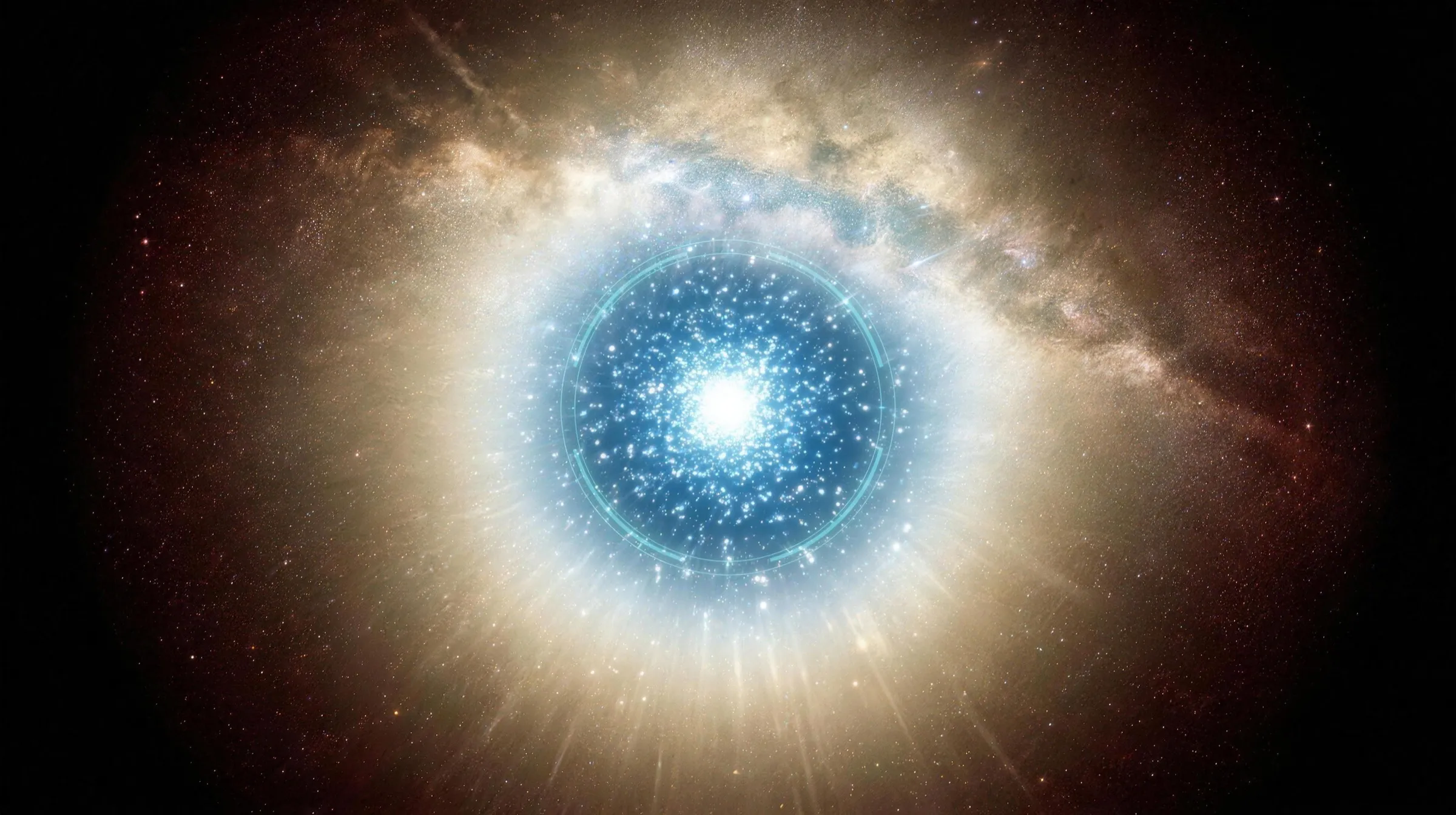 Open the interactive ▸
 What you're looking at
The windscreen of a ship looking straight ahead as it accelerates toward the speed of light. At a crawl the star field is ordinary. Push the speed up and the whole sky pours forward, gathers into a brilliant blue-white disc dead ahead, and leaves a widening ring of red and then black behind. Three things are happening at once, and you can switch two of them off to study each on its own:
- Aberration sweeps every star toward the direction you are heading, even the stars that started behind you.
- Doppler shifts the light ahead toward blue and the light astern toward red.
- Beaming (the "headlight effect") pours brightness into the forward direction and drains it from the rear, so the disc ahead becomes a floodlight.
The two cards read out the live shift dead ahead and dead astern; the banner gives your speed, the Lorentz factor γ, and the half-angle of the cone the forward sky has been crushed into.
Why it's here
The rest of the site keeps circling two ways to bend spacetime, named in The Bubble: extreme mass and extreme speed. This piece is the speed route seen from the bridge: what a crew aboard a relativistic craft would actually have outside the window.
It also sharpens what a warp drive is for. Flip to the Warp bubble preset and the sky goes calm and normal, because an Alcubierre bubble carries a pocket of flat space and never truly moves through space at speed: no blueshift, no blinding glare, no lethal forward-beamed radiation. And, as the companion pieces show, no crushing g-force and no aging toll. The optical violence of real near-light travel is exactly what the bubble is meant to sidestep. Whether it can be built is the open question; that the sky leans, reddens and brightens at speed is settled, measured physics.
(Cross-link: see The Bubble for the framework, Warp Drive for the toll it means to dodge, and Black Hole for the mass route.)
How it works
One geometry, three transformations, all exact:
cos θ′ = (cos θ + β) ⁄ (1 + β cos θ) (aberration · β = v∕c)
- Aberration (where the stars go). A star seen at angle θ from your direction of travel appears, at speed β = v/c, at a new angle θ′ given by cos θ′ = (cos θ + β) ⁄ (1 + β cos θ). As β → 1 this drives θ′ → 0 for almost every star: the whole sky collapses forward. A star at a right angle to your path (θ = 90°) appears at arccos β ahead: 26° at 0.9 c, 8° at 0.99 c, under 3° at 0.999 c.
- Doppler (what colour). Light you race toward is blue-shifted; light falling behind is red-shifted. Dead ahead the frequency is multiplied by √((1 + β) ⁄ (1 − β)) (about 4.4× at 0.9 c and 14× at 0.99 c) and dead astern by the reciprocal. Each star is recoloured by treating its observed temperature as that factor times its real one, so the Sun's yellow is shoved through violet into the ultraviolet ahead, while rear stars slide into infrared and vanish.
- Beaming (how bright). Relativity concentrates a source’s light forward; a star’s observed brightness scales as the square of the Doppler factor, its surface brightness rising as the fourth power while its solid angle shrinks as the second. The forward disc is beamed about two hundred times brighter at 0.99 c while the rear goes dark: the searchlight that gives the effect its name.
Where each star lands, what colour it shifts to and how bright it becomes are all computed live from exact special relativity at the speed you set. Only the gentle on-screen drift and the central glow are slowed or stylised for viewing.
The presets
The same optics, run from a crawl to a whisker below c. Watch the forward cone tighten and the shift multiply as β climbs.
- Cruise · 0.1 c: the reassuring baseline; the sky is barely disturbed.
- Half-light · 0.5 c: the forward sky begins to gather and tint blue.
- Fast · 0.9 c: the whole sky leans hard into your path (forward shift ×4.4).
- Extreme · 0.99 c: a blue-white disc ringed in dark (forward shift ×14).
- Near-c · 0.999 c: almost the entire sky crushed into a few degrees ahead.
- Warp bubble, the contrast: flat interior, normal sky, none of the above.
Every step up the slider is the same three transformations with a larger β. The warp-bubble preset is the exception that proves the rule: switch it on and all three effects vanish at once, because inside the bubble the ship is not moving through space at all.
Accuracy
The honest line between what is exact and what is stylised:
| Feature | Status | What that means |
|---|---|---|
| Aberration, cos θ′ = (cos θ + β) ⁄ (1 + β cos θ) | Established | Special relativity. Stellar aberration measured since Bradley (1727); the relativistic form is exact. Sets every star's position. |
| Relativistic Doppler, √((1+β)⁄(1−β)) ahead | Established | Special relativity. Confirmed by Ives–Stilwell (1938) and since. Sets each star's colour. |
| Relativistic beaming, forward flux ∝ D² | Established | The exact brightness transformation for a moving observer; seen in astrophysical jets and synchrotron beams. Sets each star's brightness. |
| γ and the forward-cone half-angle arccos β | Established | Exact closed-form special relativity, computed live and shown in the banner. |
| Blackbody colours; visible-band roll-off into UV/IR | Stylised | The temperature→colour map and the point a shifted star leaves human vision are approximations. The CMB blue-shifts into visible light only at speeds extraordinarily close to c. |
| Warp bubble: undistorted sky, no Doppler/beaming | Theoretical | The Alcubierre / Puthoff flat-interior idea, a valid metric needing negative energy, never built. The one speculative element. |
| Central bloom, edge reddening, slow roll, forward rush & star streaks | Illustrative | Motion and glow cues. The forward flight and streaks are sped up for a sense of speed. Real stars are so far apart you would pass them far more slowly. Aberration, colour and brightness are the dominant effects. |
In one line: the way the sky leans, reddens and brightens is exact, measured relativity; only the bubble that would spare a crew from it is the theory under test.
Sources
- Einstein, A. (1905). On the Electrodynamics of Moving Bodies. Annalen der Physik 17, 891. Aberration and the relativistic Doppler effect from the constancy of c.
- Bradley, J. (1729). Account of a new discovered motion of the fixed stars. Phil. Trans. R. Soc. 35, 637. The first measurement of stellar aberration.
- Ives, H. E., & Stilwell, G. R. (1938). An experimental study of the rate of a moving atomic clock. J. Opt. Soc. Am. 28, 215. Confirmation of relativistic Doppler.
- Penrose, R. (1959) & Terrell, J. (1959). On the apparent shape of a relativistically moving object. Proc. Camb. Phil. Soc. 55, 137; Phys. Rev. 116, 1041.
- Rindler, W. (2006). Relativity: Special, General, and Cosmological (2nd ed.). Aberration, Doppler and beaming as standard results.
- Kortemeyer, G., et al. (2013). A Slower Speed of Light (MIT Game Lab). A modern interactive rendering of relativistic optics.
- Alcubierre, M. (1994). The warp drive: hyper-fast travel within general relativity. Class. Quantum Grav. 11, L73; and Puthoff, H. E. (2010), DIA reference document on spacetime-metric engineering.