Earth's Shifting Crust
In 1958 a sincere, footnoted book proposed that the entire crust of the Earth can slip over the interior as one piece: poles in Hudson Bay within human memory, a temperate Antarctica, and an engine made of ice. Albert Einstein wrote the foreword, praised the idea's boldness, and in one clause named the joint it would break at: the only doubtful assumption is that the earth's crust can be moved easily enough over the inner layers. This bench is that clause, built. It replays the claimed slide on a globe where the geography moves and the axis does not. It runs the book's own engine at face value, with every dial set in the claim's favour, and reads out the result: the thrust of a hand resting on a table, against a bill of gigapascals; a bought speed of 0.43 millimetres a year; a 30-degree slide priced at 7.7 billion years, longer than the age of the Earth. It sets the claim on a ladder beside every motion the solid Earth has ever been measured to make, all of them in centimetres per year, and beside the ice cores that counted straight through the claimed catastrophe, one ordinary year at a time. And it files the ending honestly: the author himself withdrew the engine in 1970, and the idea's most famous champion swapped it for a different catastrophe in 2015. The crust does move. We know how fast. That is the whole story, and it is enough.
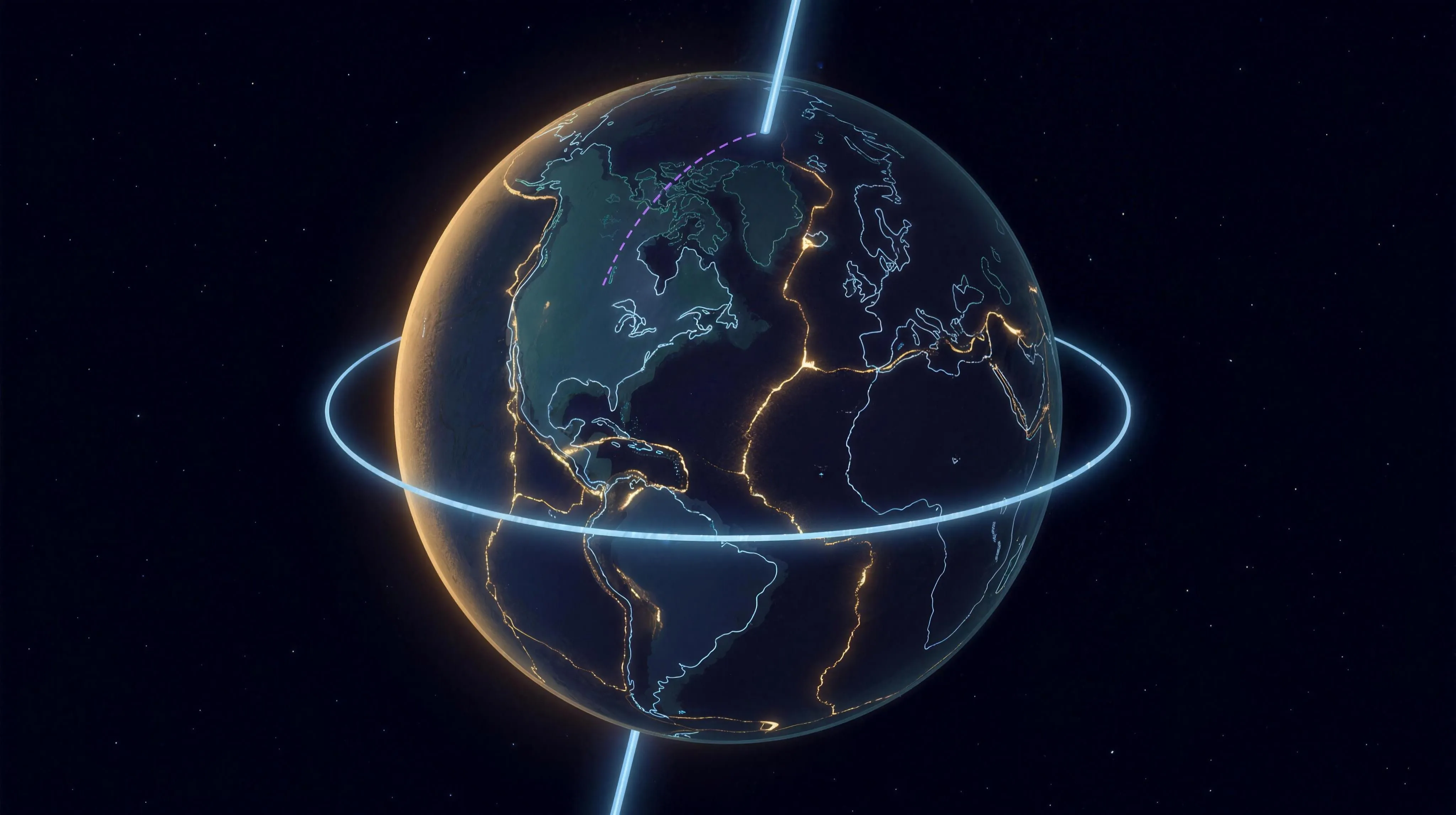 Open the interactive ▸
 What you're looking at
The Globe view is 3D because the claim is a geometric act: the whole lithosphere rotating as one piece over the interior. A real-coastline Earth carries the geography; the rotation axis and the climate rings stay fixed in space; a strip along the bottom replays Hapgood's claimed last slide on his own clock, 17,000 to 12,000 BP. Hudson Bay exits the polar circle, Antarctica enters it. The claim's furniture is drawn as claimed: the pole stations, the dashed slide path. Three overlays price it live: a misfit heat-map running the exact bulge arithmetic per pixel, the staged ice caps, and the real measured motions, GPS arrows and the Hawaiian-Emperor chain, at a printed ×4,000,000 magnification, because at true scale centimetres per year would be invisible on a planet.
The Engine view is the book's mechanism on three cards of closed forms. The thrust card computes the off-axis cap's centrifugal pull and spreads it over the crust-mantle interface: pascals to kilopascals. The drag card computes what sliding at the claimed speed through a viscous channel demands, on a log axis, with rock strength marked: gigapascals, a gap of millions, and, run forward, the millimetres per year the engine can actually buy. The bulge card prices the brake nobody can dial away: a shell slid 30° misfits the spheroid by up to 10.7 km, and the strain alone exceeds what rock survives.
The Records view is the measured Earth: a log-scale rate ladder from post-glacial uplift through GPS plates, the chain, true polar wander and its theoretical ceiling, up to the fastest contested claim in the literature, and then the claim, which does not join the ladder so much as leave it. Below, five records that run through the claimed dates unbroken: the Greenland layer count, the Antarctic cores, the chain, the paleomagnetic poles, and the continuously watched pole itself.
The File view is nine cards, 1958 to 2015: the book, the foreword, the arithmetic already on the shelf, the plate-tectonics revolution, the author's own 1970 retreat, the real true polar wander, the 1995 afterlife, the 2015 switch, and the measured irony: the pole drifts toward Hudson Bay today, ten centimetres a year. It closes on two verdicts at equal size: the physics one and the record one.
Why it's here
This bench is the foundation test of the lost-civilisation line. The station's Culture 14 review of Fingerprints of the Gods records which stone that book's climactic argument stands on: Earth-Crust Displacement, Charles Hapgood's 1958 hypothesis, on which Hancock in 1995 sank an entire civilisation beneath the Antarctic ice. INST-39, the Piri Reis projection bench, has already tested Hapgood's other artefact, the map he read as proof that an ice-free Antarctica was once surveyed; this bench tests the premise that made such a reading possible in the first place: can the whole crust really slide thirty degrees in a few thousand years. On the Piri Reis bench, Hapgood's verdict card sits at the same size as McIntosh's; here the two equal-sized verdicts belong to the physics and to the record.
It also closes an arc. In Magicians of the Gods (2015), Hancock quietly swapped mechanisms: Earth-crust displacement out, the Younger Dryas impact in, conclusion untouched. That replacement claim has its own bench at INST-46, the Younger Dryas Impact Ledger, facing its own vise. Read the two side by side and you are looking at the two horses the same story has ridden, and at what each looks like under arithmetic. This bench also supplies something the station has owed for a while: a draggable Earth on which "the whole crust slides" stops being a sentence and becomes, for the first time, a geometric act you can watch happen, and then watch run up its bill.
How it works
One closed-form engine, one closed-form brake, one exact piece of spheroid geometry, and a ladder of published measurements. The panel tags every number exact, modelled, reported or reading.
F = MΩ²R·sinθcosθ · τ꜀ = F/4πR² · τ = ηv/h · v_bought = τ꜀h/η · Δr = a·f·|sin²φ₁ − sin²φ₂| · TPW ≤ 2.4°/Myr
The claim, at face value. Thirty degrees of arc is 3,336 km. Hapgood's clocks give it 10,000 years (1958), 5,000 (1970 front matter) or 1,500 (the 1970 body's "about a mile a year"); Hancock gives 2,000. At the default 5,000 the crust must move 667 metres a year, about 2,800 times the fastest plate velocity ever recorded. Every number downstream follows from the dialled duration.
The engine, exactly. An ice cap of mass M centred at colatitude θ feels an equatorward pull F = MΩ²R·sinθcosθ. The bench stages the cap as a point mass and checks that staging against a distributed-disc integral in the tune script; the difference is under a factor of two. Spread over the whole interface, the kindest case, Laurentide at the top of its published mass range, 3,300 km off-pole, supplies 914 pascals.
The brake, exactly. Dragging the lithosphere at speed v across a channel of viscosity η and thickness h costs τ = ηv/h at the base. At the canonical 10¹⁹ Pa·s and 150 km, the claimed slide demands 1.4 GPa: about ten thousand times the deviatoric stresses real tectonics runs on, and 1.5 million times what the engine supplies. Inverted, the engine sustains v = τh/η: 0.43 millimetres a year, which prices the claimed 30 degrees at 7.7 billion years.
The bulge, exactly. The spinning Earth is an oblate spheroid, 21.4 km wider through the equator, and a crust in equilibrium is built to that figure where it sits. Rotate the shell by β and the radial misfit is a·f·|sin²φ₁ − sin²φ₂|, at most (a−c)·sinβ: 10.7 km at 30°. The membrane strain scale f·sinβ, against a crustal Young's modulus, prices at ~117 MPa: beyond rock strength. The shell must break to move, and a shell that breaks and moves piecemeal at centimetres per year is called plate tectonics.
The kindnesses, honestly. Every modelling choice favours the claim: the whole thrust is delivered as useful shear with no losses; the channel is uniform and dialled as soft as 10¹⁷ Pa·s, below any published average; the cap mass sits at the top of its range; the bulge bill is priced separately instead of added. The gap survives every kindness, which is the point of granting them.
What is deliberately not computed. No probability for lost civilisations; no verdict on what the Piri Reis map shows, which is INST-39's bench; no motive reading of anyone. Where a number is staged, the label says staged; where the record is quoted, the words are the record's own.
The thrust, the stress budget, the bought speed, the 7.7-billion-year bill and the 10.69-km misfit are exact and machine-checked; the uniform channel, the cap discs and the centroid dials are labelled staging chosen in the claim's favour; the stations, clocks, foreword sentences, ladder rates and layer counts are reported as printed; and what the story built on the hypothesis is worth is a reading, for which the bench hangs two verdicts at equal size and adds no third.
The dials that decide what happens
A slide replay, an ice cap with its offset, a channel with its viscosity and thickness, and the claimed duration: between them they hold every number the hypothesis ever put on the table, and every kindness this bench grants it.
- The slide. Hapgood's own window, 17,000 to 12,000 BP, replayed on the globe: scrub it or run it. The heat-map, caps, measured motions and claim marks toggle on top.
- The cap. Laurentide at the top of its published range (3.2×10¹⁹ kg) or today's Antarctica (2.44×10¹⁹ kg, Bedmap), with the centroid offset dialled from 100 to 3,300 km and labelled staged, because no published centroid exists.
- The channel. Viscosity from the 10¹⁷ postseismic floor to Haskell's 10²¹, thickness 50 to 300 km. The named stops snap. Softer and thicker is kinder to the claim; the dial lets you be kinder than any published Earth.
- The duration. 100 years to 100 million, with the four claimed clocks snapping: 1,500, 2,000, 5,000, 10,000. Drag right until the demanded stress becomes survivable and read where the duration has landed: tens of millions of years, at which point the claim has stopped being a catastrophe and started being geology.
- The presets. Hapgood 1958, Hapgood 1970, his own "a mile a year", Hancock 1995, the kindest-possible channel, and today's Antarctica: the engine as it is actually running right now, buying a tenth of a millimetre a year.
The claims, as they stand
Five claims that orbit the hypothesis, from the real and slow polar wander to the Einstein of the cover copy, with who carries each and where it lands once the arithmetic is done.
| The solid Earth can reorient relative to its spin axis carried by Gold 1955; Goldreich & Toomre 1969; modern geophysics | BEST SUPPORTED | Real, measured, and slow: true polar wander runs typically below one degree per million years, with a theoretical ceiling near 2.4°/Myr (Tsai & Stevenson 2007), and the rotation pole's present drift is about 10 cm/yr. This is the respectable core of Hapgood's question, answered: the phenomenon exists, six orders of magnitude slower than his claim. |
| The whole crust can slide as one piece, thousands of kilometres in millennia carried by Hapgood 1958/1970; the claim this bench prices | DID NOT SURVIVE | Did not survive the arithmetic, including the book's own. The kindest engine supplies ~900 Pa against a demanded ~1.4 GPa; run forward it buys 0.43 mm/yr, pricing the claimed 30° at 7.7 billion years; the bulge misfit alone breaks rock. Hapgood himself withdrew the ice engine in 1970 after the IGY gravity surveys showed the Antarctic cap isostatically compensated, keeping the displacements with no motor named. |
| Antarctica was largely ice-free until the last slide, and could host a civilisation carried by Hapgood 1958 (two Ross Sea cores); Flem-Ath 1995; Hancock 1995 | DID NOT SURVIVE | Did not survive the ice. The claim rests on two Ross Sea sediment cores read as a temperate window from 15,000 to 6,000 BP. Against it: continuously layered ice 800,000 years deep at EPICA Dome C, over 1.2 million in the newest core, and a sheet held in near-modern form for around 14 million years. The Greenland layer count runs through the claimed dates without a seam. |
| Einstein endorsed the theory carried by the afterlife's cover copy | READING | A reading that overruns its sources. Einstein corresponded warmly from 1952, wrote the foreword in May 1954, found Campbell's magnitudes "of the right order" at the January 1955 conference, and in the same breath declined to endorse the calculations in detail; the foreword itself names the doubtful assumption and closes by demanding a check. The check was run, during the IGY, and the assumption failed. Interest is not endorsement. |
| The ancient maps show an ice-free Antarctica, so the crust must have shifted carried by Mallery 1956; Hapgood, Maps of the Ancient Sea Kings 1966 | CROSS-EXAMINED | Circular as stated, and tried elsewhere: the map is offered as evidence for the displacement while the displacement is what makes the map's reading possible. The station's INST-39 runs the cartography itself: the azimuthal projection machine, the Procrustes fits, and where Queen Maud Land actually falls. The two benches together close the loop the books left open. |
Try this
- Run the slide once with the heat-map off, once with it on. First watch the claim as its authors imagined it: continents gliding under fixed rings. Then watch what the same motion owes: the misfit bands lighting up as the shell leaves the figure it was built to. Kilometres of misfit, live, from one closed form.
- Set the duration to Hancock's 2,000 years. The demanded stress rises past 3.5 GPa. Then drag the duration right until the demanded stress drops below rock strength, and look at the clock: the slide is now slower than tens of millions of years. There is no dial position where the claim is both fast and possible.
- Press the kindest-possible preset. Channel at 10¹⁷ Pa·s, 300 km thick, top-of-range ice. The gap falls from 1.5 million to about 15,000. Grant the claim everything, and it still owes a factor of ten thousand.
- Switch the cap to today's Antarctica. The engine is running right now, on a real ice sheet: it supplies about 270 Pa and buys about a tenth of a millimetre a year. The mechanism is not forbidden; it is just weaker than the problem by six orders of magnitude.
- On the Records view, click the claim's bar, then the chain's. One is a rate someone wrote; the other is a rate the Pacific floor recorded in dated volcanoes for eighty million years. The ladder's two registers never touch.
- End on the File's ninth card. The pole is drifting, measurably, ten centimetres a year, toward Hudson Bay. The Earth grants the premise, in the claimed direction, at one millionth of the claimed rate. Decide for yourself what that grants the story.
Accuracy
The honest line between what is exact, what is modelled here, what the record reports, and what is a reading:
| Feature | Tier | What that means |
|---|---|---|
| The engine arithmetic | T1 Exact | The off-axis cap's equatorward centrifugal thrust is closed form, F = MΩ²R·sinθcosθ, cross-checked against a distributed-cap numerical integral in the tune script (the point-mass staging sits within a factor ~2 and errs in the claim's favour). The basal stress budget, the viscous drag at the claimed speed, the speed the engine can actually sustain (0.43 mm/yr at the canonical channel) and the 7.7-billion-year bill for 30° are all the same four numbers rearranged, machine-checked, with no fitted constant. |
| The bulge misfit | T1 Exact | A shell rotated by β over the spinning Earth's spheroid misfits it radially by (a−c)·|sin²φ₁ − sin²φ₂|, exact geometry on the WGS84 figure, maximum (a−c)·sinβ: 10.69 km at the claimed 30°, verified against a brute-force scan over the sphere. The membrane strain scale f·sinβ prices at ~117 MPa against rock that fails near 100. The Globe view's heat-map runs this same closed form per pixel. |
| The channel and the caps | T2 Modelled | The asthenosphere is staged as a single uniform channel of dialled viscosity (10¹⁷ to 10²¹ Pa·s) and thickness (50-300 km): the kindest possible frame for the claim, since any real layering only adds resistance. The ice caps are staged discs: masses derived from published volumes (Antarctica ~26.5M km³, Bedmap; Laurentide at the TOP of the published range), centroid offsets dialled and labelled staged, because no published centroid number exists. |
| The claim itself | T3 Reported | Hapgood's stations and clocks are carried as printed, edition by edition: regions in 1958 (Hudson Bay, southern Greenland, Alaska; ~2,000 miles in ~10,000 years), coordinates only in 1970 (60°N 83°W; 73°N 10°E; the Yukon as a derived antipode), with the 1970 book alone carrying three different durations, down to his own "about a mile a year". Einstein's foreword is quoted from the 1958 text, including the sentence naming the doubtful assumption, and his January 1955 conference verdict is carried as recorded. |
| The measured Earth | T3 Reported | Every bar on the rate ladder is a published measurement: N Tonga 24 cm/yr (Bevis 1995), Hawaiian-Emperor 8.6 ± 0.2 cm/yr (Sharp & Clague 2006), true polar wander typically < 1°/Myr (Torsvik 2012) with a ~2.4°/Myr theoretical ceiling (Tsai & Stevenson 2007), the 20th-century polar drift ~10 cm/yr. The continuity records are carried as published: GICC05's counted layers (YD boundary 11,703 b2k ± 99), EPICA's 800,000 years, Beyond EPICA's 1.2 million, the ~14-million-year stability of the East Antarctic sheet. |
In one line: the engine's thrust, the stress budget, the bought speed, the 7.7-billion-year bill and the 10.69-km bulge misfit are EXACT and machine-checked with no fitted constant; the uniform channel and the staged caps are MODELLED, labelled, and chosen in the claim's favour; Hapgood's stations and clocks, Einstein's foreword, the 1970 retreat, the 2015 switch, the rate ladder and the layer counts are REPORTED as printed; and what the lost-civilisation story is worth on top of all that is a READING, for which this bench hangs two verdicts at equal size and adds no third. Run the slide, work the engine, read the ladder, and decide.
Sources
- Charles H. Hapgood (with James H. Campbell), Earth's Shifting Crust: A Key to Some Basic Problems of Earth Science, Pantheon, 1958, read in full text: the mechanism, the two stated assumptions, the 1958 stations (regions, not coordinates), the ~10,000-year clock, Campbell's centrifugal calculation (7.5×10¹² short tons; the 500:1 bulge-wedge; 1,738 psi bursting stress, reviewed by Frankland of the Bureau of Standards), and the Ross Sea core argument for a 15,000-6,000 BP temperate window.
- Charles H. Hapgood, The Path of the Pole, Chilton, 1970, read in full text: the coordinates (Hudson Bay 60°N 83°W; Greenland Sea 73°N 10°E front matter vs 72°N body; the Yukon's printed antipode 63°S 45°E), the three durations the one book carries (17-12 ka front matter; "a millennium and a half ... about a mile a year"; "centuries rather than millennia"), and the author's own retreat: "their doubts have been vindicated", "since the abandonment of the ice cap as the cause".
- Albert Einstein, foreword to Earth's Shifting Crust, written 18 May 1954, quoted from the 1958 text: "the only doubtful assumption is that the earth's crust can be moved easily enough over the inner layers", and the closing paragraph demanding the mass-anomaly check. The Einstein-Hapgood correspondence (ten letters, 24 Nov 1952 to 9 Mar 1955, via the Einstein Archives / Flem-Ath) and the January 1955 conference notes, approved by Einstein as accurate while declining detailed endorsement of the calculations.
- The claim "Einstein calculated the force was too small" is carried NOWHERE on this bench: no primary source contains such a computation, and the January 1955 conference records the opposite impression. The mechanism died on isostasy: the IGY-era gravity surveys showing the Antarctic cap largely compensated, which is the reason Hapgood's 1970 preface gives.
- Mantle viscosity: Haskell 1935 (via Mitrovica 1996, "Haskell [1935] revisited", JGR: 0.65-1.1×10²¹ Pa·s from Fennoscandian rebound, on the shelf 23 years before the book); low-viscosity channels 10¹⁸-10¹⁹ Pa·s (Caribbean ~3×10¹⁸, Nat. Comms. 2021; West Antarctica 10¹⁸-10¹⁹, Nat. Comms. 2024); postseismic transients to 10¹⁷, the dial's floor.
- Rates: N Tonga 24 cm/yr, the fastest recorded relative plate velocity (Bevis et al. 1995, Nature); Hawaiian-Emperor propagation 8.6 ± 0.2 cm/yr with the bend at ~47 Ma (Sharp & Clague 2006, Science); true polar wander typically < 1°/Myr (Torsvik et al. 2012, ESR); the ~2.4°/Myr theoretical TPW ceiling (Tsai & Stevenson 2007, JGR); the fastest contested TPW claim, 3-10°/Myr (Sager & Koppers 2000, Science, disputed); 20th-century polar drift ~10 cm/yr toward ~75°W with the post-2000 eastward turn (Adhikari & Ivins 2016, Science Advances).
- Continuity records: GICC05 annual-layer chronology, YD termination 11,703 b2k with 99-year maximum counting error (Rasmussen et al. 2006, JGR); GISP2 layer counting (Alley et al. 1997); EPICA Dome C 800 kyr (EPICA community, Nature 2004); Beyond EPICA Little Dome C >1.2 Myr continuous (BAS, 2025); East Antarctic sheet near-modern ~14 Myr (Balter-Kennedy et al. 2020; Shakun et al. 2018); Vostok 420 kyr (Petit et al. 1999).
- Ice masses: Antarctica ~26.5×10⁶ km³ (Bedmap/BedMachine) × 917 kg/m³ ≈ 2.44×10¹⁹ kg; Laurentide LGM 16-37×10⁶ km³ across reconstructions, most-likely ~20×10⁶ (Stoker et al. 2023, The Cryosphere), staged at the TOP of the range. Centroid offsets are staged dials: no published centroid exists; Dome A (80.37°S, ~1,070 km off-pole) anchors the Antarctic scale.
- The spheroid: WGS84, a − c = 21,384.7 m, f = 1/298.257; the rotated-shell misfit identity Δr = a·f·|sin²φ₁ − sin²φ₂| is exact spheroid geometry, with Vening Meinesz 1947 as the classic treatment of crustal shear under polar wander. Lithosphere strength: tectonic deviatoric stresses 10-100 MPa; strength envelopes per Kohlstedt, Evans & Mackwell 1995.
- The afterlife: Rand & Rose Flem-Ath, When the Sky Fell, 1995 (Atlantis in Antarctica, 9600 BC); Graham Hancock, Fingerprints of the Gods, 1995, Part VIII (30° "concentrated, in the main, between 14,500 BC and 12,500 BC"); NBC, The Mysterious Origins of Man, February 1996; BBC Horizon, Atlantis Reborn, November 1999, and Hancock's 22 November 1999 statement ("I continue to believe that the mechanism ... is a very plausible explanation"); Magicians of the Gods, 2015, adopting the Younger Dryas impact, with the paperback appendix "Whatever Happened to Earth Crust Displacement?". Critiques: Longwell 1959; Auden 1960; Heinrich 1996 (talkorigins); Krause 1996; Brass, Skeptical Inquirer 2002.
- All computed anchors (the thrust, the stress budget, the bought speed, the 7.7 Gyr bill, the 10.69 km misfit, the ladder ratios, the distributed-cap cross-check, the chain's implied rate) are solved and printed by scripts/crust-displacement-tune.mjs, re-runnable, the only source for every constant the instrument carries. This bench fits no constant anywhere.
- Cross-referenced instruments on this site: INST-39, The Piri Reis Map, Hapgood's cartographic artefact on its own bench; INST-46, The Younger Dryas Impact Ledger, the mechanism Hancock switched to in 2015; INST-35, Precession & the Orion Correlation, the archaeoastronomy the same book leans on.
Run the slide. Work the engine. Read the ladder. Then decide what a crust that moves in centimetres makes of a story that needs metres.
Open the interactiveCompiled August 2026