The Gold Shield
The whole scenario runs on one sentence: the Anunnaki came to Earth for gold, 'not to be used in jewelry or ornaments, but in order to create, on their own planet, a shield of suspended gold particles with which to protect their dwindling atmosphere' (p. 72). The book says it five times and never once says how much. This bench does the sum the book left out. Mie theory on gold's measured optical constants finds the cheapest sunshade at a particle radius of about 70 nanometres and a cost of about one gram of gold per square metre for one unit of optical depth, two and a half times what Pinatubo's sulfate needed. Over Nibiru at the size INST-70 read from the same book, that is 6.4 billion tonnes: thirty thousand times everything humanity has ever mined, a quarter of all the gold in the continental crust, a cube 700 metres on a side beside the 22-metre cube of the human total. Then the layer falls: gold is nineteen times denser than water, stratospheres are thin, and Stokes with the slip correction has 80-nanometre gold sinking 64 metres a day, a 7-kilometre layer thinning e-fold in 109 days, faster if the particles stick when they meet. And the book's own logistics deliver the ore 'once a year in the time scale of the Nefilim': once per 3,600-year orbit, to a shield that lives a season. Two verdicts at equal size.
 Open the interactive ▸
 What you're looking at
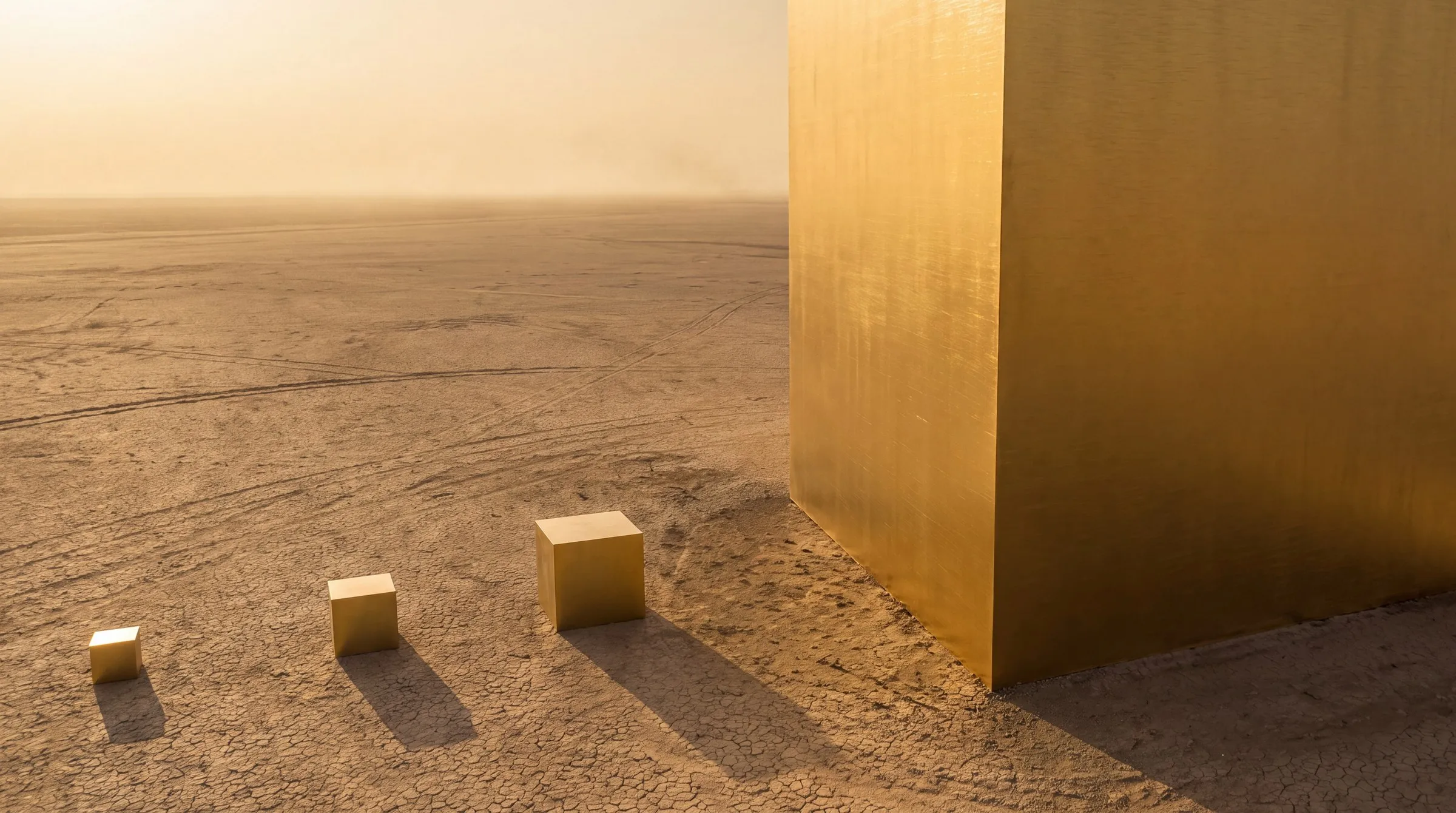
The Veil is 3D: the planet under a gold haze drawn at the dialled optical depth, its transmittance exact along every line of sight so the limb brightens the way a real haze layer does; and on the surface, at true scale, six cubes of gold, the reservoirs of the ledger, from the 22 m cube of everything ever mined to the 16 km cube of one delivery that would hold the veil for an orbit. Zoom from one to the other.
The Haze is the optics: extinction per gold sphere and mass per unit optical depth against particle radius, from Mie theory on Johnson & Christy's constants, band-averaged over the solar spectrum or over the planet's own glow. The plasmon minimum sits near 70 nm at about a gram per square metre; Pinatubo's sulfate line is drawn beneath it. Drag the radius and every other view follows.
The Ledger puts every gold reservoir on one logarithmic ruler, a year of the world's mines, the oceans, the Witwatersrand, the human total, the continental crust, and stands the shield and the delivery among them, each with its cube. The Fall is a one-shot layer at the dialled optical depth, settling by Stokes with the slip correction and coagulating by the Fuchs kernel, optical depth against time, with the layer's pressure, temperature, thickness and gas on dials.
The Schedule takes the book's cadence, one delivery per 3,600-year orbit, draws the layer's life against it, and prices what one delivery would have to carry: tonnes, cubes, crusts, human stocks, per miner, and the energy to lift it off Earth. The File runs nine cards, the words first, then the arithmetic, then two verdicts at equal size.
Why it's here
This site's culture wing carries a source note on The Anunnaki Chronicles that lays out Sitchin's scenario in seven rings, and the second ring is this motive: the Anunnaki came to Earth for gold, 'not to be used in jewelry or ornaments, but in order to create, on their own planet, a shield of suspended gold particles with which to protect their dwindling atmosphere' (p. 72). The mines, the mutiny, the making of workers, the Deluge: everything else in the scenario follows from that sentence. The anthology states it five times (pp. 72, 246, 258, 300, 334) and never once with a quantity: no mass, no particle size, no layer thickness, no word on what the shield is meant to stop; the altitude is 'stratosphere' once (p. 258) and 'above the atmosphere' twice (pp. 246, 334). The one figure that touches it is a rate: the ore goes on to the approaching Twelfth Planet 'once a year in the time scale of the Nefilim' (p. 13), and a Nibiru year is 3,600 Earth years. This bench supplies the arithmetic the book never did.
It also follows the note on The Anunnaki Connection, where Heather Lynn reports the same motive as 'extracting large quantities of gold' to 'replenish that planet's depleted atmosphere' (pp. 21, 39): an adjective, not a figure. It follows INST-70, the Nibiru orbit bench: that bench read the book's 'three or four times the size of Earth' as 3.5 Earth radii, and this one takes the same size for the area and the gravity; the 3,600-year clock that bench could not keep is, here, the delivery interval the shield cannot survive. And it follows the materials line of INST-48, the osmium fingerprint: a metal budget that owes a source no one has found. As ever, the answer is not presupposed. An aerosol veil is a real kind of thing; gold at the right size is a fair scatterer; the gold for one veil exists in the crust. The bench writes those down, and then the number, the fall and the calendar.
How it works
Everything on the bench is arithmetic on the book's words and on published constants: Mie theory for the optics, Stokes and Smoluchowski for the fall, one-line ledgers for the reservoirs and the schedule. A script that ships with the site re-derives every displayed number before the build passes, the ones the book gave and the ones it never did.
Q_ext(r, λ) by Mie on n + ik (J&C 1972) · ⟨Q⟩ = ∫ Q B_λ(T) dλ / ∫ B_λ dλ · m/τ = 4ρr / 3⟨Q⟩ · M = (m/τ) · τ · 4πR² · v = 2ρgr²C_c / 9η · τ(t): dn/dt = −(v/Δz) n − ½K n² · stock = M · 3,600 yr / (Δz/v)
The optics are computed from a table, not assumed. Gold's complex refractive index is interpolated from Johnson & Christy's 1972 measurements and continued into the infrared with the Drude fit of Ordal et al. Bohren & Huffman's Mie code gives extinction and scattering efficiencies at every radius and wavelength; the sunshade band averages them over a 5,772 K Planck spectrum, the blanket band over the planet's own. The plasmon puts the minimum mass per unit optical depth at 71 nm, 1.02 g/m²; below that the particle sees less light per gram, above it the mass grows as the radius. The same code on 0.5 µm sulfate droplets gives 0.35 g/m² against Pinatubo's measured 0.39.
The mass is that times an area. One unit of optical depth over a planet of radius R is (m/τ) × 4πR². For Nibiru at INST-70's 3.5 Earth radii, 12.25 times Earth's area, that is 6.4 billion tonnes at 80 nm, 6.4 at the optimum; over Earth, 525 million. The World Gold Council's 216,265 tonnes is the human total, 3,661 tonnes a year the rate; the crust holds 27 billion tonnes at 1.3 parts per billion; the shield is 30,000 human totals and 24% of the crust. Every ratio is a division of published numbers.
The fall is textbook aerosol physics, integrated. A gold sphere's terminal speed is 2ρgr²C/9η; at 25 hPa the mean free path is 1.8 µm, twenty times the particle, so the Cunningham factor is 38 and 80 nm gold falls 64 m a day; a well-mixed 7 km slab drains e-fold in 109 days. At the number density a τ 1 layer needs, 3,600 particles per cubic centimetre, Brownian collisions halve the count in four days at first (Fuchs kernel); mass is conserved so the survivors grow, fall faster and shade less per gram: half the optical depth is gone in 25 days, nine tenths in 90. Sulfate at Pinatubo's size in the same layer lasts of order a year, which is what was measured.
The schedule is the book's, priced. 'Once a year in the time scale of the Nefilim' is once per 3,600 Earth years (p. 13). A layer that lives 109 days shields the planet for one part in twelve thousand of that gap. To hold the veil, mass must arrive as fast as it falls, 2×10¹⁰ t a year, so each delivery must carry 7.7×10¹³ t: 2,800 continental crusts of gold, a 16 km cube, 3.6×10⁷ t per miner per year for the 600 the book counts. Lifting one veil to Earth escape speed is 4×10²⁰ J, 0.65 of the world's annual energy supply.
What survives every dial is worth stating: the words describe a real kind of thing; a gold aerosol at the right size is a competent sunshade; the mass for one veil exists in the crust; and the mines are set over the richest goldfield on Earth. What does not survive is the number, thirty thousand human totals for one veil that lasts a season; the fall, which no dial slows by more than a factor of a few; and the calendar, which the book itself set at once an orbit. Whether that closes the question or reprices it is a reading the bench leaves to you.
The dials that decide what happens
A reading, a planet, an optical depth, a particle size, and for the fall a pressure, a temperature, a thickness and a gas. Between them they draw every shield the words could mean, which is the exhibit.
- The reading. Sunshade (cuts sunlight coming down) or blanket (holds the planet's own infrared). The book never says which; the sunshade is thirty-odd times cheaper and is the default. The blanket adds a planet-temperature dial (40 to 320 K) that sets where its glow peaks.
- The planet. Nibiru at the book's size and Neptune's density (3.5 R⊕, 12.7 M⊕, from INST-70), the same size at rock (43 M⊕), or Earth as the smallest reading. Radius sets the area and so the mass; mass sets the gravity and so the fall.
- The optical depth. 0.05 to 3; τ 1 by default because the book names no target. τ 1 passes 37% of the light straight down; Pinatubo's 0.15 cooled the Earth half a degree. The mass scales with it.
- The particle radius. 5 nm to 20 µm, 80 nm by default; a button sits on the optimum. Below the plasmon the mass per τ flattens onto a floor; above it, it grows as the radius. Larger particles also fall faster.
- The layer. Pressure 1 to 1,000 hPa (25 by default: Earth's stratosphere at 25 km), temperature 150 to 320 K, thickness 1 to 30 km, gas from hydrogen to carbon dioxide (air by default), and coagulation on or off. Thinner gas and heavier particles fall faster; thicker layers live longer and are more dilute.
The claims, as they stand
Six claims that make up the gold-mining scenario, from the anthology's own sentences to Lynn's report of them, with where each lands against the arithmetic.
| The Anunnaki came to Earth for gold, to make a shield of suspended gold particles to protect Nibiru's dwindling atmosphere proposed by Zecharia Sitchin, The 12th Planet (1976) and throughout the 2015 anthology (pp. 72, 246, 258, 300, 334) | CONTESTED | A real kind of thing: aerosol veils exist, and gold near 70 nm stops sunlight at about 1 g/m² per unit optical depth (Mie theory on measured constants). At the book's size for the planet, one veil of τ 1 is 6.4 billion tonnes: 30,000 times all the gold ever mined, a quarter of the gold in the continental crust. Finite, then, and physically meaningful; not the same order as anything anyone has mined. |
| The gold particles were suspended "in that planet's stratosphere" / "above the atmosphere" proposed by Sitchin (p. 258; pp. 246, 334) | REFUTED | Nothing suspends above an atmosphere: a particle there is in orbit or falling. In a stratosphere, 80 nm gold falls 64 m a day (Stokes with the slip correction) and a 7 km layer thins e-fold in 109 days; with coagulation half the optical depth is gone in 25 days. Pinatubo's real veil decayed on about a year. The layer is a season's work, not a shield. |
| The ore was refined on Earth, lifted by shuttle to a mother ship, and delivered to Nibiru "once a year in the time scale of the Nefilim" proposed by Sitchin (p. 13); the Mars way-station "for a heavy load of cargo" (p. 333) | REFUTED | One delivery per 3,600-year orbit against a layer that lives 109 days: the planet is shielded one part in ten thousand of the time. Holding the veil needs mass to arrive as fast as it falls, 2×10¹⁰ t a year, so one delivery must carry 7.7×10¹³ t: 2,800 continental crusts of gold, a cube 16 km on a side. Lifting one veil off Earth is 0.65 of the world's annual energy. |
| The mines were in southeastern Africa (Rhodesia? / Zimbabwe), the Abzu; the first attempt took gold from seawater and failed proposed by Sitchin (p. 13, p. 246, pp. 128-130); Lynn (p. 22) | MEASURED | The Abzu is a real place: the Witwatersrand, under Johannesburg, has yielded 1.6 billion ounces since 1886, the richest goldfield ever worked, about a quarter of today's above-ground stock and one part in 130,000 of a shield. The oceans hold about 13,500 t at NOAA's gram per hundred million tonnes; the book's failure there is the right call. |
| Nibiru is "a radiating planet, generating its own heat and atmosphere" proposed by Sitchin (p. 10) | CONTESTED | Which leaves what the shield shields undefined. Read it as a blanket on the planet's own infrared instead of a sunshade and gold is a mirror at those wavelengths: the cheapest blanket at 288 K wants 2 µm particles at 37 g/m² per τ, thirty-six times the sunshade, eight and a half crusts for one layer. The sunshade is the kinder reading, and it is the one the bench prices by default. |
| "Large quantities of gold" were extracted over the Anunnaki tenure proposed by Heather Lynn, The Anunnaki Connection (2020), pp. 21, 39; the 600 rank-and-file miners (Sitchin p. 13) | REFUTED | An adjective, not a figure, in either book. Priced: 600 miners holding the veil for one orbit would each deliver 3.6×10⁷ t a year, ten thousand times the world's entire annual mine production per miner. The number is the finding; the book never wrote one down. |
Try this
- Start on the veil and press "the limb". The haze brightens where the path is longest. Drag the optical depth to 0.15, Pinatubo's peak: the planet reappears; the mass in the status bar is still 960 Mt.
- Press "the human cube". A 22 m block of gold on a plain: everything ever mined. Press "the cubes": the 693 m shield and the 1.1 km crust stand in front of the 16 km delivery. Zoom out until the planet's curve returns.
- Go to the haze. Drag the radius from 5 nm to 20 µm and watch mass per τ: a floor at 2.3 g/m², a minimum at 71 nm, then a straight line up. Press "sit on the optimum". Flip the reading to blanket: the minimum moves to 2 µm and 37 g/m².
- Go to the ledger. Eight bars, twelve decades. Read the shield against the human total, then against the crust. Switch the planet to Earth: 525 Mt, still 2,400 human totals.
- Go to the fall. The dashed line is settling alone; the solid line adds coagulation. Turn coagulation off, then thicken the layer to 30 km, then drop the pressure to 5 hPa: the half-life moves by a factor of a few, never to a decade.
- Go to the schedule. The layer's life is the sliver at the start of the 3,600-year bar. Read the stock table: what one delivery must carry, in tonnes, crusts, human totals and per miner.
- End on the file. The Words, The Cadence, The Planet, The Mass, The Fall, The Schedule, then both verdicts: what a real kind of thing amounts to at that number.
Accuracy
The honest line between what is reported, what is measured, what is modelled on them, and what is a reading:
| Feature | Status | What that means |
|---|---|---|
| The book's words | Reported | The shield of suspended gold particles (pp. 72, 246, 258, 300, 334), the stratosphere (p. 258) and 'above the atmosphere' (pp. 246, 334), the shipping cadence (p. 13), the mines in southern Africa (pp. 13, 246; Lynn p. 22), the 600 miners (p. 13), the radiating planet (p. 10), the Mars way-station (p. 333). Quoted with page numbers; the anthology gives no mass, size, thickness or optical target anywhere. |
| Gold, the reservoirs and Pinatubo | Measured | Gold's optical constants (Johnson & Christy 1972; Ordal et al. 1985 in the infrared) and density; the World Gold Council's above-ground stock (216,265 t, end-2024) and mine production (3,661 t, 2024); the Witwatersrand's 1.6 billion ounces; the continental crust at 1.3 ppb (Rudnick & Gao 2003); NOAA's gram per hundred million tonnes of seawater; Pinatubo's 30 Mt of sulfate, peak optical depth near 0.15 and year-long decay. |
| The optics and the mass | Exact | Bohren & Huffman's Mie code on the measured constants, band-averaged over a 5,772 K Planck spectrum (the sunshade) or the planet's own (the blanket): extinction per sphere at every radius; mass per unit optical depth 4ρr/3Q, minimum 1.02 g/m² at 71 nm; the shield as that times τ times 4πR²; the cube sides; the reservoir ratios; the lift energy. No free parameter stands between the table and these numbers. |
| The fall | Modelled | Stokes settling with Sutherland's viscosity and the Cunningham slip correction (the mean free path at 25 hPa is 1.8 µm, twenty times the particle); a well-mixed slab draining as exp(−vt/Δz); Brownian coagulation with the Fuchs kernel, monodisperse, mass conserved, the optical depth re-evaluated at the grown radius each step. Textbook aerosol physics, integrated live, nothing fitted; the layer's pressure, temperature, thickness and gas are dials. |
| The borrowed planet | Modelled | Nibiru's size and gravity from INST-70's reading of "three or four times the size of Earth" (3.5 R⊕; 12.7 M⊕ at Neptune's density, 43 at rock; Earth as the smallest reading); an Earth-like stratosphere for a planet the book never describes; τ = 1 as the target because the book names none; the veil's drawn thickness in the 3D view. Every one is a dial or labelled. |
| What it amounts to | Reading | A real kind of thing, at thirty thousand times all the gold ever mined, that falls out in months and is delivered once in 3,600 years: whether that closes the question or merely reprices it is a reading, and the bench declines to make it. |
In one line: the book's words are REPORTED with page numbers; gold's optical constants, the reservoirs and Pinatubo are MEASURED; the extinction, the mass per τ, the shield's mass, the cubes and the ratios are EXACT arithmetic on them; the fall, the coagulation and the borrowed planet are MODELLED, every choice on a visible dial, every number re-derived by scripts/gold-shield-tune.mjs before the build passes; and what a real kind of thing at an impossible number amounts to is a READING this bench declines to make.
Sources
- Zecharia Sitchin, ed. Janet Sitchin, "The Anunnaki Chronicles: A Zecharia Sitchin Reader" (Bear & Company, 2015): the shield of suspended gold particles (pp. 72, 246, 258, 300, 334), the stratosphere (p. 258), the shipping cadence and the 600 miners (p. 13), the mines (pp. 13, 128-130, 246), the radiating planet (p. 10), the Mars way-station (p. 333). Reviewed as a source note in this site's culture wing.
- Heather Lynn, "The Anunnaki Connection" (New Page Books, 2020): "large quantities of gold" and the depleted atmosphere (pp. 21, 39), Enki's mines in Zimbabwe (p. 22), the 416,000-year date for the African operation (p. 46). Reviewed as a source note in this site's culture wing.
- P. B. Johnson and R. W. Christy, "Optical constants of the noble metals", Physical Review B 6 (1972): gold's n and k from 0.19 to 1.94 µm, the table the Mie code runs on. M. A. Ordal et al., "Optical properties of fourteen metals in the infrared and far infrared", Applied Optics 24 (1985): the Drude parameters (9.03 eV, 0.0267 eV) used beyond it.
- C. F. Bohren and D. R. Huffman, "Absorption and Scattering of Light by Small Particles" (Wiley, 1983): the bhmie algorithm for a homogeneous sphere, ported here; the Rayleigh and geometric limits it is checked against.
- J. H. Seinfeld and S. N. Pandis, "Atmospheric Chemistry and Physics" (Wiley, 3rd ed. 2016): the Cunningham slip correction, Sutherland's viscosity, the mean free path, and the Fuchs interpolation of the Brownian coagulation kernel between the continuum and free-molecular regimes.
- World Gold Council, "How much gold has been mined?" (Goldhub, 2025): above-ground stock 216,265 t at end-2024; Gold Demand Trends: mine production 3,661 t in 2024. The 22 m cube of everything ever mined is the Council's own image.
- R. L. Rudnick and S. Gao, "Composition of the Continental Crust", Treatise on Geochemistry 3 (2003): gold at 1.3 ppb in the bulk continental crust; a crustal mass of 2.1×10²² kg for the total.
- H. E. Frimmel, "Archaean atmospheric evolution: evidence from the Witwatersrand gold fields", Earth-Science Reviews 70 (2005), and R. F. Tucker et al., "A review of the Witwatersrand Basin", Episodes 39 (2016): about 1.6 billion troy ounces produced since 1886, the largest goldfield ever worked.
- NOAA Ocean Service, "Is there gold in the ocean?": about one gram of gold per hundred million metric tons of seawater; the ocean's mass 1.35×10²¹ kg for the total.
- M. P. McCormick, L. W. Thomason and C. R. Trepte, "Atmospheric effects of the Mt Pinatubo eruption", Nature 373 (1995), and G. L. Stenchikov et al., "Radiative forcing from the 1991 Mount Pinatubo volcanic eruption", JGR 103 (1998): about 20 Mt of SO₂ becoming about 30 Mt of sulfate aerosol, global-mean visible optical depth peaking near 0.15, e-folding on about a year; the yardstick the whole chain is checked against.
- IEA, "World Energy Balances" (2024): world total energy supply about 620 EJ in 2023, the unit of the lift-energy row.
Wiki: Anunnaki · Zecharia Sitchin · Nibiru · Source note: The Anunnaki Chronicles · Source note: The Anunnaki Connection
Price the motive from the book's own words. Then watch the layer fall.
Open the interactiveCompiled August 2026