The Dyson Swarm
In 1960 Freeman Dyson published three pages in Science observing that a long-lived civilization's energy hunger ends at its star, and that thermodynamics makes the project impossible to hide: every captured watt must re-emerge as mid-infrared heat. One small planet, dressed out at a kilogram per square metre, covers the whole sphere. The searches he asked for have now been run, across a quarter-million infrared sources, a hundred thousand galaxies and five million stars, and they came back almost, but not quite, empty. This instrument builds the swarm honestly, prices it exactly, and shows you what the telescopes did and did not find.
 Open the interactive ▸
 What you're looking at
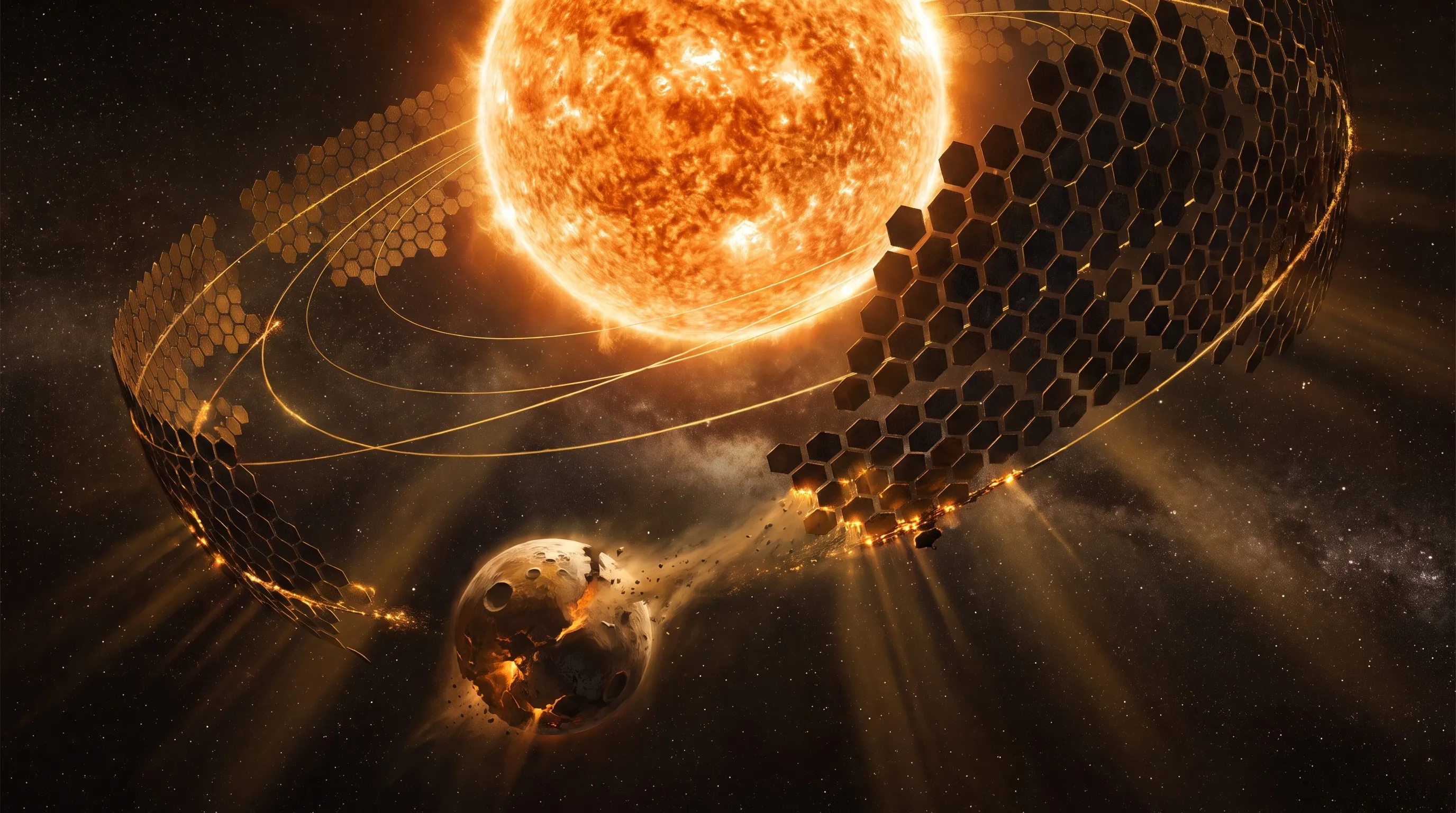
The Swarm view is the star, encircled. A live-shader Sun convects inside the Milky Way's cube sky while rings of hexagonal collectors, each plate standing for some 10¹³ real ones, assemble out of Mercury: a mass stream arcs from the shrinking planet to a glowing construction front, and pressing ▶ Build compresses the 31-year exponential into fifty seconds, two decades of nothing and then everything, exactly the ambush exponentials are. An infrared toggle re-lights the whole scene at the swarm's honest 331 K: the star curtained, the cloud glowing, the reason the searches look where they look.
The Fingerprint view is the search strategy as one picture: the νL_ν spectrum with the photosphere's hump sinking as the capture fraction grows and a second hump rising in the mid-infrared carrying exactly the captured share, twin peaks at f = ½. WISE's four bands and Kepler's window are shaded in, the four real searches, 1960, 2009, 2015, 2024, sit in cards beneath, and a violet note records the case of Tabby's Star: enormous dips, no waste heat, reading retired.
The Ledger view prices ambition. A Kardashev ladder climbs from humanity's 18.5 TW (K 0.73) past all sunlight on Earth (K 1.12) to the full Sun (K 2.06) and a galaxy of suns (K 3.2), your swarm's dot ascending it live; beside it the build-out curve runs its 58 doublings with Earth's actual photovoltaic pace, a doubling every ~3 years, drawn shallow beside it for honesty. Mass and count ladders at the bottom weigh the finished cloud against the Moon, Mercury and every grain of sand on Earth.
Why it's here
This instrument is the terminus of this site's SETI arc. The Drake Equation asks how many civilizations are out there; the Wow! Signal shows what a possible hail looks like; Tabby's Star shows what possible engineering looks like, and how it dissolved into dust under testing. The Dyson swarm is what that arc was always pointing at: not another signal or another dip, but what physics says we must see if anyone, anywhere, ever got seriously organized. It flips the search from listening to looking: it waits for no one to transmit, and simply checks the sky for heat that cannot be hidden.
It also caps the site's energy scale. The Laser Sail spends 100 gigawatts, humanity's boldest design, throwing 3.6 grams at Proxima; this page's dial turned to the stop reads 3.83×10²⁶ watts, four quadrillion times more, and it breaks no known physics. Permitted by engineering, absent from observation: that combination is the Fermi question at its sharpest. The instrument puts both halves on the table, the arithmetic of building and the blank sheet of searching, and then, in this site's tradition, goes quiet.
How it works
One measured number and three lines of arithmetic run the whole instrument; nothing else is asserted.
P = f·L☉ · A(t) = A₀·2^(t/196 d) · T = (L☉ / 8πσR²)^¼ · λ_peak = 2898 µm·K / T · K = (log₁₀P − 6) / 10
The energy budget is exact. The Sun's 3.828×10²⁶ W is the IAU nominal luminosity; captured power is that number times the covered fraction of the sphere at your chosen radius, and every comparison, the 18.5 TW of humanity, the 656,000 years per second, the Kardashev index, is division. The instrument adds no physics beyond bookkeeping, which is the point: the project never needed new physics.
The build is a labelled model. Armstrong & Sandberg's scheme, reinvested energy mining and launching Mercury with exponential feedback, is pinned by this instrument to a clean doubling every 196 days: one 1 km² seed to a spent planet in 31 years. Their published assumptions (1/3 collector efficiency, five-year processing surges, half the planet usable) are the provenance; the exponential arithmetic between the endpoints is exact; every derived readout says MODELLED.
The waste heat is thermodynamics, not speculation. A collector absorbing sunlight at radius R and radiating from both faces settles at T = (L☉/8πσR²)^¼: 331 K at 1 AU, 532 K at Mercury's orbit, 148 K at 5 AU, Wien peaks from 5 to 20 µm. The infrared view and the Fingerprint's second hump use these temperatures unmodified. Energy in equals energy out is the one law no engineering evades.
The searches are measured, and drawn to scale. Carrigan's IRAS census, the Ĝ galaxy survey and Project Hephaistos are plotted with their real sample sizes and real results, including the seven candidates nobody has closed. The instrument neither rounds the nulls up to "proof of absence" nor the candidates up to "detection"; both readings are left standing exactly as the data leaves them.
The evidence is tagged as you go. The bottom-left table is the conscience of the sim: the Sun's output and the survey results are MEASURED, the build pace and every temperature are MODELLED, and what the silence means is a READING. Rows flash as you touch the controls that depend on them, so the boundary between fact and model stays visible at all times.
The luminosity and the nulls are measured. The build-out and the temperatures are modelled, exactly, from stated assumptions. And whether the silence means absence or patience is the reading this site never supplies. The instrument computes; you conclude.
The four scenarios on the dial
Four stations along the same arithmetic, so the scale of the thing has somewhere to land.
- Year 0 · the seed. One square kilometre of factory in orbit, indistinguishable from nothing. Captured power: a rounding error on a rounding error. Everything that follows is already latent in this frame plus one rule: each doubling pays for the next.
- Year 28 · the knee. The swarm crosses about one percent coverage, some 10⁵ times humanity's entire consumption, and for the first time the star's dimming would be measurable from another system. Twenty-eight years of apparent failure were the exponential working exactly as designed.
- Year 31 · Mercury spent. The full sphere at 1 AU: 85% of Mercury's mass airborne, 3.8×10²⁶ W captured, K 2.06, the visible star curtained and a 331 K infrared beacon in its place. The state every infrared survey since 1983 has been checking the sky for.
- 0.39 AU · the hot swarm. The same capture packed at Mercury's own orbit, where Armstrong & Sandberg actually put it: a sixth of the collector area and mass, panels running at 532 K, the fingerprint shifted to 5.4 µm. The dial every real search must guess, which is why survey bands are wide.
The search, as it stands
Every serious way the sky has been checked for this object, with who ran it and where it landed. One row is still open.
| A full Dyson sphere around a nearby star searched / argued by searched by Carrigan 2009 across ≈ 250,000 IRAS sources | RETIRED | Heavily constrained. Out to roughly 300 parsecs, nothing with the right blackbody signature survives inspection; every candidate dissolved into carbon stars and dust. |
| Kardashev III: galaxy-spanning energy capture searched / argued by tested by the Ĝ survey, Wright et al. 2015, in 100,000 galaxies | RETIRED | Excluded at the ≥ 85% level in the entire sample. If galactic civilizations are common, they do not glow in the mid-infrared the way thermodynamics says they must. |
| Tabby's Star as a swarm under construction searched / argued by raised by Wright 2015; killed by Meng et al. 2018 and the missing IR excess | RETIRED | Retired. The dips are real, but they run deeper in blue than red, the fingerprint of fine dust, and infrared photometry finds no waste heat. The megastructure lost in exactly the band this instrument teaches. |
| Partial swarms around nearby stars searched / argued by Project Hephaistos II, Suazo et al. 2024, 5 million stars | OPEN | Open. Seven M-dwarf candidates keep an unexplained infrared excess; follow-up leans toward background galaxy contamination, and none is claimed artificial. The shortlist has not gone to zero. |
Try this
- Feel the ambush. Reset to Year 0, press ▶ Build, and do not touch anything for the first thirty seconds. Nothing happens. Watch the strip chart instead: the line was climbing the whole time, in the only way exponentials ever climb, invisibly and then all at once.
- Watch a star go out. With the build past year 29, drag the epoch slider slowly through the final two years and keep your eyes on the Sun. That two-year dimming, from a distance, is a civilization's entire construction era compressed into an eyeblink of stellar history.
- See what WISE sees. At Year 31, flip the Infrared view on and off. Visible: a star-shaped absence. Infrared: the brightest object in the neighbourhood. That flip is the entire logic of forty years of searches in one toggle.
- Grow the second hump. Open the Fingerprint, set the epoch to year 25, and play from there: the mid-IR hump rises through the WISE bands as the visible hump sinks, equal heights at half coverage. Then click the Tabby card and read why the one famous candidate failed exactly this chart.
- Price the real world. In the Ledger, find the shallow dashed line: humanity's actual solar build-out, doubling every three years. Follow it to where it meets a spent Mercury: about 170 years. The gap between that line and the amber one is the entire distance between an economy and a self-replicating one.
- End at the shortlist. Click the 2024 Hephaistos card in the Fingerprint view and read it as a skeptic, then as an optimist. Seven faint M dwarfs, probably contamination, formally open. Both readings are currently true, and holding both at once is what this site means by the periphery.
Accuracy
The honest line between what has been measured, what is modelled here, and what is a reading:
| Feature | Tier | What that means |
|---|---|---|
| The Sun's output: 3.828×10²⁶ W | T1 Measured | The IAU nominal solar luminosity, the single number every readout on the panel descends from. About twenty trillion times humanity's 18.5 TW primary consumption; one second of it would run 2026-pace civilization for roughly 656,000 years. |
| Mercury's mass: 3.3011×10²³ kg | T1 Measured | Radio tracking of MESSENGER pinned it to four digits. The build story starts here because the mass is real even if the project is not. |
| One planet suffices: 1.17 spheres of collector | T2 Modelled | At an assumed 1 kg/m² areal density, Mercury yields 3.3×10²³ m² against the 2.81×10²³ m² a full 1 AU sphere needs. The density is a design assumption in the Armstrong & Sandberg tradition; change it and the count of planets changes with it, exactly and transparently. |
| The 31-year exponential build-out | T2 Modelled | Armstrong & Sandberg's feedback scheme: collectors power the mining and launch of more collectors, a third of captured energy reinvested, five-year processing surges, Mercury fully processed in ≈ 31 years. This instrument pins a clean 196-day-doubling exponential to their endpoints and labels every readout derived from it MODELLED. |
| Waste heat: 148-633 K, peaking at 5-20 µm | T2 Modelled | Straight Stefan-Boltzmann on the drawn geometry: a flat panel at 1 AU radiating from both faces sits near 331 K with its Wien peak at 8.8 µm; at Mercury's orbit 532 K, at 5 AU 148 K. No orientation or cloaking changes the total, which is why the mid-infrared is where everyone looks. |
| The survey nulls: IRAS, Ĝ, and 100,000 galaxies | T1 Measured | Carrigan's 2009 sweep of ≈ 250,000 IRAS sources found no convincing sphere within ~300 pc. The Ĝ survey found no galaxy among 100,000 reprocessing ≥ 85% of its starlight, with all 93 warm outliers reading as dusty astrophysics. These are published measurements, not opinions. |
| Hephaistos II's seven open candidates | T1 Measured | From 5 million Gaia×2MASS×WISE stars, seven M dwarfs keep an infrared excess no natural model has yet closed; follow-up argues most are background dust-obscured galaxies contaminating the photometry. Formally unresolved, claimed by no one as artificial: the honest current frontier. |
| What forty years of silence means | T3 Reading | Rare builders, small builders, cold and distant builders below the survey floors, or no builders at all: every reading survives the data so far. The instrument computes what a swarm must look like; it does not vote on why none has appeared. |
In one line: the Sun's 3.828×10²⁶ W, Mercury's mass, and every survey result, IRAS's empty census, Ĝ's hundred thousand quiet galaxies, Hephaistos's seven open candidates, Tabby's missing infrared excess, are measured; the 1 kg/m² collector, the 196-day doubling and every temperature on the panel are modelled, exact arithmetic on stated assumptions; and what forty years of silence means is a reading, the one this site leaves to you. The engineering is permitted; the telescopes have looked; the instrument keeps the two facts from being confused with each other.
Sources
- Dyson, F. J. (1960). Search for Artificial Stellar Sources of Infrared Radiation. Science 131 (3414), 1667-1668. The three-page letter: the energy argument, the waste-heat signature, and the proposal to search for infrared point sources.
- Dyson, F. J. (1960). Letters in response, Science 132. The correction on record: "a loose collection or swarm of objects traveling on independent orbits," not a rigid shell.
- Stapledon, O. (1937). Star Maker. The novel Dyson credited as the source of the idea.
- Kardashev, N. S. (1964). Transmission of Information by Extraterrestrial Civilizations. Soviet Astronomy 8, 217. The Type I / II / III energy scale this instrument's ladder is built on.
- Sagan, C. (1973). The Cosmic Connection. The interpolated K-index formula, K = (log₁₀P − 6)/10, used by the readouts.
- Armstrong, S., & Sandberg, A. (2013). Eternity in Six Hours: Intergalactic spreading of intelligent life and sharpening the Fermi paradox. Acta Astronautica 89, 1-13; with Armstrong's 2012 Oxford presentation of the Mercury-disassembly scheme. The ≈ 31-year exponential feedback build the instrument's timeline is pinned to.
- Carrigan, R. A. (2009). IRAS-based Whole-Sky Upper Limit on Dyson Spheres. Astrophysical Journal 698, 2075-2086. The first serious census: ≈ 250,000 sources, no convincing sphere.
- Griffith, R. L., Wright, J. T., et al. (2015). The Ĝ Infrared Search for Extraterrestrial Civilizations with Large Energy Supplies. III. ApJS 217, 25. 100,000 resolved WISE galaxies; none consistent with ≥ 85% starlight reprocessing.
- Suazo, M., Zackrisson, E., et al. (2024). Project Hephaistos II. Dyson sphere candidates from Gaia DR3, 2MASS, and WISE. MNRAS 531, 695. Five million stars filtered to seven unresolved M-dwarf candidates; subsequent work argues for background-galaxy contamination.
- Boyajian, T. S., et al. (2016). Planet Hunters IX. KIC 8462852, Where's the Flux? MNRAS 457, 3988; and Meng, H. Y. A., et al. (2018), ApJ 853, 1. The dips, and the chromatic, dust-like extinction with no infrared excess that retired the swarm reading.