The Laser Sail
In April 2016, Yuri Milner and Stephen Hawking announced the only costed plan our species has for reaching another star within a generation: a 100-gigawatt laser array, a four-metre sail, and a starship weighing less than a coin, thrown to a fifth of light speed in five minutes. This instrument hands you the beamer, integrates the relativity exactly, and tags every subsystem by how real it is.
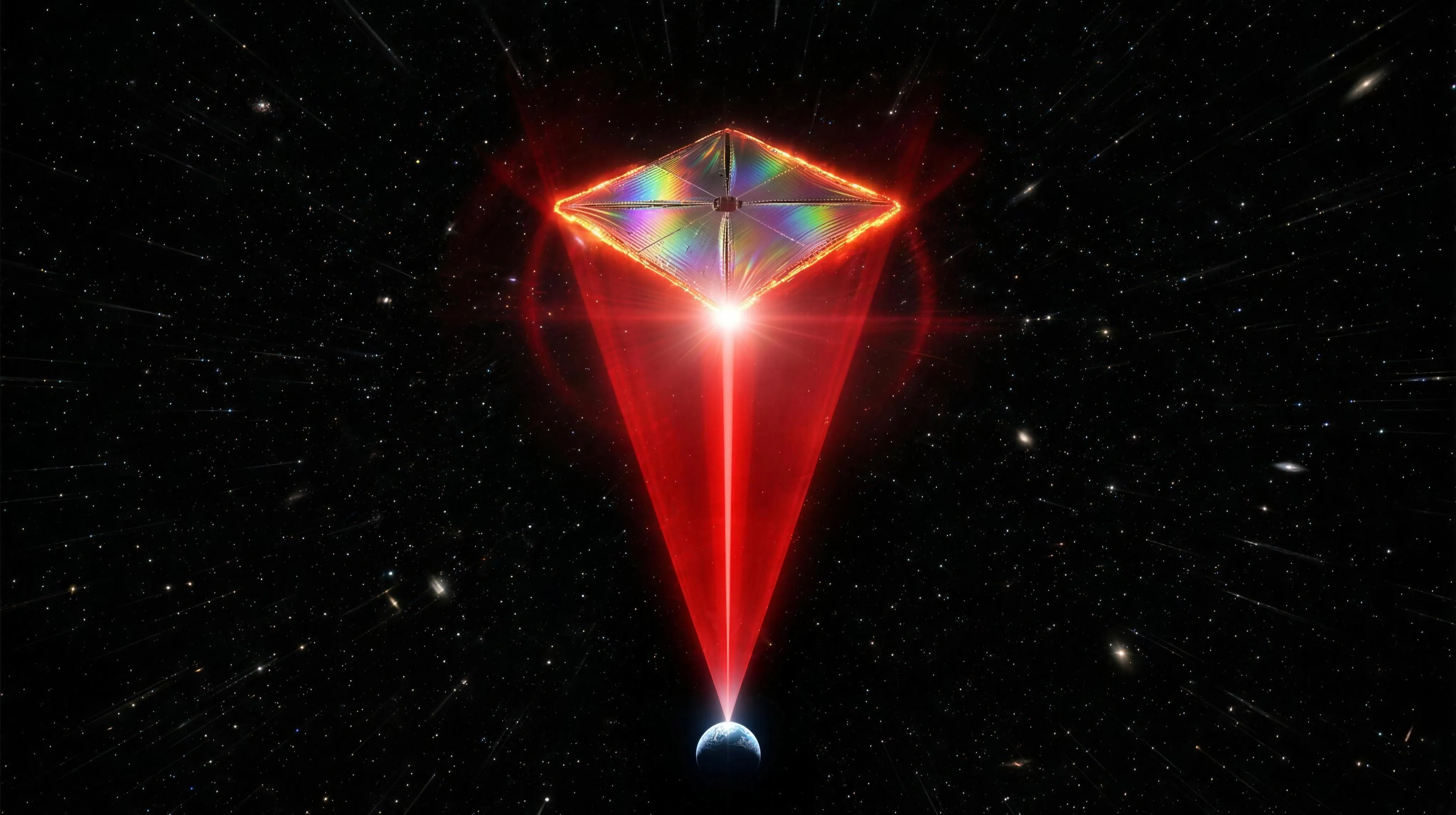 Open the interactive ▸
 What you're looking at
The Beam view is the launch, ridden from alongside the sail. Press LAUNCH: the array site flares on the night side of Earth, a volumetric red column connects it to four metres of spinning iridescent film, and the status bar starts counting: v/c climbing, the g-load in the tens of thousands, the wavelength at the sail reddening as the Doppler tax bites. The beam is drawn at the true spot-to-sail ratio, so you can watch diffraction widen it until light pours uselessly past the rim and the burn dies of geometry.
Then the theatre changes tempo: twenty years compress into twenty seconds, the compression factor always on screen. The stars slide forward and blueshift by the exact aberration formulae; dust impacts flash against the film with the energy budget of artillery; Proxima swells from a red point, its planet sweeps past in the hours the encounter really lasts, and a hairline of cyan laser fires back along the way you came, carrying the picture that will take 4.2 years to arrive.
The Curve view is the same mission with the drama removed and the argument kept: v/c in cyan and delivered thrust in red on a log axis from the pad to Proxima, the diffraction cliff in violet, and along the bottom, barely above zero, the amber line of Voyager 1: the fastest thing we have ever actually sent. Bottom-left, the Engineering Board tags each subsystem FLOWN, PHYSICS, DESIGN or OPEN and flashes as the mission touches it.
Why it's here
This instrument is the gallery's nearest-term starship blueprint. Beneath every sighting debate this site archives sits one physical fact: the distances between stars are, to chemical rockets, close to absolute. On display here is the only public plan humanity currently has that prices "reach another star within twenty years" to the decimal: Breakthrough Starshot. It is neither fantasy nor yet engineering: photon pressure has been measured in orbit, the equation solves exactly, and the 100 GW array and the gram-class starship remain on paper. Summarise, attribute, link; the sliders are yours, and as always, so is the verdict.
It is also where three sibling instruments meet. The Doppler tax (1−β)/(1+β) that eats the thrust as speed rises is The c-Wall seen from the engine room; the star colours shifting outside the window on the cruise use the same exact aberration and Doppler formulae as Near-Light Speed; and when Avi Loeb proposed that ’Oumuamua might be a derelict light sail, the physics he cited is the physics here: we are already seriously costing one of our own. After this instrument, you have seen both sides of that argument.
How it works
One relativistic equation, integrated exactly, runs the whole instrument:
d(γβ)/dt = (2ηP / mc) · (1−β)/(1+β) · min(1, (D_sail / D_spot)²) · with · D_spot ≈ 2.44 λL / D_array
Photon momentum does the pushing. Each photon carries p = E/c; a mirror doubles the transfer. 100 GW of reflected light is about 600 newtons: a person's weight. On 3.6 grams, that is seventeen thousand g, which is why the payload is a wafer and not a probe: the mission survives its own engine only by owning almost no mass.
The Doppler tax is exact, and it is the c-wall. In the sail's frame the beam arrives red-shifted: less momentum per photon, fewer photons per second, thrust falling as (1−β)/(1+β). At 0.2c a third of the push is gone; as β → 1 the factor goes to zero, which is why no laser can push any sail to light speed. The instrument integrates the full relativistic form, no approximation.
Diffraction decides when it's over. A D-kilometre aperture spreads at θ ≈ 2.44 λ/D, so the spot outgrows the sail at a computable distance: about 7 million kilometres for the baseline, the violet cliff on the curve. Past it thrust dies as 1/L². Five minutes of violence buy twenty-one years of ballistics; everything the mission will ever have, it has at the cliff.
The coast is drawn with the same relativity as the siblings. Star positions shift by the exact aberration formula cos θ′ = (cos θ + β)/(1 + β cos θ) and their colours and brightness by the exact Doppler factor, computed per star in the shader at your cruise β: the same optics as Near-Light Speed, here at a sedate 0.2c.
The trade space is the point. Four sliders: power, sail diameter, all-up mass, array size. The presets walk the classic corners: the 2016 baseline, a 1 GW pathfinder that still revolutionises the solar system, Forward's terawatt dream, a 100 kg probe that shows why mass is tyranny, and a one-tonne crewed reading whose ETA answers itself. Every readout, both curves and the whole animation recompute from your settings.
Photon pressure is flown; the sail equation, the Doppler tax and the diffraction limit are exact physics; the 100 GW array, the sail film and the gram-class chip are design; dust survival and the data link home are open. The beam is drawn red because infrared is invisible, and time is compressed because twenty years is twenty years: both liberties are labelled where they happen.
The presets
Six ways to set the beamer, from the published baseline to the reading that answers itself.
- Starshot 2016. The published baseline: 100 GW, 4.1 m, 3.6 g, and an array sized to the headline. 0.198c, Proxima in 21 years.
- First light. The same chip under a 1 GW pathfinder array: 2.3% of c. Pluto in under a fortnight, the heliopause in weeks: the solar system opens long before the stars do.
- The gram wafer. Lubin's minimum starship: one gram, one metre of sail. The burn is even more violent and even shorter; read the peak load.
- The heavy probe. A 100 kg Voyager-class payload under the same beam: 0.4% of c, over eleven centuries to Proxima. Mass is the whole argument, and this preset is its cross-examination.
- Forward's dream. A terawatt, a 100-metre sail, a kilogram. Robert Forward's 1984 ambition scaled to a chip's budget: 0.34c, and the cliff moves out with the bigger array.
- People on board. One tonne, the slider maximum, under a terawatt. Read the ETA, then read the g-row, and you have the honest answer to "when do we go".
Try this
- Watch the tax, not the beam. Launch the baseline and keep your eye on the λ-at-sail readout: 1.06 µm reddening toward 1.30 µm as β climbs. The thrust curve sags while the array holds full power. That sag is special relativity, live.
- Find the cliff twice. Ride the burn in Beam view until the spill ring blooms past the sail's rim, then flip to Curve view and find the same moment as the violet line: the red curve dying at 7 million kilometres. Same physics, two languages.
- Buy speed with aperture. Drag the array from 500 m to 20 km and watch the cliff slide outward and the cruise speed climb. Diffraction, not power, is the quiet boss of this design.
- Run the mass ladder. 3.6 g, then 1 kg, then 100 kg, then a tonne, same beam. The ETA runs 21 years, three centuries, three millennia, nearly ten millennia. Somewhere on that ladder, starflight stops being a mission and becomes a monument.
- Race Voyager. In Curve view, run First light and compare its modest 2.3% of c with the amber floor: even the pathfinder beats the fastest thing humanity ever sent by a factor of four hundred.
- End at the postcard. Let the flyby finish and watch the cyan hairline fire back toward Sol. Twenty years out, hours of science, 4.2 years home. Then look at the Engineering Board and count what is still violet and amber.
Accuracy
The honest line between what has flown, what is exact physics, what is design, and what is drawing:
| Feature | Status | What that means |
|---|---|---|
| Photon pressure: light pushes | Measured | Measured in the laboratory since 1901 (Nichols & Hull, Lebedev) and flown: JAXA's IKAROS sailed on sunlight in 2010, the Planetary Society's LightSail 2 raised its orbit by photon pressure in 2019. The foundation of the whole instrument is measured. |
| The relativistic sail equation, the Doppler tax, the diffraction limit | Measured | d(γβ)/dt = (2ηP/mc)·(1−β)/(1+β)·min(1, (D_sail/D_spot)²) with D_spot ≈ 2.44 λL/D_array. Special relativity and diffraction are among the most precisely verified physics in existence; the instrument integrates them exactly, with no small-β shortcut. |
| The mission profile: 0.198c, five-minute effective burn, 7 Gm cliff, 21-year cruise | Modelled | Exact integration of the equation above with η = 0.9 and the baseline sliders (100 GW, 4.1 m, 3.6 g, 4.5 km array). The array diameter is chosen so the profile reproduces the published Starshot headline of 0.2c; Parkin's 2018 system model makes different subsystem trades to reach the same place. All readouts recompute from your sliders. |
| That the array, the sail film and the chip can be built and afforded | Reading | Starshot's own board lists them as open engineering: a 100 GW coherent array (today's largest are laboratory scale), a metre-scale film that survives 8 GW/m², a gram of spacecraft that survives twenty years. The $10B-class cost figure is an estimate. The presets let you read the sliders optimistically or brutally. |
| Dust survival at 0.2c and the 4.2-light-year data link | Reading | Hoang et al. 2017 budget the erosion; edge-on cruise is the proposed answer; nobody has flown through twenty years of interstellar medium at relativistic speed. The watt-class laser home assumes the launch array doubles as a square-kilometre receiver. Both are tagged OPEN on the instrument's board. |
| The beam is drawn red; time is compressed; distances are staged | Illustrative | The real 1.06 µm beam is infrared and invisible; an honest render would show nothing. The burn's minutes and the cruise's decades play in seconds, with the live compression factor in the hint at all times. Earth, the sail and Proxima share a screen only through log-compressed staging. The spot-to-sail ratio, uniquely, is drawn true. |
| The sail's shape, spin and dust flashes | Illustrative | The domed, spinning, chip-on-tethers sail follows Starshot's published concept art and stability studies, not released engineering drawings, which do not exist. The dust impact flashes on the coast are paced for legibility; their energy scale (about half a ton of TNT per milligram, relative) is the real number. |
In one line: photon pressure is measured and flown; the relativistic sail equation, the Doppler tax and the diffraction cliff are exact physics integrated live from your sliders; the mission profile is a model tuned to the published 0.2c baseline; the array, the film, the chip, the dust and the data link are design and open questions from the sources below; and the red beam and compressed clock are labelled drawing liberties. The instrument takes no side on whether it will be built.
Sources
- Marx, G. (1966). Interstellar Vehicle Propelled by Terrestrial Laser Beam. Nature 211, 22. The first laser-sail paper, three pages after the laser was five years old.
- Forward, R. L. (1984). Roundtrip Interstellar Travel Using Laser-Pushed Lightsails. J. Spacecraft and Rockets 21, 187. The dream at full size: crewed sails, staged mirrors, decelerated returns.
- Lubin, P. (2016). A Roadmap to Interstellar Flight. JBIS 69, 40. The scaling argument behind Starshot: phased arrays from watts to 100 GW, spacecraft from grams up.
- Breakthrough Initiatives (2016). Breakthrough Starshot programme announcement, 12 April 2016, One World Observatory. Milner, Hawking; $100M of study funding.
- Parkin, K. L. G. (2018). The Breakthrough Starshot system model. Acta Astronautica 152, 370. The costed point design: 4.1 m sail, 3.6 g, minutes-long burn to 0.2c.
- Kulkarni, N., Lubin, P., & Zhang, Q. (2018). Relativistic Spacecraft Propelled by Directed Energy. AJ 155, 155. The exact relativistic sail dynamics this instrument integrates.
- Atwater, H. A., et al. (2018). Materials challenges for the Starshot lightsail. Nature Materials 17, 861. Why the sail must reflect almost everything and absorb almost nothing.
- Hoang, T., Lazarian, A., Burkhart, B., & Loeb, A. (2017). The interaction of relativistic spacecrafts with the interstellar medium. ApJ 837, 5. The dust and gas erosion budget for the coast.
- Heller, R., & Hippke, M. (2017). Deceleration of high-velocity interstellar photon sails into bound orbits at α Centauri. ApJL 835, L32. What it would take not to fly straight past.
- Tsuda, Y., et al. (2011). Flight status of IKAROS deep space solar sail demonstrator. Acta Astronautica 69, 833. Photon pressure, flown and measured: the board's green row.